By eight that morning, we understood what had happened.
A cafeteria worker at Noah’s school had noticed that he had stopped buying lunch.
She initially thought there was a problem at home.
Then one of Noah’s classmates told her he was saving money for “Lucy’s princess dress.”
The cafeteria worker happened to know Hannah.
She also saw the birthday video.
She shared it with her sister.
Her sister worked at Samuel’s diner.
Samuel saw it.
Then the story moved through the community faster than any of us expected.
Parents.
Teachers.
Restaurant workers.
Neighbors.
A local pediatric therapy center.
Even several teenagers from the high school service club.
Everyone contributed something.
Some lunchboxes contained ten dollars.
Some contained school lunch vouchers.
Others contained snacks or small toys.
Several held handwritten notes from parents of children with disabilities.
One mother wrote:
MY SON IS AUTISTIC. SOME PEOPLE TALK ABOUT HIM AS IF HE ISN’T STANDING RIGHT THERE. THANK YOU FOR REMINDING YOUR FRIEND THAT SHE DESERVES TO BE INCLUDED.
Another note said:
MY DAUGHTER HAS DOWN SYNDROME. SHE IS 23 NOW. SHE STILL REMEMBERS THE BOY WHO INVITED HER TO HER FIRST SCHOOL DANCE. SMALL KINDNESSES ARE NOT SMALL TO THE PERSON RECEIVING THEM.
Noah read every note.
Slowly.
Carefully.
Some words were too difficult, so I helped.
Then he became quiet.
“What’s wrong?”
He looked around the lawn.
“I didn’t do all this.”
“No.”
“I only bought a dress.”
“Yes.”
“Then why is everybody acting like I did something huge?”
Hannah sat beside him.
“Because sometimes people already want to do something good.”
“They just need somebody to remind them.”
Lucy was sitting in the grass between them, trying to put a sticker on her own forehead.
Noah laughed.
Then peeled it off and placed it on her hand instead.
My mother-in-law arrived around nine.
She had gone home the evening before after Lucy’s birthday.
She had no idea what had happened overnight.
When she stepped from her car and saw the lawn, she stopped.
“What is all this?”
Noah did not answer.
I did.
“People heard why Noah bought Lucy’s dress.”
Her eyes moved toward the metal lunchbox.
Then toward Samuel.
I watched recognition slowly settle over her face.
“What did they hear?”
Noah looked down.
I could have protected her from the answer.
For years, I had done that kind of thing.
Softened uncomfortable moments.
Changed subjects.
Pretended careless words were harmless because confronting them might ruin dinner.
Not this time.
“They heard what you said.”
Her face tightened.
“I was joking.”
“No.”
I kept my voice calm.
“You were dismissing a little girl because she has Down syndrome.”
“I didn’t mean it that way.”
Noah looked at her.
“You said Lucy doesn’t understand birthdays.”
His grandmother opened her mouth.
Then closed it.
Samuel stepped forward.
“My sister heard the same thing when she was six.”
My mother-in-law looked at Emily’s photograph.
Samuel did not attack her.
He simply told the truth.
“My sister understood every birthday she was excluded from.”
“She understood every person who spoke over her.”
“And she remembered every person who treated her like she mattered.”
My mother-in-law stared at the photograph for a long time.
Then she looked toward Lucy.
Lucy was sitting in Hannah’s lap playing with one of the colorful lunchboxes.
Finally, my mother-in-law walked toward Noah.
“I was wrong.”
He looked surprised.
She swallowed.
“I said something cruel.”
Then she looked at Hannah.
“I’m sorry.”
Hannah did not immediately tell her it was okay.
I was glad.
Apologies do not require instant forgiveness.
Finally, Hannah said:
“Thank you for saying that.”
My mother-in-law nodded.
Then she crouched near Lucy.
But she did not reach for her.
“Hi, Lucy.”
Lucy stared at her.
Then held up a yellow sticker.
“Flower.”
My mother-in-law smiled.
“Yes.”
“A flower.”
That was all.
No dramatic transformation.
No speech about how everything had changed.
Just an adult being given the opportunity to behave better than she had the day before.
The following Monday, I went to Noah’s school.
I met with the cafeteria manager and principal.
We made sure Noah’s lunch account was restored.
Then Samuel proposed something bigger.
Instead of simply giving Noah stacks of free lunches he did not need, his foundation offered to create a small school meal assistance fund.
Families could contribute privately.
Students who needed help would receive it without being singled out.
The school approved it.
They named it the Open Lunchbox Fund.
Noah objected.
“Why not Lucy’s Fund?”
Hannah smiled.
“Because Lucy doesn’t need her name on everything good that happens.”
Noah thought about that.
“What about Emily?”
Samuel shook his head.
“She already got what she would have wanted.”
“What?”
Samuel pointed toward the cafeteria.
“Kids eating.”
Noah nodded.
That made sense to him.
The remaining community donations were handled properly.
The cash was counted with witnesses and deposited through the foundation.
The therapy support for Lucy was formally documented.
Extra money went toward the Open Lunchbox Fund and an inclusive recreation program where children with and without disabilities could participate together.
Nothing went into Noah’s pocket except enough to replace what he had secretly skipped.
And I made one rule very clear.
He would eat lunch.
Every day.
A month later, Hannah invited us over again.
Not for anything dramatic.
Just sandwiches and cake in the backyard.
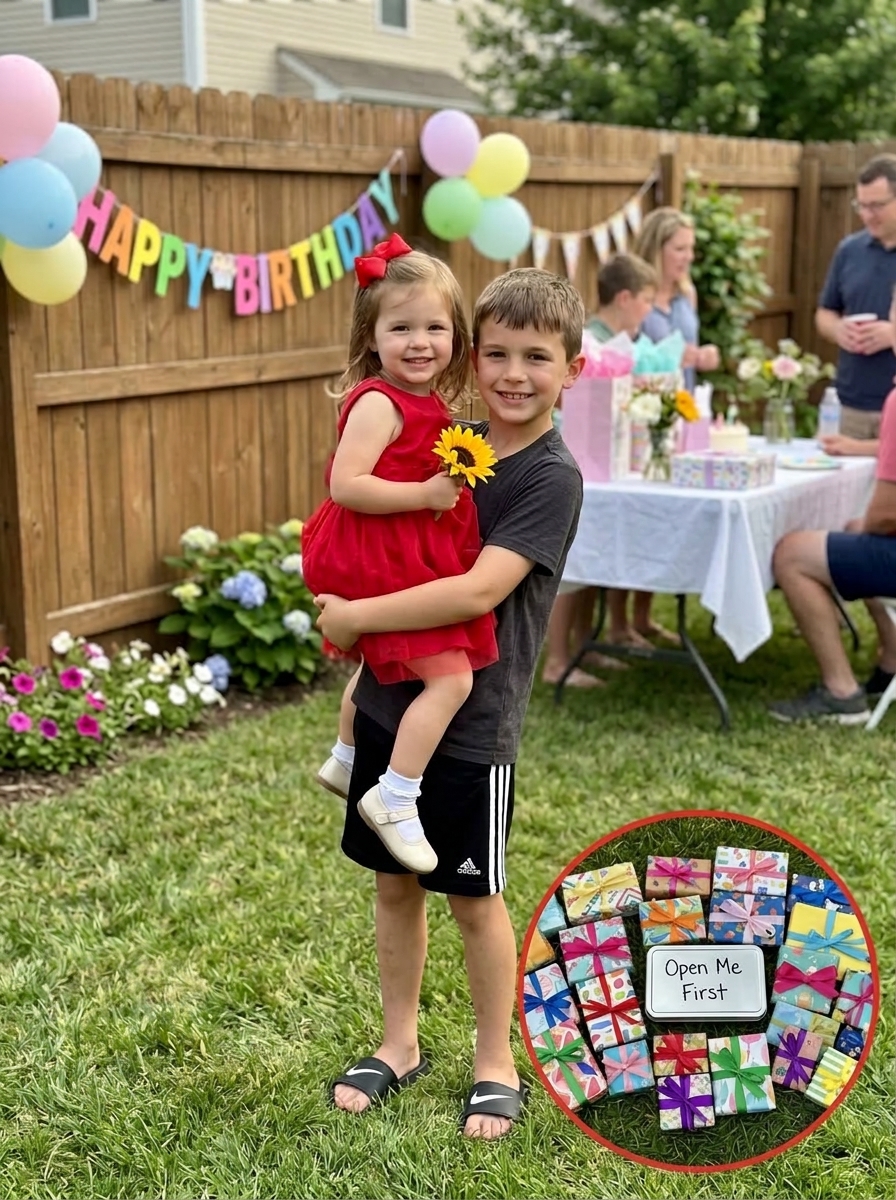
Lucy wore the red dress.
She had grown enough that the hem sat slightly higher on her knees.
She ran across the grass with the unsteady confidence of a toddler who had recently discovered speed.
Noah chased her.
She squealed.
He let her catch him.
Near the fence hung the same colorful birthday banner from the photograph.
Hannah had saved it.
Samuel came too.
He brought Emily’s battered metal lunchbox.
This time, it was empty except for one thing.
The original photograph.
He handed the lunchbox to Noah.
“I want you to keep it.”
Noah’s eyes widened.
“I can’t.”
“You can.”
“But it was Emily’s.”
“Yes.”
Samuel smiled.
“And she would have liked you.”
Noah held the lunchbox with both hands.
“What am I supposed to put in it?”
Samuel considered the question.
“Things that remind you what kindness is for.”
Noah looked at Lucy.
Then at me.
Then he reached into his pocket.
He had brought one of the unused lunch vouchers from the community drive.
He placed it inside.
“For someone who needs lunch.”
Samuel nodded.
“Good start.”
Then Lucy came running toward them.
Her red dress bounced around her knees.
She held a sunflower in one hand.
“Noah!”
He set the lunchbox down and lifted her carefully.
Hannah raised her phone.
“Look over here!”
Noah smiled.
Lucy laughed.
Behind them were balloons, flowers, presents, and the wooden backyard fence.
For one second, the scene looked almost exactly like the photograph that had started everything.
A boy holding a little girl in a red dress.
Except now, beside them, sat one battered metal lunchbox carrying a story much older than either child.
Hannah took the picture.
Later that evening, Noah asked to see it.
He stared at Lucy’s smile.
Then said:
“Mom?”
“Yeah?”
“Grandma was really wrong.”
I smiled slightly.
“Yes.”
“Lucy definitely understands birthdays.”
From across the yard, Lucy shouted because someone had started cutting the cake.
Noah immediately ran toward her.
Then stopped.
Turned around.
And grabbed the metal lunchbox.
“What are you doing?”
He grinned.
“Making sure everybody eats.”
I laughed.
That was the lesson he carried forward.
Not that kindness should make you a hero.
Not that generosity means giving away everything you have.
And certainly not that children should go hungry to prove they care.
He learned something simpler.
Kindness means noticing when someone is being left out—and making room beside you.
Noah had believed he was saving lunch money to buy one little red dress.
Instead, that dress reminded an entire community of something adults forget far too easily:
Lucy did not need anyone’s pity.
She needed what every child needs.
To be included.
To be celebrated.
To be spoken to instead of spoken about.
And to know that when she walked into a backyard wearing her favorite red dress—
someone was genuinely happy she had arrived.
The End.
Latest Posts
- My Mother-in-Law Made My Baby Shower About Herself—Then My Husband Stood Up #2
I wanted a small baby shower, but my mother-in-law ignored nearly every request and turned the day into a celebration of becoming a grandmother. I kept swallowing my frustration for one deeply personal reason, until she crossed a line neither my husband nor I could ignore. I was seven months pregnant with our first child, …
- My Son Grew His Hair for His Best Friend’s Wig—Then Her Father Called Me to School
A 14-Year-Old Boy Grew Out His Hair to Make a Wig for a Classmate Who Lost Hers to Cancer – The Next Day, His Mother Was Called to the School, Where the Girl's Father Said, 'You Have No Idea What Your Son Did, Do You?' The gum stuck in my son’s hair nearly ended the …
- 80-Year-Old Woman Spent Seven Days Visiting an Old Friend…
80-Year-Old Woman Spent Seven Days Visiting an Old Friend – She Returned Looking Half Her Size with a Suitcase That Wasn't Hers I almost walked past my mother at the train station. She was standing beside a bench, gripping the handle of an enormous black suitcase. Her gray hair was flattened against her forehead, and …
- The Winning Ticket and the Life My Husband Hid
My Husband Was Lying in a Hospital Bed When I Won 100 Million Dollars, and Then I Heard Him Laughing to His Mistress That I Would Hand Him Every Penny If I Thought He Was Dying. I Hid the Ticket, Called a Lawyer, and Walked Away, Never Imagining That His Fake Illness Was Only the …
- My husband divorced me to marry my own mother. #2
My Husband Divorced Me to Marry My Own Mother My husband divorced me to marry my own mother. Everyone told me to move on, but instead… I showed up at their wedding. And when she said, “I do,” they had no idea what I had already done. When Mark left me, he didn’t even try …