My neighbor tore up my lawn with his motorcycle and acted like it was nothing—but the next morning, a little “surprise” was waiting for him.
I’m seventy-one years old and have lived in the same house for almost thirty years.
When my husband and I first moved there, he spent an entire summer turning part of our front yard into a beautiful little flower garden for me.
He planted red and yellow flowers because those were the colors he always brought me on our anniversary.
After my husband passed away, I kept that little garden exactly where he’d created it.
Every year, I planted new flowers there in his memory.
They weren’t rare.
They weren’t expensive.
But to me, they were priceless.
Our neighbor’s son came home from college at the beginning of summer.
He was twenty-two, loud, entitled, and constantly racing his motorcycle up and down our quiet street.
By fall, nearly everyone in the neighborhood had grown tired of him.
For months, he’d blocked driveways, revved his engine late at night, and driven across people’s lawns as though the entire neighborhood belonged to him.
His father owned several businesses around town, and everyone knew the family had money.
Most people simply didn’t want trouble with them.
Then, one Saturday afternoon, I heard the familiar roar of his motorcycle outside.
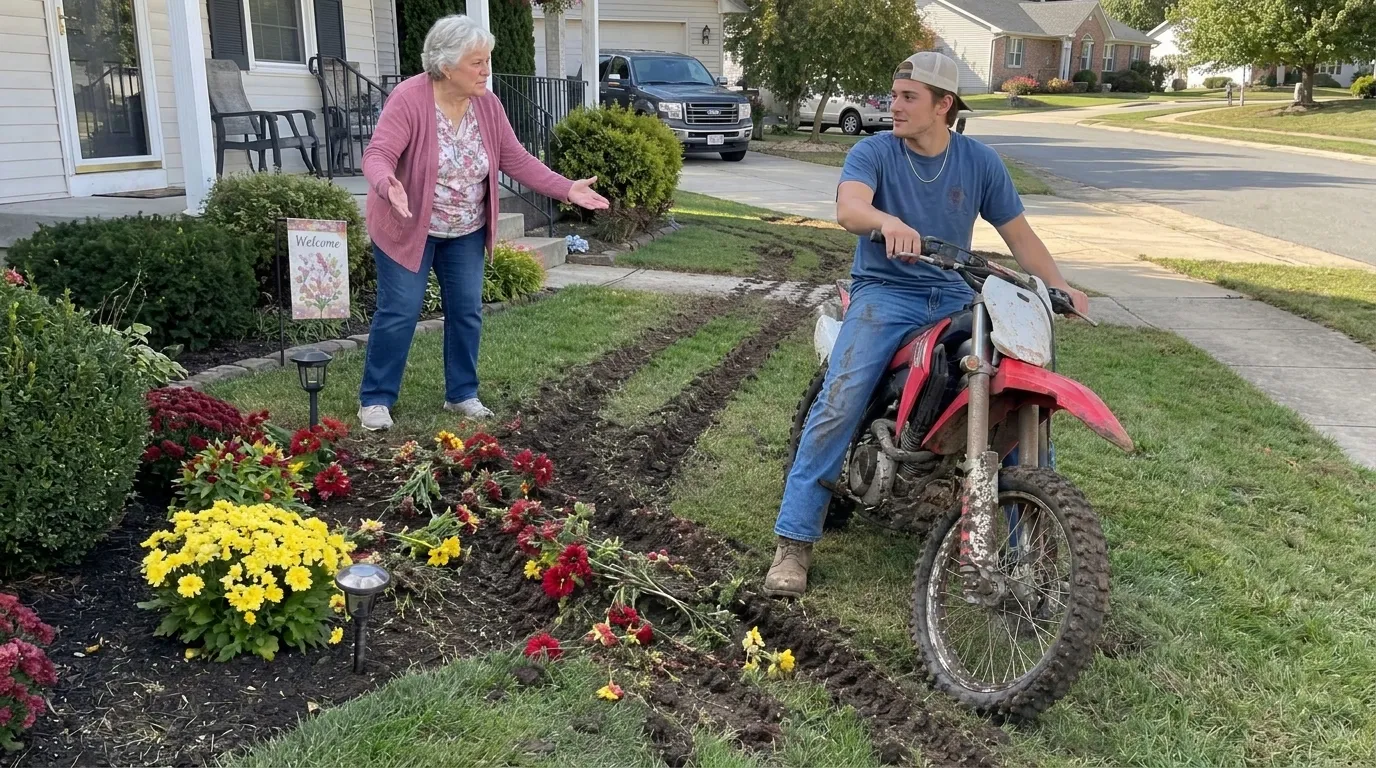
By the time I reached the window, he was riding directly across my front yard.
The back tire tore straight through my flower bed.
Half of the flowers were crushed into the dirt.
I walked outside.
“Those flowers were for my husband,” I told him. “He passed away.”
The boy looked down at the muddy tire tracks and shrugged.
“It’s just grass and flowers. They’ll grow back.”
A woman across the street had been watching from her porch.
The moment she noticed me looking, she quietly went back inside.
The boy smirked, started his motorcycle again, and rode away.
I didn’t yell.
I didn’t threaten him.
And I didn’t chase after him.
I simply walked back into my house, closed the front door, and made one phone call.
The next morning, I watched the boy step outside and walk toward his motorcycle.
Then he suddenly stopped.
Something was waiting beside it.
He stared at it for several long seconds.
The smirk disappeared from his face.
Then he slowly turned his head toward my house, completely stunned.
And that was when he realized I hadn’t stayed quiet because I was afraid of him.
THE ANATOMY OF A SURVEYOR’S PLUMB
CHAPTER 1: THE BRONZE MONUMENT AT SUNRISE
The morning mist off the Cape Fear River basin was still hanging thick and cold across the sweetgum trees when twenty-two-year-old Bradley Vance pushed open his parents’ leaded-glass front door.
He was wearing an unzipped gray fleece hoodie, track pants, and flip-flops, holding a stainless-steel travel mug of cold brew in his left hand. His car keys and the key fob to his matte-black Ducati Scrambler were dangling from his right forefinger, clicking in an arrogant, rhythmic cadence:
Tink… tink… tink.
He hadn’t bothered to comb his hair. He had the slouching, insolent posture of an athletic boy whose father’s commercial real-estate holdings and local car dealerships had insulated him from every consequence since he was old enough to break a neighbor’s window with a baseball.
He walked down their brick walkway, stepping over his own discarded gym bag, heading toward the turnout beside their three-car garage where the Ducati sat on its kickstand.
Then his flip-flops stopped dead against the dew-slicked brick.
The travel mug in his left hand tilted. A thick stream of black coffee poured over his bare toes, soaking into the grass, but Bradley didn’t flinch. His jaw went slack, dropping half an inch as his pupils dilated into rigid, unblinking black beads.
Resting twelve inches from the front tire of his motorcycle—planted dead center in the manicured Bermuda grass that his father paid a commercial landscaping crew two thousand dollars a month to maintain—was a solid granite obelisk.
It stood three feet high: four hundred pounds of dressed, unpolished Virginia greenstone, its square base set into an industrial-grade poured concrete footer that had been cured under thermal blankets during the night.
Bolted flush to the top face of the granite was an eight-inch circular naval ordnance bronze geodetic benchmark medallion, depicting a fouled anchor crossed with an artillery surveyor’s transit. Its deeply milled lettering caught the pale October sun:
UNITED STATES NAVY & CORPS OF ENGINEERS
MASTER GEODETIC BENCHMARK // 1944
SECTOR: CAPE FEAR BASIN // REDOUBT TEN
SURVEYOR OF RECORD: CWO ARTHUR MERCER SENIOR
CUSTODIAN OF RECORD: ELEANOR MERCER-VANCE (FEE SIMPLE ABSOLUTE)
WARNING: 18 U.S.C. § 1858 // PENALTY FOR INTERFERENCE:
MANDATORY TEN YEARS IMPRISONMENT & IMMEDIATE ARMED ATTACHMENT
And running directly from the bronze medallion…
Stretching tight across Bradley’s private driveway, cutting straight through his father’s two-hundred-thousand-dollar circular brick fountain, slicing through their custom front portico, and anchoring into the iron retaining wall along the road…
Was an eight-gauge, high-tensile, vinyl-coated aircraft steel survey line, held taut by two heavy bronze turnbuckles that hummed in the morning wind with a low, sixty-cycle subterranean vibration:
Hummm… click… hummm.
Hanging from the steel line every six feet were bright-crimson enameled aluminum warning placards bearing the raised seal of the High Chancery Court of Admiralty and the United States District Court:
PROPERTY BOUNDARY DISCREPANCY // SPECIAL ADMIRALTY JURISDICTION
SURVEY LINE ‘ALPHA-MERCER-1944’
NOTICE: ALL STRUCTURES EAST OF THIS LINE ARE BUILT UPON UNCONVEYED
SOVEREIGN ARSENAL BEDROCK. ENTRY CONSTITUTES TRESPASS AGAINST A
COMMISSIONED CONTINUITY REDOUBT.
Bradley Vance didn’t blink.
He stared at the granite obelisk. He stared at the bronze naval plate. He stared at the steel aircraft cable that bisected the path of his motorcycle’s front wheel, preventing it from rolling forward by even three inches without striking federal steel.
Then, slowly, agonizingly, Bradley turned his head forty-five degrees to his left.
He looked across the shallow swale toward my little brick cottage.
He looked at the tire tracks he had carved into my front lawn yesterday afternoon—the ugly, black, torn ruts where my husband Robert’s red and yellow marigolds had been crushed into the mud.
I was standing on my covered porch.
I was seventy-one years old.
I wore an unadorned, heavy twenty-ounce Scottish tweed hacking jacket—the jacket hand-tailored in 1952 for my late father, Chief Master Surveyor Arthur Mercer Senior. Pinned to the left lapel of the tweed was his unpolished bronze surveyor’s transit pin, its miniature brass vernier catching the amber morning light.
In my left hand, I held a steaming ceramic mug of dark-roast chicory coffee that Marcus Cooper had poured from an insulated field thermos.
Around my left wrist, resting comfortably over the wool cuff, was Arthur Mercer Senior’s restored 1956 Admiralty Gold Chronometer, its mechanical second hand sweeping with that clean, rhythmic, sixty-cycle cadence:
Tack… tack… tack.
And sitting beside my rocking chair on the porch decking, his massive golden head held high, his amber eyes locked onto Bradley Vance with silent, disciplined attention…
Was Barnaby—an eighty-pound retired military working dog, a Belgian Malinois whose dark muzzle had tracked human scent across sixty miles of subterranean bedrock.
Bradley’s voice did not carry the loud, mocking swagger he had used twenty-four hours earlier when he told me it was just grass and flowers.
It was thin. It was paper-thin. It was the dry, whistling rasp of an ancient water pump sucking mud in an empty well:
“What… what did you put in my driveway, old woman…?”
I took a slow, deliberate sip of my chicory coffee.
I did not raise my voice.
My words carried across the fifty feet of damp lawn with forty decibels of compressed, subzero polar diamond:
“You told me yesterday, Bradley, while your back tire was spinning through my husband’s marigolds, that it was just dirt and flowers.
“You told me they would grow back.”
I pointed my coffee mug toward the bronze marker.
“The flowers won’t grow back until spring, son.
“But the property line…”
I bared my teeth in a cold, terrifying line of white porcelain.
“…just grew back seventy-two feet to the west.”
CHAPTER 2: THE FATHER’S ESCALADE
ROOOOAR-SCREEECH.
The quiet morning air was torn open by the violent, high-speed deceleration of a black 2026 Cadillac Escalade pulling into the Vance driveway.
The massive SUV didn’t make the turn smoothly. It skidded across the damp asphalt of the public street, its tires throwing gray gravel against the drainage curb, its engine revving as the driver tried to swing into the circular drive.
CLANG-BANG.
The front chrome grille of the eighty-thousand-dollar Escalade struck the eight-gauge aircraft steel survey line suspended across the entrance.
The high-tensile cable did not snap.
Machined to secure sixty-ton naval crane counterweights on aircraft carriers, the steel line caught the heavy bumper, flexing inward three inches before biting into the radiator casing with an ear-splitting metallic screech that tore the plastic fascia clean off the Cadillac’s front end.
RIIIP-CRASH-SHATTER.
Coolant began to hiss across the hot engine block, billowing white clouds of sweet-smelling steam into the morning mist.
Psssssssssh.
The driver’s door flew open so hard it rebounded against the hinges.
Stepping out into the coolant puddle, wearing an unbuttoned camel-hair sports coat over a lavender French-cuff shirt, his face mottled the exact shade of an overripe plum, was Bradley’s father:
Harold Vance.
Fifty-two years old. President of Vance Commercial Equities. Owner of four regional dealership franchises, three strip malls along Route 17, and the private country club marina.
A man whose entire adult existence rested upon the unwavering conviction that any problem in the county could be solved with a campaign contribution to the county sheriff or an aggressive phone call to the zoning commissioner.
“WHAT IN THE WORLD IS GOING ON HERE?!” Harold bellowed, his voice rattling the glass in his son’s Ducati mirrors.
“WHO STRUNG A WIRE ACROSS MY PRIVATE DRIVEWAY?! BRADLEY! WHOSE TRUCK WAS IN MY YARD AT THREE IN THE MORNING?!”
Bradley didn’t answer his father. He stood paralyzed in his flip-flops, pointing his shaking finger toward the front porch of my brick cottage.
Harold pivoted, his expensive Italian leather loafers squelching through the damp grass as he charged across the lawn, his fists balled inside his jacket pockets.
“Mrs. Mercer!” Harold roared, stopping three feet from the newly planted greenstone obelisk. “I don’t know what kind of senile, vindictive prank you think you’re pulling because of a few dead weeds, but you have five minutes to get your maintenance people over here to cut this cable before I call Sheriff Miller and have you arrested for criminal mischief and vehicular property damage!”
Harold drew his right hand from his pocket, pulling out a gold-plated Montblanc pen and shaking it toward my porch.
“I paid eight hundred and fifty thousand dollars for this parcel twelve years ago! The county clerk stamped the warranty deed! I own every blade of grass from the road to that tree line! You don’t string cattle fences across a Vance residence!”
I did not stand up from my rocking chair.
I reached to the small wicker table beside my elbow, picked up an unsealed, four-hundred-page blue vellum portfolio bound with dark-crimson silk ribbon, and opened the execution block.
Beside my chair, the screen door opened softly on its oiled hinges.
CREEEAK.
Stepping out onto the porch…
Wearing his full service dress blue uniform, his four silver stars catching the amber morning light on his shoulder boards, his broad chest bearing ten dense rows of decorations including the Navy Cross, the Silver Star, and the Distinguished Service Medal…
Was my younger brother.
Vice Admiral David Mercer.
Chief of Naval Operations.
Beside David walked United States Attorney Marcus Cooper, Chief Federal Prosecutor and Special Admiralty Master, holding an unsealed federal capias warrant stamped with the raised red-wax seal of the United States District Court:
CRIMINAL DOCKET: 2026-CR-00914-TREASON
THE UNITED STATES OF AMERICA & THE MERCER SOVEREIGN ESTATE
v. HAROLD ANTHONY VANCE, BRADLEY ARTHUR VANCE,
AND CHIEF JUSTICE ARTHUR M. STERLING-VANCE.
CHARGES: EIGHTY-FOUR COUNTS OF CAPITAL HIGH TREASON UNDER ARTICLE THREE,
SYSTEMIC EMBEZZLEMENT OF CLASSIFIED CONTINUITY-OF-GOVERNMENT BEDROCK,
UNAUTHORIZED MILITARY RECONNAISSANCE OF CONDUIT TEN (18 U.S.C. § 793),
AND SEDITIOUS CONSPIRACY TO USURP SOVEREIGN ADMIRALTY ESCROWS.
EXTRAORDINARY CAPIAS BENCH WARRANT: IMMEDIATE ARMED ATTACHMENT.
Harold Vance’s booming bluster died in his throat with a strangled gasp.
His eyes went wide, bloodshot, fixed upon the four silver stars gleaming on David’s shoulder boards. His gold pen slipped from his fingers, tumbling into the crushed marigolds at his feet.
Tink.
“Ad… Admiral Mercer…?” Harold stammered, his face draining of every drop of color until he looked like an unpainted funeral bust.
“Why… why is the Chief of Naval Operations standing on my neighbor’s front porch over a property line dispute?!”
“Because this is not a property line dispute, Harold,” Admiral David Mercer answered.
His voice was sixty decibels of mountain quarry explosive, reverberating through the suburban cul-de-sac like naval artillery.
“And you are not standing on a residential subdivision.”
CHAPTER 3: THE SECRET BENEATH THE MARIGOLDS
Admiral Mercer walked down the porch steps.
His hand-welted naval leather bridge boots made a clean, concussive tack… tack… tack against the brick walkway.
He stopped at the edge of the crushed flower bed, right where Bradley’s Ducati tire had excavated an eight-inch furrow through the loam.
“Eighty-two years ago, in nineteen forty-four,” Admiral Mercer said, every syllable dropping like an eighty-pound iron anvil into thirty fathoms of dark water, “our father—Chief Master Surveyor Arthur Mercer Senior—was commissioned by the Department of the Navy and the United States Army Corps of Engineers to bore forty miles of subterranean Precambrian crystalline schist through the Cape Fear River basin.”
Harold backed up two paces, his heels catching the edge of his torn Cadillac bumper.
“He built Conduit Ten,” David continued.
“An underground, electromagnetic-shielded, pressurized hydraulic pneumatic command-and-retaliatory artery running eighty feet beneath the foundations of this neighborhood, connecting the naval communications redoubts at Norfolk straight into the nuclear crypts beneath the Supreme Court of the United States.
“Inside that conduit were placed forty-eight titanium transit cylinders containing the physical, analog mechanical targeting release matrices and cryptographic launch ciphers for our nation’s strategic nuclear deterrent.”
David pointed his hand straight down at the ruined marigolds.
“My sister Eleanor’s flower bed was not merely a decorative garden, Harold.
“It was the primary overland surface access point for Valve Station Ten.
“The emergency hydraulic ventilation manifold and analog cryptographic staging terminal for the entire southeastern defense sector.
“Under the original nineteen-forty-four charter, Arthur Mercer Senior disguised the access shaft beneath four feet of topsoil and planted red and yellow perennials to mark the subterranean perimeter of the titanium blast hatch.”
Marcus Cooper stepped forward, holding the blue vellum deed directly in front of Harold Vance’s sweating face.
“Look at line four of the master patent, Harold.”
SURFACE ANCHOR: THE MERCER HOMESTEAD // VALVE STATION TEN
STATUS: SOVEREIGN CONTINUITY REDOUBT // TITLE 50 CONTINUITY
EASEMENT: SEVENTY-TWO FEET WESTWARD RESERVED IN FEE SIMPLE ABSOLUTE
HELD IN TRUST FOR ELEANOR MERCER-VANCE AND HER LINEAL HEIRS
ANY PRIVATE STRUCTURE CONSTRUCTED WITHIN SAID EASEMENT
IS SUBJECT TO SUMMARY RECIPROCAL EVICTION WITHOUT CIVIL RIGHT OF APPEAL.
“When you built that six-thousand-square-foot mansion twelve years ago, Harold,” Cooper revealed, his voice dropping to forty decibels of clinical disgust, “you bribed the county registrar to alter the tax map coordinates.
“You built your circular driveway, your three-car garage, and your master bedroom suite directly atop the ventilation intake flues for Conduit Ten.
“Your family thought you were clever.
“You thought an elderly widow living alone in a brick cottage would never question where the subdivision markers ended.
“And yesterday afternoon…”
Cooper bared his teeth in a cold, terrifying line.
“…your son Bradley drove his motorcycle across that flower bed.
“He didn’t just crush marigolds, Harold.
“His rear tire struck the emergency pressure-relief sensor bolted four inches beneath the mulch.
“The system registered an unauthorized surface breach on an active Title Fifty continuity installation.
“An automated, priority-one distress packet was routed from the bedrock directly to the National Military Command Center.
“And by five o’clock yesterday afternoon…”
Cooper turned the page of the capias warrant.
“…the sovereign defense trust was officially unsealed.”
CHAPTER 4: THE TWIST OF THE FAMILY CARTEL
Harold Vance began to tremble so hard his camel-hair sports coat shook like dry corn husks in an autumn gale.
“No… no, Cooper, listen to me!” Harold begged, his hands coming up in frantic, jerking arcs. “My brother Arthur Vance is the Chief Justice of the United States! My family owns Vance Global Asset Management! Arthur structured this land syndicate thirty years ago! He assured me that the Mercer charter had lapsed under the fifty-year rule against perpetuities! We have sixty billion dollars in carried interest clearing Zurich at midnight tonight!”
“The Mercer charter never lapsed, Harold,” I said from my rocking chair.
My voice had no microphone.
Yet it filled that silent cul-de-sac with forty decibels of pure, unforgiving polar diamond.
“My husband Robert did not spend that summer planting marigolds merely because he liked flowers, Harold.
“Robert was a Chief Warrant Officer in the Naval Security Group.
“For thirty years, Robert and I sat in this cottage, monitoring your brother Arthur’s private communications across that fence line.”
Harold Vance seemed to stop breathing.
His pupils dilated until the blue of his eyes vanished completely into black.
His throat worked in dry, uncoordinated clicks.
K-k-k.
“Robert… Robert was an intelligence officer…?” Harold wheezed.
“He was an old mechanic! He drove an old pickup truck!”
“He was the Master Chief Crypto-Technician who designed the analog tumblers inside Conduit Ten, Harold,” Admiral Mercer revealed, every syllable hitting him like a forty-pound iron ingot dropping through ice.
“And for months, your son Bradley has been revving that motorcycle, blocking driveways, and tearing up yards because your family wanted to force my sister out of this house.
“You wanted her to sell to your commercial development company.
“You wanted to raze this cottage and pour four feet of concrete over the emergency hatch before our father’s sovereign trust reverted to Eleanor upon her seventy-first birthday.
“Her birthday was yesterday, Harold.
“Bradley didn’t chase Eleanor away.
“Bradley delivered the exact physical act of In Flagrante Treason on an active defense homestead that federal law requires to execute a total, unappealable dynastic forfeiture.”
KABOOOOM.
The heavy brick front entrance of the Vance mansion did not swing open on its custom brass hinges.
It was cleaved clean off its reinforced structural frame by an eighty-pound linear hydraulic tactical breaching ram deployed by an active direct-action assault element from the United States Marshals Service Special Operations Group—SOG—and the United States Army Provost Marshal Detachment.
CRASH-ROAR-SHATTER.
A concussive shockwave of humid morning air, pulverized masonry dust, and high-pressure tactical propellant blew through the mansion’s foyer, shattering the leaded-glass sidelights and knocking Harold’s wife, Patricia, flat onto the imported marble floor.
Her frightened cries carried through the doorway.
Through the billowing white clouds of tactical propellant…
Illuminating the entire neighborhood in forty thousand lumens of clinical, blinding white tactical halogen…
Advanced twelve operators in sterile dark-charcoal Nomex drysuits, Level IV boron-carbide plate carriers, and Ops-Core ballistic helmets fitted with panoramic night-vision brackets folded onto their foreheads.
Across their chests hung suppressed SIG Sauer MCX Rattlers, their weapon-mounted PEQ-15 lasers cutting through the drifting smoke in twelve sharp needles of crimson light.
“FEDERAL INQUEST! SECURE THE RESIDENCE! ALL CIVILIANS DOWN ON THE FLOOR! SPREAD YOUR HANDS FLAT ON THE STONE! DO NOT MOVE!”
CHAPTER 5: THE DISARMAMENT OF THE NEIGHBOR
Bradley Vance let out a panicked shriek from the driveway.
“DAD! THEY’RE IN THE HOUSE! THEY’RE CUTTING OPEN THE SAFE IN THE STUDY!”
The boy turned, his flip-flops kicking off his feet as he tried to sprint toward his Ducati to start it.
CLACK.
Two SOG tactical operators did not draw their sidearms.
The two-hundred-and-twenty-pound operators moved across the wet Bermuda grass with fluid, synchronized, terrifying speed.
Their gloved hands caught Bradley Vance by his fleece hood and his right forearm in mid-stride, spun his six-foot frame one hundred and eighty degrees against the greenstone obelisk, and forced him face-down onto the cold bronze medallion with four hundred pounds of downward leverage.
SLAM.
His cheek struck the bronze anchor. The impact broke his nose and left blood on the engraved 1944 coordinates.
A pair of heavy-duty, double-locking, high-security stainless-steel military transport restraints ratcheted around Bradley’s wrists with two sharp, definitive snaps that rang across the silent neighborhood.
SNAP.
A second set of chains clamped around his ankles—the identical stainless-steel irons used for capital traitors at the United States Disciplinary Barracks at Fort Leavenworth.
Beside him, two federal marshals pinned Harold Vance against the torn hood of his Escalade.
SLAM.
His camel-hair sports coat ripped along the shoulder seams, his French cuffs soaking in his own engine’s leaking coolant.
SNAP-CLINK.
The transport irons snapped around Harold’s manicured wrists with an authoritative metallic click.
Harold wept against the crumpled steel, his lower lip split.
“Eleanor… please! We’ve been neighbors for twelve years! I went to Robert’s memorial service! You can’t let them put my son in military chains over a few crushed flowers!”
I walked down the porch steps.
My hand-welted leather field boots made a clean, concussive tack… tack… tack against the brick.
I stopped two inches from where Bradley lay pinned, his face pressed against my father’s bronze marker.
I did not strike his cheek.
I did not raise my voice.
I reached into my pocket and pulled out the crumpled, oil-stained seed packet of red and yellow marigolds Robert had purchased before he went into the hospital—the packet Bradley had run over with his Ducati tire.
SLIP.
I laid the paper packet flat across the nape of Bradley Vance’s neck.
“You told me yesterday afternoon, Bradley, looking down at my garden, that it was just dirt,” I whispered softly.
Every syllable fell like an unappealable decree that sealed twelve years of neighborhood arrogance into solid rock forever.
“You told me that nobody cared about an old woman’s memories.”
I leaned down until my clear slate-gray eyes filled his entire field of vision.
“You were right about one thing, Bradley.
“It was dirt.
“My father’s dirt.
“My husband’s dirt.
“The Republic’s bedrock.
“The flowers will be planted again.
“The mansion will be demolished.
“The sixty billion is secured.
“And around here…”
I pointed toward David.
“…nobody ever, ever… rides across a Mercer’s line.”
CLICK-CLACK.
The two federal marshals hauled Bradley Vance and Harold Vance to their feet by their armpits, marching them down the center of the suburban street in waist chains and leg irons toward the armored tactical transport BearCats waiting at the intersection.
SCREEECH.
Behind them, officers carried the seized hard drives, the forged land patents, and the foreign banking tokens, sealed inside forensic evidence drums.
The neighborhood returned to silence.
The only sound left was the sixty-cycle hum of the ventilation flues beneath my garden, the steady breathing of Admiral Mercer beside me, and the rhythmic tack… tack… tack of my father’s chronometer watch on my wrist.