Robert stood in the doorway holding Maya’s deleted coach message on his phone.
“What is going on?”
Maya immediately became tense.
I saw it happen.
Her shoulders pulled inward.
Her fingers tightened around the paper sheet.
Robert held up his phone.
“Your coach says you fell weeks ago.”
Maya looked down.
“You deleted this?”
She nodded.
“Why?”
She did not answer.
I did.
“Because she was afraid you would complain about the cost of taking her to a doctor.”
Robert stared at me.
“That’s ridiculous.”
“No.”
Maya’s voice surprised both of us.
She looked directly at him.
“I knew you’d be mad.”
His expression changed.
“I would not be angry because you fell.”
“You get angry whenever I’m sick.”
The room became silent.
Robert opened his mouth.
Dr. Lawson interrupted before he could answer.
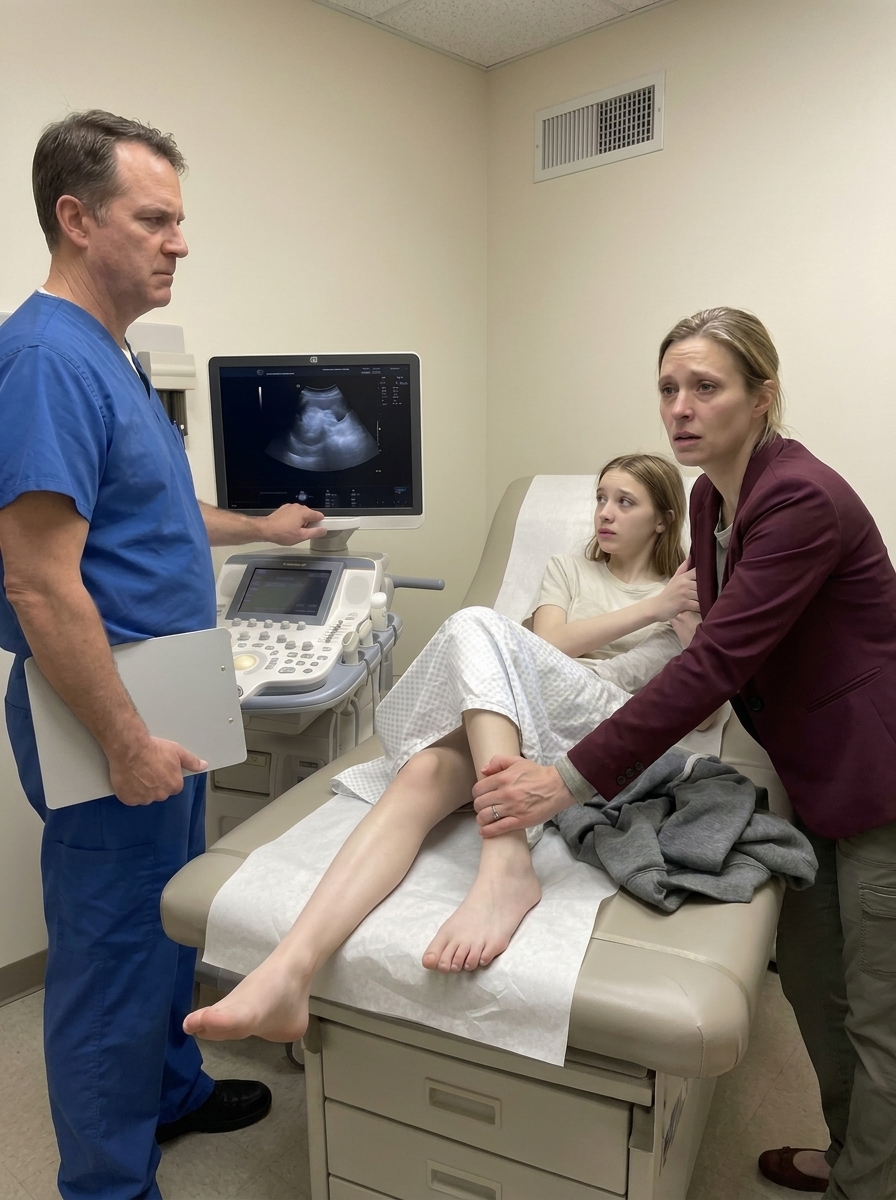
“Mr. Thorne, right now our priority is determining what is causing your daughter’s symptoms.”
Robert looked toward the monitor.
“What did you find?”
“We’re still evaluating it.”
The specialist arrived shortly afterward.
Additional imaging was ordered.
Before proceeding, the medical team completed the standard testing necessary for a patient Maya’s age.
Then a CT scan gave them a much clearer answer.
Dr. Lawson and a pediatric gynecologic specialist returned together.
I knew from their expressions that whatever they were about to tell us was serious.
Dr. Lawson pulled his stool close to Maya’s bed.
“The scan shows a large mass arising from your right ovary.”
My hand closed around Maya’s.
“How large?”
“Approximately eighteen centimeters.”
For a second, the number meant nothing.
Then the specialist continued.
“The weight of the mass appears to have caused the ovary to twist.”
She paused.
“That twisting is interfering with its blood supply.”
Maya stared at her.
“Is that why it hurts?”
“Yes.”
“The nausea too?”
“Yes.”
“The dizziness?”
“Your bloodwork also shows significant anemia, which could be contributing.”
I struggled to process everything.
“Is it cancer?”
“We do not know yet,” the specialist said. “Many ovarian masses in young patients are benign. Pathology will tell us exactly what this is.”
Robert finally spoke.
“So what do we do?”
The specialist looked at him.
“We operate.”
Maya went completely still.
“Today?”
“Yes.”
Her voice became tiny.
“Am I going to die?”
“No.”
The doctor spoke carefully.
“You came here. We know what we are dealing with now.”
Then she looked at me.
“But we need to move quickly.”
I thought of every week Robert had said:
She’s exaggerating.
It’s stress.
Don’t waste money.
My phone buzzed with insurance information.
I ignored it.
The only number that mattered was the eighteen centimeters growing inside my daughter while we argued about whether she deserved to see a doctor.
The surgical team began preparing Maya.
Robert followed me into the hallway.
“Wait.”
I turned.
“We need to talk about this.”
“About what?”
He lowered his voice.
“This is going to be expensive.”
I simply stared at him.
“Our daughter is about to have emergency surgery.”
“I understand that.”
“Do you?”
“I’m saying there will be a deductible. Hospital fees. Surgery—”
“Stop.”
He looked irritated.
“We cannot pretend money doesn’t matter.”
“No.”
I stepped closer.
“But you behaved as though money mattered more than Maya.”
“That’s not fair.”
“She was afraid to tell you she fell because she thought you would be angry about the bill.”
Robert looked through the window toward our daughter.
“I didn’t know there was a mass.”
“You didn’t try to know.”
The nurse handed me the consent papers.
My hands shook as I signed.
Then I walked beside Maya’s bed until the double doors stopped me.
She grabbed my hand.
“Mom?”
“I’m here.”
“Don’t leave.”
“I’ll be waiting right outside.”
Her eyes filled.
“Promise?”
“I promise.”
Then the doors closed.
The waiting room had twelve blue chairs, two vending machines, and a television showing a silent home-renovation program.
I sat with Maya’s gray hoodie folded across my lap.
Robert paced.
At 5:41, he finally sat down.
“What exactly did the doctor say?”
I looked at him.
“You were standing there.”
“I want to understand whether this could have waited.”
Something inside me went cold.
“No.”
“Natalie—”
“My name isn’t Natalie.”
He blinked.
I was so exhausted and angry that even hearing him speak felt unbearable.
“Maya begged for weeks to be taken seriously.”
I held her hoodie tighter.
“You do not get to sit here now and search for another reason she could have waited.”
Before Robert could answer, a nurse entered.
“Mrs. Thorne?”
I stood so quickly my chair struck the wall.
“The surgeon would like to speak with you.”
Robert followed.
Dr. Helena Cruz met us in a small consultation room.
She removed her surgical cap.
“Maya is stable.”
My knees nearly gave way.
“She’s okay?”
“She is in recovery.”
“What happened?”
“The mass caused complete torsion of the right ovary.”
She paused.
“Unfortunately, the blood supply had been interrupted for too long. The tissue could not be preserved.”
I closed my eyes.
“We had to remove the damaged ovary along with the mass.”
Robert sat down.
I could barely speak.
“What about the other one?”
“Her left ovary appears healthy.”
“Will she be able to have children someday?”
“It is possible to have normal hormonal function and fertility with one healthy ovary. She’ll need follow-up care, but one healthy ovary can be sufficient.”
Then I asked:
“Cancer?”
“The mass has features consistent with a mature teratoma, which is often benign. Pathology will confirm that.”
Robert looked toward Dr. Cruz.
“If she had come in sooner…”
His voice disappeared.
“Would the ovary have been saved?”
Dr. Cruz answered carefully.
“We cannot know exactly when the torsion became complete.”
Then:
“But earlier evaluation might have identified the mass before it became an emergency.”
Robert lowered his head.
“She told me her stomach hurt.”
“Yes,” Dr. Cruz said.
“Persistent pain, vomiting, dizziness, weight loss, and major changes in activity should be medically evaluated.”
He looked toward me.
I did not rescue him from the truth.
Dr. Cruz continued.
“Your daughter is fortunate her mother brought her in when she did.”
The word fortunate felt strange.
Maya had lost part of her reproductive system after spending weeks being told she was lying.
But I understood what Dr. Cruz meant.
The alternative could have been much worse.
Several hours later, Maya opened her eyes.
“Mom?”
“I’m here.”
“Did they take it out?”
“Yes.”
“Was it cancer?”
“We’re waiting for the final test, but the doctors think it may be benign.”
She swallowed.
Then looked frightened.
“What else did they remove?”
I would not let someone else tell her.
“The mass twisted your right ovary.”
I held her hand.
“The doctors couldn’t save it.”
Maya stared at me.
“So they took it?”
“Yes.”
Tears filled her eyes.
“Can I still have kids someday?”
“The other ovary is healthy. The doctor said one healthy ovary can still work normally.”
She stared at the ceiling.
Then whispered:
“I told him it hurt.”
“I know.”
“I kept telling Dad.”
“I know.”
“He said I was lying.”
Robert stood near the doorway.
Maya noticed him.
Her entire body tightened.
He stepped forward.
“Sweetheart…”
She turned away.
“I’m sorry.”
Maya said nothing.
“I thought—”
“I don’t care what you thought.”
Robert stopped.
“You said I wanted attention.”
“I was wrong.”
“You said Mom would waste money because of me.”
“I shouldn’t have said that.”
“You told me to stop being dramatic.”
Her breathing quickened.
The monitor began beeping faster.
I stood.
“You need to leave.”
“I’m her father.”
“She needs rest.”
“I need to apologize.”
I looked directly at him.
“Your need to be forgiven is not more important than her recovery.”
A nurse entered and asked Robert to step outside.
He looked at Maya.
Waiting for her to stop him.
She didn’t.
After the door closed, Maya began crying.
Quietly.
Almost apologetically.
The same way she had learned to experience pain in our house.
I carefully sat beside her.
“You never have to make your pain smaller for another person again.”
“What if people think I’m dramatic?”
“Then they can think it from far away.”
She pressed her face against my shoulder.
“Are you going to leave Dad?”
I did not answer immediately.
“I’m going to make sure you’re safe.”
I stroked her hair.
“Then I’ll decide what that requires.”
Maya remained in the hospital for four days.
On the third day, the pathology report came back.
The mass was benign.
I cried so hard I had to sit down.
Maya cried too.
It wasn’t cancer.
But relief did not erase what had happened.
She had still undergone emergency surgery.
She had still lost an ovary.
And for weeks before that surgery, she had begged to be believed.
The specialist explained Maya’s follow-up care.
Future imaging.
Hormonal monitoring.
The importance of reporting persistent symptoms immediately.
Maya listened carefully.
Then asked:
“What if someone says I’m exaggerating?”
The doctor looked directly at her.
“You know your body. If something feels wrong, keep speaking until someone listens.”
Robert visited again only after Maya agreed.
He brought flowers.
A stuffed bear.
A hospital gift-shop card.
Maya looked at them without touching anything.
“I’m sorry,” he said.
She remained quiet.
“I was afraid of the bills.”
Maya finally looked at him.
“You made me afraid to be sick.”
His face changed.
“I didn’t realize that.”
“That doesn’t make it better.”
“No.”
“I asked Mom whether she was angry because I thought I made the hospital expensive.”
Robert lowered his eyes.
Then Maya said something that silenced him completely.
“I was scared you’d be angry even if I died.”
Robert looked up.
“I would never want you to think that.”
“But I did.”
Silence.
He reached toward her hand.
Maya pulled it beneath the blanket.
“I’m tired.”
He left.
Afterward, Maya pointed toward the gifts.
“Can you throw away the card?”
“Of course.”
“But keep the bear.”
I smiled.
“Okay.”
“Is that weird?”
“No.”
“You’re allowed to like the bear without accepting everything attached to it.”
When Maya was discharged, Robert expected us to return home.
Instead, I drove to my sister Caroline’s apartment.
She had prepared a guest room with extra pillows, clean sheets, and a small table for Maya’s medicine.
Robert called before we reached the highway.
“Where are you taking her?”
“Somewhere she can recover.”
“She can recover at home.”
“She spent weeks being told her pain wasn’t real in that home.”
“You can’t take my daughter away.”
“She asked not to return while you’re there.”
“She’s fifteen.”
“She’s also the patient whose suffering you dismissed.”
“This is between us.”
“No.”
I tightened my grip on the steering wheel.
“It stopped being just between us when our daughter became afraid to ask for medical care.”
I ended the call.
That night, Maya slept for almost nine hours.
I sat beside her and listened to her breathe.
The following morning, Caroline brought me coffee.
“What are you going to do?”
“I don’t know.”
She looked at me.
“Yes, you do.”
I did.
The scan had revealed more than the mass.
It had exposed our marriage.
Robert’s financial control had become so normal that I had stopped naming it.
He questioned grocery receipts.
Complained about medical copays.
Criticized expenses involving Maya or me.
Yet he upgraded his truck without discussing it.
Bought expensive equipment for his hobbies.
Went out with friends.
Paid subscriptions he barely used.
That afternoon, I finally examined our accounts properly.
Three months earlier, Robert had spent almost five thousand dollars upgrading his truck.
From the same savings account he insisted needed to be protected from Maya’s medical expenses.
Hundreds more had gone to sporting equipment.
Restaurants.
Trips.
Subscriptions.
The hospital deductible he had used to frighten us was less than he had spent during one weekend away.
It had never been only about money.
Money was how Robert decided whose needs mattered.
I saved copies of everything.
Then contacted an attorney.
Robert reacted to the separation exactly as I expected.
First anger.
Then practicality.
Then sentimental messages.
Finally blame.
He said I was destroying the family over one mistake.
He told relatives I had frightened Maya into believing she was sicker than she really was.
That argument disappeared when the medical records documented:
An eighteen-centimeter ovarian mass.
Complete torsion.
Anemia.
Emergency surgery.
Removal of the damaged ovary.
The facts were harder to reshape than conversations around our kitchen table.
Robert then argued that nobody could prove an earlier appointment would definitely have saved the ovary.
That was true.
No doctor claimed certainty.
But he was defending the wrong question.
The issue was not whether anyone could guarantee a different outcome.
The issue was that Maya deserved medical attention when she repeatedly said she was in pain.
I filed for divorce.
Temporary custody arrangements allowed Maya to recover without being forced back into Robert’s home.
Because she was fifteen, her wishes mattered.
She told the evaluator:
“I don’t want to lose my dad.”
Then:
“I just don’t want to live somewhere I have to prove I’m hurting.”
The evaluator wrote that sentence down.
Robert began counseling.
At first, I assumed his lawyer had suggested it.
Maybe that was true.
But gradually, something changed.
He stopped using every visit to beg Maya for forgiveness.
Stopped arriving with gifts.
Stopped explaining what he meant.
And finally began listening to what she said.
During one supervised visit, he sat across from Maya.
“I was wrong.”
She looked at him.
“About the tumor?”
“No.”
He swallowed.
“About you.”
That caught her attention.
“I believed saving money made me responsible.”
He looked down.
“But I used money to avoid things that frightened me.”
“I made you feel like your health was a burden.”
Maya said nothing.
“I also made your mother handle every difficult decision so I could blame her if it went badly.”
“That’s true,” Maya said.
Robert nodded.
No argument.
No defense.
That was the first useful apology he had given.
Trust did not return because of it.
It returned slowly.
When Maya allowed it.
Some visits lasted an hour.
Others ten minutes.
Sometimes she answered his calls.
Sometimes she didn’t.
Robert learned that being her father did not entitle him to immediate forgiveness.
The divorce became final eight months after Maya’s surgery.
Maya and I moved into a smaller townhouse.
Pale walls.
Narrow backyard.
A kitchen table beside a large window.
The medical bills went onto a payment plan.
We did not collapse financially.
That mattered.
Because Robert had spent years treating every potential expense like catastrophe.
The bills arrived.
I paid what I could.
Called when I needed arrangements.
Life continued.
The thing that nearly destroyed us had never been the cost of medical treatment.
It had been the cost of delay.