My Mother-in-Law Brought 38 Friends to My Restaurant and Left Me a $14,800 Bill
“Come in, ladies, don’t be shy. My daughter-in-law’s restaurant is practically family property. Today we eat like queens… and it’s all on me.”
My mother-in-law Theresa’s voice echoed across the dining room at one-thirty in the afternoon, right in the middle of our peak lunch rush.
Behind her filed thirty-eight impeccably dressed women with designer handbags, heavy perfume, and the unshakable confidence of people who fully expected someone else to foot the bill.
David, my general manager, rushed over to me near the pass, eyes wide.
“Elena, they don’t have a reservation. Every table in the main dining room is fully committed. Should I tell them we can’t seat a party of thirty-nine?”
I looked past him. Theresa was already sweeping a “Reserved” sign off a central booth and ordering two busboys to push three four-tops together.
“No,” I said quietly. “Seat them in the private salon.”
David blinked.
“All thirty-nine?”
“Every single one of them. Take care of them like queens, and give them whatever they order.”
He didn’t understand. Nobody did. But I knew this was going to be the last day Theresa walked into my establishment acting like she owned what she had never worked to build.
I had built Aura, my farm-to-table restaurant in downtown Austin, after a decade of grinding as a line cook, sous-chef, and eventually executive chef.
I saved every dollar of the initial capital. I picked the brick, selected the Rational ovens, hired every dishwasher and line cook, designed the seasonal menus, and stayed up until three in the morning balancing food costs.
My husband, Mark, hadn’t invested a single dime.
Yet Theresa told a very different story to her country-club social circle.
“My son set the business up for her,” she would boast over bridge games. “Elena just handles the kitchen.”
For three years, she had shown up unannounced with friends, ordered dry-aged ribeyes, seafood towers, pastry platters, and reserve-list Cabernet, then glided out the front door without ever opening her purse.
When I confronted Mark about it in private, he always gave me the same line.
“She’s my mother, Elena. Besides, she brings you exposure. Don’t be dramatic over a couple thousand dollars.”
My mistake was staying silent for too long.
On this particular Friday, Theresa decided to test how far my silence would stretch.
“We’ll take the full ten-course tasting menu for everyone,” she announced loudly to the server. “And open the private-cellar Napa Cabernet. Nothing from the house tier.”
The thirty-eight women clapped in delight.
“Oh, Theresa, you are far too generous!”
“Well, what’s the point of having a high-end restaurant in the family if you can’t enjoy it?” Theresa replied, catching my eye with a triumphant smirk.
At that rate, I thought the bill might reach twenty thousand dollars.
David hurried back to my side.
“Elena, we can still stop this before the kitchen fires the first course.”
“No,” I replied softly. “Fire every course. Bring out the good crystal.”
Theresa took over the private dining salon, holding court like a queen.
Plates of sea scallop crudo, wagyu carpaccio, blue-corn heirloom tostadas, bone-in ribeyes, and artisanal cheese boards flooded the tables, accompanied by bottles from our top-shelf cellar reserve.
I personally brought out one of our rarest bottles of Opus One to pour for her table.
Theresa watched attentively as I filled her glass.
“Look at that, girls,” she said with a slight sneer. “The grand executive chef can serve tables, too.”
Several women chuckled into their linen napkins.
“She cooks wonderfully,” one woman remarked. “A bit plain-looking, though.”
Theresa took a slow sip of wine.
“Elena’s always been like that. Simple. She’s a workhorse, really. That’s what she’s good for.”
I gripped the neck of the wine bottle, keeping my posture rigid and my face completely blank. I kept smiling.
Then one of her friends leaned in.
“And how is Mark? I haven’t seen him around the club lately.”
Theresa leaned forward over her wine glass, lowering her voice just enough for everyone at the table—and me—to hear.
“Mark is doing better than ever. He actually has a gorgeous young thing on the side who’s keeping him very happy.”
The room went silent.
Theresa let out an airy, dismissive laugh.
“Oh, don’t make those faces! Elena is never home anyway. She practically lives in this kitchen. Besides, Mark deserves to have his fun.”
Another woman frowned.
“With what money? I thought his logistics firm was struggling.”
Theresa raised her glass in a toast.
“With money from this restaurant, of course! At the end of the day, it’s all family money.”
I stood frozen behind her chair.
For three months, I had been privately tracking strange, unauthorized withdrawals and charges involving my business account.
Luxury hotels. Jewelry stores. Wire transfers.
Debts Mark had claimed were “unexpected business overhead.”
Until that moment, I hadn’t realized the full, sickening scope of it. Theresa knew about her son’s infidelity—and she knew exactly whose hard work was funding it.
As she clinked her crystal glass against those around her, she had no idea that I already held evidence that could shatter her grand illusion.
Something inside me became perfectly still.
Not broken.
Not angry.
Still.
There is a kind of pain so sharp that your body refuses to react to it immediately.
You don’t scream. You don’t cry. You don’t throw the wine bottle in your hand against the wall.
You simply notice strange little things.
The condensation sliding down a water glass.
The tiny crack in the gold polish on Theresa’s thumbnail.
The sound of silverware touching porcelain three tables away.
The scent of rosemary from the lamb course waiting beneath the heat lamps.
Thirty-eight women sat around the private dining salon of Aura, eating food I had created and drinking wine I had purchased, while my mother-in-law explained that my marriage was apparently just another thing she considered hers to manage.
A few women looked uncomfortable.
Others stared at their plates.
One woman named Judith Campbell whispered, “Theresa, that’s a terrible thing to say.”
Theresa shrugged.
“Elena practically sleeps in this restaurant. What did she expect?”
Then she raised her glass toward me.
“Don’t worry, sweetheart. You still have this place.”
I smiled.
That frightened her more than anger would have.
Because Theresa knew me well enough to expect silence. She had spent seven years teaching me exactly what happened whenever I objected to anything she did.
I became difficult.
Ungrateful.
Sensitive.
Dramatic.
She never said she was taking advantage of me. She said I was keeping score.
She never said her son was disrespecting me. She said marriage required flexibility.
Whenever I confronted Mark privately, he used softer words to deliver the same message.
“She’s my mother.”
“She doesn’t mean anything by it.”
“Why create a family war over dinner?”
“You’re making this bigger than it is.”
For three years, Theresa had walked into Aura as if my restaurant were an extension of her country-club membership.
Lunches. Birthday dinners. Anniversary parties. Wine tastings.
A charity planning committee once ordered nearly four thousand dollars’ worth of food and champagne, and Theresa simply kissed me on the cheek before leaving.
“Put it on the family tab.”
There was no family tab.
There was only me.
Apparently, I had finally reached the price of my silence.
Fourteen thousand eight hundred twelve dollars and sixty-three cents.
I didn’t know that exact amount yet.
But I would.
Before the night ended, that bill would become the most important receipt I had ever printed.
I lowered the bottle.
“Enjoy the Cabernet,” I told Theresa.
She smiled triumphantly.
“That’s my girl.”
I walked back into the kitchen.
David followed me immediately.
My general manager had worked beside me for nearly six years. He had seen me survive a broken walk-in refrigerator during opening week, a flood in the prep kitchen, an investor offer I refused because the buyer wanted to fire half my staff, and a food critic who arrived unannounced fifteen minutes before closing.
David had never seen my hands shake.
They were shaking now.
“Elena.”
“I’m fine.”
“You’re not.”
I placed the wine bottle on the stainless-steel counter.
“How much are they at?”
He checked the tablet.
“Eleven thousand three hundred, before the last wine order.”
“Keep serving.”
“Elena—”
“Keep serving.”
He stared at me.
Then something in my face made him stop arguing.
“Okay.”
“And David?”
“Yeah?”
“From this moment forward, nobody comps anything at that table.”
His eyebrows lifted.
“Nothing?”
“Not a dessert. Not an espresso. Not a bread basket adjustment.”
I looked through the service window toward the private salon.
“And make sure every item is entered under Theresa Whitmore’s name.”
David’s expression changed.
He finally understood.
“Everything?”
“Everything.”
He nodded slowly.
“I’ll take care of it.”
I pulled my phone from my chef’s coat and sent three words to the woman who had been helping me quietly for almost two months.
Something just changed.
Nina Salazar replied less than thirty seconds later.
How bad?
I looked through the window again.
Theresa was laughing.
Worse than we thought.
Nina was a forensic accountant.
Not the kind who prepared tax returns in a little office with motivational posters on the wall.
Nina found money people worked very hard to make disappear.
I had hired her after noticing the first withdrawal.
$6,800.
The transaction description said:
RIDGELINE OPERATIONAL TRANSFER.
RidgeLine was Mark’s logistics company.
When I asked him about it, he barely looked away from his laptop.
“Temporary cash flow issue.”
“You transferred almost seven thousand dollars from Aura.”
“Transferred. Not stole.”
“You didn’t ask.”
“I’m your husband.”
I remembered the way he’d said it.
Not apologetically.
Like marriage was a banking credential.
He promised to repay it within two weeks.
He didn’t.
Then came $11,200.
Then $4,950.
Then hotel charges.
A jewelry store in Houston.
A Miami restaurant where Mark claimed never to have eaten.
Three wire transfers to an account labeled AH HOLDINGS.
Every time I asked, Mark had an explanation.
Vendor reimbursement.
Client entertainment.
Temporary liquidity.
Accounting correction.
Once, when I pressed too hard, he actually laughed.
“You’re a chef, Elena. Not a CFO.”
That sentence stayed with me.
Mostly because Aura had no outside investors.
No corporate parent.
No hidden partners.
I owned one hundred percent of it.
I had bought my first commercial range with money I saved working double shifts. I had painted the original dining room myself.
I had slept on flour sacks during the first three months because driving home at two in the morning only to return at five seemed pointless.
Mark had been supportive at first.
He carried boxes. Built shelves. Told everyone he was proud of me.
Then Aura appeared in Texas Monthly.
Then came national press.
Then celebrity customers.
Then a waiting list.
Somewhere along the way, Mark stopped saying, “Elena built this.”
He started saying, “We built this.”
Then Theresa shortened it further.
“Our restaurant.”
I had tolerated the language because I believed love was not supposed to keep accounting records.
Then the accounting records started disappearing.
That was why Nina existed.
That was why, when Theresa announced in front of thirty-eight witnesses that Mark was financing his mistress with restaurant money, I did not throw the wine.
I needed clarity more than revenge.
At three-forty that afternoon, Theresa ordered dessert.
Thirty-nine tasting menus had already passed through the kitchen.
The private salon looked like the aftermath of a royal banquet.
Crumbs. Half-empty wine bottles. Coffee cups. Lipstick-stained crystal.
Theresa leaned back in her chair while one of my pastry chefs placed a burnt-honey semifreddo in front of her.
“This is adorable,” she said.
Adorable.
That dessert had taken Luis seven weeks to perfect.
I stayed away from the room.
At four-oh-seven, David appeared beside me carrying a black leather check presenter.
His face was almost solemn.
“Final total.”
He handed it to me.
I looked.
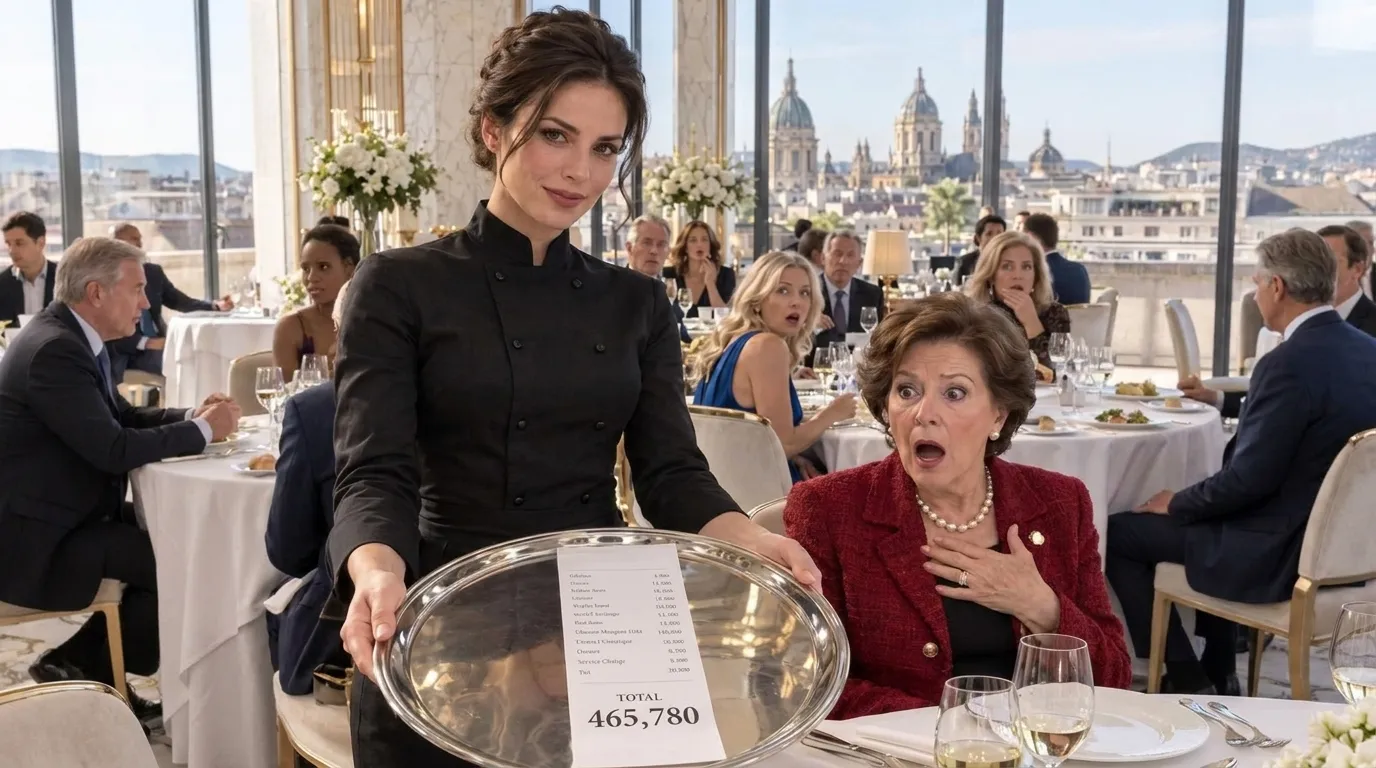
$14,812.63.
I felt no satisfaction.
Not yet.
“Bring it to her.”
David hesitated.
“You sure?”
“Absolutely.”
Two minutes later, I watched from the service corridor.
David placed the check presenter beside Theresa.
“Mrs. Whitmore, whenever you’re ready.”
Theresa barely glanced at it.
“Oh, honey. Give that to Elena.”
David remained standing.
“I’m sorry?”
“The bill.”
She waved one manicured hand toward the kitchen.
“Elena handles our family account.”
A few women continued chatting.
But several stopped.
David smiled professionally.
“Mrs. Whitmore, Ms. Ruiz has instructed me that payment is required today.”
Theresa’s smile disappeared.
“Excuse me?”
“Payment is required.”
“Do you know who I am?”
“Yes, ma’am.”
“Then you know I don’t receive bills here.”
“Today you do.”
The table went silent.
I saw Theresa’s face change from confusion to disbelief and finally to fury.
“Where is Elena?”
David didn’t answer quickly enough.
Theresa stood.
“Elena!”
Every head in the dining room turned.
I wiped my hands on a towel and walked out.
“What seems to be the problem?”
Theresa held up the folder.
“This.”
“Your bill?”
“Don’t play games.”
“I’m not.”
Her voice dropped.
“You are embarrassing me.”
“No. I’m charging you.”
A woman at the far end of the table cleared her throat.
Theresa ignored her.
“You approved this lunch.”
“I approved serving you.”
“You said to take care of us like queens.”
“And we did.”
“You knew I wasn’t paying.”
“Actually, Theresa, you announced in front of the entire restaurant that the lunch was ‘all on you.’”
A few women looked at one another.
Theresa’s face reddened.
“You know perfectly well what I meant.”
“I’m afraid I don’t.”
“This restaurant belongs to the family.”
“No.”
I didn’t raise my voice.
“This restaurant belongs to me.”
The sentence landed harder because I spoke it quietly.
Theresa laughed.
But it sounded strained.
“Oh, please. Mark—”
“Mark does not own a single share of Aura.”
That silenced her.
One of the women looked sharply at Theresa.
Another slowly put down her coffee cup.
Theresa took a step toward me.
“Don’t do this.”
“Do what?”
“Make some pathetic feminist point because you’re angry at your husband.”
That was when I realized she believed I had only just discovered the affair.
She thought that was the danger.
She had no idea about Nina.
No idea about the bank statements.
No idea about the copied invoices locked in my office safe.
No idea that my attorney had already advised me to separate Aura’s accounts from every access credential Mark knew.
So I gave her one final opportunity.
“Pay your bill.”
“I’m not paying fourteen thousand dollars for lunch at my own son’s restaurant.”
“It isn’t his.”
“It might as well be.”
“It isn’t.”
“Call him.”
That surprised me.
Not because I was afraid of Mark.
Because Theresa sounded confident.
Actually confident.
She pulled out her phone.
“I’m calling him right now.”
“Please do.”
Her eyes flickered.
That answer bothered her.
She tapped his name and placed the phone on speaker.
Mark answered after four rings.
“Mom?”
Theresa immediately changed her voice.
She was suddenly wounded.
Fragile.
The victim.
“Mark, darling, I’m at Aura and Elena is having some kind of episode.”
I almost laughed.
“What happened?”
“She has presented me with a ridiculous bill.”
“How much?”
“Almost fifteen thousand dollars.”
Silence.
Theresa continued.
“We had the girls’ luncheon. The one I told you about.”
Another pause.
Then Mark said something that surprised both of us.
“Mom, pay it.”
Theresa blinked.
“What?”
“Pay the bill.”
“What are you talking about?”
“I’m serious.”
“Mark, stop it.”
“I’m not joking.”
Her face tightened.
“You told me—”
She stopped herself.
Everyone heard it.
You told me.
Those three words changed the air in the room.
I watched Mark’s mother carefully.
“What did he tell you?” I asked.
Theresa ignored me.
“Mark, you get down here and handle your wife.”
Mark’s voice became strange.
Low.
Tired.
Almost frightened.
“Mom, listen to me.”
“No, you listen to me.”
“Pay Elena.”
“I will not.”
“You have to.”
“Why?”
There was a long silence.
Then Mark said:
“Because Aura isn’t mine.”
Theresa stared at the phone.
“I know Elena technically—”
“No.”
His voice sharpened.
“You don’t understand. It isn’t technically hers. It is completely hers. It always has been.”
Around the table, chairs shifted.
Theresa’s mouth opened.
Mark continued.
“I never invested in it. I never owned part of it. I was never a co-founder. Elena didn’t get it because she married me. I didn’t set it up for her. None of that is true.”
Someone whispered, “What?”
Theresa grabbed the phone.
“Mark.”
But he didn’t stop.
“And Mom?”
“What?”
“You had no authority to promise anyone anything connected to Aura.”
The silence after that sentence was so complete I could hear the refrigeration system humming behind the bar.
Theresa went white.
I looked at the women.
Some looked confused.
Others looked horrified.
But at least six of them were staring directly at Theresa.
Judith Campbell stood.
“What does he mean by promise anyone anything?”
Theresa’s head snapped toward her.
“Nothing.”
Judith didn’t sit down.
“You said Mark approved it.”
“Judith, not now.”
“Approved what?” I asked.
Theresa looked at me.
For the first time in seven years, I saw something I had never seen in her face.
Fear.
A second woman reached into her handbag.
Her name was Caroline Brooks.
I had served her several times.
Polite woman. Silver hair. Widowed.
She always tipped the staff directly, even when Theresa tried to wave away the bills.
Caroline removed a folded document.
“Theresa,” she said slowly, “you said Elena knew.”
Theresa’s voice hardened.
“Put that away.”
Caroline looked at me.
“Ms. Ruiz, have you ever heard of Aura Hospitality Holdings?”
My stomach dropped.
AH HOLDINGS.
The transfer label.
I walked toward her.
“Where did you get that document?”
Caroline handed it to me.
The first page carried a logo that looked almost identical to Aura’s.
Same font.
Same shape.
Same gold ring around the A.
Underneath were the words:
AURA HOSPITALITY HOLDINGS, LLC.
PRIVATE PARTICIPATION AGREEMENT.
I read the first paragraph.
Then the second.
My vision blurred.
It described an opportunity to purchase preferred ownership interests in “the award-winning Aura restaurant brand and future expansion properties.”
Minimum investment:
$25,000.
Projected return:
Eight percent annually.
Investor privileges:
Priority reservations.
Private cellar access.
Complimentary quarterly dining events.
My hands went cold.
I looked at Caroline.
“How much did you invest?”
She hesitated.
“Ninety thousand.”
A woman across the table said, “I put in fifty.”
Another said, “Seventy-five.”
A third whispered, “My husband and I transferred one hundred and twenty.”
Theresa slammed her palm against the table.
“Everybody stop talking.”
Nobody did.
The room erupted.
Questions. Accusations. Paperwork appearing from handbags. Phone screens displaying wire confirmations.
I stood there while reality rearranged itself around me.
These women had not come merely because Theresa liked showing off.
Many of them believed they were investors in my restaurant.
The extravagant lunch was not simply Theresa being generous with my money.
It was proof.
A demonstration.
She had brought them into Aura, ordered like an owner, commanded my staff, accessed the private cellar, and walked around as if she possessed the building because she needed them to believe the documents she had sold them were real.
Judith pushed a certificate toward me.
“You signed this.”
I looked.
At the bottom was my name.
ELENA RUIZ.
Managing Founder.
Beneath it was a signature.
My signature.
Almost.
I knew immediately what it came from.
Three years earlier, I had signed hundreds of vendor renewal forms using a digital signature pad.
Someone had copied it.
My stomach turned.
“I did not sign this.”
Judith’s face drained of color.
“What?”
“I have never seen this document.”
“Theresa said—”
“She lied.”
Thirty-eight faces turned toward my mother-in-law.
Theresa backed away from the table.
“This is absurd.”
Caroline stood.
“You took ninety thousand dollars from me.”
“It was an investment.”
“In what?”
Theresa pointed at me.
“Ask her.”
I laughed.
I couldn’t help it.
The sound was ugly.
“Don’t.”
Theresa stared.
“Don’t what?”
“Don’t point at me.”
“You own the restaurant.”
“Exactly.”
I held up the fake certificate.
“And I never sold you the right to sell a single inch of it.”
Then Mark’s voice came from the forgotten phone.
“Mom.”
Nobody spoke.
Theresa looked down.
“Hang up,” he said quietly. “Mom, hang up the phone.”
But it was too late.
Caroline picked it up.
“Mark?”
Silence.
“Did you know about these investment agreements?”
Theresa lunged forward.
Caroline stepped away.
“Did you?”
Mark inhaled.
“I need to speak to Elena.”
“Answer the question.”
“I said I need to speak to my wife.”
My stomach twisted at the word wife.
Caroline looked at me.
I took the phone.
“Mark.”
“Elena.”
“How much?”
He didn’t answer.
“How much money did your mother take from these women?”
“I don’t know.”
“That’s a lie.”
“It’s complicated.”
“No. Tax law is complicated. Marriage is complicated. This question has numbers.”
I looked around the room.
“How much?”
“Elena, not on speaker.”
“You’re on speaker.”
“Take me off.”
“No.”
He swore under his breath.
I had heard Mark angry before.
This wasn’t anger.
It was panic.
“Go to your office,” he said. “Alone.”
“Why?”
“Because there are things you don’t understand.”
“Then explain them.”
“Not there.”
“You’re confusing me with the woman who protected you this morning.”
He went silent.
That sentence hurt me as much as it hurt him.
Because that morning, before I knew about the mistress, before Theresa turned the private salon into a confession booth, some part of me had still been trying to save our marriage.
I had thought the financial irregularities might be reckless business decisions.
Maybe gambling.
Maybe hidden debt.
Something ugly but survivable.
I had not understood that my husband was spending my money on another woman while his mother mocked me for working too hard.
Now fake investment certificates carrying my signature were scattered across my dining room.
“Come to Aura,” I said.
“Elena—”
“You have twenty minutes.”
“I can’t.”
“Then my next call is the police.”
The line went dead.
Theresa stared at me.
“You wouldn’t.”
I looked at her.
“Wouldn’t what?”
“Do this to Mark.”
“Do what to him?”
“Destroy him.”
I almost couldn’t believe her.
“Theresa, look around.”
Women she had known for decades were crying.
One sat motionless with both hands over her mouth.
Another was calling her husband.
“You stole money from your own friends and forged my name.”
“You don’t know what happened.”
“Then tell me.”
“It wasn’t stealing.”
“What was it?”
“Money moves through families, Elena.”
There it was again.
Family money.
I had heard those words so many times that they had almost lost meaning.
Now I understood what Theresa meant by them.
Money belonged to whoever was bold enough to take it.
I turned to David.
“Lock my office.”
He nodded.
“Preserve the security footage from today. Every camera.”
Theresa scoffed.
“Oh, for goodness’ sake.”
“And print the complete itemized bill.”
Her face tightened.
“Elena.”
I looked at her.
“You wanted me to treat you like a queen.”
I nodded toward the check presenter.
“Queens still pay their debts.”
The women began leaving one by one.
Not happily.
Not quietly.
Most refused to leave until they had copies of the itemized bill and their investment statements.
I had David offer them additional coffees on the house, but nothing else.
The original $14,812.63 remained Theresa’s responsibility.
Her first credit card was declined.
The second went through for only $8,000 before the issuer blocked any further charge.
She stood at the host stand, humiliated, while two servers waited.
Finally Caroline said, “Put the balance on mine.”
I turned.
“No.”
Caroline looked at me.
“Why?”
“Because you’ve already paid enough.”
Theresa closed her eyes.
She eventually called her bank, moved money between accounts, and paid the rest herself.
At 5:23 p.m., Theresa Whitmore signed the receipt for $14,812.63.
I kept the merchant copy.
I still have it.
Mark arrived eleven minutes later.
He didn’t come alone.
A blonde woman climbed out of the passenger seat of his BMW.
Young.
Maybe twenty-nine.
Expensive coat.
Dark glasses despite the cloudy sky.
I knew immediately who she must be.
Simone, as I would learn.
I had never met her.
But I recognized the bracelet.
Six weeks earlier, Mark had charged $9,400 at a jewelry store. He told me it was a corporate gift package for a major client.
The bracelet on Simone’s wrist sparkled as she entered my restaurant.
For one unbelievable second, I almost admired the audacity.
Then she saw me.
And froze.
“Mark.”
Her voice was barely audible.
“You said she wouldn’t be here.”
Theresa turned toward her son.
“You brought her?”
Mark closed his eyes.
“I didn’t have a choice.”
“Of course you had a choice!”
“Mom, stop.”
“No! Do you understand what she just did to me?”
I laughed.
Simone stared.
Theresa pointed at me.
“She made me pay!”
Fourteen thousand dollars had somehow become Theresa’s greatest tragedy.
Mark looked at the nearly empty dining room.
“What happened?”
“You tell me.”
I handed him one of the fake investment contracts.
His face changed.
Only slightly.
But I saw it.
Recognition.
He recovered quickly.
“I’ve never seen this.”
Theresa stared at him.
“Mark.”
“Don’t.”
Her expression hardened.
“Don’t you dare.”
I looked between them.
“What?”
Neither answered.
Theresa marched toward her son.
“You said you would handle this.”
“Lower your voice.”
“You said the paperwork was fine.”
Mark grabbed her elbow.
“Mom.”
She pulled away.
“You told me Elena signed everything!”
He went pale.
There it was.
A crack.
Tiny.
But enough.
I looked at Simone.
She had started backing toward the entrance.
“Don’t leave.”
Her head snapped toward me.
“I don’t have anything to do with this.”
“You have nine thousand dollars of my restaurant’s money on your wrist.”
She stared down at the bracelet.
Mark stepped between us.
“Leave her out of it.”
I looked at him.
“Was the hotel in Miami also a corporate gift?”
He flinched.
“Elena.”
“How about the Four Seasons?”
“Stop.”
“The twelve hundred dollars at La Mer?”
“Stop.”
“The wire transfer to her apartment?”
Simone turned toward him.
“You said that came from your company.”
Mark said nothing.
Her face changed.
“Mark.”
He rubbed both hands over his face.
Theresa suddenly looked less angry than exhausted.
“Can we please go somewhere private?”
“No,” I said. “This is a business matter.”
“Exactly.”
“My business.”
“Elena, please.”
I stared at the three of them.
My husband.
His mistress.
His mother.
Three people whose lives had apparently been financed by the hours I spent standing over stoves while my back ached and my hands blistered.
“Here’s what happens next.”
Mark looked up.
“My attorney will contact you.”
He stared.
“Attorney?”
“My accountant has been reviewing Aura’s books for seven weeks.”
The color left his face.
That was when I knew.
Nina had been right.
I had told her that I hoped this was simply sloppy bookkeeping.
She told me something I didn’t want to hear.
“People who make innocent accounting mistakes usually don’t hide the statements.”
Now Mark looked like a man who had just learned the building was already on fire.
“How much have you seen?” he asked.
Theresa whispered, “Mark.”
I smiled without warmth.
“Enough.”
He grabbed my arm.
“Elena, listen to me.”
David took one step forward.
Mark released me.
“There are transactions you won’t understand.”
“I understand theft.”
“You think I stole from you?”
“I think you spent $186,000 from accounts you had no authorization to use.”
His eyes widened.
Theresa looked at him.
“One hundred eighty-six?”
Mark snapped, “Stay out of it.”
Her mouth fell open.
That reaction caught me.
She hadn’t known.
Interesting.
Mark turned back to me.
“I can explain.”
“Do it.”
“RidgeLine was struggling.”
“I know.”
“I had a contract fall through.”
“I know.”
“I had forty employees depending on me.”
“Did they all stay at the Four Seasons with Simone?”
His jaw clenched.
“I made mistakes.”
“You committed adultery.”
“I know.”
“You stole.”
“I borrowed.”
“You forged my signature.”
“No.”
The answer came too quickly.
I held up the investment contract.
“What do you call this?”
“I didn’t create that.”
Theresa laughed once.
Bitterly.
“You coward.”
Mark turned on her.
“Shut up.”
“No.”
Her eyes flashed.
“You don’t get to stand there and pretend this was me.”
“Mom.”
“You came to me.”
My heart started pounding.
Mark stepped closer.
“Stop talking.”
Theresa pointed at his chest.
“Your company was failing.”
“Stop.”
“You said you needed investors.”
“Mom.”
“You said Aura could support the valuation.”
“Shut up!”
“You said Elena would never notice!”
The entire restaurant heard it.
Mark stared at his mother.
Then at me.
I felt strangely calm again.
“Get out.”
“Elena—”
“All three of you.”
“Please.”
I pointed toward the door.
“Get out of my restaurant.”
Theresa started crying.
Not softly.
She sank into a chair and covered her face.
“This can’t be happening.”
I looked at her.
For years I would have gone to her.
Comforted her.
Found water.
Told Mark to be gentle.
Instead, I saw the woman who had humiliated me in front of friends, celebrated her son’s affair, stolen from people who trusted her, and helped sell pieces of a business she didn’t own.
“Go home, Theresa.”
She lifted her face.
“I could lose everything.”
Caroline, who had remained near the bar, answered before I could.
“So could we.”
Theresa looked at her oldest friend.
Caroline’s voice trembled.
“My husband died believing that money was invested safely.”
Theresa looked away.
Caroline continued.
“He asked me three times whether I trusted you.”
Tears filled her eyes.
“I told him yes.”
That finally silenced Theresa.
Mark led his mother out.
Simone followed separately.
Before leaving, she turned back toward me.
For a moment I expected an apology.
Instead, she said:
“He didn’t tell me you owned the restaurant.”
I stared at her.
“What did he tell you?”
Her eyes shifted toward Mark through the glass doors.
“That he did.”
That sentence followed me home.
But I didn’t go home immediately.
At midnight, I was still sitting in my office with Nina and my attorney, Priya Shah.
The restaurant had closed early.
Nobody argued.
The staff knew something terrible had happened.
Luis left food outside my office.
I never touched it.
Nina had three laptops open.
Priya had covered half my desk in documents.
“Start at the beginning,” Priya said.
I told them everything.
Theresa.
The lunch.
The mistress.
The fake certificates.
Mark’s confession.
The women.
The investments.
Nina barely reacted until I showed her the Aura Hospitality Holdings agreement.
Then she stopped typing.
“Where did you get this?”
“One of Theresa’s friends.”
“AH Holdings.”
I nodded.
“You recognize it?”
“That’s where the transfers went.”
My pulse quickened.
“From Aura?”
“Some of them.”
“How much?”
Nina rotated the laptop.
A spreadsheet filled the screen.
“$312,400 over twenty-nine months.”
I stared.
“Mark took three hundred thousand?”
“Not exactly.”
“What does that mean?”
“The account isn’t registered to RidgeLine.”
“Then who?”
Nina clicked.
“That’s what I’ve been trying to determine.”
Priya leaned over her shoulder.
“Aura Hospitality Holdings is registered in Delaware.”
“Why Delaware?”
“Privacy and corporate flexibility,” Nina said. “Nothing inherently suspicious about that. But the bank account receiving funds is in Texas.”
“Whose name?”
“We requested enhanced documentation from your bank this morning after you authorized the fraud review.”
She clicked another file.
“Initial paperwork lists Elena M. Ruiz as a managing member.”
I stopped breathing.
“Me?”
Priya stared at the screen.
Nina nodded.
“You.”
“I’ve never heard of this company.”
“I believe you.”
“Then why is my name there?”
She looked at me.
“Because somebody wanted it there.”
That was the first moment I understood how much danger I was in.
This wasn’t simply Mark stealing from Aura.
Someone had built a second company carrying my restaurant’s name.
Someone had sold investments under my identity.
Someone had accepted money from dozens of people.
And on paper, I appeared to be running it.
“What happens if those women go to the police?”
Priya answered carefully.
“They should.”
“And then?”
“Then law enforcement follows the records.”
“To me.”
“Initially, possibly.”
I felt sick.
Nina reached across the desk.
“Elena, that’s why we document everything now.”
I stood.
I couldn’t sit anymore.
“How much money came into that company?”
“We don’t know yet.”
“Guess.”
“I don’t guess.”
“Nina.”
She looked at me.
“Based on the agreements you brought us tonight?”
“Yes.”
“Potentially over two million.”
I gripped the edge of the desk.
Two million dollars.
Thirty-eight women.
Maybe more.
Mark had once argued with me for spending $1,700 on a replacement mixer.
Two million dollars had apparently moved through a company using my name while I worried about the price of butter.
My phone buzzed.
Mark.
I ignored it.
Again.
Ignored.
Third time.
Priya said, “Answer.”
I put him on speaker.
“Yes?”
“Where are you?”
“At Aura.”
“Who is with you?”
“My attorney.”
Silence.
Then Mark said, “We need to talk before you make this worse.”
Priya raised one eyebrow.
“How can I make fraud I didn’t commit worse?”
“It’s not fraud.”
“What is it?”
“Private financing.”
“Using my forged signature?”
“Nobody forged anything.”
“Then why is my signature on documents I’ve never seen?”
Silence.
I heard him breathing.
Then he said:
“Mom handled the investors.”
“Your mother says you designed the paperwork.”
“She’s protecting herself.”
“She says you came to her because RidgeLine was failing.”
“She knew people with money.”
“You told her Aura supported the valuation.”
“We were married.”
“Still are, technically.”
“Exactly.”
I felt something snap.
Not emotionally.
Logically.
A piece suddenly slid into place.
“You thought being married meant you owned Aura.”
“No.”
“You did.”
“Elena—”
“That’s why you kept saying family money.”
He said nothing.
“You thought if Aura was worth eight million dollars, you were worth four.”
“That’s not what happened.”
“You thought my company could collateralize yours.”
“No.”
“You thought my work belonged to you.”
“Stop.”
“And when RidgeLine started failing, you sold pieces of Aura because you were too embarrassed to admit your company couldn’t survive on its own.”
His voice turned cold.
“Be careful.”
Priya smiled slightly.
I understood why.
He had stopped pretending.
“Is that a threat?”
“It’s advice.”
“Then here’s mine.”
I looked at Priya.
She nodded.
“Do not delete a single email, message, bank record, file, or device.”
Silence.
“Why?”
“Because you’ve been formally instructed to preserve evidence.”
He exhaled.
“You really want to turn this into war?”
“No, Mark.”
I looked around the office I had built.
The framed opening-night menu.
My father’s photograph.
The handwritten note from my first food critic.
“This stopped being a marriage long before I knew we were at war.”
I ended the call.