The elderly man stopped at the edge of our driveway.
He looked to be in his seventies.
Gray hair.
Brown jacket.
Hands shaking slightly as he stared at the battered metal lunchbox sitting in the middle of our lawn.
The police officer walked toward him.
“Sir, are you the person who left this?”
The man nodded.
“My name is Samuel Bennett.”
His eyes moved toward Noah.
“I probably should have knocked instead of leaving all this before sunrise.”
Noah remained close to me.
Samuel smiled gently.
“I didn’t mean to frighten you.”
Then he pointed toward the old photograph inside the lunchbox.
“That was my sister, Emily.”
Noah picked it up carefully.
Emily looked about six years old in the picture.
She had Down syndrome.
She wore a bright red dress and stood beside a homemade birthday cake.
Her smile filled almost the entire photograph.
“She looks like Lucy,” Noah said.
Samuel nodded.
“She laughed like her too.”
He crouched slowly so he was closer to Noah’s height.
“When Emily was little, people said things about her that they shouldn’t have.”
Noah looked at him.
“Like what Grandma said?”
I felt my stomach tighten.
Samuel did not pretend he hadn’t heard.
“Yes.”
His voice remained gentle.
“Things like that.”
He looked at the photograph.
“People said Emily wouldn’t understand birthdays.”
“They said there was no point buying her certain toys because she wouldn’t appreciate them.”
“They assumed she didn’t understand when people left her out.”
Samuel swallowed.
“But she understood.”
He tapped the photograph lightly.
“She understood who sat beside her.”
“She understood who laughed with her instead of at her.”
“She understood when people were kind.”
“And she absolutely understood birthdays.”
Noah looked toward Hannah’s house.
Lucy was still asleep.
The red dress from the day before was probably hanging somewhere inside.
Samuel continued.
“Emily died last winter.”
His voice broke slightly.
“She was sixty-eight.”
Noah’s eyes widened.
“You mean she grew up?”
Samuel smiled.
“Oh, yes.”
“She worked at my family’s diner for nearly forty years.”
“She remembered every regular customer’s birthday.”
“She knew who liked extra pickles.”
“She could tell when someone was sad before the rest of us noticed.”
“And every year, she insisted on wearing red for her birthday.”
He gave a soft laugh.
“She said red was a princess color.”
Noah looked back at Emily’s photograph.
Then he smiled a little.
“That’s what I said about Lucy.”
“I know.”
Samuel stood slowly.
“My daughter showed me the video from Lucy’s party last night.”
I frowned.
“What video?”
“Hannah posted a short clip for family.”
That made sense.
I had seen Hannah recording when Noah handed Lucy the dress.
Samuel’s expression changed.
“She wrote that an eight-year-old boy had secretly saved his lunch money to buy it.”
Then he looked at me.
“I own Bennett’s Market and three restaurants in town.”
“I know a lot of people.”
“I sent the video to a few.”
“Apparently, they sent it to a few more.”
I looked around our lawn.
Dinosaurs.
Superheroes.
Football teams.
Bright pink boxes.
Plain brown ones.
Nearly fifty lunchboxes covered the grass.
“You organized all of this overnight?”
Samuel laughed.
“Not exactly.”
“I suggested twenty.”
“Then people started showing up at the diner.”
The officer smiled.
Samuel pointed toward the lunchboxes.
“Open some.”
Noah looked at me.
“Can I?”
I nodded.
He chose a green dinosaur lunchbox.
Inside was a prepaid school-lunch card and a handwritten note.
NOAH, KINDNESS SHOULD NEVER REQUIRE YOU TO GO HUNGRY. HAVE LUNCH ON US. — THE MARTINEZ FAMILY
He opened another.
Inside were granola bars, fruit snacks, a small toy car, and another note.
MY SON SITS TWO TABLES FROM YOU IN THE CAFETERIA. NEXT TIME YOU’RE SAVING FOR SOMETHING KIND, TELL US. WE’LL HELP. BUT EAT YOUR LUNCH. — MRS. CARTER
Noah looked embarrassed.
“I wasn’t really hungry.”
I gave him the look mothers have been giving children since the beginning of time.
“Noah.”
He sighed.
“Okay. I was hungry.”
Samuel smiled.
“That part bothered people.”
Noah looked down.
“I just really wanted the dress.”
“I understand.”
Samuel’s voice softened.
“But you don’t have to hurt yourself to prove you care about somebody.”
That sentence stayed with me.
Because I had been so proud of Noah’s kindness that I had almost missed the dangerous part of it.
He was eight.
He should not have believed generosity required him to secretly go without food.
I knelt beside him.
“Samuel’s right.”
Noah looked worried.
“You’re mad?”
“No.”
I hugged him.
“I’m proud of your heart.”
Then I pulled back.
“But no more skipping lunch.”
“What if I need money for something important?”
“Then you tell me.”
“What if you say no?”
“Then we talk about another way to help.”
He considered that.
“So kindness can have a budget?”
Samuel laughed so loudly the officer did too.
“Yes,” I said. “Kindness can absolutely have a budget.”
Then Hannah appeared at the edge of the driveway.
She was wearing sweatpants, an oversized sweater, and the confused expression of a woman who had looked out her window and discovered a small lunchbox convention on her neighbor’s lawn.
“What happened?”
I walked toward her.
“You should probably see this.”
Lucy was in Hannah’s arms.
Still sleepy.
Still wearing red socks from the birthday party.
The moment she saw Noah, she smiled.
“No-ah!”
Noah’s entire face lit up.
“Lucy!”
Samuel froze.
For several seconds, he simply stared at her.
Not because Lucy was a spectacle.
Because something about the sight of her clearly pulled him backward through decades.
Hannah noticed.
“You okay?”
Samuel wiped his eyes.
“Sorry.”
He held up Emily’s photograph.
“My sister.”
Hannah studied it.
“Oh.”
Lucy leaned toward the photograph.
“Dress!”
Samuel laughed through his tears.
“Yes.”
“Red dress.”
Lucy pointed toward herself.
“Lucy dress!”
“Exactly.”
Then Hannah saw the cashier’s check.
Her expression changed immediately.
“What is that?”
Samuel explained.
The money had come from the Bennett Family Foundation.
The check was intended to help cover some of Lucy’s developmental services and childcare costs.
Hannah shook her head almost before he finished.
“I can’t take twenty-five thousand dollars.”
“Yes, you can.”
“No.”
Her eyes filled.
“I don’t want people feeling sorry for Lucy.”
Samuel’s expression became serious.
“This isn’t pity.”
He pointed around the lawn.
“And none of this is because Lucy needs strangers to feel sorry for her.”
“It’s because one little boy reminded a lot of adults that inclusion is something you do.”
“Not something you say.”
Hannah looked at Noah.
Samuel continued.
“And the money comes with paperwork. It’s not cash handed over in a parking lot. My foundation will work directly with you and the providers you choose.”
Hannah’s shoulders relaxed slightly.
“No conditions?”
“One.”
She raised an eyebrow.
Samuel smiled.
“When Lucy turns three, send me a picture if she wears red again.”
Hannah laughed.
Then started crying.
“That I can do.”
Lucy, apparently deciding everyone had become far too serious, reached toward Noah.
“Up!”
Noah opened his arms.
I helped him hold her safely.
Exactly as he had at the birthday party.
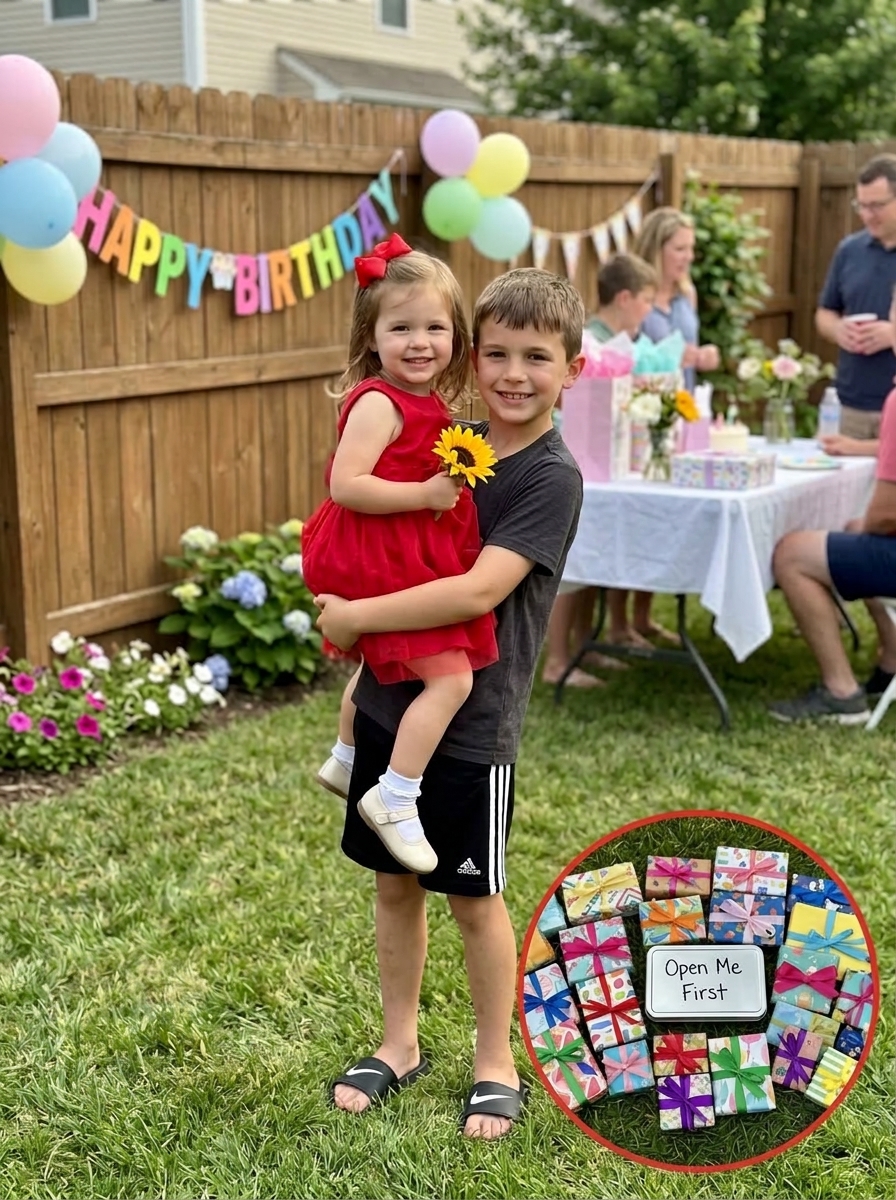
Lucy’s red dress from the day before was still visible in the photographs on Hannah’s phone—her bright skirt against Noah’s dark shirt, the birthday banner behind them, presents on the table, Lucy holding a sunflower and grinning as if the entire backyard belonged to her.
Samuel looked at the photo.
Then at the two children in front of him.
“That,” he whispered, “is what Emily understood.”
“What?” Noah asked.
Samuel smiled.
“Being wanted.”