Maya’s physical recovery happened faster than her emotional recovery.
The incisions healed.
Her blood count improved.
Her appetite gradually returned.
The scar faded from angry red to pale pink.
But for months, she apologized whenever she needed something.
Pain medicine.
A ride.
A different meal because a smell made her nauseous.
A day off school because she was exhausted.
Every time, I answered:
“You do not need to apologize for having a body.”
She began counseling with someone experienced in adolescent medical trauma.
We learned that Maya had begun distrusting her own symptoms.
She wasn’t only afraid of getting sick again.
She was afraid of being wrong about feeling sick.
That frightened me.
So we practiced.
She rated pain honestly.
She asked questions during medical appointments.
She kept a notebook of symptoms without first deciding whether they were “important enough.”
She learned that reporting pain did not mean predicting disaster.
It simply meant giving information.
Several months after surgery, Maya stood in the driveway holding her soccer ball.
She had been cleared for light activity.
But she had not touched that ball since becoming ill.
She put it on the pavement.
Then looked at me.
“What if it hurts?”
“Then you stop.”
“What if it doesn’t?”
“Then you keep going.”
She kicked it gently against the garage door.
The ball returned.
She trapped it under one foot.
Then kicked it again.
Ten minutes that day.
Fifteen the next.
A week later, while I made dinner, I heard the old familiar rhythm outside.
Ball.
Garage door.
Ball.
Garage door.
I stood in the kitchen and cried.
But I didn’t interrupt her.
Some things deserve to be reclaimed privately.
Her sunset photographs returned too.
First from her bedroom window.
Then the mailbox.
Then the small hill near school.
They were still blurry.
I loved every one.
Almost a year after surgery, Maya attended her final major follow-up.
Her remaining ovary looked healthy.
Hormone levels were normal.
There was no sign of recurrence.
The doctor reminded her:
“If you ever have persistent pain again, tell someone immediately.”
Maya nodded.
“I will.”
There was certainty in her voice.
Afterward, we stopped at a diner.
She ordered pancakes, eggs, and hot chocolate.
Halfway through breakfast, she put down her fork.
“Mom?”
“Yeah?”
“Do you ever regret taking me to the hospital without telling Dad?”
“No.”
“Even though you got divorced?”
“The divorce didn’t happen because I took you to a doctor.”
She waited.
“It happened because your father believed controlling the decision mattered more than listening to you.”
I stirred my coffee.
“The scan didn’t destroy our family. It revealed what was already wrong.”
Maya became quiet.
“Do you hate him?”
“No.”
“Why?”
“Hating him would keep him at the center of every decision.”
I looked at her.
“He doesn’t belong there anymore.”
“I’m still angry.”
“You’re allowed.”
“Sometimes I miss how things used to be.”
“You’re allowed to do that too.”
“Even if things weren’t good?”
“Yes.”
“People can miss something familiar without wanting it back.”
Robert’s relationship with Maya continued carefully.
Eventually, she agreed to spend an afternoon at his apartment.
Before going, she gave him three rules.
“If I say I feel sick, you believe me.”
He nodded.
“If I ask to come home, you bring me back.”
Another nod.
“And you never discuss what my medical treatment costs in front of me.”
“I understand.”
She returned four hours later.
“How was it?”
“Awkward.”
“Bad awkward?”
“Just awkward.”
That was enough.
Not every relationship needs a beautiful reconciliation.
Sometimes progress is simply an afternoon that ends safely.
A year after the scan, Maya joined her school’s junior soccer program again.
She didn’t play every game.
Some days, she tired faster than the other girls.
But she wore her uniform.
Tied her shoes.
Walked onto the field with her shoulders straight.
At her first match, I sat on the lowest bleacher.
Robert arrived shortly before kickoff.
He sat several rows behind me.
We did not pretend we were still the family we had once been.
Then Maya scored from the edge of the penalty area.
Both of us stood.
She turned toward the stands.
Looked at Robert.
Then me.
Robert simply clapped.
No instructions.
No criticism.
I threw both hands into the air.
Maya smiled.
That was enough.
Later that evening, she stood beside the mailbox photographing another sunset.
Orange light covered the rooftops.
Pink edged the clouds.
“Is it blurry?” I asked.
“Probably.”
“Perfect.”
She rolled her eyes.
Then looked back at her phone.
“Mom?”
“Yeah?”
“What would have happened if you listened to Dad?”
I did not answer immediately.
The doctors had never told us exactly how long she could safely have waited.
I refused to place that fear inside her.
“We don’t live in that version of the story.”
“But you think about it.”
“Yes.”
“So do I.”
I stepped beside her.
“Then when you do, remember what actually happened.”
“You told me you were hurting.”
“I listened.”
“We went to the hospital.”
“And the doctors helped you.”
Maya looked toward the sunset.
“You believed me.”
Those words hurt.
Because for several weeks, I had allowed Robert’s confidence to make me hesitate too.
I carried that regret.
“I should have acted sooner.”
She lowered the phone.
“I’m sorry.”
“You did act.”
“Eventually.”
“You came when I asked you to make it stop.”
My throat tightened.
“I’ll never wait that long again.”
“I know.”
Then Maya raised the phone and took another photograph.
My husband had believed the greatest danger was an expensive hospital bill.
He was wrong.
The greatest danger was teaching our daughter that pain needed proof before it deserved compassion.
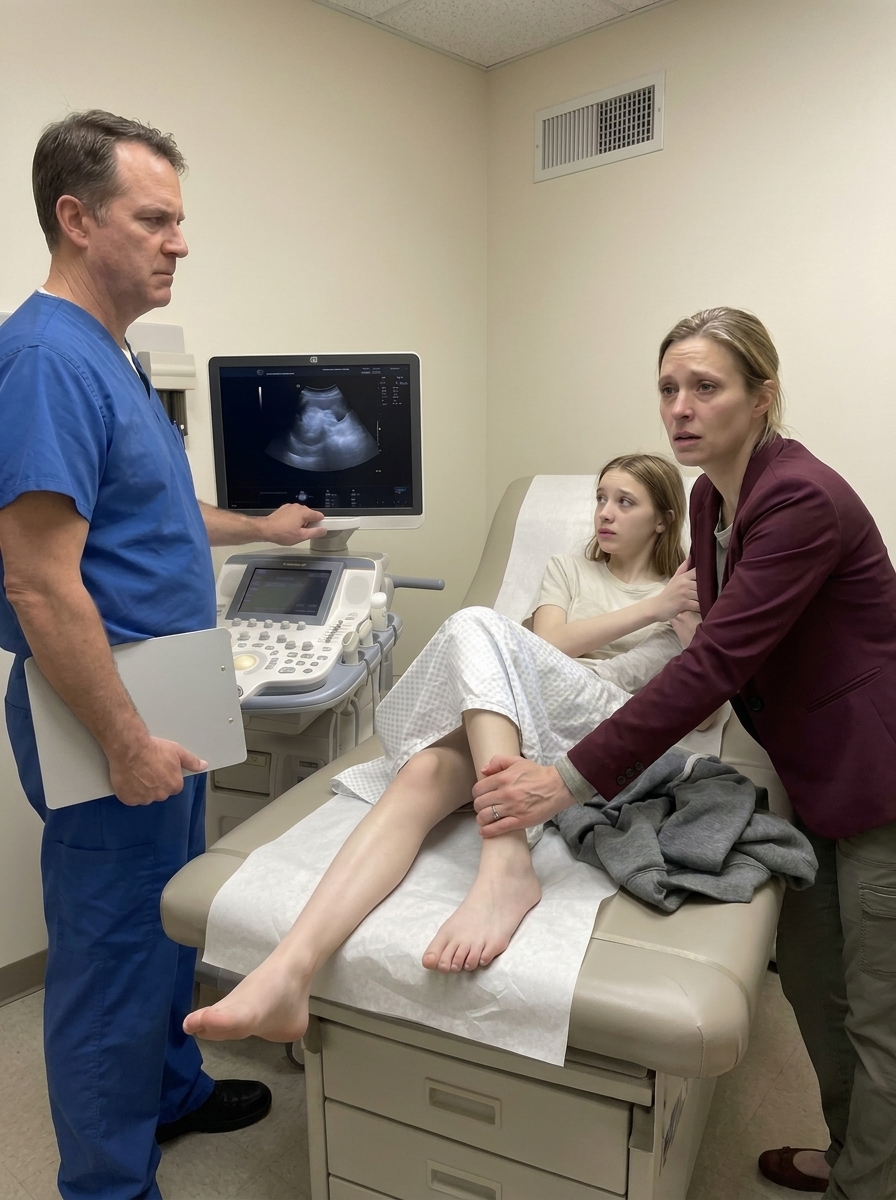
The scan revealed an eighteen-centimeter mass.
It revealed the twisted ovary doctors could not save.
But it also revealed every hidden fracture inside our home.
Robert’s fear.
My hesitation.
Maya’s silence.
And the terrible cost of refusing to believe a child because believing her might become inconvenient.
The mass was removed.
The marriage ended.
The bills were paid slowly.
And Maya learned to trust her own voice again.
That was the part doctors could not repair for us.
We had to rebuild it together.
One honest answer at a time.
“Does it hurt?”
“Yes.”
“I believe you.”
The End.
Latest Posts
- My Mother-in-Law Made My Baby Shower About Herself—Then My Husband Stood Up #2
I wanted a small baby shower, but my mother-in-law ignored nearly every request and turned the day into a celebration of becoming a grandmother. I kept swallowing my frustration for one deeply personal reason, until she crossed a line neither my husband nor I could ignore. I was seven months pregnant with our first child, …
- My Son Grew His Hair for His Best Friend’s Wig—Then Her Father Called Me to School
A 14-Year-Old Boy Grew Out His Hair to Make a Wig for a Classmate Who Lost Hers to Cancer – The Next Day, His Mother Was Called to the School, Where the Girl's Father Said, 'You Have No Idea What Your Son Did, Do You?' The gum stuck in my son’s hair nearly ended the …
- 80-Year-Old Woman Spent Seven Days Visiting an Old Friend…
80-Year-Old Woman Spent Seven Days Visiting an Old Friend – She Returned Looking Half Her Size with a Suitcase That Wasn't Hers I almost walked past my mother at the train station. She was standing beside a bench, gripping the handle of an enormous black suitcase. Her gray hair was flattened against her forehead, and …
- The Winning Ticket and the Life My Husband Hid
My Husband Was Lying in a Hospital Bed When I Won 100 Million Dollars, and Then I Heard Him Laughing to His Mistress That I Would Hand Him Every Penny If I Thought He Was Dying. I Hid the Ticket, Called a Lawyer, and Walked Away, Never Imagining That His Fake Illness Was Only the …
- My husband divorced me to marry my own mother. #2
My Husband Divorced Me to Marry My Own Mother My husband divorced me to marry my own mother. Everyone told me to move on, but instead… I showed up at their wedding. And when she said, “I do,” they had no idea what I had already done. When Mark left me, he didn’t even try …