Alistair Vance swallowed, his Adam’s apple bobbing against his starched linen collar.
He looked at the porcelain bowl, then at the dark barrel of the Winchester resting three inches from his forehead.
“In 1878,” Vance began, his voice shaking so hard his teeth clicked, “your grandfather, Silas Rook, was not a simple rancher. He was a master surveyor for the United States Geological Survey and the Department of War. He was commissioned to map the continental aquifers beneath the Wind River Range.”
Gideon’s eyes narrowed.
“The water surveys. My father had the notebooks in the iron chest.”
“Not water, Gideon,” Vance whispered, shaking his head slowly. “Oil. Not the heavy sludge they drill in Pennsylvania. Something else. A pressurized subterranean reservoir of pure, high-grade crude, trapped beneath a cap of Precambrian crystalline quartz under the entire northern basin. A reserve large enough to fuel the navy of an empire for two centuries.”
Rosalie stared at him.
“Oil? Beneath this valley?”
“Your grandfather realized what would happen if the rail trusts and the eastern syndicates discovered it,” Vance continued, clutching his beaver-skin coat around his shivering chest.
“They would turn this entire territory into an industrial wasteland. They would blast the mountains, poison the streams, and burn every ranch from here to the border. So Silas buried the survey markers. He filed false reports claiming the basin was dry granite. And then he secured the master land patent—thirty thousand acres covering the entire pressure dome.”
“And my father?” Gideon demanded, his voice trembling with a dark, dangerous rage.
“Your father, Arthur, found the markers,” Vance confessed, his eyes darting toward the floor. “He was preparing to register the sovereign claim under the 1890 Mining Act. The Trust couldn’t allow that. We owned the rail rights. If the Rook family held the fee-simple title to the sovereign oil dome, we would have had to pay millions in royalties. So my father… Dr. Vance… was sent here.”
“He killed my father,” Gideon said, pressing the barrel of the rifle firmly against Vance’s forehead.
“It was supposed to look like a logging accident!” Vance stammered, tears of sheer panic welling behind his spectacles.
“A rolling timber! But your father had already trained you, Gideon. You were eight years old, but you knew where the boundary monuments were hidden. You knew the acoustic soundings—the echoes Silas used to locate the cavern vaults beneath the granite! You could tell where the pressure caps were by the ring of the stone under an iron hammer!”
Rosalie felt the pieces of the puzzle click into place in her mind.
“The acoustic dampener. You didn’t just deafen him to make him helpless.”
“We deafened him so he could never hear the resonance of the rock,” Vance wept.
“The cavern system beneath this valley acts like an acoustic chamber. At certain frequencies, during hard freezes, the pressure beneath the quartz hums through the bedrock. Anyone with Silas Rook’s training could locate the release valves simply by listening to the mountain!
“The regulator inside his ear didn’t just block external sound—it generated a micro-frequency that canceled the resonance of the stone and sent agonizing pain through his temporal lobe whenever the earth began to vibrate!”
Gideon lowered the rifle slightly, his gaze drifting toward the stone hearth.
Happens often, he had written in the notebook.
Discomfort near intense heat.
Rusty stains on his pillow.
The machine had been fighting his body for thirty years, pulsing with mechanical venom every time the subterranean caverns groaned beneath the winter ice, injuring his ear canal to keep him deaf to his own birthright.
“And my father?” Rosalie asked, gesturing with the revolver toward Thomas Ashford, who was slowly pushing himself up from the floor, his mouth still bleeding. “How did he become your tool?”
Vance let out a bitter, shuddering laugh.
“Thomas Ashford is a drunkard and a gambler who owed five thousand dollars to the bank in Cheyenne. The Trust bought his notes. We told him we would burn his house down and hang his son for cattle rustling unless he gave us legal entry into the Rook estate.
“He knew about the fifty-dollar conservatorship loophole. He knew that if he sold you to Gideon, he could claim the ranch under the abandonment statutes.”
“You were going to kill him too,” Rosalie said, watching Vance’s eyes flick away. “Once the deed was signed.”
Vance didn’t answer.
He didn’t have to.
From the floor, Thomas Ashford groaned, wiping his injured mouth with a trembling, dirty sleeve.
His red eyes looked between Vance and Rosalie, the realization of his own disposable nature finally piercing through his drunken fog.
“Vance…” Thomas slurred, his voice distorted by his broken jaw. “You… you said… two thousand… clear my debts…”
“Shut up, Thomas,” Vance hissed with venomous disdain. “You are an illiterate wretch who sold your own daughter for fifty dollars. You think the Continental Trust cares about your tavern debts? You were going to be found frozen in the drift beside your son before the sun rose tomorrow.”
Thomas stared at him, his face crumpling in sudden, pathetic horror.
He looked up at Rosalie, his eyes pleading, begging for mercy from the daughter he had treated like livestock.
Rosalie looked down at him without a shred of pity.
“You sold me into an exile you thought would kill me,” she said, her voice dropping into a register of icy, absolute finality. “Instead, you brought me to the only honest man in this territory.”
She turned to Gideon.
“What do we do with them?”
Gideon’s expression was unreadable.
For thirty years, he had lived as a phantom in his own home, mocked by children in the street, cheated by merchants, pitied by neighbors, and tormented by an iron insect interfering with his mind.
Now the silence was broken, the conspirators sat in his cabin, and the law in this territory was five days’ ride through a blizzard.
He stepped to the writing desk, picking up the heavy vellum deed Vance had brought. He looked at the clauses, the legal jargon, the signatures already witnessed by corrupt judges in Cheyenne.
Then he walked to the stone hearth.
Without a word, Gideon tossed the entire packet of documents into the blazing cedar logs.
The parchment curled, blackened, and burst into roaring orange flame, the red wax seal melting into the ashes.
“No!” Vance cried out, half-rising from his chair before finding the cold muzzle of Rosalie’s revolver leveled between his eyes.
“That is the only legal copy of the conservatorship transfer! Without it, the Trust will send sixty armed men from the Pinkerton agency to take this valley by force!”
“Let them come,” Gideon said quietly.
He walked to the corner of the room, near the large pine wardrobe where he kept his winter coats. He reached behind the false back of the cabinet, his calloused fingers finding a concealed iron latch.
With a dull, mechanical clack, the false wall swung open.
Inside the hidden recess sat a heavy, brass-bound oak chest stamped with the insignia of the United States Corps of Engineers.
Gideon lifted the heavy iron lid.
Inside were not ledgers or banknotes.
Resting in fitted velvet compartments were four brass instruments: an 1878 geodetic surveyor’s transit and three precision acoustic tuning forks stamped with military serial numbers. Beside them lay a thick, blue-vellum master patent bearing the handwritten signature of President Grover Cleveland and the Great Seal of the United States.
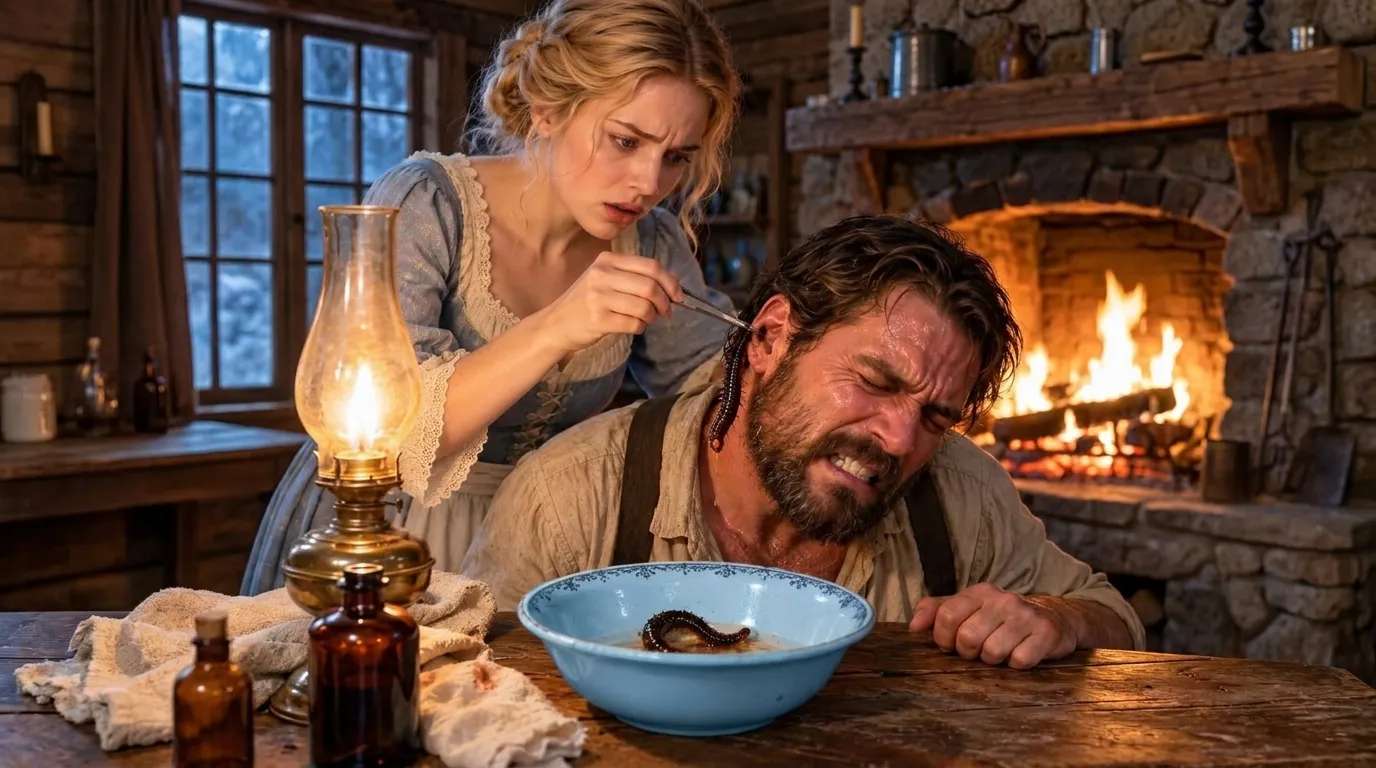
Gideon withdrew the vellum patent, laying it flat atop the pine table beside the dead mechanical parasite.
“Under the Federal Defense Reserves Act of 1884,” Gideon recited, his voice ringing with absolute, unyielding authority, “any subterranean sovereign resource discovered by a commissioned officer of the United States Army Corps of Engineers and certified under national security seal remains under the permanent, inalienable military jurisdiction of the United States War Department.”
He looked directly at Alistair Vance.
“My father, Arthur Rook, was a brevet major in the United States Army. And I am not a half-mad rancher, Vance.”
Gideon reached into the oak chest and withdrew a small, velvet-lined leather case.
He popped the brass clasp, revealing the Congressional Medal of Honor and the silver oak leaves of a lieutenant colonel in the United States Army Reserve.
“I was retired under covert medical disability after the Spanish campaign in Cuba,” Gideon said, every word dropping like an anvil. “My commission was never vacated. The territorial courts in Cheyenne have zero legal jurisdiction over an active military reservation.”
Alistair Vance’s mouth fell open, his eyes widening behind his glasses as if his mind refused to process the revelation.
“A… a military reservation…? But the county records—the taxes—”
“The county records were a civilian cover identity established by the War Department to protect the reserve from speculators like your father,” Gideon answered coldly.
“Every tax assessment, every deed record was monitored by the regional garrison at Fort D. A. Russell. The only thing preventing me from reporting your syndicate’s infiltration thirty years ago was that machine inside my skull.”
He tapped the scarf beside his injured ear.
“It scrambled my speech center whenever I attempted to communicate the classified coordinates. It kept me locked in silence while your agents circled like vultures. But my wife took the dampener out tonight.”
Gideon turned toward the window, looking out into the howling storm.
“And thirty miles south, at the telegraph station in Bitter Creek, there is an encrypted military wire connected directly to the Department of War in Washington.”
Thomas Ashford let out a broken, pathetic sob from the floor.
“Gideon… please… I’m your wife’s father… you can’t hang your own kin…”
“You are not my kin, Thomas,” Gideon replied, not even looking at him. “You are an unregistered foreign agent who conspired with an offshore factoring syndicate to commit high treason against the strategic defense reserves of the United States.”
He looked at Rosalie.
“Tie them.”
Rosalie did not hesitate.
Taking the heavy hemp lariat from behind the door, she bound Alistair Vance to the cedar chair, pulling the knots tight until he groaned in helpless defeat.
Then, stepping over the broken pottery on the floor, she bound her father’s wrists and ankles, securing him to the iron post of the hearth.
Outside, the storm shrieked against the logs, but inside the cabin, the air had cleared.
The suffocating weight of fear, debt, and isolation that had choked both of their lives had burned away in the hearth fire alongside the forged deeds.
Gideon walked to the basin.
With the tips of his fingers, he picked up the dead clockwork parasite and carried it to the fireplace. He tossed the three-inch brass-and-steel monstrosity straight into the white-hot heart of the cedar coals.
The tiny balance wheel flashed green as the copper burned away.
The miniature springs coiled and snapped with tiny, dying sparks, the articulated casing melting down into a harmless bead of slag that settled into the gray ash.
Gideon stood watching it burn, his hands resting easily at his sides, his head upright, his face bathed in the clean, honest warmth of the flame.
Rosalie stepped to his side, resting her hand gently against his arm.
He turned to her.
In the soft light of the hearth, his weathered features looked young again, unburdened by thirty years of simulated madness.
“Can you hear the fire now, Gideon?” she asked softly.
Gideon looked down at her, his amber eyes shining with an emotion deeper and purer than any words they had ever scribbled in their worn notebook.
He reached up, his calloused, scarred fingers gently brushing a stray lock of dark hair from her forehead, his touch infinitely tender.
“I hear the fire, Rosalie,” Gideon whispered, his voice steady, whole, and completely free.
“And for the first time in thirty years… I hear you.”
Three days later, the sun broke over Coldwater Ridge, turning thirty thousand acres of untouched Wyoming powder into an ocean of blinding, diamond-bright snow.
The wind had died down to a gentle mountain breeze that whispered through the yellow pines, carrying the sweet, clean scent of melting frost and sun-warmed cedar bark.
Down the long, winding trail from the northern rim came a column of forty mounted cavalrymen from the 6th United States Cavalry, their blue wool overcoats brilliant against the white drifts, the yellow guidons fluttering proudly in the crisp winter air.
At the head of the column rode Colonel Marcus Vance—the elder, honorable brother of the disgraced Alistair Vance—accompanied by two federal marshals and an armed military ambulance wagon.
Standing on the broad, hand-hewn cedar porch of the Rook homestead, dressed in a clean, dark-navy wool winter dress with her mother’s restored gold locket resting against her collar, was Rosalie.
Beside her, tall, broad-shouldered, and wearing his tailored blue officer’s service coat with the silver oak leaves gleaming proudly in the morning sun, stood Lieutenant Colonel Gideon Rook.
His ear was neatly bandaged with clean white gauze, but his head was held high, listening with quiet, unshakable joy to the distant jingle of cavalry bridles, the barking of his ranch dogs, and the laughter of his bride.
The two prisoners—Thomas Ashford and Alistair Vance—were marched down from the cabin under armed guard, their wrists chained in heavy stainless-steel military irons, their heads bowed in total, irrevocable disgrace.
Behind them, from the snowbank where he had surrendered after three frozen nights in the timber, hobbled Merrick Ashford, his face burned, his spirit broken, ready to face twenty years of hard labor at the federal penitentiary in Leavenworth.
Colonel Marcus Vance reined in his mount at the foot of the porch, looking up at Gideon with deep, generational respect.
He snapped his gloved hand to the brim of his campaign hat in a crisp, sharp military salute.
“Colonel Rook,” the cavalry commander boomed across the silent snow. “The dispatch reached Washington. The Continental Trust’s charters have been revoked by executive order of the President. The conspirators in Cheyenne and Vaduz are in irons. The Rook sovereign reserve is secured in perpetuity.”
Gideon returned the salute with textbook, razor-sharp precision.
“Thank you, Colonel,” Gideon replied, his voice clear, strong, and carrying across the valley like mountain thunder. “The perimeter is held. The reserve is intact.”
The cavalry commander looked at Rosalie, tipping his hat with profound deference.
“And to you, Mrs. Rook. The War Department owes you a debt that sixty million dollars in gold could never repay.”
Rosalie smiled—a real, wide, radiant smile that held no fear, no debts, no lies, and no regrets.
She turned to her husband, slipping her small, warm hand into his scarred, calloused fingers.
Gideon looked down at her, his grip tightening with fierce, unshakable devotion, his amber eyes reflecting the limitless blue American sky that arched over their mountains.
The fifty-dollar debt had been paid.
The silence had been broken.
And the girl who had been sold to a deaf rancher in the winter snow had found, on the high ridges of Wyoming, the only freedom that ever mattered: a home built on bedrock, defended by honor, and crowned with an unyielding, unbreakable love.
Latest Posts
- My Mother-in-Law Made My Baby Shower About Herself—Then My Husband Stood Up #2
I wanted a small baby shower, but my mother-in-law ignored nearly every request and turned the day into a celebration of becoming a grandmother. I kept swallowing my frustration for one deeply personal reason, until she crossed a line neither my husband nor I could ignore. I was seven months pregnant with our first child, …
- My Son Grew His Hair for His Best Friend’s Wig—Then Her Father Called Me to School
A 14-Year-Old Boy Grew Out His Hair to Make a Wig for a Classmate Who Lost Hers to Cancer – The Next Day, His Mother Was Called to the School, Where the Girl's Father Said, 'You Have No Idea What Your Son Did, Do You?' The gum stuck in my son’s hair nearly ended the …
- 80-Year-Old Woman Spent Seven Days Visiting an Old Friend…
80-Year-Old Woman Spent Seven Days Visiting an Old Friend – She Returned Looking Half Her Size with a Suitcase That Wasn't Hers I almost walked past my mother at the train station. She was standing beside a bench, gripping the handle of an enormous black suitcase. Her gray hair was flattened against her forehead, and …
- The Winning Ticket and the Life My Husband Hid
My Husband Was Lying in a Hospital Bed When I Won 100 Million Dollars, and Then I Heard Him Laughing to His Mistress That I Would Hand Him Every Penny If I Thought He Was Dying. I Hid the Ticket, Called a Lawyer, and Walked Away, Never Imagining That His Fake Illness Was Only the …
- My husband divorced me to marry my own mother. #2
My Husband Divorced Me to Marry My Own Mother My husband divorced me to marry my own mother. Everyone told me to move on, but instead… I showed up at their wedding. And when she said, “I do,” they had no idea what I had already done. When Mark left me, he didn’t even try …