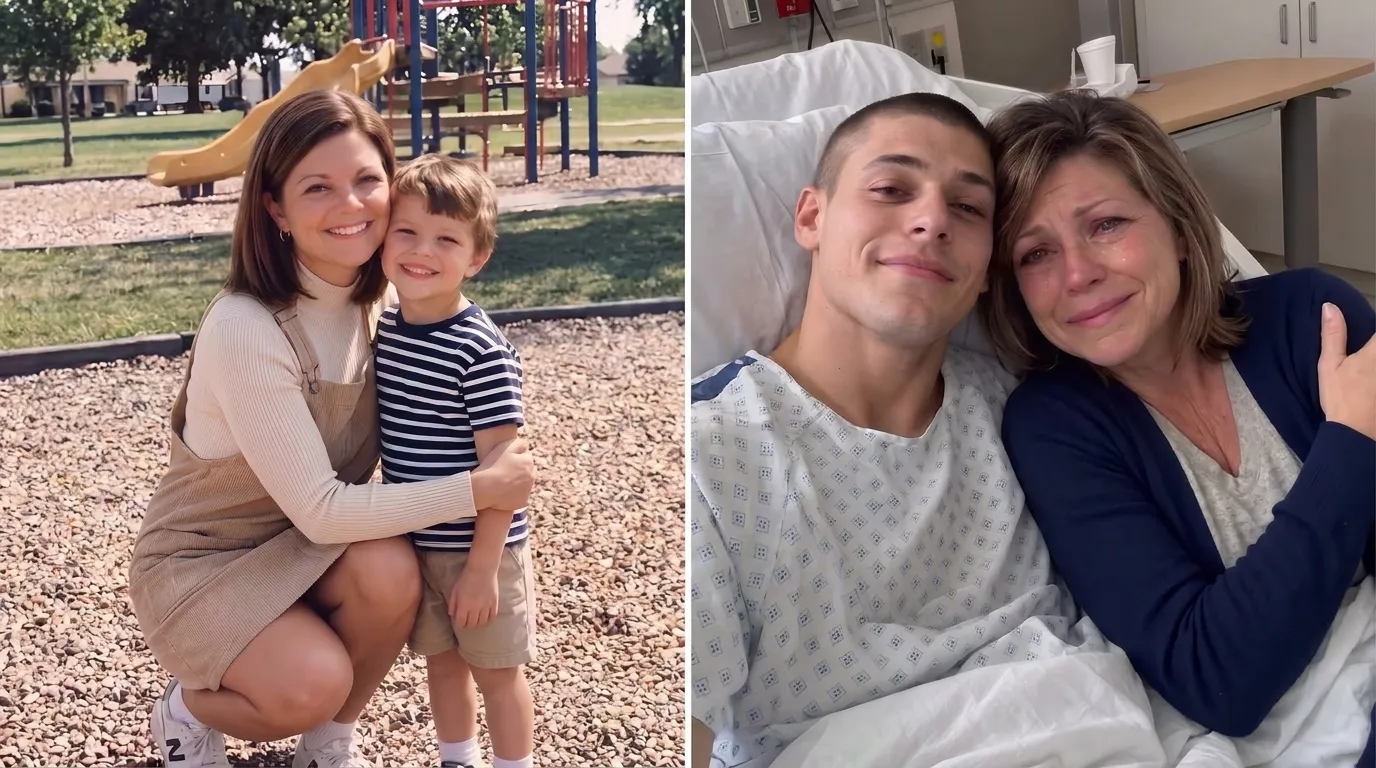
My husband had died years earlier, so I raised our son, Caleb, alone.
He was all I had.
A year before, he had been perfectly healthy. Then, one afternoon, he suddenly became dizzy and collapsed.
After weeks of tests and specialists, a doctor told me he had a rare, progressive neurological disease.
There was no cure.
I refused to accept it.
I sold my car, sold the family gold I had kept for years, and spent nearly everything I had on specialists, treatments, and anything that offered even a little hope.
Nothing worked.
My son kept getting weaker.
I couldn’t understand how I was supposed to lose him too.
I had already buried my husband. Now I was being told I might bury the boy I had raised alone and be left with no one.
I had imagined him growing up, falling in love, getting married, and building a life of his own.
Then, one evening in the hospital, he took my hand.
“Mom, I want to do something useful. If I can, I want to give my heart to someone who needs it.”
I stared at him.
“Please, Mom. If I’m really going to heaven, let this be my last wish. I already spoke to the doctor, and he said it could be done.”
I cried, but eventually I nodded.
Caleb was nineteen when he died.
His heart went to an eighteen-year-old girl.
At his funeral, a woman I had never seen before approached me.
“My daughter received your son’s heart,” she said.
Then she handed me a sealed envelope.
“He asked me to give you this.”
I recognized what looked like Caleb’s handwriting immediately.
After he had been laid to rest, I opened the envelope.
The first line read:
“Mom, there’s something you need to know about her.”
Tears streamed down my face as I stared at the faint blue ink on the hospital paper. My hands shook so badly that the sheet fluttered between my fingers.
I took a deep breath, sank onto a wooden bench outside the chapel, and continued reading.
“Mom, there’s something you need to know about her.
“Her name is Maya. She’s eighteen, and she’s been in the cardiac ICU on the fifth floor for four months. I met her six weeks ago when someone took me down the hallway in my wheelchair.
“I saw her through the glass—she was sitting by the window, drawing pictures of the ocean. Mom, she has the softest smile I’ve ever seen, but her heart was failing fast. By the time I wrote this, the doctors said she had only a few days left unless a matching donor appeared.
“I knew my time was running out, Mom. My body was shutting down, but my heart was still strong. When I asked the doctors if my heart could go to her, they checked the files and gasped—we were a 99% genetic match. It felt like destiny.
“I didn’t tell you because I knew you would break down. I knew you would think she stole me from you. But Mom, she didn’t. She gave me a reason to smile in my final days.
“Through her, a part of me gets to keep living. Please, don’t be angry at her. Go see her. Let my heart tell you how much I love you.”
I pulled the letter to my chest and sobbed in the quiet churchyard.
The girl’s mother, a tired-looking woman named Sarah, sat beside me. She placed a gentle hand on my trembling shoulder.
“Caleb wrote that letter three days before he passed,” she whispered, her eyes glistening. “He made me promise not to give it to you until after he was laid to rest. He wanted you to focus on saying goodbye to him first.”
“Is she… is Maya okay?” I asked through my tears.
“The surgery was a success.” Sarah wiped her cheek. “His heart is beating strong inside her right now. She’s awake, and all she wants is to meet the mother of the boy who saved her life.”
Two days later, I gathered every ounce of courage I had left and walked into the cardiology wing of the city hospital.
When I pushed open the door to Room 512, a young girl with long dark hair turned toward me.
She was pale and thin, but her eyes were bright and full of life.
The moment she saw me, her breath caught. She set her sketchbook aside and sat up in bed.
“Mrs. Vance?” she whispered.
I couldn’t speak.
I walked slowly to her bedside.
Maya’s eyes filled with tears. She reached out, took my right hand, and gently guided it over her chest, above the surgical dressing.
I felt the beat beneath my palm.
Thump. Thump. Thump.
Strong. Steady. Alive.
It brought back the nights when Caleb had slept against my chest as a baby, and I had rested my hand over his little back.
“He’s still here,” I sobbed, sinking into the chair beside her bed. “My boy is still here.”
Maya wiped a tear from her cheek.
“He told me all about you, Mrs. Vance. He told me how you sold everything to fight for him. He told me you were the bravest woman in the world.”
For the next three months, Maya became a light in my dark, empty world.
I visited her every week as she recovered. I brought home-cooked meals, helped her with the exercises her rehabilitation team had given her, and listened to her talk about her dream of going to art school.
In a strange, beautiful way, caring for Maya helped me live with the hole Caleb’s death had left.
She was sweet, lively, and deeply grateful.
But as the months went on, an uneasy feeling began to settle in the back of my mind.
Something wasn’t adding up.
It started with small details.
One afternoon, while sitting in Maya’s room, I noticed an old, leather-bound sketchbook in her backpack.
On the inside cover, written in faded black ink, was a name:
Caleb Vance.
I froze.
“Maya, why do you have Caleb’s high school sketchbook?”
A nervous look crossed her face before she smiled.
“Oh! Caleb gave it to me when we met in the hospital hallway. He said he wanted me to have his old drawings.”
I accepted her explanation, but the question stayed with me.
Caleb had been fiercely protective of his artwork. He had never let anyone touch his high school sketchbooks.
A week later, I was cleaning out his room at home, preparing to donate some of his clothes, when I found his private journal beneath his mattress.
I sat on his bed and turned the pages.
He had written in it during his final months in the hospital. At some point, it had come home with his belongings, and he had tucked it away.
I began with the entries from two months before he died, looking for any mention of Maya.
Page after page, there was nothing.
He wrote about his pain. He wrote about his love for me. He wrote about his fear of dying.
But there was no mention of a girl named Maya.
Not a word about meeting an eighteen-year-old artist in the hallway.
The absence alone proved nothing. Caleb had been entitled to private thoughts he never put on paper.
Then I reached an entry dated exactly two weeks before his death.
“October 12: The doctor told me today that my heart is still healthy, even though my nervous system is failing. I told Mom I want to be an organ donor.
“I don’t know who will get my heart. The transplant coordinator said the matching list is managed through the regional network, and they haven’t identified a recipient to me.
“I hope whoever gets it lives a long, happy life.”
I lowered the journal into my lap.
I read the entry again.
Then a third time.
According to the letter, Caleb had met Maya six weeks before he died.
Yet two weeks before his death, he had written that he didn’t know who would receive his heart.
The letter claimed he had asked for it to go specifically to her.
His journal said something entirely different.
I pulled the letter from my purse and examined it beneath his desk lamp.
The handwriting looked almost identical to Caleb’s.
But as I compared it with the journal, small differences emerged.
The slant of the t’s.
The loops of the y’s.
The spacing between certain words.
I had recognized it through tears, at my son’s funeral, when I would have given anything to hear from him one more time.
Now I wasn’t sure it was his handwriting at all.
Who had written that letter?
Why had Maya’s mother handed it to me?
And how had Caleb’s private sketchbook ended up in her daughter’s backpack?
The next morning, I went straight to the hospital’s administrative offices.
I requested a private meeting with Dr. Harrison, the physician who had overseen Caleb’s neurological care and worked with the transplant team.
He sat across from me in his office as I laid the letter and Caleb’s journal on his desk.
“Dr. Harrison,” I said, my voice trembling, “I don’t believe my son wrote this letter. His journal says he didn’t know who would receive his heart. This says he knew Maya and asked for her to receive it.”
I pushed the papers closer.
“Who is she? And how did her mother get my son’s information?”
Dr. Harrison studied the letter.
Then he let out a long breath and closed his eyes.
“Mrs. Vance,” he said quietly, “I was hoping you would never have to find out this way. But you deserve the truth.”
“What truth?”
He leaned forward, resting his hands on the desk.
“Sarah didn’t forge that letter,” he said. “She didn’t know it was a fake.”
“Then who wrote it?”
He looked at me.
“The person who forged that letter was your husband, Richard.”
For a moment, I couldn’t hear anything beyond the blood pounding in my ears.
“Richard?” I whispered. “My husband?”
Dr. Harrison said nothing.
“Richard died seven years ago.”
“No, Mrs. Vance.” His voice remained low. “He faked his death.”
I stared at him.
The room felt suddenly unfamiliar—the desk, the framed certificates, the window behind his shoulder.
Nothing made sense.
Dr. Harrison took an archive file from his drawer.
“Seven years ago, Richard was involved in a major corporate embezzlement scheme. Facing federal prosecution and financial ruin, he staged a drowning accident off the coast. Then he began using another identity and fled the country.”
I gripped the arms of the chair.
“But before he left,” the doctor continued, “he had a daughter with another woman.”
My mouth opened, but no words came.
“That daughter was Maya.”
He paused.
“Maya is Caleb’s biological half-sister.”
I pressed my hands against my face.
For seven years, I had grieved a man who had chosen to leave us.
I had raised Caleb alone. I had sold what little I owned to fight for him.
And somewhere in the world, Richard had been alive.
“Nineteen months ago,” Dr. Harrison said, “Richard secretly returned to the United States under his assumed identity because Maya was suffering from end-stage heart failure. She was high on the regional transplant list, but finding a suitable donor had been difficult.”
I lowered my hands.
“Three months before Caleb died, Richard discovered that his son was being treated here. He learned that Caleb’s neurological condition was terminal, but that his heart remained healthy.”
“Did Caleb know?”
“Not according to anything we found.”
I swallowed hard.
Dr. Harrison continued.
“When Caleb voluntarily agreed to organ donation, Richard used a contact with access to the hospital’s transplant records to interfere with the process and push Maya forward as the recipient.”
I looked down at the letter.
The words about destiny.
The supposed match.
The story about the hallway.
All of it had been written to make me believe Caleb had chosen this himself.
“And the letter?” I asked.
“Richard had samples of Caleb’s handwriting. He had followed both of your lives from a distance for years.”
The doctor’s expression tightened.
“He wrote it himself. He gave it to Sarah while presenting himself under the identity he was using, and told her Caleb had entrusted it to a nurse.”
“So she believed it?”
“Yes. She believed she was carrying out your son’s request.”
I thought of Sarah sitting beside me outside the chapel.
Her hand on my shoulder.
Her tears.
“And Maya? She told me Caleb spoke to her. She said he gave her his sketchbook.”
Dr. Harrison looked at the papers between us.
“The sketchbook also reached her through Richard. He had taken it from Caleb’s belongings at the hospital.”
My throat tightened.
“Then why did she say they met?”
“She was given a story about where those things came from. But I can’t explain why she repeated it as a meeting she remembered. That is something only Maya can answer.”
I stared at the edge of his desk.
There were lies I could now trace.
And others I still couldn’t.
“Why would Richard do this to me?” I asked.
Dr. Harrison hesitated.
“He said he knew Caleb’s death would leave you alone. He wanted you to find Maya. He wanted his daughter to have another person who loved her, and he wanted you to have a reason to keep living.”
“She already has a mother,” I said.
“Yes,” he answered quietly. “She does.”
I looked at the letter again.
Richard had put words in our dead son’s mouth.
He had decided what grief should lead me to, just as he had once decided I could survive his disappearance without knowing the truth.
“Where is he?”
My voice rose.
“Where is Richard?”
“Two weeks after the transplant, once he knew Maya had survived and you had met her, he surrendered to federal authorities.”
Dr. Harrison lowered his eyes.
“He is now serving a fifteen-year sentence in a federal prison in Ohio.”
I sank back into the chair.
Richard was alive.
Caleb was gone.
And the letter I had carried in my purse for months had never been my son’s goodbye.
I covered my face and cried until I had nothing left to say.
Two days later, I walked into Maya’s room at the rehabilitation center.
She was sitting by the window, painting a bright, sunlit ocean.
When she saw me, she smiled.
She had no idea what I had learned.
She didn’t know that Richard was alive under another identity. She didn’t know he was in prison.
She didn’t know that the boy whose heart beat inside her chest was her biological brother.
Whatever she understood about the letter and sketchbook, she still spoke of Caleb as the boy who had saved her life.
I sat beside her easel and watched her paint.
I looked at her dark hair, the shape of her hands, and the line of her jaw.
How had I not noticed?
She had Richard’s eyes.
And in the careful way she worked over the canvas, I saw something that reminded me of Caleb.
I thought about Richard in a federal prison cell.
The anger was still there.
His staged death. His abandonment. The years I had spent mourning him while struggling to raise our son.
And now this letter.
I couldn’t call any of it kindness.
But Maya was sitting beside me, alive.
She had not caused Caleb’s illness. She had not chosen Richard’s crimes.
Caleb had wanted his heart to help someone.
That wish had been real, even when the words in the envelope were not.
I couldn’t know whether Maya would have received his heart without Richard’s interference. I couldn’t untangle every decision that had brought us into that room.
What I knew was simpler.
My son had wanted someone else to have a chance.
And this girl had one.
“Mrs. Vance?”
Maya set down her paintbrush.
“Are you okay? You look like you’re somewhere far away.”
I reached for her hand.
It was warm.
Alive.
“I’m right here, Maya,” I said, my eyes filling. “I’m right here.”
I chose not to tell her about Richard’s crimes or the forged letter.
I could not bring myself to place that history beside her easel while she was still learning how to live with her second chance.
It was a choice I would have to carry.
Keeping the truth from her did not erase it, and loving her did not mean forgiving Richard.
But I could sit beside her.
I could listen when she talked about art school.
I could care about the life Caleb’s donation had helped preserve.
Sarah was her mother. I would never take that place away from her.
Still, somewhere in those months of visits, meals, exercises, and quiet conversations, Maya had become a daughter to me too.
As I held her hand beneath the afternoon sun, I thought of Caleb.
Not the words someone else had written for him.
His own words, in his journal.
“I hope whoever gets it lives a long, happy life.”
For the first time since leaving Dr. Harrison’s office, I knew exactly which part of this story belonged to my son.
And I would spend the years ahead honoring it.
The End.
Latest Posts
- My In-Laws Gave Their Other Three Children $20,000 for Houses and Gave Us Only a Card Two Years Later, We Bought the Old Miller Place for $41,500
The envelopes were tucked under the Easter plates. Each had a name written on it in my mother-in-law’s round schoolteacher handwriting. Kim opened hers first. She’s the oldest. Divorced two years. Raising two boys in a rented trailer behind the grain elevator. She looked at what was inside the envelope and put her hand flat …
- My Mother-in-Law Told Me to Lose Weight After Giving Me a Dress That Didn’t Fit, but Minutes Later, She Regretted Everything
I couldn’t get it over my hips. I stood in my bedroom in my underwear with the dress bunched around my thighs like a deflated balloon. Midnight blue silk. A designer label I’d only ever seen in magazines. Tiny pearl buttons down the back. Beautiful. And four sizes too small. I pulled. I tugged. I …
- Teen Wore a Dress to His Best Friend’s Funeral—The Family Nearly Had Him Removed Before He Reached the Microphone
My son’s best friend read the eulogy at his funeral in a red dress. I almost had him removed before he reached the microphone. My son Jack died 17 days after his 18th birthday. Cancer. Fourteen months from diagnosis to funeral. We found out late. Too late, as it turned out, and the treatment never …
- My Mother Refused to Walk Me Down the Aisle—Then the Truth Surfaced
My mother had proudly escorted both of my sisters down the aisle as though they were miracles dressed in lace. On the morning of my own wedding, I stood in the bridal suite wearing my white gown, hoping for a single moment of family peace. Instead, she stared at me and said, “I refuse to …
- I Arrived at My Son’s House on Christmas Eve With Food and Gifts, but What Happened at the Door Broke My Heart
“Dad, who’s at the door?” My son didn’t even turn all the way around. He kept one hand on the doorknob and one foot on the porch, blocking the gap with his body like I was a salesman or a stray dog. “Wrong house,” he called back over his shoulder. Then he looked at me. …