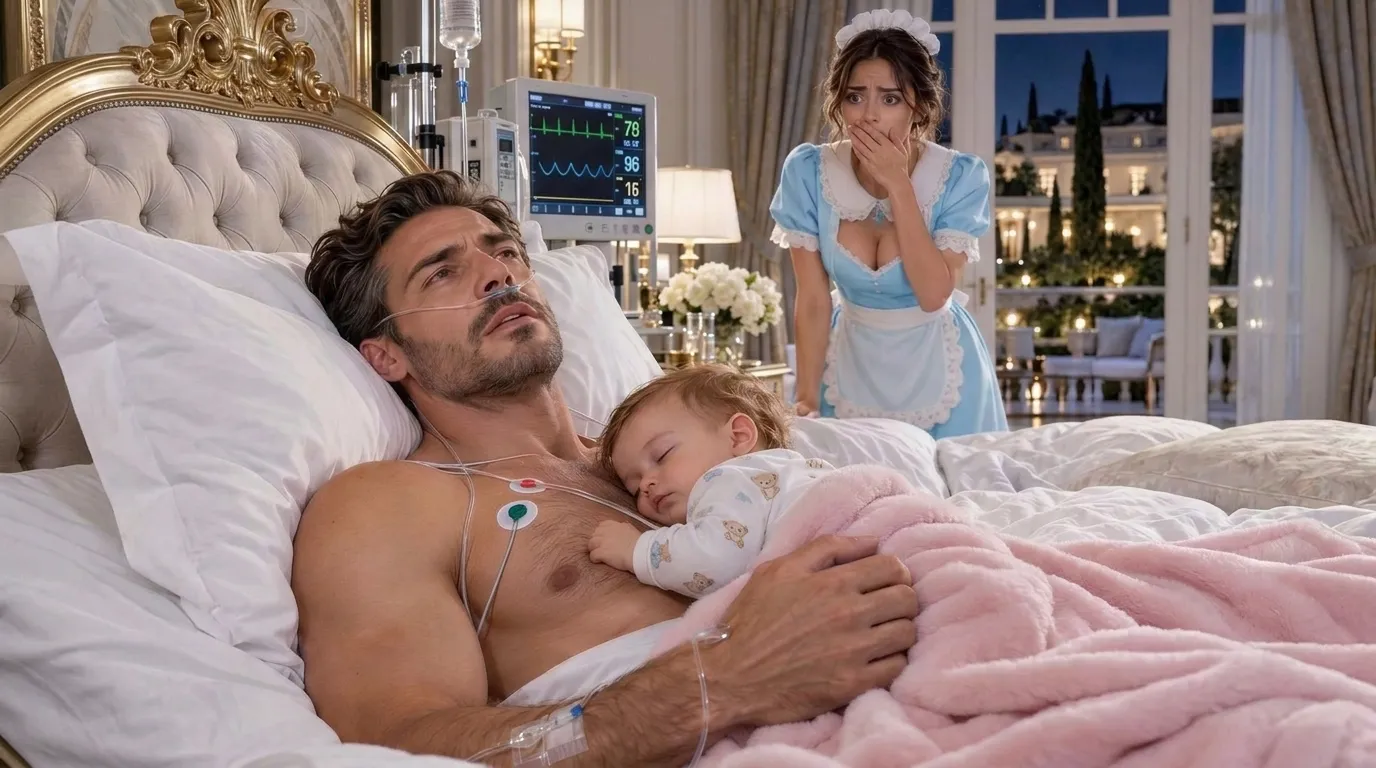
The man everyone was waiting to bury moved his hand and curled his fingers around my baby’s blanket.
I froze beside the bed, convinced my mind was playing tricks on me.
For three hours, I had been pacing the cramped service quarters of the massive Bel Air estate, cradling my nine-month-old son, Theodore. He was teething and had a fever, and nothing could soothe him. I’d walked him, hummed softly, and tried feeding him, but he just kept crying.
Desperate for a quiet space, I had slipped into Raymond Winslow’s master suite.
The doctors said he only had days left.
Raymond was forty-six years old. He had built a successful regional transportation company from scratch and grown it into an immense transportation and logistics empire. But for two months, he had been bedridden.
He couldn’t speak.
Couldn’t sit up.
Couldn’t seem to move a single muscle.
His nephew, Christopher, practically ran the estate while Raymond lay upstairs. He was already discussing funeral arrangements with the casual tone most people used to reserve a dinner table.
Funeral arrangements. Estate documents. What would happen to the company. Which properties might be sold.
I’d assumed that was simply how wealthy families handled impending death.
I was working as Raymond’s live-in caregiver because I desperately needed the paycheck. More importantly, it was one of the few positions that allowed Theodore to live with me.
That night, I sat in the armchair beside Raymond’s bed just to rest my aching arms. Theodore was still whimpering, so, without overthinking it, I gently laid him against the sick man’s chest.
The baby instantly grew quiet and fell fast asleep.
And then it happened.
Raymond’s fingers twitched, slowly sliding across the fabric until his grip tightened around the edge of Theodore’s blue blanket.
“Mr. Winslow?” I whispered, my heart hammering against my ribs.
His eyelids fluttered. One eye opened just a sliver.
He looked directly at me.
He was conscious. Fully, completely aware.
Suddenly, I wasn’t so sure Christopher’s easy talk about his uncle’s death was simply a practical response to an impending loss.
I spent the rest of the night learning how to communicate with Raymond. One blink meant yes. Two blinks meant no. Looking toward the door meant someone was coming.
“Can you hear everything they say around you?” I asked softly.
One slow blink.
A cold shiver ran down my spine.
By morning, he had gained enough strength to move his lips faintly. I leaned in until my ear was inches from his mouth.
“Christopher… isn’t waiting for my inheritance,” Raymond rasped, his voice barely a whisper. “He’s… accelerating it.”
Before I could ask what he meant, heavy footsteps echoed down the hallway.
Christopher walked in without knocking. Tailored suit, expensive watch, a permanent scowl on his face. He didn’t even look at his uncle.
“How’s our patient?” Christopher asked, his voice dripping with annoyance.
“No change,” I replied smoothly, stepping in front of the bed to block his view.
“Good. Dr. Wallace will be here at four.” He eyed my son. “And another thing, Nora: if your kid keeps crying through the night, you and that brat can find somewhere else to live.”
I gritted my teeth.
“It won’t happen again.”
The moment Christopher’s footsteps faded down the hall, Raymond opened his eyes.
“Don’t… tell him… anything,” he whispered.
I nodded solemnly.
By that afternoon, Raymond managed a few more whispered words.
“Don’t tell Christopher.”
“Tell him what?”
“That I’m awake.”
I leaned closer.
“Why?”
Raymond swallowed painfully.
“Because I don’t think I’m dying naturally.”
At four o’clock sharp, Dr. Wallace arrived carrying a worn leather medical bag. He pulled out an otherwise unlabeled white box with a single drug name handwritten on the side. He drew a clear liquid into a syringe and injected it directly into Raymond’s IV line.
I didn’t interfere.
I wasn’t a doctor.
But I watched.
Within minutes, Raymond’s responsiveness diminished dramatically. Ten minutes after the injection, the rhythm of his breathing faltered. The small movements he’d regained disappeared, and his fingers went entirely limp.
“He’s slipping away,” Dr. Wallace remarked with terrifying calm.
“How long?”
“Five days. Maybe six.”
Instead of leaving the ampoules with the rest of Raymond’s prescribed medication, Wallace slipped them back into his personal bag.
After he left, I wrote down everything I remembered.
The time.
The medication packaging.
What I’d observed before and afterward.
Then I waited.
Late that night, while the house slept, I looked up the drug name I had memorized from the box.
I read the medical description once. Then twice.
It described a powerful paralytic agent that could cause profound muscle immobility and suppress breathing. What I read sounded frighteningly like the final stages of the terminal neurodegenerative collapse I had been told I was witnessing.
I looked over at Raymond.
I feared he wasn’t dying naturally.
Someone might be trapping him inside his own body, taking his strength and breath away a little at a time. And the nephew standing to inherit millions walked in every single day to ask how much time was left.
I reached out and took Raymond’s cold hand.
“I’m not going to let them kill you.”
His fingers mustered a faint, trembling squeeze against my wrist.
Hours after the injection, he was beginning to move again.
In that quiet room, I realized I had just stepped into something far more dangerous than losing a job. But I had no idea what was waiting for me next.
The change in Raymond was enough to make me seek help. I wasn’t going to experiment with his medication or attempt to diagnose him myself.
Instead, when he could communicate again, I asked, “Is there anyone outside this house you trust?”
One blink.
“An attorney?”
Another blink.
Raymond eventually whispered a name.
Harrison Vance.
His personal attorney of more than twenty years.
There was an old phone hidden inside Raymond’s desk.
We used it.
Harrison didn’t arrive with police officers and handcuffs.
He did something much more useful.
He arranged for Raymond to be evaluated independently.
Quietly.
Once another physician became involved, the situation changed quickly.
There were questions about Raymond’s treatment.
Questions about what medications had been administered.
Questions about whether his documented condition matched what was actually happening.
Harrison also made sure records were preserved before anyone could conveniently lose them.
Christopher knew none of this.
Whenever he entered the room, Raymond became still again.
One afternoon, Christopher stood beside the bed and said, “Not much longer now, Uncle.”
Raymond stared blankly at the ceiling.
Christopher left.
A few seconds later, Raymond whispered, “I’ve never wanted to punch someone so badly in my life.”
Despite everything, I laughed.
It was the first time I’d heard him joke.
Then Christopher made a mistake.
Someone searched my room while I was away.
Things had been moved.
Among the trash, I found packaging from sterile swabs.
I immediately told Harrison.
I couldn’t prove who had taken anything or why. But, as I later learned, several days afterward Christopher received a private laboratory report.
Whatever was inside terrified him.
He left the estate and returned later with Dr. Wallace.
That night, Raymond finally told me something he’d kept secret for almost thirty years.
“I had a son.”
I stared at him.
Raymond had been seventeen. The child’s mother’s family had separated them, and the baby eventually entered the foster-care system.
Raymond searched for years but never found him.
Then he buried the grief beneath work.
“What’s your son’s name?” I asked.
“I don’t know what name he uses now.”
My stomach tightened.
Because Theodore’s father had grown up in foster care.
Brandon.
Twenty-nine years old.
He had left us when Theodore was three months old because, in his words, he didn’t know how to be anybody’s son and certainly didn’t know how to be a father.
I looked at Raymond.
Then at Theodore.
“No.”
Raymond said nothing.
We had no proof.
Not yet.
But suddenly, the sterile-swab packaging—and the possibility that Christopher had been looking for a biological connection—took on a different meaning.
Harrison arranged proper testing.
The initial results indicated that Raymond and Theodore were biologically related.
That still didn’t establish the entire family history by itself.
But combined with Raymond’s account and what we knew about Brandon, it gave Harrison somewhere to investigate.