The morning after the gala, my mother called at 6:14.
I let it ring.
She called again at 7:02.
Then she sent a message.
I am sorry. I don’t know how to say more than that yet.
I did not answer immediately.
Apologies mattered.
So did time.
Grant sent something different.
Three paragraphs about humiliation, family loyalty, and how my “public display” might damage his business.
I read it once.
Then replied:
Do not use my name, rank, office, or professional relationships in connection with your business again.
That was all.
He called five times.
I did not answer.
Two weeks later, one of my ethics officers asked me to review a document.
Grant’s consulting company had been distributing promotional material claiming “direct relationships with senior defense and naval leadership.”
Several photographs from family events had been positioned in a way that implied official access.
My name was not printed.
It didn’t need to be.
I immediately issued a written statement through the proper channels confirming that I had never endorsed, advised, or represented Grant’s company.
I did not call his clients.
I did not threaten him.
I did not use my rank against him.
I simply told the truth.
Apparently, the truth was enough.
Some clients began asking questions.
One contract disappeared.
Then another.
Grant blamed me.
I reminded him that I had not created his claims.
I had only stopped allowing my silence to support them.
For the first time in his adult life, my brother had to build something without using someone else’s reputation as scaffolding.
The Porsche disappeared within four months.
I never asked whether he sold it voluntarily.
My mother changed more slowly.
At first, every conversation turned into an apology.
Then I finally told her:
“I don’t want you to spend the rest of our relationship apologizing.”
She looked relieved too quickly.
I continued.
“I want you to learn who I am.”
The relief vanished.
“What do you mean?”
“What did I study at Annapolis?”
She opened her mouth.
Nothing came out.
“What was my first command?”
Silence.
“Where was I deployed the first time?”
Her eyes dropped.
“What work did I do before becoming a flag officer?”
She began crying.
“I don’t know.”
“I know.”
That was the problem.
She knew Grant’s clients.
Grant’s favorite restaurants.
Grant’s suit size.
What wine he preferred.
Which model Porsche he wanted.
She could describe every one of his business ambitions.
But she could not explain what her daughter had spent nearly thirty years doing.
So we started there.
Not with forgiveness.
With information.
Once a week, she called without asking for money.
At first the conversations were painful.
She would ask:
“How was work?”
I would say:
“Busy.”
Then silence.
We had spent decades building a relationship almost entirely around what I could solve for her.
Neither of us knew what to do when there was no bill to pay.
Eventually she began asking better questions.
“What made you choose EOD?”
“What were you most afraid of at Annapolis?”
“Did your father know you wanted the Navy before he died?”
That one stopped me.
“Yes.”
“What did he say?”
I had not thought about it in years.
“He told me I was too stubborn to drown.”
My mother laughed through tears.
“That sounds like him.”
For the first time in a very long time, we shared a memory that had nothing to do with Grant.
Several months after the gala, she arrived at my home carrying an old cardboard box.
“I found this in the attic.”
Inside were things I thought had disappeared decades ago.
My science-fair certificate.
The coffee ring was still there.
A newspaper clipping about my Naval Academy appointment.
A photograph from high school.
Three letters I had written from Annapolis.
And beneath everything else, my father’s old address book.
My mother picked up the certificate.
“I thought I threw this away.”
“So did I.”
She touched the brown circle.
“I remember the coffee.”
“So do I.”
Her face crumpled.
“I was so focused on making Grant feel important after your father died.”
I waited.
“He cried,” she whispered. “You didn’t.”
“I was busy.”
“I know that now.”
I looked at her.
“I was sixteen.”
She nodded.
“You handled everything because I let you.”
That was the first apology that reached the right place.
Not:
I’m sorry you felt overlooked.
Not:
I’m sorry things were difficult.
She named what she had done.
“You were a child,” she said. “And I rewarded you for needing nothing.”
My eyes burned.
“I kept doing that your whole life.”
I sat beside her.
“I learned it well.”
She took my hand.
“I taught you that being useful was the price of belonging.”
For a few seconds, I could not speak.
Then I said:
“The Navy taught me something different.”
“What?”
“That asking for support isn’t weakness.”
I smiled sadly.
“I’m still learning to believe it.”
She squeezed my hand.
“So am I.”
Grant took almost a year.
He had never been good at arriving without an audience.
One Saturday afternoon, he appeared at my door.
No Italian suit.
No sports car.
No speech prepared.
At least not one I could see.
“Can I come in?”
I hesitated.
Then stepped aside.
He sat at my kitchen table.
For several minutes he stared at his hands.
Finally:
“Mitchell really reports to you?”
I almost laughed.
“Parts of his organization reported through mine at the time, yes.”
Grant shook his head.
“I told that story so many times.”
“I know.”
“I never actually said he called me.”
I raised an eyebrow.
Grant sighed.
“Fine. I made people believe he did.”
“Why?”
He stared toward the window.
“Because everybody listened when I said I knew important people.”
I waited.
“And nobody listened when I was just me.”
There it was.
For the first time, I understood something about my brother.
Our mother had made him visible.
But visibility had become its own prison.
He needed applause almost as badly as I had needed usefulness.
That did not excuse him.
But it explained something.
“I was awful to you,” he said.
“Yes.”
“You could make this easier.”
“No.”
He laughed softly.
“I deserved that.”
Then he looked at me.
“I think I hated that you never seemed to need anyone.”
“I needed plenty of people.”
“You never needed us.”
I thought about that.
“I wanted you.”
His face changed.
“That’s different.”
“It shouldn’t have been.”
Grant cried then.
Quietly.
It was the first time I had seen him cry since our father died.
I did not tell him everything was fine.
It wasn’t.
I did not offer money.
I never did again.
But when he left, he hugged me.
Awkwardly.
Like we had forgotten how siblings did that.
Maybe we had.
A year after the gala, I attended another formal Navy event in Washington.
My mother came.
This time, she did not walk ahead of me.
She wore the same teal gown.
I wore dark navy again.
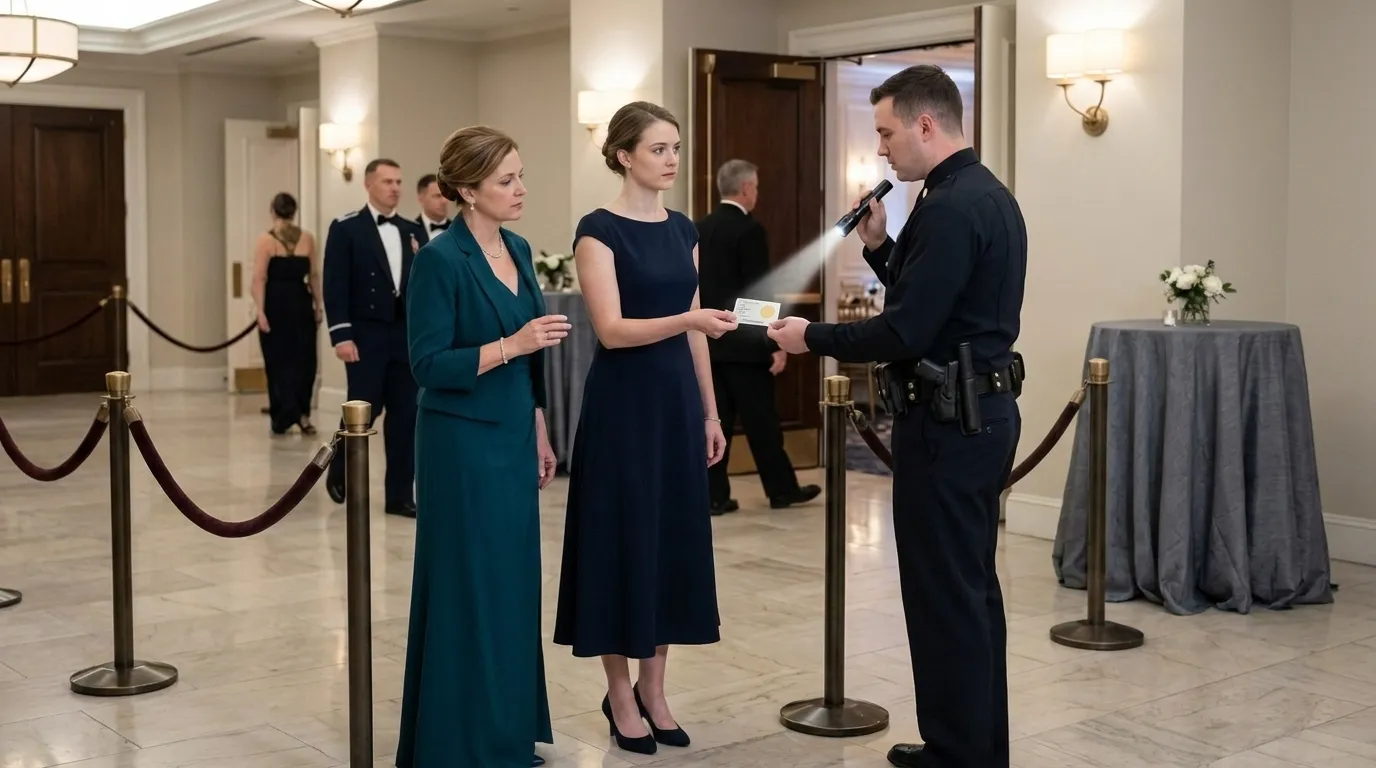
At security, a young officer looked between us.
“Ma’am, are you together?”
My mother glanced at me.
For just a second, I saw the old reflex.
Then it disappeared.
She smiled.
“Yes.”
The officer looked toward her.
“And you are?”
My mother straightened.
“I’m her mother.”
Then she looked at me.
“My daughter is Vice Admiral Emily.”
There was pride in her voice.
But strangely, I did not need it as much as I once would have.
That was how I knew something in me had healed.
The officer checked our credentials.
No dramatic pause this time.
No shocked faces.
No flashlight revealing a secret.
We were simply admitted.
Inside, my mother stopped before entering the ballroom.
“Emily?”
“Yes?”
“I am proud of you.”
I looked at her.
Thirty years earlier, I would have given almost anything to hear those words.
At fifty-one, I could finally receive them without needing them to determine whether I mattered.
“Thank you.”
She smiled.
Then I offered my arm.
Not because she had earned complete forgiveness.
Healing is rarely that clean.
Not because the past had disappeared.
It hadn’t.
I offered it because boundaries had finally given us the possibility of choosing one another instead of simply performing the roles our family had assigned.
As we walked inside, I remembered the first gala.
The marble lobby.
My mother in teal.
Bethany’s phone.
Grant’s smirk.
The guard’s flashlight crossing my credential.
The small gold seal catching the light.
For years, I thought recognition was what I wanted.
For my mother to recognize me.
For Grant to recognize me.
For someone at home to look at the woman everyone else respected and finally admit she had been there all along.
But the gold seal had not changed who I was.
Neither had the stars.
Neither had the room standing when I entered.
They had only made it impossible, for one brief moment, for my family to continue pretending not to see.
The real change came afterward.
When I stopped paying for belonging.
When I stopped translating silence into love.
When I stopped shrinking so other people could remain comfortable.
My family had spent decades introducing me as the quiet one.
Grant’s sister.
The woman who did paperwork.
The person who could fix a problem or pay a bill.
They were wrong.
But I had been wrong too.
Because somewhere along the way, I had begun believing that if the people closest to me refused to see my worth, perhaps it wasn’t real.
I know better now.
The guard did not give me my rank that night.
The gold seal did not give me authority.
The gala did not give me a life worth respecting.
I had already built all of that.
One deployment.
One decision.
One impossible night.
One quiet act of service at a time.
The flashlight simply illuminated what had been there all along.
And for the first time in my life, when my family finally looked at me—
I did not need their permission to believe what they saw.
THE END.
Latest Posts
- My Husband Mocked My Postpartum Appearance in His Brothers’ Group Chat—I Stayed Quiet for Five Days
Four months after giving birth, I thought my husband understood why I hardly recognized myself. Then I discovered the cruel joke he'd been sharing with his brothers, along with photos I never knew he'd taken. I kept my discovery secret for five days, determined to make him regret every word. “Dude, you weren't exaggerating 😂” …
- My Stepdaughter Called Me the Help Until My Envelope Changed Everything
The insult came before I’d even finished setting down the peach cobbler. I’d baked it at five that morning in the kitchen of the lake cabin we’d rented, and it was still warm under the foil. The smell of cinnamon followed me across the grass toward the pavilion tables, where thirty-two members of the Cole …
- My In-Laws Gave Their Other Three Children $20,000 for Houses and Gave Us Only a Card Two Years Later, We Bought the Old Miller Place for $41,500
The envelopes were tucked under the Easter plates. Each had a name written on it in my mother-in-law’s round schoolteacher handwriting. Kim opened hers first. She’s the oldest. Divorced two years. Raising two boys in a rented trailer behind the grain elevator. She looked at what was inside the envelope and put her hand flat …
- My Mother-in-Law Told Me to Lose Weight After Giving Me a Dress That Didn’t Fit, but Minutes Later, She Regretted Everything
I couldn’t get it over my hips. I stood in my bedroom in my underwear with the dress bunched around my thighs like a deflated balloon. Midnight blue silk. A designer label I’d only ever seen in magazines. Tiny pearl buttons down the back. Beautiful. And four sizes too small. I pulled. I tugged. I …
- Teen Wore a Dress to His Best Friend’s Funeral—The Family Nearly Had Him Removed Before He Reached the Microphone
My son’s best friend read the eulogy at his funeral in a red dress. I almost had him removed before he reached the microphone. My son Jack died 17 days after his 18th birthday. Cancer. Fourteen months from diagnosis to funeral. We found out late. Too late, as it turned out, and the treatment never …