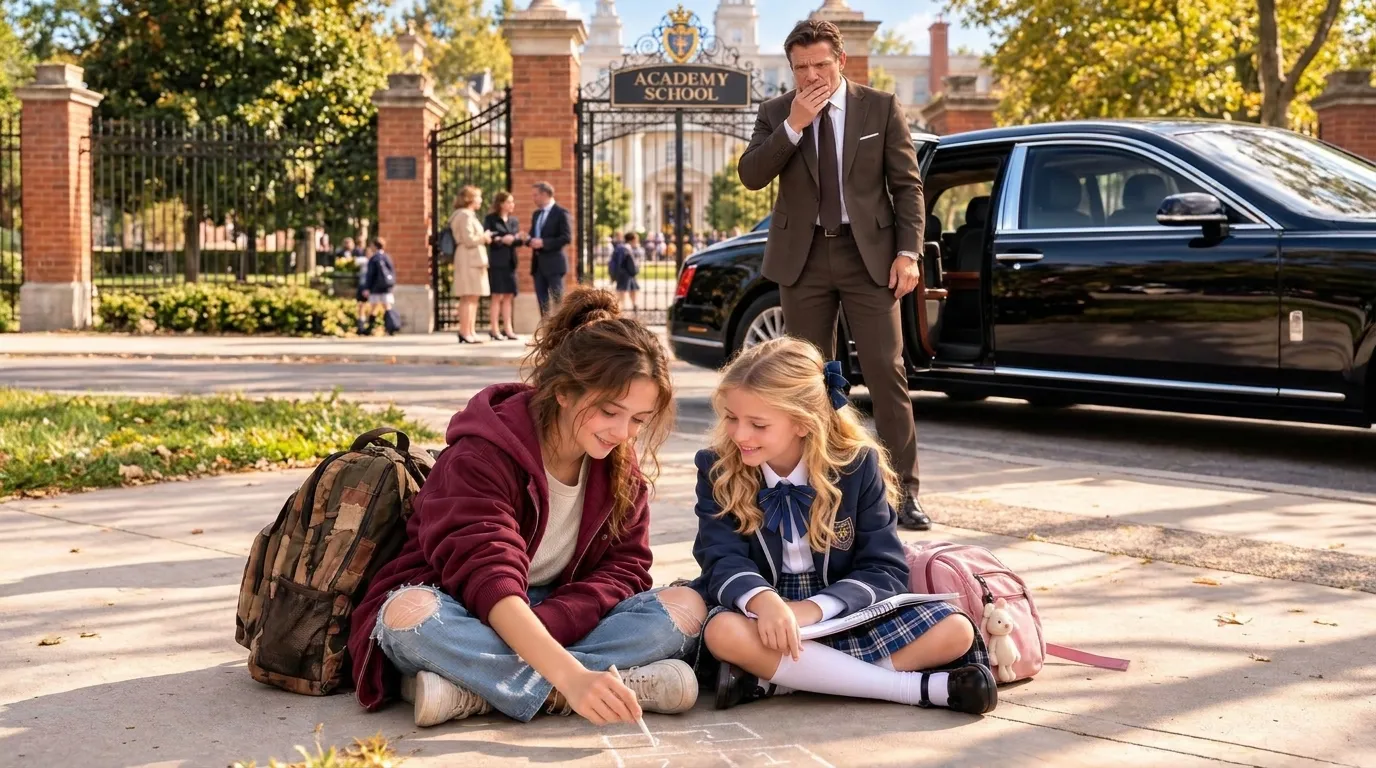
It wasn’t a magical adoption story.
Real life was messier.
There were social workers.
Attorneys.
Placement approvals.
Case records.
School transcripts.
Interviews.
Forms.
Maya was seventeen and still legally connected to foster care.
Emotionally, she trusted almost nobody.
For the first month, she slept with her shoes beside the bed.
For the first three months, she hid food in drawers.
When our housekeeper discovered granola bars beneath folded towels, she quietly placed a basket of snacks in Maya’s room.
Nobody mentioned it.
Eventually, empty wrappers began appearing neatly inside the basket.
Progress.
Small progress.
Sophie changed fastest.
Within days, Maya became part sister, part tutor, part bodyguard, and part personal adviser.
“Maya says my teacher explains decimals wrong.”
“Maya says I’m old enough to choose my own hairstyle.”
“Maya says rich people use too many forks.”
Maya was correct about at least two of those things.
I changed more slowly.
Control was harder to surrender.
One Saturday I handed Maya a printed schedule.
Breakfast.
Study.
School applications.
Lunch.
Shopping.
She stared at it.
“What is this?”
“A plan.”
“For today?”
“Yes.”
She tore it in half.
Sophie gasped.
I stared at Maya.
She stared back.
Then said:
“Mrs. Harrison warned me about this.”
“What?”
“She said you think a calendar is a personality.”
Sophie exploded with laughter.
I wanted to be offended.
Instead, I laughed too.
We went out for pancakes without a reservation.
I considered it major personal growth.
Finding Maya another school became the next challenge.
Her academic records were exceptional until her housing instability disrupted them.
She completed a competitive entrance examination and scored in the top one percent.
The new school offered her admission.
I insisted her tuition come from Claire’s original scholarship fund.
After the independent audit, Whitmore Academy returned the unused portion of the restricted money.
Quietly.
They wanted confidentiality.
I refused.
Not because I wanted revenge.
Because secrecy had helped create the problem.
An independent review discovered that Maya was not the only scholarship student whose designated funds had been redirected after enrollment interruptions.
School policies changed.
Dr. Whitmore resigned before the end of the semester.
I took no satisfaction in that.
Well.
Very little.
Sophie eventually asked to leave Whitmore too.
“I don’t like who I am there.”
That mattered more to me than prestige.
We toured five schools.
She selected the least expensive.
Naturally.
A small independent academy with an art room, community garden, and a principal who wore sneakers.
During our tour, a fourth grader interrupted to ask whether worms could become depressed.
The principal answered seriously.
Sophie whispered:
“I like this place.”
She transferred the following year.
Within two months, she joined theater.
I thought my daughter hated speaking in public.
Apparently, she hated speaking only when adults were measuring her.
At her first performance, she froze on stage.
Then she saw Maya.
Maya crossed her eyes.
Sophie laughed.
So did the audience.
Then she delivered every line perfectly.
Afterward, Sophie ran toward us.
“Maya made me laugh.”
“That’s cheating,” I told her.
“No,” Maya said. “That’s strategy.”
Claire would have loved them together.
That thought no longer destroyed me.
It still hurt.
But grief had changed shape.
For two years, I treated grief like an intruder.
Something to contain.
Control.
Schedule.
Avoid.
Maya and Sophie taught me grief behaves more like weather.
Some days it storms.
Some days it sits quietly on the horizon.
Some days sunlight appears without permission.
You don’t defeat it.
You learn to live beneath the same sky.
One evening, Sophie asked Maya:
“Do you remember the last thing Mom said to you?”
Maya put down her fork.
“She asked what I wanted to become.”
“What did you say?”
“I didn’t know.”
“And?”
“She said that was good.”
Sophie frowned.
“Why?”
“Because adults who decide too early what children should become usually stop paying attention to who they already are.”
I looked down.
“That sounds like Claire.”
Maya smiled.
“Then she told me something else.”
“What?”
“She said someday I’d meet Daniel and he’d annoy me.”
Sophie burst out laughing.
“She did not.”
“She absolutely did.”
“What else?”
“That you’d try to solve everything.”
I sighed.
“That part is plausible.”
“She told me not to let you.”
Sophie almost fell out of her chair.
Then Maya’s expression softened.
“She loved you.”
I looked at her.
“She talked about you constantly.”
“What did she say?”
“That you acted like you didn’t need anyone.”
My throat tightened.
“But she said you needed people more than anyone she knew.”
I looked toward the empty place where Claire once sat.
For the first time since her death, I allowed myself to imagine her voice without shutting it out.
“She was right.”
Months later, I gave Maya a box.
Inside were photocopies of every note, recommendation, and photograph of her I had found in Claire’s files.
At the bottom was the photograph of Claire kneeling beside thirteen-year-old Maya.
Maya turned it over.
Maya solved the scholarship exam in 41 minutes. She pretended it was easy so nobody would know she was proud.
She laughed through tears.
Then she saw the second sentence.
Daniel would like her.
“She wrote that?”
“Yes.”
“What if she was wrong?”
“She frequently was.”
“Daniel.”
I smiled.
“She wasn’t wrong.”
Maya looked down.
Then hugged me.
Only briefly.
But afterward, something between us had changed.
Two years later, Maya graduated near the top of her class.
The ceremony took place beside Lake Michigan.
She had college offers from six universities.
Three came with major scholarships.
One was Northwestern.
One the University of Chicago.
One MIT.
I tried to remain neutral.
Sophie did not.
“MIT has robots.”
“That is not an academically serious argument,” Maya told her.
“Robots are always serious.”
When the principal announced:
“Maya Reynolds, graduating with honors.”
Sophie screamed louder than anyone beneath the tent.
Maya crossed the stage.
Accepted her diploma.
Then looked toward us.
For one second, she seemed like the frightened teenager on the sidewalk again.
The girl with taped sneakers.
The girl who expected every adult to remove her from any place she tried to belong.
I stood.
Soon everyone around us stood too.
Maya covered her mouth.
Afterward, Sophie tackled her.
“You did it!”
“We did it.”
“No. You did.”
Maya looked at me.
I held out my hand.
She ignored it and hugged me.
Longer this time.
Then she gave me an envelope.
“Don’t read it until tonight.”
“What is it?”
“Instructions.”
“That sounds dangerous.”
“Claire-style instructions.”
That evening I opened it.
Daniel,
You spent three years helping me get somewhere I was already trying to go.
Thank you for finally learning the difference between helping and controlling.
I laughed.
Then continued.
I used to think your wife saved me.
Then I thought you saved me.
I was wrong both times.
Claire gave me a door.
You made sure it stayed open.
But I still had to walk through it.
That matters.
Please remember it when Sophie gets older.
She doesn’t need you to build her entire road.
She only needs to know you’ll still be there if she gets lost.
At the bottom:
P.S. I’m choosing MIT.
Do not buy an apartment in Cambridge.
I stared at the paper.
Then shouted upstairs:
“Maya!”
Her laughter echoed down.
“No!”
“I wasn’t going to!”
“You absolutely were!”
Then Sophie yelled:
“He already looked at real estate!”
Traitor.
Maya left for college that fall.
At airport security, she turned toward me.
“You’re doing the thing.”
“What thing?”
“Standing there like I’m being deployed.”
“I’m standing normally.”
“You’re terrifying the TSA agent.”
I stepped back.
“Better?”
“No.”
She smiled.
Then became serious.
“I’ll come home for Thanksgiving.”
“This is your home?”
The question escaped before I could stop it.
Maya looked at me.
“Where else would I go?”
I couldn’t answer.
She hugged me.
Then disappeared into the crowd.
That night, Sophie found a small mathematics notebook under her pillow.
On the first page, Maya had written:
Math is like solving a puzzle.
You just have to find the pattern.
Sophie kept that notebook for years.
Five years after the afternoon I first saw Maya on the sidewalk, I stood outside a renovated brick building on Chicago’s West Side.
Above the entrance was a simple sign:
THE CLAIRE PROJECT
Education. Housing. Continuity.
No giant Harrison name.
No marble donor wall.
No photographs of wealthy benefactors holding champagne.
The project had been Maya’s idea.
Students.
Educators.
Foster-care advocates.
Social workers.
Lawyers.
Private donors.
Its purpose was simple.
If a teenager lost stable housing, they would not automatically lose school.
If transportation changed, transportation followed them.
If records disappeared, advocates helped rebuild them.
If scholarship money followed a child, lawyers made sure the money actually followed the child.
Maya called the idea continuity.
“People always talk about opportunity,” she said. “Opportunity doesn’t matter if everything disappears every six months.”
She was right.
At the opening, a reporter asked why we had named it after Claire instead of Harrison Capital.
Before I answered, Maya took the microphone.
“Because Mrs. Harrison saw children before she saw problems.”
The reporter asked:
“Did she save your life?”
Maya shook her head.
“No.”
People looked surprised.
“She noticed me.”
The room became still.
“There’s a difference.”
She looked toward the young people in front of her.
“Saving someone can turn them into a story about the person doing the saving.”
Then she continued:
“Noticing somebody means saying, ‘I see what you’re capable of, and I’m not going to pretend your circumstances are your identity.’”
Sophie, now thirteen, whispered beside me:
“She practiced that speech.”
“I know.”
“How?”
“She used three semicolons in the draft.”
Sophie laughed.
That sound.
The same laugh that had made me stop my car years earlier.
Only now I heard it constantly.
At breakfast.
In hallways.
During terrible movies.
Whenever Maya came home.
The reporter turned to me.
“Mr. Harrison, what did you learn?”
I hated that question.
Mostly because I knew the answer.
“Money is very good at paying for things.”
People laughed politely.
“But it is terrible at noticing people.”
The room became quiet.
“My wife understood that before I did.”
I looked toward Sophie.
“My daughter understood it before I did.”
Then toward Maya.
“And Maya made sure I eventually understood it too.”
Outside, children were drawing with chalk on the sidewalk.
One girl sat alone working on a math problem.
Maya noticed her immediately.
Of course she did.
She crouched down.
“Stuck?”
The girl nodded.
Maya picked up a piece of chalk.
“If you move this here, the answer changes.”
Sophie stopped walking.
So did I.
“Math is like solving a puzzle,” Maya said. “You just have to find the pattern.”
The past folded into the present.
The curb.
The worn sneakers.
The stick scratching numbers into pavement.
Sophie laughing.
Claire’s name inside a broken backpack.
Everything that happened because I arrived early one ordinary afternoon.
Sophie slipped her hand into mine.
“Dad?”
“Yes?”
“Do you ever think about what would’ve happened if you came at the normal time?”
I looked toward Maya.
“Yes.”
“What?”
“I think I would’ve missed something important.”
Sophie rested against my shoulder.
“You miss lots of important things.”
“Thank you.”
“You’re getting better.”
High praise.
Years later, Sophie graduated from high school.
She gave a speech.
She was supposed to speak for four minutes.
She spoke for seven.
Apparently disobeying schedules had become a family tradition.
Near the end, she looked toward the audience.
Maya sat beside me.
She had finished college and was beginning graduate work in applied mathematics and education policy.
She still rejected expensive gifts.
Still corrected my assumptions.
Still came home every Thanksgiving.
Sophie said:
“When I was eight, I thought the smartest person I knew was a homeless girl sitting outside my school.”
The auditorium became silent.
“She taught me fractions with a stick.”
Maya lowered her head.
“Later, she taught me something harder.”
Sophie continued.
“She taught me that where somebody is standing today does not tell you where they belong tomorrow.”
My vision blurred.
“She also taught my dad that schedules are not personalities.”
The room erupted with laughter.
I looked at Maya.
“You two planned that.”
“Absolutely.”
Then Sophie became serious.
“My mother helped Maya because she believed a child’s future should never be decided by money.”
“Maya helped me because she believed knowledge should never be treated like something only certain people deserve.”
“And my dad eventually learned that loving someone sometimes means opening a door and resisting the urge to drag them through it.”
More laughter.
Then:
“So wherever you go after today, notice people.”
“Not their clothes.”
“Not their address.”
“Not their last name.”
“Not what they can do for you.”
“Notice them.”
“Because one person noticing another person can change more than one life.”
“Sometimes it can change an entire family.”
She stepped away from the microphone.
Everyone stood.
Maya was crying.
I pretended not to.
After graduation, we returned to the Claire Project.
Near the entrance, the original sidewalk had been preserved.
A small bronze plaque rested there.
Maya had selected the words.
Naturally, she ignored every elegant suggestion I made.
The plaque simply said:
NOTICE SOMEONE.
No donor names.
No explanation.
One afternoon, I found a boy sitting beside it.
He was helping another child with homework.
They were drawing equations on the pavement.
The younger child tried an answer.
Wrong.
Tried again.
Wrong.
Then suddenly understood.
His face transformed.
He laughed.
I smiled.
And for once, I didn’t interrupt.
I didn’t ask questions.
I didn’t make a phone call.
I didn’t create a schedule.
I simply stood there and watched.
Because after all those years, I finally understood what Claire had known from the beginning.
Sometimes the first thing a person needs is not to be rescued.
Sometimes they simply need someone to see them.
And sometimes, if you are lucky enough to notice at exactly the right moment, the life that changes most may be your own.
THE END.
Latest Posts
- My Husband Mocked My Postpartum Appearance in His Brothers’ Group Chat—I Stayed Quiet for Five Days
Four months after giving birth, I thought my husband understood why I hardly recognized myself. Then I discovered the cruel joke he'd been sharing with his brothers, along with photos I never knew he'd taken. I kept my discovery secret for five days, determined to make him regret every word. “Dude, you weren't exaggerating 😂” …
- My Stepdaughter Called Me the Help Until My Envelope Changed Everything
The insult came before I’d even finished setting down the peach cobbler. I’d baked it at five that morning in the kitchen of the lake cabin we’d rented, and it was still warm under the foil. The smell of cinnamon followed me across the grass toward the pavilion tables, where thirty-two members of the Cole …
- My In-Laws Gave Their Other Three Children $20,000 for Houses and Gave Us Only a Card Two Years Later, We Bought the Old Miller Place for $41,500
The envelopes were tucked under the Easter plates. Each had a name written on it in my mother-in-law’s round schoolteacher handwriting. Kim opened hers first. She’s the oldest. Divorced two years. Raising two boys in a rented trailer behind the grain elevator. She looked at what was inside the envelope and put her hand flat …
- My Mother-in-Law Told Me to Lose Weight After Giving Me a Dress That Didn’t Fit, but Minutes Later, She Regretted Everything
I couldn’t get it over my hips. I stood in my bedroom in my underwear with the dress bunched around my thighs like a deflated balloon. Midnight blue silk. A designer label I’d only ever seen in magazines. Tiny pearl buttons down the back. Beautiful. And four sizes too small. I pulled. I tugged. I …
- Teen Wore a Dress to His Best Friend’s Funeral—The Family Nearly Had Him Removed Before He Reached the Microphone
My son’s best friend read the eulogy at his funeral in a red dress. I almost had him removed before he reached the microphone. My son Jack died 17 days after his 18th birthday. Cancer. Fourteen months from diagnosis to funeral. We found out late. Too late, as it turned out, and the treatment never …