The name printed beneath the school crest was Claire Harrison.
My wife.
For several seconds, downtown Chicago seemed to disappear around me.
Cars still passed.
Parents gathered near the iron gates.
Someone honked impatiently across the street.
But I heard none of it.
Claire Harrison.
My wife had been dead for two years.
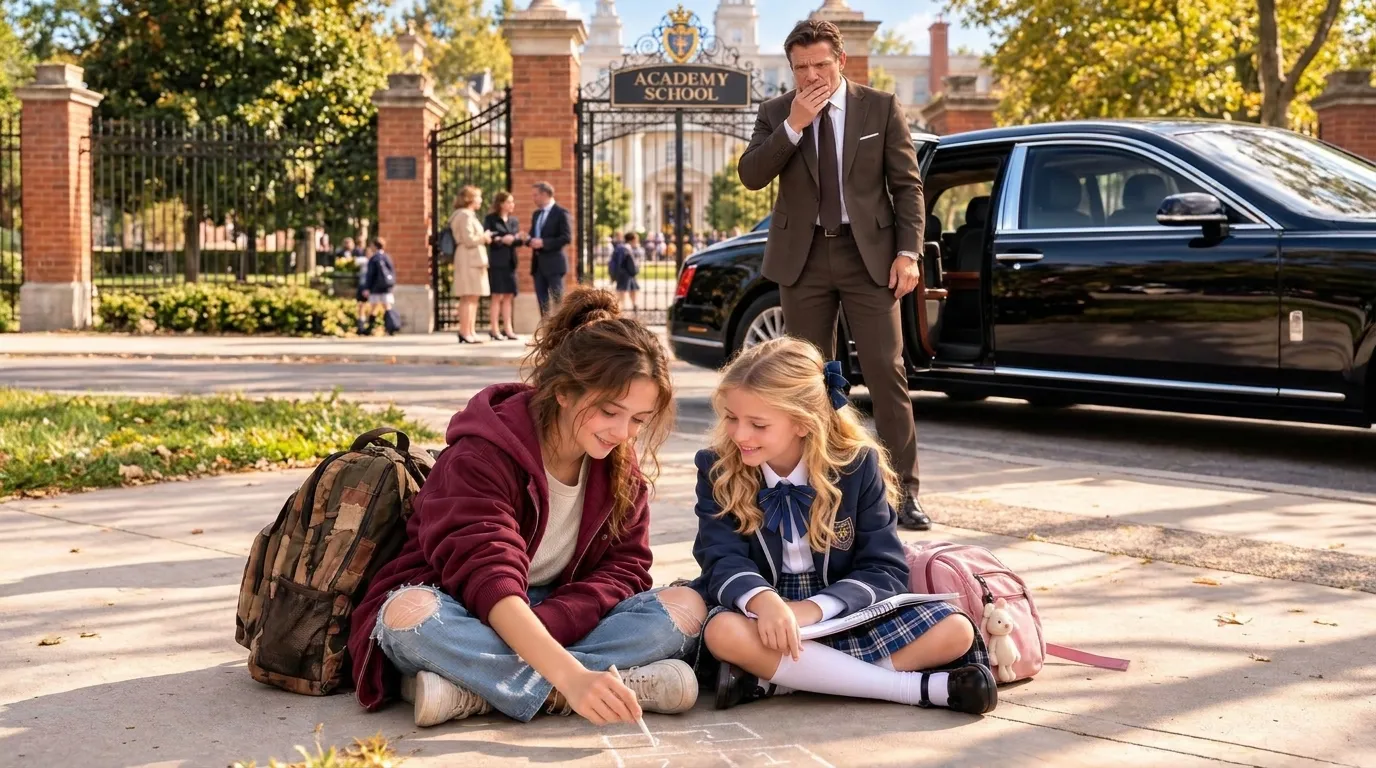
Yet her name was inside the torn backpack of a homeless teenager teaching my daughter mathematics on a sidewalk.
The girl noticed where I was looking.
She immediately pushed the paper deeper into the pocket.
“Where did you get that?”
Her face changed.
Not guilt.
Fear.
“I should go.”
She swung the backpack over her shoulder.
Sophie stepped between us.
“Dad.”
Her voice carried a warning I rarely heard from my eight-year-old.
“Don’t scare her.”
I looked at Sophie.
Then at the girl.
I lowered my voice.
“I’m not trying to scare you.”
“You’re staring at my bag.”
“Because I saw my wife’s name.”
The teenager froze.
For the first time, she really looked at me.
Not at my suit.
Not at the black sedan.
At my face.
“You’re Daniel?”
My chest tightened.
“You knew Claire?”
“I knew Mrs. Harrison.”
Sophie slipped her hand into mine.
The teenager looked toward the school gates.
More parents were starting to notice us.
A man in an expensive wool coat glanced at her clothes and pulled his child closer.
She saw it.
Her shoulders hardened.
“I have to leave.”
“Wait.”
“No.”
“I just want to understand.”
She laughed once without humor.
“That’s what adults always say before they decide what should happen to me.”
She turned.
Sophie ran after her.
“Maya!”
The girl stopped.
So that was her name.
Sophie hurried back toward me.
“Dad, please.”
Her eyes were anxious.
“She comes sometimes after school. She helps me with math.”
“How long?”
Sophie hesitated.
“Three weeks.”
Three weeks.
My daughter had been sitting outside one of the most expensive schools in Chicago with a homeless teenager, and I hadn’t known.
My driver hadn’t known.
The school apparently hadn’t told me.
Or perhaps nobody had noticed.
That bothered me more.
“Maya,” I called.
She stopped again.
“I won’t force you to stay.”
Her shoulders loosened slightly.
“But Claire was my wife. If you knew her, I’d like to know how.”
Maya remained still for several seconds.
Then she turned.
“She helped me get into this school.”
I looked toward the iron gates.
“This school?”
She nodded.
Sophie stared at her.
“You went here?”
“For a little while.”
The answer made no sense.
The academy charged more per year than many families earned.
Its students were the children of surgeons, attorneys, executives, athletes, politicians, and old Chicago money.
Yet Maya was currently carrying everything she owned in a backpack repaired with duct tape.
“What happened?”
Maya looked down.
“Your wife died.”
That sentence struck harder than it should have.
I already knew Claire was gone.
I had sat beside her hospital bed.
Signed documents.
Chosen flowers while feeling as though I were watching somebody else’s life.
But hearing a stranger connect Claire’s death to another tragedy shifted something beneath my feet.
“What did Claire’s death have to do with you leaving school?”
Maya pulled the folded paper from her backpack.
Its edges were soft from being opened hundreds of times.
She handed it to me.
At the top was the academy crest.
Below it:
HARRISON INDEPENDENT SCHOLARSHIP RECOMMENDATION
Applicant: Maya Reynolds
Then I saw Claire’s signature.
I recognized the slight curve she always put beneath the final letter of her name.
The date was three years earlier.
Claire described Maya as an exceptional student she had met through a community tutoring program.
She wrote about Maya solving mathematics several grade levels above her age.
She wrote that academic talent should never depend on a child’s ZIP code.
At the bottom, Claire had handwritten:
Please do not let money decide what happens to this child.
I had to stop reading.
For two years, I had avoided Claire’s handwriting.
Birthday cards.
Notes inside cookbooks.
A grocery list I once found in a kitchen drawer.
Every piece of her writing felt like opening a door into a room I couldn’t survive entering.
Now I stood on a Chicago sidewalk reading something she had written for a girl I never knew existed.
Sophie leaned against me.
“What does it say?”
“Your mother helped Maya come to this school.”
Sophie looked at Maya.
“You knew my mom?”
Maya nodded.
“She was nice to me.”
Sophie’s eyes filled.
Then she asked:
“What did she sound like?”
Maya blinked.
“What?”
“My mom. When she talked to you.”
I closed my eyes.
And suddenly I understood something I had failed to understand for two years.
Sophie did not need another structured grief exercise.
She needed people who remembered Claire.
Real people.
People who could give her pieces of her mother I couldn’t provide because my own grief had turned Claire into something too painful to discuss.
Maya’s voice softened.
“She talked really fast when she got excited.”
Sophie smiled.
“She did.”
“And she always carried two pens.”
“Blue and black?”
“Yeah.”
Sophie laughed.
Not quite as loudly as before.
But enough.
Then the school doors opened.
A man in a charcoal coat walked toward us.
Dr. Edward Whitmore.
Headmaster.
His smile disappeared the instant he saw Maya.
“Mr. Harrison.”
He approached quickly.
“I didn’t realize you were here.”
“I came early.”
His gaze shifted toward Maya.
“You’ve been told before that you may not loiter near school property.”
Maya stiffened.
“She isn’t loitering.”
Whitmore blinked.
“She was helping Sophie.”
“That may be, but we have security procedures.”
“She’s standing on a public sidewalk.”
He changed his tone.
“Of course. I’m simply concerned about student safety.”
Maya lowered her eyes.
Suddenly I saw the entire scene differently.
A prestigious school.
An elegantly dressed administrator.
A homeless teenager.
The assumption that danger belonged to the poorest person present.
“Did Maya Reynolds attend this school?”
Silence.
Whitmore’s face changed almost imperceptibly.
“That was some time ago.”
“How long?”
“Mr. Harrison, perhaps we should discuss this privately.”
“That sounds like yes.”
Sophie squeezed my hand tighter.
“Did my wife arrange Maya’s scholarship?”
“I’d need to review the records.”
Maya laughed quietly.
“You know exactly who I am.”
Whitmore’s jaw tightened.
“Maya.”
The way he said her name told me enough.
Whatever had happened was not simply forgotten paperwork.
I requested Maya’s records.
Whitmore resisted.
I asked Maya directly whether she gave permission for the school to discuss her enrollment with me.
“Yes.”
Whitmore reluctantly agreed to a meeting the following morning.
Then I asked Maya to attend.
“No.”
“Maya—”
“I’m not going inside that building again.”
She walked away.
Sophie watched her disappear.
Then looked at me.
“Dad?”
“Yes?”
“Are you going to help her?”
“I’m going to find out what happened.”
“That isn’t what I asked.”
She looked so much like Claire in that moment that it frightened me.
“Are you going to help her?”
I nodded.
“Yes.”
I had no idea how complicated that promise would become.
That evening Sophie barely touched dinner.
Usually, I would have reminded her about the schedule.
Dinner ended at seven.
Homework at seven-fifteen.
Reading at eight.
Bed at eight-thirty.
Instead, I asked:
“Tell me about Maya.”
Sophie looked suspicious.
“You’re not mad?”
“Should I be?”
“You get mad when I do things without asking.”
She wasn’t wrong.
“I’m listening.”
Sophie pushed a pea around her plate.
“The first time I saw her, I was crying.”
“Why?”
“Fractions.”
“You usually like math.”
“I used to.”
“What changed?”
She shrugged.
“My brain gets loud.”
“What does that mean?”
“When everybody tells me to focus, I think about how I’m not focusing. Then I think about Mom. Then I think about everybody watching me. Then everything gets mixed up.”
Shame moved through me.
How many times had I told her to focus?
How many tutors had I hired because I thought more instruction was the answer?
“Maya asked why I was crying,” Sophie continued.
“And?”
“I told her to leave me alone.”
I smiled.
“That sounds like you.”
“She left.”
“But came back?”
“Next day.”
“Why?”
“She said she had a better way to explain fractions.”
Sophie finally smiled.
“She drew pizzas.”
I laughed.
Sophie stared at me.
Then she started laughing too.
And for the first time in a long time, our enormous dining room sounded alive.
Later that night, Sophie told me Maya sometimes stayed at the library until closing because she had nowhere stable to go.
Then she said something that chilled me.
“Don’t call the police.”
“Why would I?”
“Because security came once and Maya ran.”
“At school?”
Sophie nodded.
“They told her she couldn’t sit near the gate.”
I couldn’t sleep.
At 2:10 a.m., I opened storage boxes I had avoided since Claire died.
Inside were charity receipts.
Volunteer records.
Letters.
Photographs.
I searched for Maya.
Eventually I found a photograph of Claire kneeling beside a young girl with dark hair and serious eyes.
Maya.
She looked thirteen.
On the back, Claire had written:
Maya solved the scholarship exam in 41 minutes. She pretended it was easy so nobody would know she was proud.
Then:
Daniel would like her.
My throat closed.
Claire had intended for us to meet.
Maybe some ordinary evening she planned to say:
There’s a girl you should know.
Then life ended before the conversation happened.
I kept searching.
Eventually, I found the scholarship agreement.
Claire had committed enough money to cover four years of Maya’s tuition through the Harrison Family Education Foundation.
The foundation still existed.
I chaired it.
After Claire died, I delegated its operation to my finance office.
If the agreement was valid, Maya should never have lost the scholarship.
At 6:15 the next morning, I called my chief financial officer.
“I need every payment to Whitmore Academy during the last four years.”
“Which account?”
“The Harrison Family Education Foundation. Specifically Maya Reynolds.”
Three minutes later, he returned.
“I found it.”
“How much?”
“Seventy-four thousand five hundred dollars annually.”
“For Maya?”
“Yes.”
“Were the payments stopped?”
“No.”
I turned from the window.
“What?”
“They continued.”
The school had continued taking Claire’s scholarship money.
Even while Maya was no longer attending.
At eight that morning, I walked into Whitmore Academy.
Dr. Whitmore was waiting.
So was the school attorney.
That told me enough.
“Where is Maya Reynolds’s scholarship money?”
The attorney started speaking.
I stopped him.
“$74,500 annually. Transferred from my family foundation after Maya stopped attending.”
Whitmore’s face lost color.
The school eventually admitted that after Maya’s foster placement collapsed and her enrollment ended, the scholarship funds had been redirected into its general scholarship pool under contractual language granting institutional discretion.
Legally, they believed they were protected.
Morally, they had abandoned a child.
Then the office door opened.
A secretary said:
“There’s a girl downstairs.”
“Maya Reynolds.”
Whitmore stood sharply.
“Who allowed her inside?”
I turned toward him.
He immediately realized what he had revealed.
I went downstairs.
Maya stood beside reception with her backpack pressed against her chest.
She looked ready to run.
“What are you doing here?”
She handed me an envelope.
“Sophie gave me your card.”
Inside was another letter from Claire.
Daniel,
If Maya ever comes to you instead of me, listen before you fix anything. You always try to solve people before you understand what they’re asking for.
Even from the grave, my wife knew how to criticize me.
Maya watched my expression.
“She gave that to me before her surgery.”
I looked up.
“You saw Claire while she was sick?”
“She still came to the tutoring center.”
“She shouldn’t have.”
Maya smiled faintly.
“She said she didn’t want everyone treating her like she was already gone.”
That sounded exactly like Claire.
I continued reading.
Maya is brilliant, stubborn, suspicious of kindness, and terrible at accepting help.
Maya saw my face.
“She wrote that?”
“Yes.”
“She wasn’t wrong.”
Then came the sentence that crushed me:
If something happens to me, I need you to make sure the scholarship continues.
Not because Maya owes us anything.
Because a child should not lose her future just because the adults around her disappear.
Please don’t turn this into one of your projects.
Just make sure she gets the chance to become who she already is.
Love, Claire.
My vision blurred.
“I’m sorry.”
Maya frowned.
“For what?”
“For not knowing.”
“That’s not your fault.”
“Maybe not.”
I folded the letter.
“But it became my responsibility.”
I finally asked Maya what had happened.
Then I remembered Claire’s instruction.
Listen before you fix anything.
So I waited.
Maya’s foster mother, Mrs. Alvarez, had suffered a stroke six months after Claire died.
Maya was transferred.
Then transferred again.
One placement was unsafe.
Another had too many children and was too far from school.
Eventually she ran.
Not away from education.
Back toward it.
She returned to Chicago because she believed the school would help her.
Instead, the academy told her it could not reenroll her without proper guardianship documentation.
Then Whitmore told her:
“The school isn’t a shelter.”
He tried to describe the remark as being taken out of context.
I didn’t care.
I asked Maya one question.
“What do you want?”
She looked confused.
“Not what do you need. What do you want?”
“I want to finish school.”
“Here?”
She looked around.
“I don’t know.”
“That’s allowed.”
Whitmore immediately offered to discuss reinstatement.
Maya looked at him.
“You called security on me last month.”
His face reddened.
“You walked past me.”
He had no answer.
Maya looked at me.
“I don’t want to come back here.”
“Then you won’t.”
Whitmore objected.
I turned toward him.
“You’re right about one thing. We shouldn’t make emotional decisions.”
For a second, he relaxed.
“I’m making a financial one.”
His expression changed.
Effective immediately, the Harrison Family Education Foundation suspended discretionary contributions to Whitmore Academy pending an independent audit of every restricted scholarship we funded.
Technology-wing maintenance funding?
Suspended.
Lecture series?
Suspended.
Spring gala underwriting?
Suspended.
Then I looked toward the plaque bearing my name.
“And remove my name from the technology wing.”
Whitmore stared at me.
“You can’t be serious.”
“I’ve never been more serious.”
Maya touched my sleeve.
“Can we leave?”
“Yes.”
We walked out together.
Outside, rain had begun.
My driver opened the sedan door.
Maya stopped.
“I’m not getting in that.”
“It’s a car.”
“It probably costs more than every apartment I’ve ever lived in.”
“Probably.”
She laughed.
“Where are you going?”
“The library.”
“Do you have somewhere safe tonight?”
Her expression immediately closed.
I remembered Claire.
“Forget I asked.”
Maya looked surprised.
“What?”
“I’m trying something new.”
“What?”
“Not solving you.”
She laughed.
“You’re bad at it.”
“I know.”
I gave her my card.
“If you need something, call.”
“I don’t want charity.”
“Then don’t call it charity.”
“What would you call it?”
I thought of Claire.
“A promise I’m late keeping.”
Maya put the card into her backpack.
That night, at 11:43 p.m., she called.
Her bag had been stolen.
Everything inside it was gone.
Clothes.
Documents.
And Claire’s original letters.
I found Maya inside the entrance of a twenty-four-hour pharmacy.
No coat.
No backpack.
Shivering.
I gave her mine.
She tried to refuse.
Then she started crying.
“The letters are gone.”
For once, I didn’t promise I could fix it.
Because I couldn’t.
I just sat beside her.
Eventually she whispered:
“I don’t know where to go.”
That was the first time Maya really asked for help.
I gave her options.
A youth housing organization.
A social worker.
Or one night in our guest room until we could work through the proper system the next morning.
Maya studied me.
“How do I know you’re safe?”
“You don’t.”
That surprised her.
“You barely know me.”
“That goes both ways.”
A long silence.
“Can I stay one night?”
“Yes.”
“One.”
“Yes.”
Maya stayed three years.