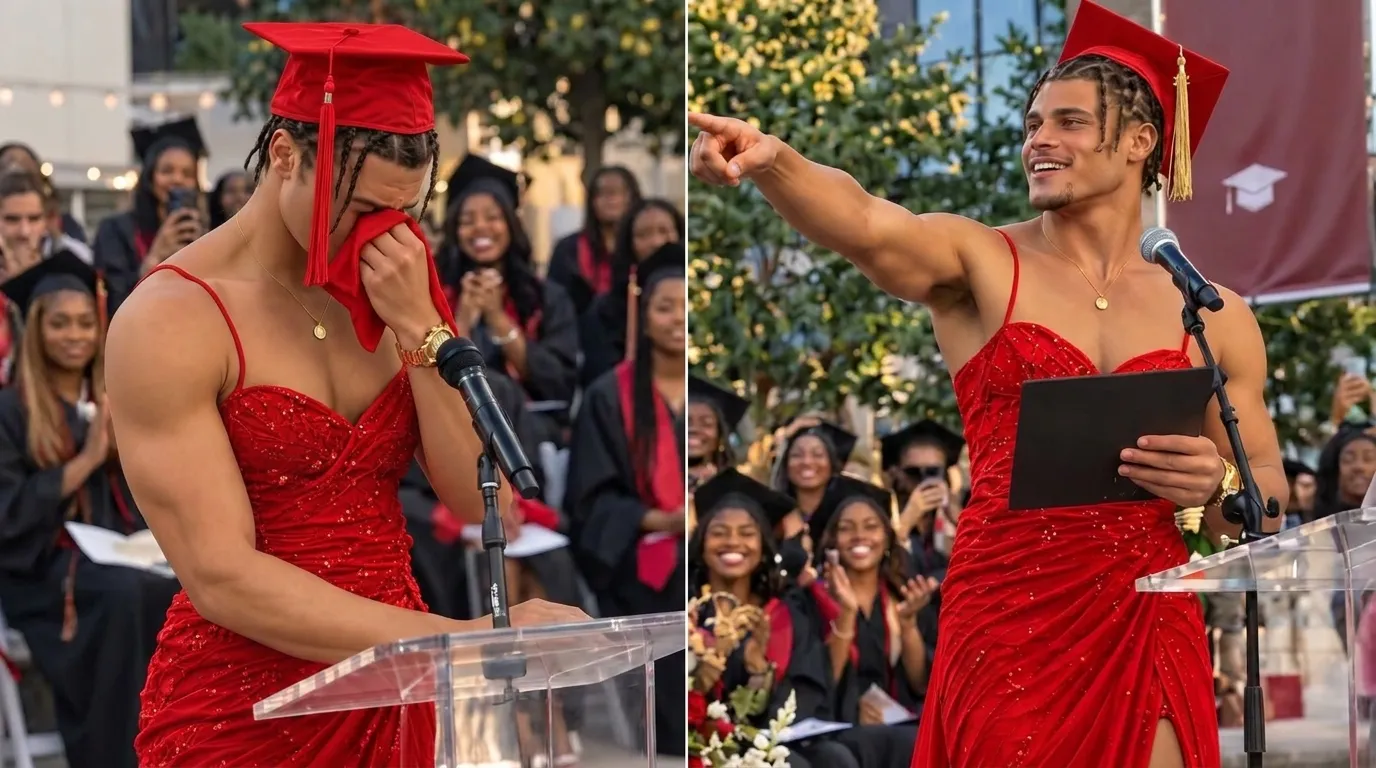
My son walked across his graduation stage wearing a bright red dress while hundreds of people laughed.
At first, I was one of the only people in the auditorium who knew the dress wasn’t a joke.
But even I didn’t yet know the entire reason.
The whispers started before Ethan’s name was called.
A woman leaned toward her husband.
Two teenagers several seats away looked at each other and grinned.
Someone farther back lifted a phone.
Then Ethan stepped into view.
The dress was impossible to miss beneath the auditorium lights.
Bright red.
Simple.
Elegant.
Completely unlike what anyone expected a teenage boy to wear to graduation.
I sat in the third row with my hands locked together.
There should have been someone beside me.
There wasn’t.
Ethan’s father had made his decision two weeks earlier.
He said he would not attend if Ethan insisted on wearing the dress.
That night, staring at the empty seat, I realized he had meant it.
Then the announcer called Ethan’s name.
He walked onto the stage.
Someone behind me said:
“What is wrong with that guy?”
A few people laughed.
My back went rigid.
I wanted to turn around.
I wanted to demand to know what kind of adult laughed at a teenager who had done nothing to them.
But Ethan kept walking.
So I stayed facing him.
He never searched the audience for approval.
He shook the principal’s hand.
Accepted his diploma.
Paused for the photograph.
Then continued toward the stairs.
Watching him carried me back to our kitchen two weeks earlier.
It had been after two in the morning.
Neither of us had slept well for months.
The red fabric lay across the kitchen table.
The moment I understood what Ethan intended to do, I shook my head.
“No.”
He hadn’t even explained.
“Please don’t do this.”
“Mom, I have to.”
“They’ll be cruel.”
“I know.”
“Your classmates will film you.”
“I know.”
“People will post it everywhere.”
“I know.”
That calm answer frustrated me more than an argument would have.
I grabbed his hand.
“Then why put yourself through that?”
Ethan looked down at the dress.
Then whispered:
“Because I made a promise.”
I knew what the dress represented generally.
It had belonged to his twin sister, Emma.
But I hadn’t known the promise.
Eleven months earlier, our family had been shattered.
Emma and Ethan had entered the world eleven minutes apart.
For seventeen years, they had moved through life like two people speaking a language nobody else fully understood.
They fought.
Teased each other.
Borrowed things without asking.
Defended each other fiercely.
Emma loved theater, music, and anything bright enough to attract attention.
Ethan preferred quiet rooms and small groups.
She once joked that they had split one personality between them and she had accidentally taken ninety percent of it.
Then, during their senior year, Emma became seriously ill.
Everything changed quickly.
School became hospital rooms.
College applications became treatment schedules.
Graduation plans became something nobody wanted to discuss.
Emma had already bought the red dress.
She had shown it to me once.
I remembered saying:
“You’re going to be visible from space.”
She loved it.
Then we lost her before she could wear it.
Afterward, I packed many of Emma’s things away because I couldn’t bear seeing them.
I thought the dress was among them.
I didn’t know Ethan had kept it.
And I definitely didn’t know what Emma had asked him to do.
Not until graduation night.
Ethan’s father reacted badly when he learned about the dress.
“You are not wearing that.”
“I am.”
“People will laugh at you.”
“I know.”
“You’ll humiliate yourself.”
Ethan remained calm.
“I’m still wearing it.”
His father eventually said:
“If you do this, I’m not coming.”
I expected Ethan to break.
He didn’t.
“Okay.”
His father left the room furious.
Later, I asked Ethan whether he wanted to reconsider.
“No.”
Even his closest friend stopped responding after hearing what Ethan planned.
That hurt Ethan more than he admitted.
I watched him check his phone.
Put it down.
Check again.
Nothing.
Then Willowcrest High called.
The administrator was polite.
They understood grief, they said.
They respected Ethan’s desire to honor his sister.
But perhaps there was a “more appropriate” way.
A photograph.
A pin.
A mention in the ceremony program.
Ethan listened.
Then answered:
“Thank you. But I already made my promise.”
That was the end of the discussion.
So every fear I had voiced came true.
His father wasn’t there.
His friend had disappeared.
The school was uncomfortable.
And strangers were laughing.
Yet Ethan walked.
After receiving his diploma, he didn’t return to the graduates.
Instead, he came down the center aisle toward me.
People turned to follow him.
When he reached my row, his eyes were wet.
“This is for you, Mom.”
I couldn’t speak.
Then:
“And for both of us.”
He reached into a hidden pocket.
Something tiny rested in his hand.
Wrapped in tissue.
I took it.
Unfolded it.
And stopped breathing.
It was an old laminated school photograph of Emma.
She was sixteen in the picture.
Smiling too widely.
Hair blowing across one eye.
On the back was her handwriting.
Six words:
IF I CAN’T WALK, TAKE ME.
Everything inside me collapsed.
I looked up at Ethan.
“You promised her?”
He nodded.
“When?”
“The hospital.”
His voice trembled.
“A few weeks before she died.”
I covered my mouth.
“She asked if I’d still graduate if she didn’t make it.”
My eyes filled.
“I told her I didn’t know.”
Ethan glanced down at the red dress.
“She told me I had to.”
Then he almost smiled.
“She said she’d already paid too much for this stupid dress for nobody to use it.”
A broken laugh escaped me through my tears.
That sounded exactly like Emma.
Ethan continued:
“She made me promise that if she couldn’t walk across the stage, I’d take her with me.”
I touched the photograph.
“So you wore her dress.”
“Yes.”
“Why didn’t you tell me?”
His face softened.
“Because you would have tried to protect me from it.”
He was right.
“You would have told me Emma wouldn’t want people laughing at me.”
I nodded through tears.
“And maybe she wouldn’t.”
Then he looked at the picture.
“But she also wouldn’t have wanted fear deciding for me.”
The woman beside me leaned closer.
She saw Emma’s photograph.
Then the writing.
Her expression changed instantly.
Another mother noticed.
Then someone behind us.
The laughter began disappearing.
A phone lowered.
A man cleared his throat.
Nobody made a dramatic apology.
No entire auditorium rose to applaud.
Real life rarely repairs itself that neatly.
But the cruelty lost its confidence.
People had looked at Ethan’s dress and decided they understood him.
One tiny photograph proved how little they knew.
I closed my fingers around Emma’s picture.
Ethan crouched beside me.
For a few seconds, neither of us spoke.
Then I looked toward the empty chair.
His father should have been there.
Ethan followed my eyes.
His face changed.
“That part hurts,” he admitted.
“I know.”
“Do you think Dad will ever understand?”
“I don’t know.”
That was the truth.
I wasn’t going to promise Ethan another person would become better.
“But I understand.”
He looked at me.
“I’m sorry it took me until tonight.”
Ethan shook his head.
“You were scared for me.”
“I was.”
“I knew.”
Then he squeezed my hand.
That simple kindness broke me all over again.
Because Ethan had spent two weeks being judged, abandoned, advised, mocked, and misunderstood.
Yet he still had room to understand why his mother had been afraid.