Her Father Sold Her to a Deaf Rancher for $50—On the Eighth Night, She Saw Something Moving Inside His Ear
On the eighth night of her marriage, Rosalie Ashford held an oil lamp beside her husband’s face and saw something black moving deep inside his swollen ear.
Gideon Rook was doubled over in agony, gripping the table while she reached for her sewing tweezers.
Whatever had been tormenting the deaf rancher since childhood was alive.
Eight days earlier, Rosalie’s father had sold her future for fifty dollars.
The Ashford household was drowning in debt, and Rosalie had become the easiest thing left to bargain away. Her father called the arrangement practical. Her drunken brother Merrick told her she should be grateful.
No one asked what Rosalie wanted.
Snow covered Coldwater on her wedding morning as she stood before a cracked mirror wearing her late mother’s faded ivory gown.
Then Gideon Rook arrived.
At thirty-eight, Gideon owned the largest ranch beyond the northern ridge. He was tall, broad-shouldered, and almost completely deaf.
The townspeople had transformed those facts into something sinister.
They called him the “half-mad deaf rancher.”
During the ceremony, Gideon barely brushed Rosalie’s cheek when instructed to kiss his bride. On the wagon ride to his isolated property, he remained silent.
But Rosalie knew cruelty.
Cruelty smelled like whiskey on her father’s breath and sounded like creditors pounding on the door.
Gideon smelled of pine, leather, and woodsmoke.
His cabin surprised her. The floors were clean. A fire burned brightly. Fresh bread waited beneath a cloth, and clean blankets covered the bed.
Then Gideon opened a worn notebook.
The bedroom belongs to you. I’ll sleep beside the fire.
Rosalie read the sentence twice.
She had prepared herself for anger, demands, perhaps even violence.
She had not prepared herself for kindness.
Over the following days, they developed a quiet routine. Gideon rose before dawn to tend cattle, repair fences, and split timber. Rosalie cooked, washed clothes, and repaired blankets.
Their marriage existed mostly through penciled messages.
Storm tonight.
Flour is above the stove.
North fence tomorrow.
There was little affection between them, but Rosalie slowly realized something remarkable.
She wasn’t afraid of him.
Then, on their fifth night together, she found Gideon collapsed beside the hearth.
Sweat soaked his shirt despite the freezing weather. His trembling hand pressed against his right ear.
Rosalie rushed toward him.
Gideon grabbed the notebook.
Happens often.
That answer disturbed her more than any explanation could have.
Afterward, she began noticing details she had overlooked: rusty stains on his pillow, his discomfort near intense heat, and the way his hand repeatedly moved toward the same ear, sometimes clutching the side of his head.
That evening, she pushed the notebook toward him.
How long?
Gideon hesitated.
Since I was a child.
Doctors had blamed everything on the accident that destroyed his hearing. They had told him nothing could be done.
Rosalie wrote another question.
Did you believe them?
His pencil remained still for several seconds.
No.
Three nights later, during supper, Gideon’s chair suddenly crashed backward.
He folded over, both hands clamped against his skull.
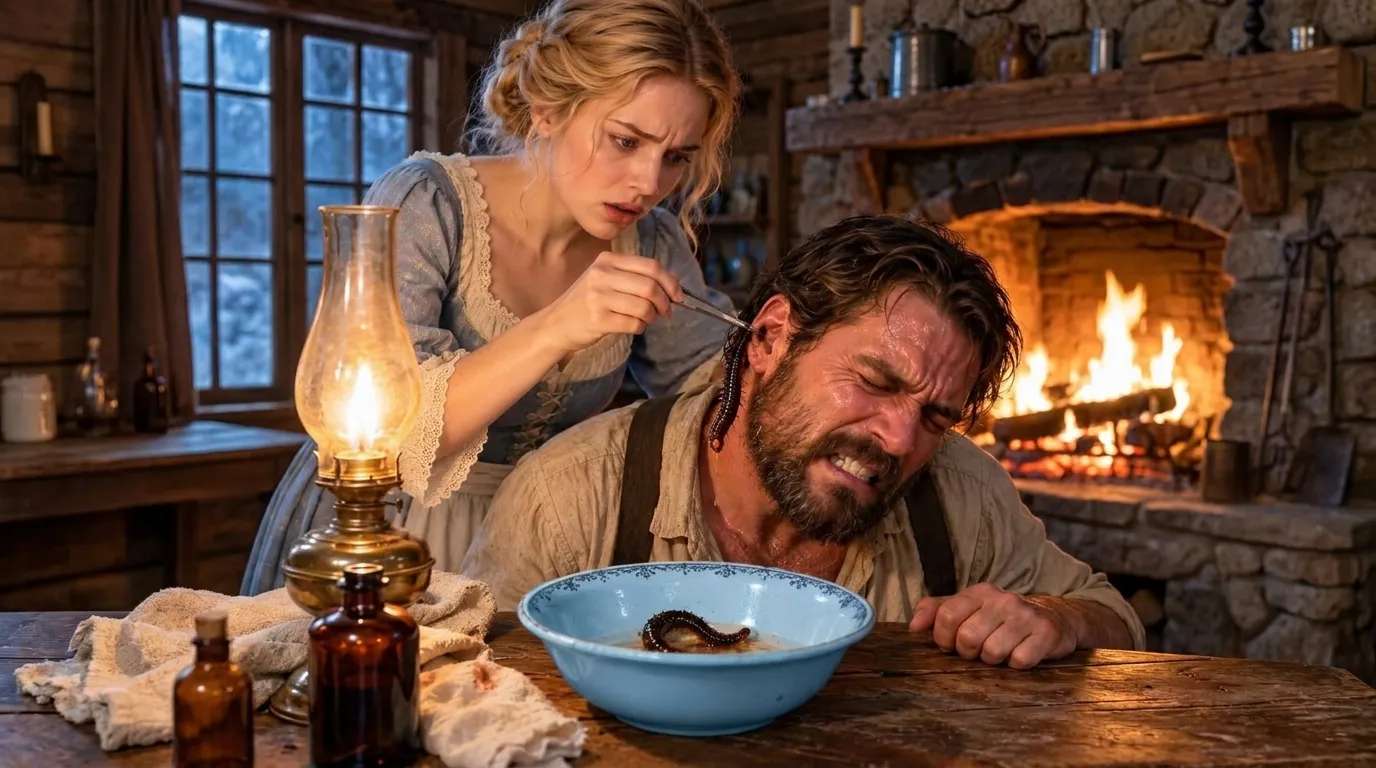
Rosalie grabbed the oil lamp and hurried beside him. His right ear looked swollen and inflamed.
She raised the light.
Then she saw it.
Deep inside the ear canal was something black.
Wet.
Moving.
Rosalie’s fear disappeared beneath instinct.
She boiled water, found alcohol, placed a porcelain bowl on the table, and retrieved her sewing tweezers.
Gideon caught her wrist before she could begin.
He wrote one word.
Dangerous.
Rosalie took the pencil from him.
More dangerous if it stays. Do you trust me?
For a long moment, Gideon stared at her.
Then he nodded.
Rosalie carefully inserted the tweezers.
Metal touched something firm.
Gideon’s fingers tightened around the table.
She pulled.
Nothing.
The metal tweezers scraped against bone, sending a shudder through Rosalie’s arm as Gideon’s knuckles turned white against the pine boards. He groaned, lowering his head toward the wood.
Rosalie adjusted her grip.
Then she pulled again.
Something suddenly released.
A long, black object slid from Gideon’s ear and dropped into the porcelain bowl with a faint click.
Rosalie froze.
Gideon stared at her face, unable to hear the sound.
Then both of them looked down.
The thing in the bowl began to move, its wet, segmented black casing unwinding beneath the lamplight, revealing a delicate coil of brass gears and tiny, pulsing copper wires.
The porcelain bowl clinked against the rough pine table as the thing within it contracted, flexing against the white glaze.
It was neither worm nor insect.
As the dark fluid drained away under the hot lamplight, the metallic truth gleamed with unsettling precision.
It was three inches of segmented, blackened steel, fine as a river leech, fringed with tiny pincers and threaded with hair-thin filaments of spun silver and insulated copper.
At the center of its tapered head, a minuscule balance wheel ticked with an erratic, frantic beat, like the dying heart of a pocket watch starved of oil.
Gideon remained slumped over the table, his forehead pressed against the scarred timber, his chest heaving with ragged, shuddering breaths.
Blood trickled from his injured ear, spotting the floorboards below.
Rosalie stood frozen, the tweezers slipping from her fingers to clatter against the floor.
Her mind fought against the sight.
She was a village girl from Coldwater, raised on hard winters, debt ledgers, and sheep shears. She knew livestock sickness; she knew the infection that took hold of old wounds.
But she had never seen metal that moved like living tissue, nor a machine that fastened itself inside a man.
Slowly, Gideon lifted his head.
The agony that had carved lines into his weathered features for eight days had given way to an expression of hollow, dazed bewilderment. His hand rose instinctively to the side of his head, but his fingers hovered over the bleeding ear without touching it.
The silence in the cabin was suddenly broken.
The cast-iron kettle on the stove was whistling softly, a thin wisp of steam rising toward the rafters. Outside, the pine branches scratched against the cedar shingles under the weight of the mountain wind.
Beneath the floorboards, the dry timbers groaned in the winter freeze.
Gideon’s eyes widened with a terror far more profound than the pain that had wracked him moments before.
He flinched, snapping his head toward the stove, then toward the window, then directly at Rosalie. His pupils were wide, nearly swallowing his amber irises.
“Gideon?” Rosalie whispered, her voice barely a breath.
Gideon recoiled as if she had fired a pistol beside his temple.
He pressed both palms against his ears, curling inward, his breath hitching in his throat. Tears of sensory overload cut clean tracks through the soot and sweat on his hollow cheeks.
He was hearing.
For the first time since childhood, the muffled, heavy void that had isolated him from the world had ruptured, and the ordinary sounds of the room were pouring into his raw auditory nerve with searing intensity.
Rosalie moved cautiously, lowering the oil lamp’s wick until the cabin settled into a dim, amber twilight.
She reached across the table, gently grasping Gideon’s wrist and easing his hand away from his bleeding ear. He looked up at her, trembling like a foundered horse in a snowdrift.
“Can you hear me?” she asked, shaping each word softly, her voice pitched to a soothing murmur.
Gideon swallowed hard.
His dry lips parted, sticking together before producing a voice that was hoarse, rusty, and thick with thirty years of disuse.
“It… hurts,” he rasped.
The timbre was deep, resonant, and entirely unlike the harsh grunts the townsfolk in Coldwater mimicked behind his back.
“The wind. The kettle. Your voice. It sounds like… like breaking glass.”
“Sit still,” she whispered. “Don’t move. I’m going to clean the wound.”
She soaked a clean strip of linen in boiled water, wringing it out before pressing it gently to his ear.
Gideon hissed through his teeth, but he didn’t pull away. He sat motionless, his chest rising and falling as he stared at the porcelain bowl.
Within the basin, the metallic parasite had finally ceased its frantic mechanical spasms.
The spring had run down.
The silver filaments, once embedded deep in the tissues surrounding his auditory canal, lay slack against the porcelain, dull and lifeless.
“What is it, Gideon?” Rosalie asked, keeping her tone measured even as cold dread crawled along her spine. “What was inside you?”
Gideon’s jaw tightened until the muscles stood out along his neck.
He reached down with an unsteady hand, picking up the small sewing tweezers from the floor. Carefully, avoiding the needle-sharp prongs, he prodded the segmented carcass in the bowl, flipping it over.
On the underbelly of the central segment, stamped into the darkened brass with microscopic precision, was a maker’s mark: an eagle clutching an anchor, bordered by four numbers.
“It was not an accident,” Gideon said, each syllable heavy with bitter realization.
He spoke slowly, listening to the vibration of his own words as if they belonged to a stranger.
“The fever when I was eight. The doctor who came from Cheyenne on the private train. My father told everyone I fell from the loft and struck my head on the anvil. But I remembered the smell of chloroform. I remembered the cold brass against my skull.”
“Why would someone do this to a child?” Rosalie asked, horror tightening her chest.
“To keep me quiet,” Gideon replied, his voice dropping into a harsh, hollow register. “And to keep me from ever listening to what lay beneath this valley.”