At a Military Gala, My Mother Told the Armed Guard, “My Daughter? No, She’s Just My Guest.” I Stayed Quiet and Handed Over My ID—Then His Flashlight Hit the Gold Seal on My Card.
The Gold Seal
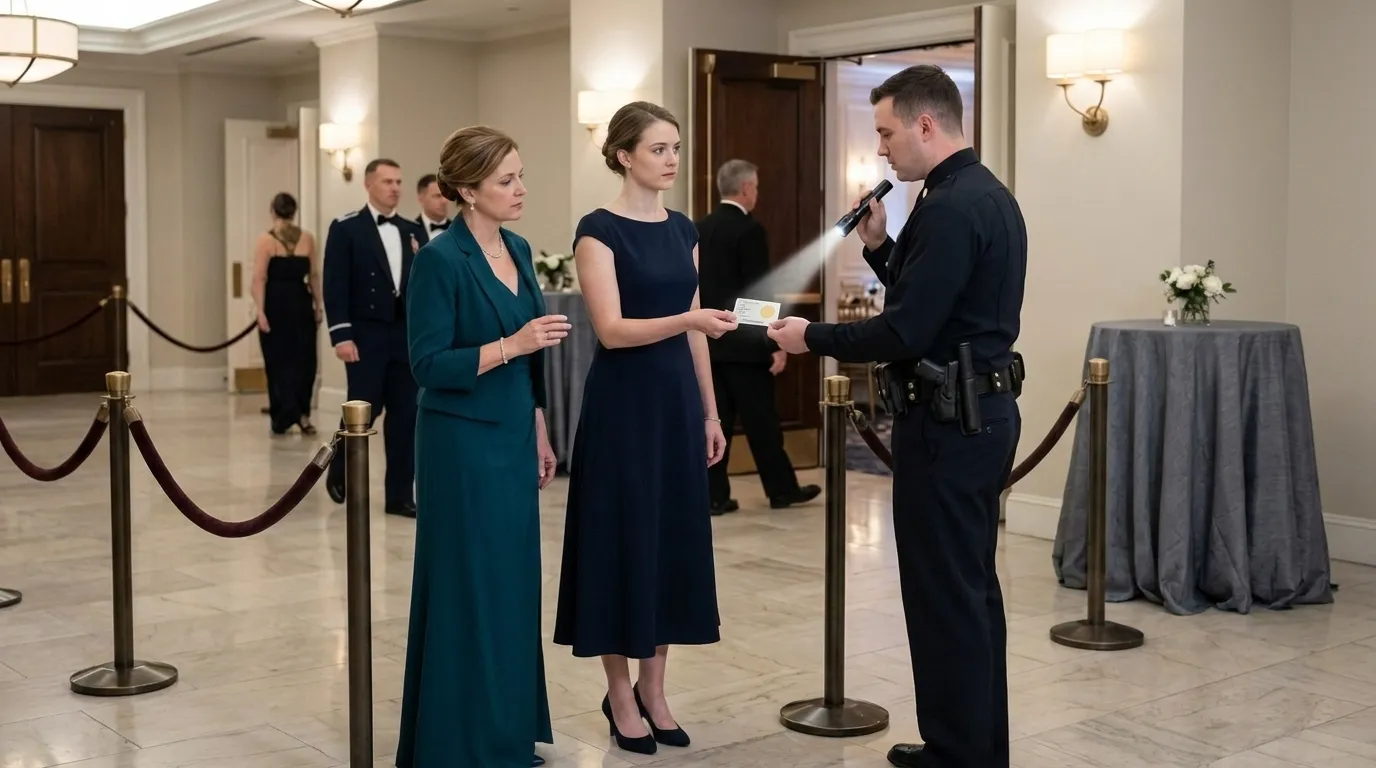
The supervisor took my credential from the guard.
For several seconds, nobody spoke.
My mother stood beside me in her teal evening gown, one hand still resting near the pearls at her throat. Bethany’s phone had lowered slightly, but the camera was still pointed in our direction.
Grant’s smirk remained on his face.
It simply stopped looking natural.
The supervisor studied the gold seal beneath the light.
Then he looked at me.
His entire posture changed.
He straightened.
“Good evening, ma’am.”
The security officer immediately stepped back.
The supervisor returned my credential with both hands.
“Vice Admiral, my apologies. We weren’t told you were entering through the public security line.”
My mother made a small sound beside me.
Grant blinked.
“What did he call you?”
I ignored him.
The guard looked horrified.
“Ma’am, I’m sorry. I didn’t recognize—”
“You did exactly what you were supposed to do,” I said. “You checked the credential presented to you.”
His shoulders relaxed slightly.
The supervisor turned toward the ballroom entrance.
“Admiral Mitchell has been asking whether you’ve arrived. Your receiving party is waiting inside.”
That was when Grant’s face changed completely.
“Mitchell?”
The supervisor glanced at him.
Grant stepped forward.
“Admiral Mitchell?”
“Yes, sir.”
Grant laughed nervously.
“I know Mitchell.”
I looked at him.
He had spent Thanksgiving telling everyone Admiral Mitchell called him for advice.
My mother turned toward me.
“Emily?”
Her voice sounded strange.
“You’re an admiral?”
“Vice admiral.”
She stared.
“Since when?”
“Four years.”
“Four years?”
“Yes.”
“You never told me.”
I finally looked at her.
“I did.”
She opened her mouth.
I continued before she could speak.
“I sent you the promotion announcement.”
Her face went blank.
“You called me that afternoon.”
“I did?”
“You needed eight thousand dollars because Grant’s car required repairs.”
Grant’s expression tightened.
I remembered the conversation perfectly.
I had been standing outside the ceremony venue in uniform, three stars newly pinned to my shoulder.
My mother had called.
Not to congratulate me.
She had barely let me finish saying where I was.
“Your brother is in a terrible situation, Emily. You know how important that car is for his business.”
I wired the money before dinner.
Apparently, nobody had remembered the other part of the call.
The supervisor gestured toward the ballroom.
“If you’re ready, ma’am.”
I stepped forward.
My mother remained frozen.
Grant caught up.
“Wait.”
I stopped.
“You’re saying Mitchell reports to you?”
I looked directly at him.
“Yes.”
Grant’s face went rigid.
Bethany finally lowered her phone.
“All this time?”
“All this time.”
“Why would you let us think you were doing paperwork?”
That almost made me laugh.
“I didn’t.”
I walked through the doors.
They followed.
For years, my family had always moved ahead of me.
That night, security opened the rope for me first.
Inside, the ballroom glittered beneath enormous chandeliers.
Dress uniforms.
Formal gowns.
Flags.
Gold trim.
Senior officers, civilian leaders, veterans, and invited families filled the room.
A young lieutenant spotted me and immediately straightened.
“Good evening, Admiral.”
“Good evening.”
Another officer nodded.
Then another.
My mother began walking more slowly.
At the entrance to the reception line stood Admiral Mitchell.
Grant had described him at Thanksgiving as though the two of them shared classified secrets over coffee.
Mitchell saw me and smiled.
“Ma’am.”
We shook hands.
“Glad you made it. They moved the speaking order by ten minutes, but your remarks are still after dinner.”
“Understood.”
Then his eyes moved toward my family.
I made the introduction.
“My mother. My brother Grant. And Bethany.”
Mitchell greeted each politely.
Grant immediately reached for the opportunity.
“Admiral Mitchell. Good to finally meet in person.”
Mitchell paused.
“Finally?”
Grant’s smile faltered.
“We’ve spoken.”
Mitchell looked genuinely confused.
“I’m sorry. Remind me where?”
Grant’s face turned red.
“At… a few points. Naval consulting.”
Mitchell glanced at me.
I said nothing.
Then he looked back at Grant.
“I don’t believe we’ve met.”
The silence lasted maybe two seconds.
For Grant, I imagine it lasted a year.
Mitchell gave him a courteous nod and turned back to me.
“Ma’am, the chief’s staff has your updated briefing packet at your table.”
“Thank you.”
We moved on.
Behind me, I heard Bethany whisper:
“Oh my God.”
Our seating cards were waiting near the front of the ballroom.
Mine read:
VICE ADMIRAL EMILY
GUEST OF HONOR
My mother’s card read:
GUEST OF VICE ADMIRAL EMILY
Grant stared at his.
So did Bethany.
My mother lowered herself into her chair.
For the first time in my life, she looked unsure of where she belonged in a room.
I knew that feeling.
I had spent half a century living inside it.
Dinner began.
Officers stopped by my table.
Some asked about deployments.
Others mentioned sailors we both knew.
One retired captain reminded me of an operation more than twenty years earlier, when I had been a young EOD officer and spent fourteen hours working around a damaged weapons system while everyone else was evacuated.
My mother listened as though strangers were describing another woman.
Maybe they were.
At home, I had never been allowed to become this version of myself.
Grant became quieter with every conversation.
Finally he leaned toward me.
“What exactly do you do?”
I looked at him.
“You really want to know?”
“Yes.”
It was the first time I could remember him asking.
So I told him.
Not everything.
Some parts of my work would never belong at a dinner table.
But enough.
I told him about Annapolis.
EOD training.
Sea deployments.
Joint commands.
Years spent responsible for people whose families expected them to come home.
I told him about the promotion boards.
The commands.
The decisions.
The officers who now reported through my chain.
Grant listened without interrupting.
When I finished, he looked down at his plate.
“You never talked about any of this.”
“I tried.”
My mother closed her eyes.
That ended the conversation.
A little later, the master of ceremonies walked onto the stage.
After several awards, he began introducing the evening’s principal speaker.
He did not introduce “Emily who does paperwork.”
He spoke about a Naval Academy graduate.
An explosive ordnance disposal officer.
A leader who had served through multiple deployments.
A commander trusted with decisions affecting thousands of sailors and civilian personnel.
Then he said my name.
The room stood.
All of it.
Hundreds of people.
My mother stood too.
Grant stood.
Bethany stood.
For a moment, I remained seated.
Not because I was overwhelmed by applause.
I had heard applause before.
What struck me was the strange memory of a county science-fair certificate with a coffee ring across it.
My father’s funeral bills spread across my sixteen-year-old lap.
My Naval Academy appointment letter ironed flat on my bedroom floor.
My mother laughing.
Maybe they can teach you to answer phones in a uniform.
I stood.
Then I walked to the stage.
My prepared speech was about service.
But when I looked toward my family, I changed the first few lines.
“People often confuse visibility with value,” I began.
The ballroom became quiet.
“They assume the person at the microphone is the person who made everything happen.”
I glanced toward the sailors and civilian staff seated throughout the room.
“That has never been true in the Navy, and it is rarely true anywhere else.”
I spoke about technicians nobody photographed.
Young sailors standing midnight watches.
Families carrying responsibilities while someone they loved was deployed.
People who solved problems quietly and received no applause.
“Service,” I said, “is what you continue doing when no one important appears to be watching.”
Then I paused.
“And sometimes the hardest thing a person can learn is that being overlooked does not make them small.”
My mother lowered her eyes.
I did not expose her.
I did not mention Grant.
I did not tell the ballroom about Thanksgiving or the $400,000 or the appointment letter.
That evening was not about revenge.
For the first time, I understood that I didn’t need an audience to punish them.
I simply needed to stop agreeing with the version of me they had created.
When the speech ended, the room stood again.
I returned to my table.
My mother was crying.
Grant was not looking at me.
Bethany’s phone remained face down beside her plate.
After dinner, my mother asked quietly:
“Can we talk somewhere private?”
I led them into a small reception room adjoining the ballroom.
The moment the door closed, Grant turned on me.
“This was planned.”
I looked at him.
“What was?”
“Bringing us here.”
“You asked to come.”
“You knew what would happen.”
“I knew there was a gala.”
“You knew everyone would see us finding out.”
I stared at him.
“Grant, you told me I needed you here to make introductions.”
He said nothing.
“You walked ahead of me because you believed I was the one who needed access.”
His face reddened.
“I never said—”
“You rarely do.”
That stopped him.
I looked toward my mother.
“You do that too.”
She wiped her eyes.
“I truly didn’t know.”
“No.”
My voice remained calm.
“You didn’t want to know.”
She flinched.
“That isn’t fair.”
“Isn’t it?”
I reached into my clutch and took out my phone.
I had not prepared evidence for this conversation.
I didn’t need to.
My bank app was enough.
I scrolled through years of transfers.
Power bills.
Car repairs.
Business loans that were never repaid.
My mother’s investment loss.
Grant’s consulting expenses.
Insurance.
Property taxes.
The Porsche down payment.
More than $400,000 over fifteen years.
I turned the screen toward them.
My mother stared.
Grant’s face hardened.
“You offered to help.”
“Yes.”
“Then don’t weaponize it now.”
“I’m not.”
I locked the phone.
“I’m explaining something I should have understood years ago.”
“What?”
“I thought if I kept being useful, eventually I would become family in the same way Grant already was.”
Nobody spoke.
“I thought one more payment might make you ask how I was doing.”
My mother covered her mouth.
“One more emergency might make Grant respect me.”
Grant looked away.
“One more family dinner might be different.”
I shook my head.
“It never was.”
My mother whispered:
“Emily…”
“No.”
My voice was not loud.
But both of them stopped.
“I spent my career learning that silence has consequences.”
I looked at her.
“At home, I kept forgetting.”
Grant folded his arms.
“So what now?”
It was such a Grant question.
Not Are you okay?
Not How did we miss this?
Just:
What now?
I answered honestly.
“Now I stop paying.”
His arms dropped.
“What?”
“No more consulting money.”
“Emily—”
“No car payments.”
He stared.
“No emergency business loans.”
“You can’t just—”
“I absolutely can.”
I turned toward my mother.
“I will not abandon you. If you genuinely need something, we can discuss it directly.”
Her eyes filled again.
“But I will not finance this family as the price of being tolerated by it.”
Grant laughed bitterly.
“So this is punishment.”
“No.”
I stepped closer.
“This is what happens when help stops being confused with obligation.”
He stared at me.
Then he said the cruelest thing he could still find.
“You always thought you were better than us.”
For years, that accusation would have sent me rushing to prove I wasn’t.
That night, it did nothing.
“No, Grant.”
I looked him directly in the eyes.
“I spent most of my life believing the opposite.”
That was when his expression finally broke.
Not completely.
But enough.
My mother sank into a chair.
“Why didn’t you make us see you?”
The question hurt more than I expected.
I sat across from her.
“I was your daughter.”
My voice softened.
“I thought that was supposed to be enough.”
She began to cry.
And for once, I did not rush across the room to comfort her.