Chapter 4: The Viral Fracture
The base hospital was sterile, cold, and aggressively bright.
X-rays confirmed severe fractures in both bones of my forearm—one clean break near the wrist and a jagged break higher along the ulna.
The attending trauma surgeon remarked that I was incredibly lucky the steel frame hadn’t crushed the elbow joint completely.
Lucky.
The word tasted like ash in my mouth.
General Hayes stayed in the waiting room until the cast was set. Daniel Mercer and three guys from my unit sat in the plastic chairs, drinking terrible vending machine coffee, standing guard.
My father was conspicuously absent.
At least, for the first few hours.
It was nearing midnight when a hesitant knock sounded at my room door.
The door creaked open, and my father stood on the threshold. He looked incredibly small without Linda’s towering, chaotic energy beside him. His suit was wrinkled.
“Can I come in?” he asked, his voice trembling.
Every instinct told me to send him away.
Instead, I gave a single, exhausted nod.
He shuffled to the visitor’s chair but didn’t sit. He stared at the heavy white plaster encasing my arm from knuckles to bicep.
“I’m sorry,” he whispered.
I kept my eyes on the ceiling tiles.
“For today?”
“For everything.”
That answer caught me off guard.
I turned my head to look at him. His eyes were bloodshot, the skin beneath them dark with exhaustion.
“I kept telling myself it wasn’t as bad as you made it out to be,” he confessed, his voice breaking. “I convinced myself you were just clashing.”
“It was worse,” I stated flatly.
No comfort. No polite pretense.
“I know,” he choked out. “I know now. Because she did it in front of a General. She did it where I couldn’t pretend I didn’t see it.”
“I told you when I was seventeen,” I reminded him, my voice devoid of pity. “I told you when she went through my phone. When she threw my clothes in the snow. When she told everyone I’d fail basic training and come crawling home pregnant.”
He covered his face with both hands. A ragged sob shook his chest.
The dam of his denial had finally shattered. He was facing the full weight of his own complicity.
We sat in absolute silence for ten minutes.
He didn’t ask for immediate forgiveness. He didn’t try to explain Linda’s childhood trauma.
For the first time in my existence, he simply sat in the discomfort of what he had failed to do.
Before he left, he paused at the door, his hand on the handle.
“I gave my statement to the military investigators. And… I informed Linda that I will not be paying a single cent of her legal defense.”
I blinked in genuine shock.
“That’s…”
“A very small thing, after everything,” he finished for me with a sad, self-deprecating laugh. “But it’s a start.”
By sunrise, the private nightmare had become a public spectacle.
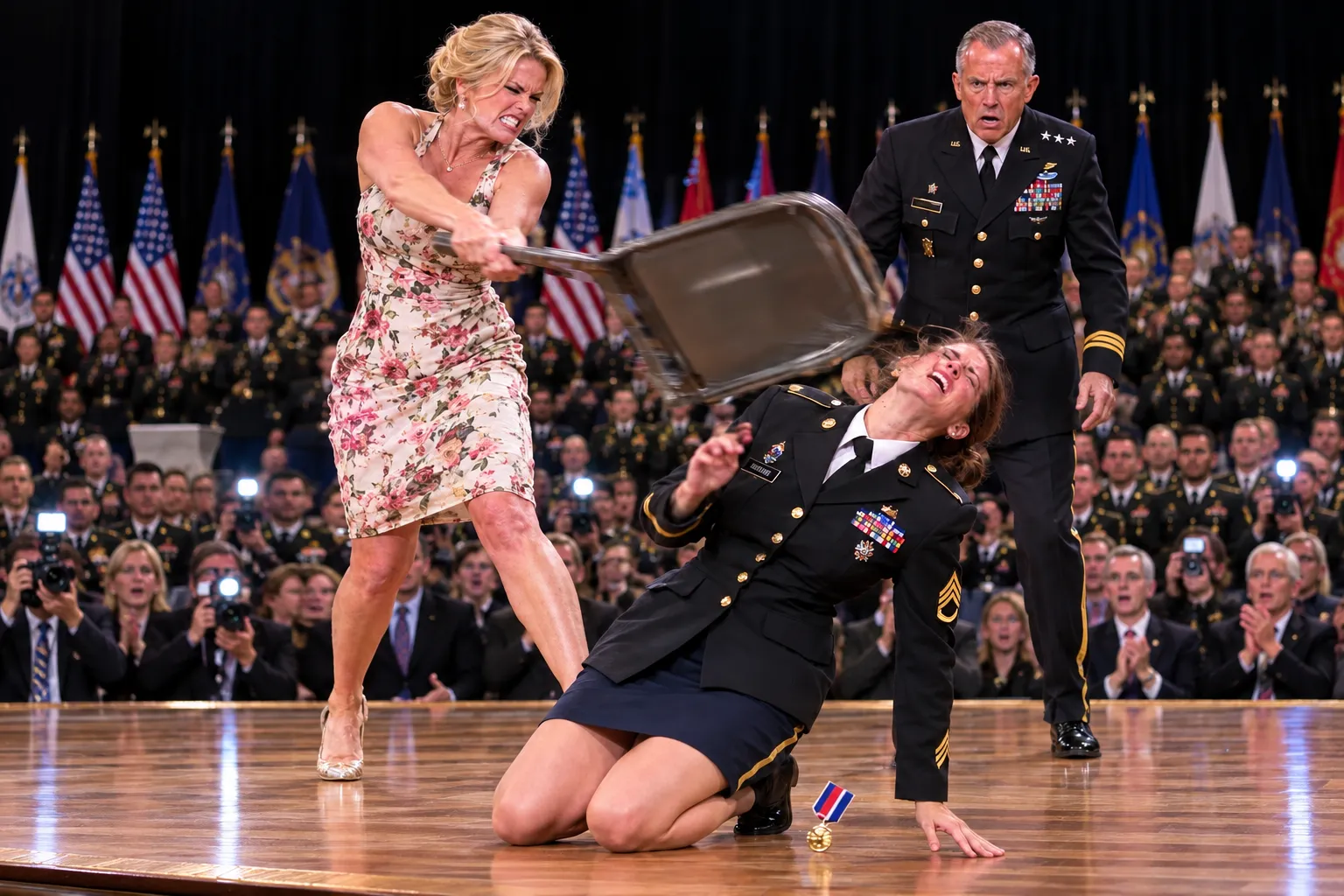
With three hundred people and their cell phones in the auditorium, a video of the incident had inevitably leaked. The footage spread like a California wildfire.
The clip that went viral didn’t start with the chair. It started seconds after the strike.
It showed me injured on the polished floor, Linda screaming, and the towering silhouette of General Hayes declaring, “She is not trash.”
My phone filled with notifications.
Friends I hadn’t spoken to since high school were texting. Civilian news outlets were hounding the base public affairs office.
People online had identified Linda within hours, and her name was being condemned everywhere.
I hated the exposure. I despised being reduced to the “abused soldier” in a sensational article.
But as the days passed, I realized the narrative the public was sharing wasn’t the one Linda had tried to force.
They didn’t see a rebellious daughter destroying her family.
They saw a decorated soldier being attacked by someone who should have cared for her.
Three days into my medical leave, my father texted me.
Linda had been released on bail pending a felony trial. My father had packed his bags and moved into an extended-stay hotel.
Ten minutes later, a text from my stepbrother appeared:
You realize you completely ruined this family, right? I hope you’re happy, psycho.
I stared at the glowing screen.
A year ago, that text would have sent me into a spiral of guilt.
Now, it just felt pathetic.
Before I could formulate a response, another text arrived from my father:
I saw what he sent you. I told him if he ever contacts you like that again, I will cut him off financially. Do not reply to him.
I locked my phone and laid my head back against the pillows.
The war wasn’t over, but the alliances had irrevocably shifted.
Chapter 5: The Auditorium’s Echo
Healing is an agonizingly slow, uneven process.
Bones knit together, but they may never feel quite the same. They might be thicker at the fracture site, yet ache when the winter rain rolls in.
Families can feel much the same.
Sometimes, the healthiest form of healing isn’t resetting the bone perfectly. It’s allowing the fracture to remain visible, a permanent reminder of the boundaries you must protect.
Six long weeks after the disaster, General Hayes requested my presence back at the Fort Bragg auditorium.
The idea made my stomach clench.
I almost declined.
But the General hadn’t made it an order.
“You decide when you’re ready,” he had said.
So I put on my uniform, carefully sliding my healing, braced arm through the tailored sleeve, and drove to the hall.
The massive room was entirely empty, save for General Hayes and Daniel Mercer standing quietly near the front of the stage.
No glaring camera flashes. No reporters. No whispering crowds.
As I walked down the center aisle, my boots echoing in the cavernous space, my mind misfired.
For one terrifying second, I vividly heard the scrape of metal behind me.
My heart hammered against my ribs.
I stopped, my breathing shallow.
Daniel saw my panic. He limped over, leaning on his cane, and stood shoulder-to-shoulder with me.
“You good, sister?” he asked softly.
I swallowed the lump in my throat.
“Not really.”
“Fair enough. Take your time.”
When I finally reached the exact spot on the oak floor where I had fallen, General Hayes stepped forward.
He held out a small, velvet-lined box.
Resting inside was my original Purple Heart.
The gold edges gleamed; the purple ribbon was pristine. One of the medics had carefully wiped the blood off before I was loaded into the ambulance.
“I thought you should have the final say on how this specific memory ends,” Hayes said, his voice gentle.
He lifted the medal from the lining.
“Permission to approach, Sergeant?”
I snapped to attention, ignoring the dull ache in my wrist.
“Yes, sir.”
In the total silence of the empty auditorium, without the fanfare of orchestras or the applause of politicians, General Robert Hayes pinned the medal back onto my chest.
He took a step back and saluted.
“There.”
I looked down at the brass profile of George Washington.
For six weeks, every time I closed my eyes, this medal had been linked to the image of Linda’s twisted, screaming face.
But looking at it now, in the quiet, the darkness receded.
I saw Daniel’s face in the dirt. I saw the smoke of the Korangal Valley.
I felt the profound, unbreakable bond with the soldiers who had carried me out of the fire.
“She didn’t give you that medal, kid,” Hayes said with a smile, reading my mind. “And she absolutely does not possess the power to take its meaning away from you.”
Daniel clapped me on the good shoulder.
“She doesn’t get the last word today.”
I let out a shaky breath, a genuine smile finally breaking across my face.
“Then what is the last word?”
General Hayes looked around the vast, silent room.
“That is entirely up to the person still standing.”
Chapter 6: Walking Out of the Fire
A year is enough time for the world to move on.
Linda entered a plea agreement to avoid a highly publicized trial.
She received three years of supervised probation, mandatory anger management, and a permanent restraining order forbidding her from coming within five hundred feet of me.
My stepbrother stopped calling.
I happily let him fade into obscurity.
My father actually started intensive therapy.
He never once asked me to forgive Linda. He never tried to orchestrate a miraculous holiday reconciliation.
Instead, he simply texted me once a week.
Sometimes it was an article he thought I’d like; sometimes it was just a picture of his coffee.
If I didn’t reply, he didn’t push.
He accepted the boundary.
It was a fragile, distant peace, but it was real.
Nearly fourteen months after the incident, I found myself back in a military auditorium.
But this time, it wasn’t for me.
Daniel Mercer was being officially recognized by the Department of Defense for his tireless advocacy work with disabled combat veterans.
He hated the spotlight just as much as I did.
As the announcer began reading his biography, Daniel stood at the bottom of the stage stairs, glaring at them as if they were a Taliban bunker.
The humidity was making his injured leg ache fiercely.
I stepped up beside him.
“You want a hand, old man?”
He looked at me, a wicked grin spreading across his bearded face.
“Are you sure? Last time we were near a stage together, it didn’t work out so well for your bone density.”
I laughed out loud.
Then I firmly held out my left arm.
My completely healed left arm.
“Shut up and take the arm, Mercer.”
Daniel grabbed my forearm, and together, we climbed the stairs.
Halfway up, I instinctively glanced over my shoulder at the audience.
The trauma response was fading, but the ghost was still there.
I scanned the rows.
No Linda gripping a weapon.
No father staring at his shoes.
No stepbrother mocking me.
There was only a sea of strangers, rising to their feet to applaud a man who had sacrificed so much for them.
Daniel paused before stepping up to the podium. He leaned close to my ear over the roar of the applause.
“You know what I remember most about your ceremony?” he asked.
“The flying furniture?” I joked.
“No.”
His expression turned serious.
“I remember you taking a blow hard enough to break bone, and you still never begged her to stop. You just looked her in the eye.”
I swallowed hard.
“That just sounds like I have terrible self-preservation instincts.”
Daniel shook his head.
“I remember the General saying you weren’t trash. He was right to defend you. But he was fundamentally wrong about one thing.”
I raised an eyebrow.
“Careful, that’s a three-star you’re critiquing.”
“He made it sound like your value was derived entirely from what you did overseas. From your courage under fire.”
Daniel squeezed my shoulder.
“You were never trash before the Army, either. You didn’t need the uniform to be worthy of respect.”
For several seconds, the breath vanished from my lungs.
Because that was the ultimate truth.
That was the sentence nobody had bothered to tell the sixteen-year-old girl crying in the rain because her stepmother threw her backpack outside.
Linda had taught me that I was inherently worthless.
My father’s silence had validated that lesson.
I had spent my entire adolescence believing that if I just achieved enough—if I became a perfect soldier, if I earned enough medals, if I sacrificed enough for others—I could finally purchase my family’s basic decency.
The military had given me a profound sense of purpose. It gave me brothers and sisters I would gladly risk my life for.
But Daniel was right.
The uniform didn’t create my worth.
It merely provided the lens I needed to finally recognize it myself.
The announcer called Daniel’s name, and he stepped into the brilliant spotlight.
I moved to the shadows at the side of the stage.
My arm was healed. The scars from the valley were fading into silver lines.
The viral video had long since been buried beneath the endless churn of the news cycle.
I would never forget the violent sound of that chair breaking my arm.
But I no longer resented the memory in the same way.
Because that sharp crack wasn’t just the sound of bone giving way.
It was the sound of the chains snapping.
It was the end of the belief that accepting perpetual humiliation was the price of keeping a toxic family together.
I had spent my entire adult life walking through fire to save other people.
That day in the auditorium had finally taught me that I no longer had to walk back into the flames for a family who only wanted to watch me burn.
The crowd erupted into a deafening standing ovation for Daniel.
I smiled, raised my hands, and applauded with them.
I felt no fear. I felt no shame.
I didn’t check my six o’clock for a swinging chair.
And this time, as the thunderous applause filled the room, absolutely nothing broke.
Not my arm.
Not my spirit.
Not me.
Latest Posts
- My Husband Mocked My Postpartum Appearance in His Brothers’ Group Chat—I Stayed Quiet for Five Days
Four months after giving birth, I thought my husband understood why I hardly recognized myself. Then I discovered the cruel joke he'd been sharing with his brothers, along with photos I never knew he'd taken. I kept my discovery secret for five days, determined to make him regret every word. “Dude, you weren't exaggerating 😂” …
- My Stepdaughter Called Me the Help Until My Envelope Changed Everything
The insult came before I’d even finished setting down the peach cobbler. I’d baked it at five that morning in the kitchen of the lake cabin we’d rented, and it was still warm under the foil. The smell of cinnamon followed me across the grass toward the pavilion tables, where thirty-two members of the Cole …
- My In-Laws Gave Their Other Three Children $20,000 for Houses and Gave Us Only a Card Two Years Later, We Bought the Old Miller Place for $41,500
The envelopes were tucked under the Easter plates. Each had a name written on it in my mother-in-law’s round schoolteacher handwriting. Kim opened hers first. She’s the oldest. Divorced two years. Raising two boys in a rented trailer behind the grain elevator. She looked at what was inside the envelope and put her hand flat …
- My Mother-in-Law Told Me to Lose Weight After Giving Me a Dress That Didn’t Fit, but Minutes Later, She Regretted Everything
I couldn’t get it over my hips. I stood in my bedroom in my underwear with the dress bunched around my thighs like a deflated balloon. Midnight blue silk. A designer label I’d only ever seen in magazines. Tiny pearl buttons down the back. Beautiful. And four sizes too small. I pulled. I tugged. I …
- Teen Wore a Dress to His Best Friend’s Funeral—The Family Nearly Had Him Removed Before He Reached the Microphone
My son’s best friend read the eulogy at his funeral in a red dress. I almost had him removed before he reached the microphone. My son Jack died 17 days after his 18th birthday. Cancer. Fourteen months from diagnosis to funeral. We found out late. Too late, as it turned out, and the treatment never …