After signing the divorce papers, my mother-in-law gave me 24 hours to leave. I opened the safe, grabbed documents, and called a luxury car. She sneered, “Trying to show off now?” I smiled. “Tomorrow, you’ll understand exactly why.”
The Architecture of a Lie
Autumn in Seattle never arrived gently.
It came with cold rain, sharp wind, and the kind of damp chill that settled beneath your clothes and refused to leave.
Beyond the enormous windows of the Rhodes estate, the storm had finally weakened into a thin drizzle. Lake Washington stretched beneath the gray sky like hammered metal while the old maple trees bent in the wind.
Inside, everything was bright, polished, and perfectly controlled.
And I had just signed my divorce papers.
At least, that was what they believed mattered most.
I stared at the black ink drying beneath my signature and realized something I should have understood years ago.
For almost six years, I had been living in a house that had never truly been mine.
My name is Leah Sutton.
I was thirty-six years old and a lead architect.
Across from me sat Julian Rhodes, my newly divorced husband and the celebrated CEO of Vanguard Architects.
Beside him sat his mother, Eleanor Rhodes.
For years, I had called her Mom.
That afternoon, she looked at me as though I were a stranger who had overstayed her welcome.
Julian’s younger sister, Mila, lounged on the velvet sofa nearby, barely glancing up from her phone.
People often describe divorce as one dramatic moment when everything suddenly breaks.
For me, it was quieter than that.
The worst part was realizing that the people I had spent years supporting were simply waiting for me to disappear so they could keep everything I had helped create.
Eleanor calmly placed her teacup on its saucer.
“The papers are signed,” she said. “From this moment forward, you are no longer part of this family.”
She leaned back and smiled.
“You have twenty-four hours to get out of my house. Take your cheap clothes, whatever little belongings are actually yours, and make sure nothing from this family leaves with you.”
Then she looked toward the staircase.
“In fact, I expect you to collect your personal belongings and leave tonight.”
I stared at her.
She continued.
“You may take your clothing and personal items. But company documents, blueprints, digital drives, or anything connected to Vanguard stays here unless you can prove it belongs exclusively to you.”
Mila finally laughed.
“I suppose we should start calling you Miss Sutton again.”
She glanced at me with a satisfied smile.
“Good luck starting over. And please don’t come asking Julian for money when reality catches up with you.”
I ignored her.
Instead, I looked at Julian.
He sat forward in his chair, staring at the marble floor. He was wearing the slate-gray shirt I had chosen for our fourth anniversary.
“Do you really have nothing to say?” I asked.
Julian tightened his jaw.
“Leah, Mom is just establishing boundaries.”
He finally looked at me.
“Let’s not make this harder than it already is.”
Boundaries.
His mother was ordering me out of the home I had helped redesign while warning me not to touch anything connected to the company I had helped build.
And Julian called that boundaries.
There was no apology.
No embarrassment.
Eleanor leaned forward.
“Do not make yourself into a victim.”
Her expression hardened.
“This family gave you opportunities you never would have had otherwise. You came into this house with very little, and you should be grateful for everything you received.”
I almost laughed.
Very little.
For years, I had stayed awake until three in the morning drafting designs that helped keep Vanguard competitive.
I had watched my name disappear from presentations built around concepts I created.
I had allowed project bonuses I earned to be moved into shared financial structures because Julian insisted it was best for our future.
And somehow, I was still the one who had contributed nothing.
“If she’s leaving, she should leave now,” Mila said.
Then she added with a smirk, “People who arrive with nothing sometimes become very interested in taking things when they go.”
“Mila, enough,” Julian muttered.
But even then, he wasn’t defending me.
He simply didn’t like how ugly her words sounded inside his elegant living room.
I stood.
The leather chair shifted beneath me as I placed my copy of the divorce papers inside my tote.
“I understand.”
Eleanor smiled.
She mistook my calmness for defeat.
I looked directly at her.
“And Eleanor?”
Her smile weakened.
“That is the last time I will ever call you Mom.”
Silence filled the room.
Mila finally looked up from her phone.
Julian’s expression changed for only a second, but I saw it.
Concern.
Eleanor stared at me.
“What did you just say?”
I didn’t repeat myself.
Some things only need to be said once.
I turned and walked upstairs.
Every step reminded me of the renovation work I had once supervised throughout the house.
My office was on the third floor at the end of a long hallway.
I stepped inside and locked the door.
Seconds later, Eleanor’s voice carried up from downstairs.
“Mila! Go watch her. Make sure she doesn’t leave with company property.”
I almost smiled.
They were terrified I might steal a blueprint.
They had no idea that the documents capable of changing everything had been sitting only a few rooms away for years.
I walked toward the large oak bookshelf beside my drafting table and pushed it aside.
Behind it was a gray biometric safe mounted into the wall.
I pressed my thumb to the scanner and entered the code my late grandmother, Nana Rose, had taught me long ago.
The light turned green.
The safe opened.
There was no jewelry inside.
No stacks of cash.
Nothing Eleanor would have considered valuable.
I had never cared much about expensive objects.
What I cared about was documentation.
I removed a thick manila folder tied with red string.
Then an encrypted hard drive.
Finally, an old envelope containing a photograph of Nana Rose.
Inside the folder were original incorporation documents connected to Vanguard Architects.
There were copyright records tied to the earliest designs for Riverbend Commons, one of the company’s largest projects.
There were photographs and copies of documents showing exactly what I had signed—and what had later appeared under my name.
There were also financial statements documenting transactions that had never been properly explained to me.
One sheet of paper meant very little.
Together, they told a story.
And that story was not the one Julian’s family had been telling for years.
The encrypted drive held the supporting project records and correspondence I had preserved, including the negotiations and agreements behind work the family so often described as Julian’s achievement.
I put the folder and drive with my belongings.
Then I called Arthur Vance.
“I’m leaving,” I told him. “I have the records.”
He asked only whether I was safe and where the car should collect me.
A hard knock hit my office door soon afterward.
“Leah, open up!”
Mila.
“Mom told me to make sure you’re not taking anything!”
I unlocked the door.
The moment it opened, Mila’s eyes moved past me, searching the room.
“What took you so long?” she demanded. “Are you planning to dismantle the whole company before you leave?”
I looked at her calmly.
“Relax, Mila.”
I lifted the folder.
“What I’m taking is mine.”
She narrowed her eyes.
“You’re being incredibly condescending.”
“I’m simply adjusting to our new relationship.”
I finished packing and pulled my suitcase into the hallway.
Then I carried everything downstairs.
Less than an hour had passed since I had left the living room.
Eleanor was already waiting by the front entrance with her arms crossed.
She looked less like a woman saying goodbye and more like someone supervising an eviction.
“Open the suitcase.”
I stopped.
“What?”
“The suitcase. I want to see exactly what you’re taking.”
I placed it on the Persian rug and unzipped it.
Inside were a few work dresses and two blazers.
My personal laptop.
My passport.
Nana Rose’s photograph and the small frame I had brought from my desk.
The encrypted drive.
And the folder tied with red string.
Eleanor glanced inside and scoffed.
“For years, I wondered what you kept hidden in that ridiculous safe. I thought you were hiding corporate secrets upstairs.”
She pointed toward the folder.
“Apparently it’s just a pile of useless papers.”
Mila stepped forward and reached for it.
I moved the folder away before she could touch it.
“Mila.”
She froze.
“This belongs to me.”
Her face tightened.
“You have no right to take company documents.”
“You have no right to touch my personal property.”
For the first time, hearing her name without the warmth of “sister” seemed to unsettle her.
Eleanor waved dismissively.
“Let her take her little papers.”
She smiled.
“It’s probably some pathetic diary filled with complaints about this family.”
I closed my suitcase.
“You’re half right.”
Eleanor raised an eyebrow.
“I am taking my memories with me.”
I picked up the folder.
“They just happen to be very well documented.”
Julian finally stepped forward from the living room.
“Leah, please.”
His voice was softer now.
“Does this really have to become so hostile?”
I looked at the man I had once loved.
There had been a time when I had expected to grow old with him.
Strangely, I felt almost nothing.
“Julian, from now on, I think Miss Sutton would be more appropriate.”
His expression changed.
I continued.
“We wouldn’t want anyone getting the wrong idea about how close we still are. We should probably keep things formal.”
I paused.
“Especially around the press.”
The color faded slightly from his face.
Eleanor noticed.
“What is that supposed to mean?”
Before I could answer, the low sound of a car engine rolled through the driveway.
Everyone turned toward the front windows.
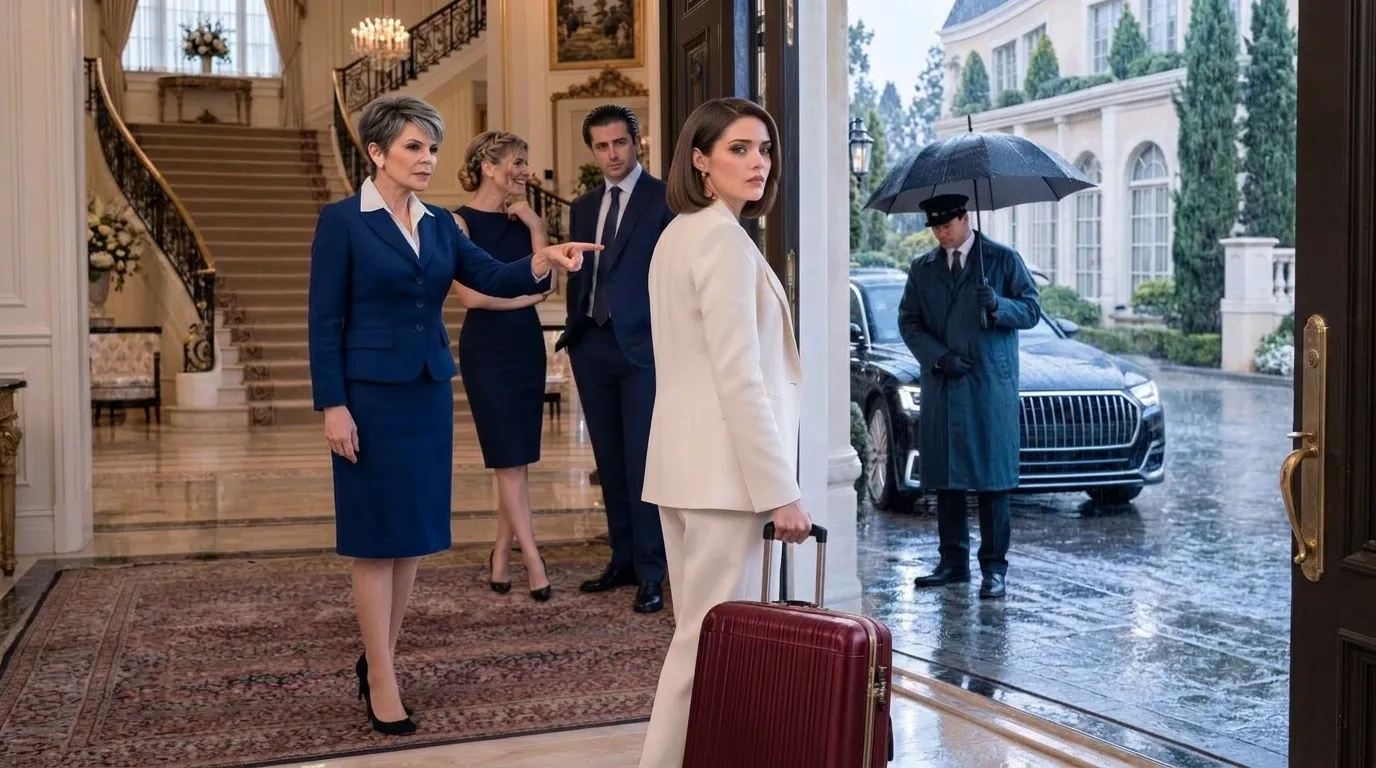
A sleek black luxury sedan stopped outside.
A driver wearing a tailored suit stepped into the rain with a large umbrella.
When I opened the door, he nodded politely.
“Miss Sutton, Mr. Arthur Vance sent the car for you.”
The entire foyer went quiet.
Arthur Vance was a former university professor, a respected investor, and a ten-percent stakeholder in Vanguard Architects.
Senior partners, board members, and executives listened when he spoke.
More importantly, he was one of the few people Eleanor Rhodes never dismissed.
Mila stared at me.
“Arthur Vance sent a private car for you?”
Eleanor recovered first.
She gave a cold laugh.
“So this is your grand exit? A luxury car to make everyone think you’re important?”
I ignored her.
I slipped my laptop into my tote, lifted my bag, and tucked the folder against my chest.
Eleanor’s jaw tightened.
“Once you leave this house, do not imagine that you can come back asking for help.”
The driver held the door open.
Cold, rain-scented air entered the foyer.
“Don’t worry, Eleanor,” I said. “I won’t be coming back to ask you for a place to stay.”
Her smile returned.
“Then what exactly would you ever come back for?”
I looked beyond her.
At the imported marble.
The carved oak staircase.
The enormous windows and portraits.
The elegant rooms.
Everything represented the Rhodes legacy: the company, the wealth, the reputation.
A legacy built, in part, on work they preferred to pretend was never mine.
For years, they had convinced themselves that Julian was the center of all of it.
Eleanor believed the company survived because of her family’s name.
Julian believed his title meant he was indispensable.
Neither of them had ever bothered to ask what happened behind closed doors when a major contract nearly collapsed.
Or who stayed up until two in the morning rewriting negotiation terms.
Or who quietly repaired damaged client relationships before executives even realized they were in danger.
They didn’t know who had rebuilt some of Vanguard’s most profitable agreements.
They didn’t know which partnerships survived because I had stepped in.
And they certainly hadn’t considered how many of those arrangements depended on protections, clauses, and contacts that had very little to do with Julian.
I knew.
Because I had created many of them.
And the proof was inside the folder in my hands.
Eleanor was still watching me.
I smiled.
“You’ll understand tomorrow.”
Then I stepped into the rain.
The brick walkway reflected the golden lights of the mansion behind me.
The driver took my suitcase and placed it in the trunk.
I got into the sedan with the folder beside me.
The door closed.
The voices behind me disappeared.
As the car moved down the long driveway, I watched the mansion grow smaller through the side window.
Then the iron gates closed behind us.
I didn’t turn to look again.
My hands were trembling.
But not because I wanted to return.
And not because I was afraid of Eleanor.
They were shaking because, after almost six years, I had finally walked away without asking anyone’s permission.
That evening, they believed they had removed an embarrassing ex-wife who no longer belonged.
They hadn’t pushed out someone dependent on their name.
They had pushed away the person who knew exactly which parts of their empire were holding by a thread.
Leaving the estate wasn’t the end.
It was only the beginning.
Because tomorrow, the documents in my bag were going to force the Rhodes family to confront everything they had spent years pretending didn’t exist.
Arthur was waiting when the car reached his office.
He didn’t ask whether I regretted leaving.
He looked at the folder in my arms.
“Are those the originals?”
“Yes.”
“And the records you told me about?”
“On the drive.”
He led me to a conference table and waited while I untied the red string.
I laid out the incorporation documents first.
Then the Riverbend Commons copyright records.
Then the copies showing what I had signed—and what had later appeared under my name.
Arthur read without interrupting.
When he reached the financial statements, he took off his glasses.
“Does Julian know you kept all of this?”
“He knows I keep records.”
“That isn’t what I asked.”
“No,” I said. “He doesn’t know how much.”
Arthur placed the statements beside the signature records.
“We need an independent review. Not a family conversation.”
For the first time that day, someone had described the problem without telling me to be grateful, reasonable, or quiet.
He looked at me.
“What do you want, Leah?”
I had spent years preparing the evidence.
Until that moment, I had barely allowed myself to prepare an answer.
“I want my work acknowledged. I want to know where my earnings went. And I want them to stop using my name as permission for decisions I never made.”
Arthur nodded.
“Do you want to stop the projects?”
“No.”
My answer came quickly enough to surprise us both.
“There are people working on those projects who have done nothing wrong. There are clients waiting for buildings, not a family argument.”
“Then we keep those things separate.”
He drew the folder closer.
“But you understand this won’t be resolved in a morning.”
“I know.”
Tomorrow was not going to make me the owner of their house or erase six years.
It was going to end their ability to pretend there was nothing to answer for.
With my permission, Arthur contacted the board and arranged for independent counsel to attend a meeting the following morning. He made it clear that the concerns involved disputed authorizations, financial records, and rights connected to active company projects.
He did not tell them that every allegation was already proven.
He told them the documents required examination.
Then he helped me make an inventory of what I had brought.
Each original was recorded. Copies were prepared for review. The encrypted drive stayed under my control while the relevant files were copied securely.
For once, being careful did not mean being difficult.
It meant someone else understood why care mattered.
By the time I reached the hotel room I had booked for myself, it was late.
I set Nana Rose’s photograph in its frame beside the bed.
My phone lit up.
Julian.
Then Eleanor.
Then Julian again.
I turned the phone facedown.
For almost six years, a ringing phone had meant someone needed a problem solved.
That night, I let it ring.
At eight the next morning, I put on one of the blazers Eleanor had watched me pack.
The sleeve had a loose button. I tightened it with the small sewing kit in my suitcase.
It was such an ordinary thing to do before something that frightened me.
Perhaps that was why it helped.
I arrived at Vanguard with my folder beneath my arm.
The reception area looked exactly as it had the week before.
The same pale stone counter. The same architectural models behind glass. The same photographs of completed projects along the wall.
I had worked on several of them.
My name appeared on none of the display cards.
Arthur met me outside the boardroom.
“Ready?”
“No,” I said.
He nodded.
“We can go in anyway.”
Julian was already seated when we entered.
Eleanor stood behind his chair.
She looked at my folder before she looked at me.
“This is completely unnecessary,” she said.
I took the empty seat beside Arthur.
“Then it should be easy to clear up.”
The board had agreed that independent counsel would lead the preliminary review. Eleanor had been allowed to attend, but this was not her living room.
When she began speaking again, she was asked to wait.
I watched her realize that the interruption would stand.
Julian leaned forward.
“Leah, surely we can discuss this privately.”
“We did discuss things privately,” I said. “For years.”
“This is about the divorce.”
“No. The divorce is why I stopped agreeing to silence. It isn’t what these records are about.”
I opened the folder.
The incorporation documents came first.
They did not reveal that I secretly owned the entire company.
They showed something simpler: the company’s own early records did not support the family’s version of a wife who had arrived with nothing and contributed nothing.
My professional involvement was recorded.
My contributions were recorded.
They had not disappeared because Eleanor no longer wanted me at her table.
Next came Riverbend Commons.
I placed the copyright records beside the project documents and opened the corresponding dated files from the drive.
“These are the earliest designs,” I said. “These are the records of my authorship. And these are the later company presentations.”
Julian looked down.
A board member studied the pages.
“Why is the design attribution different?”
Julian rubbed a hand across his jaw.
“Projects evolve. It was a team effort.”
“Yes,” I said. “And the team deserves credit. That doesn’t explain removing mine.”
I put two versions of another document side by side.
“This is what I signed.”
I touched the second copy.
“This is what later appeared under my name.”
The room grew quiet.
Counsel leaned forward.
“Did you approve these changes?”
“No.”
“Did you sign this version?”
“No.”
Julian began to speak.
“I handled the administrative side. Leah knew that.”
“I knew you handled administration,” I said. “That is not the same as agreeing to every document produced afterward.”
Eleanor made an impatient sound.
“You were his wife.”
I looked at her.
“I was also the person whose name was on those pages.”
Counsel asked that both versions be preserved for comparison with the company’s records.
No one announced a verdict.
No one needed to.
For years, a question from me had been treated as disloyalty.
Now the same question was being written down as something Vanguard had to answer.
Then came the financial statements.
I pointed to the project bonuses I had earned and the movements through the shared financial structures Julian had described as our future.
“I’m not asking this room to decide every payment today,” I said. “I’m asking for a full accounting. I want the authorizations matched to the transactions.”
Julian stared at the statements.
“I told you we were managing everything together.”
“You told me we were planning together.”
I waited until he looked at me.
“That should have meant I could see where the money went.”
Arthur had said little until then.
Now he placed his hands on the table.
“As an investor, I need to know whether the company’s records accurately reflect its obligations. So does every other stakeholder.”
Eleanor turned toward him.
“Arthur, you cannot seriously be allowing a bitter divorce to jeopardize Vanguard.”
He met her eyes.
“The documents are not jeopardizing it, Eleanor. Failing to address them might.”
I opened the final group of files.
They were not grand discoveries hidden in mysterious accounts.
They were working records.
Late-night revisions. Contract negotiations. Client correspondence. The agreements I had helped rebuild when they were close to falling apart.
I showed where design rights and permissions had been addressed.
Where approvals had been required.
Where my continued professional involvement had been part of the understanding on which a client proceeded.
“These arrangements need a proper handover,” I said. “Some need clarification. You can’t simply remove me from the house, leave my name attached to everything, and assume nothing else has changed.”
One of the directors asked, “Are you refusing to cooperate?”
“No. I am refusing to have cooperation mistaken for ownership of my time, my work, and my consent.”
For the first time that morning, my voice stopped trembling.
“I will help protect the clients. I will not pretend the records are accurate where they aren’t.”
Julian pushed his chair back slightly.
“Why didn’t you tell me you were doing this?”
I looked at him.
“I asked you to explain the statements. I asked why my name disappeared. I asked about documents I didn’t recognize.”
“That’s not what I mean.”
“I know.”
He had not meant why I had concerns.
He had meant why I had finally taken them to people he could not dismiss.
The board authorized an independent examination of the financial transactions, disputed signatures, and project-rights records.
Relevant files were to be preserved. Changes involving the disputed matters would require independent approval while the review continued.
Julian was asked to step away from decisions directly connected to the concerns.
The review would take time.
But before the meeting ended, the company had agreed in writing to the first steps.
Not a promise over dinner.
Not Julian telling me he would take care of it.
Something I could keep.
Outside the boardroom, Eleanor caught up with me.
Her voice was low.
“You have embarrassed this family.”
I held the folder against my side.
“You called these useless papers.”
She glanced toward the closed door.
For a moment, I thought she might apologize.
Instead, she said, “You could still make this easier.”
“I am making it clearer.”
Julian came out behind her.
“Leah. Please. Five minutes.”
Arthur looked at me, leaving the choice where it belonged.
I nodded.
Eleanor waited for Julian to come to her.
This time, he did not.