At 8:03 the next morning, Garrett stood inside the main boardroom of the company my parents had spent their lives building.
I watched from a private conference room down the hall through a secured video feed.
Garrett wore a black suit.
Penelope wore black too.
Her hand rested protectively over her stomach.
If I hadn’t watched them embrace beside the river, I might have believed their grief.
Garrett addressed the directors quietly.
“There is still a recovery operation underway.”
He lowered his head.
“But given the circumstances, we have to prepare for the possibility that Rosalind and Tobias are gone.”
Gone.
He couldn’t even say dead.
Perhaps saying it aloud would have made the lie too real even for him.
Penelope dabbed at her eyes.
Garrett continued.
“The company needs stability.”
Of course it did.
He produced documents.
Emergency voting proxies.
Draft trust notices.
A proposed temporary governance structure.
Most had been prepared before the crash.
That detail would later matter greatly.
A director asked:
“Why were these documents drafted before yesterday?”
Garrett hesitated.
“Estate planning.”
Then Tobias looked at me.
“Ready?”
No.
But I stood anyway.
The boardroom doors opened.
Garrett stopped speaking.
Every face turned.
I walked in first.
Still bruised.
Still exhausted.
Very much alive.
Penelope screamed.
Garrett staggered backward.
Then Tobias entered behind me.
Walking.
No wheelchair.
The shock on Garrett’s face almost looked like physical pain.
“Tobias?”
My brother smiled without warmth.
“Surprise.”
Penelope’s hand flew to her mouth.
Garrett looked toward the exits.
Investigators were already standing there.
He finally looked at me.
“Rosalind…”
I had imagined this moment during the night.
I thought I would scream.
I didn’t.
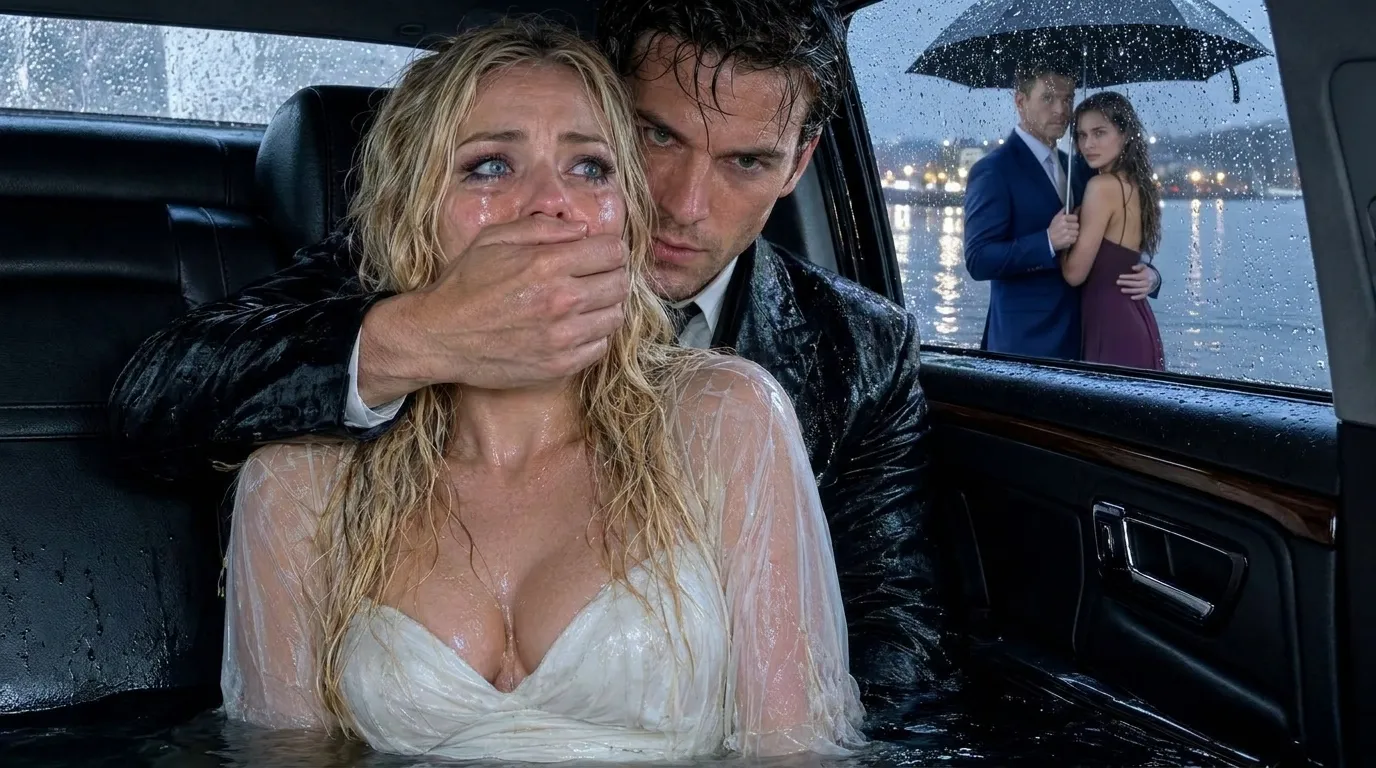
“You left me underwater.”
His face changed.
“You don’t understand.”
“I understand the wire beneath my seat.”
Silence.
“I understand the altered door.”
He looked at Penelope.
“I understand your messages.”
Penelope began crying.
I continued.
“And I understand the medication you’ve been putting into my milk for three years.”
That was the moment Garrett’s performance ended.
His face went completely still.
Several directors stared at him.
One whispered:
“What medication?”
Garrett turned toward the investigators.
“This is a family dispute.”
The lead investigator answered:
“No, Mr. Garrett. It stopped being a family dispute when two people were deliberately left inside a sinking vehicle.”
Penelope broke first.
Perhaps she believed Garrett would protect her.
Perhaps she saw immediately that he couldn’t.
She began insisting she had not known every detail.
She admitted the affair.
She admitted the pregnancy was Garrett’s.
She admitted they expected control of the shipyard after Tobias and I died.
But she claimed Garrett had told her the crash would look like an accident and that nobody would ever connect them to it.
I stared at her.
“You stood on the shore.”
Her face collapsed.
“I was scared.”
“You watched us sink.”
“I’m sorry.”
I looked at the child she was carrying.
For a second, anger wanted to turn cruel.
I stopped it.
The baby had done nothing.
Whatever happened to Penelope would be decided by evidence and the courts.
I would not spend the rest of my life confusing justice with revenge.
The deeper investigation reopened the case involving our parents.
The old crash file was examined again.
Financial records Tobias had preserved were compared with newly recovered communications from Garrett’s family.
A former subcontractor finally agreed to cooperate.
Payments that had looked meaningless fifteen years earlier now formed a pattern.
Our parents had discovered fraudulent contracts linked to Garrett’s father.
They had intended to terminate the relationship and turn the evidence over to authorities.
They died before they could.
Tobias had been right.
Their accident had been staged.
He had carried that knowledge alone for years because he could never prove enough of it.
Until Garrett repeated the family’s method of solving problems.
Make it look accidental.
Control the paperwork afterward.
Count on money and grief to keep everyone from looking too closely.
I asked Tobias one question repeatedly during those first weeks.
“Why didn’t you tell me you could walk?”
His answer never changed.
“At first, because I couldn’t.”
He had truly lost most use of his legs after the crash.
Years of rehabilitation restored enough strength for him to stand and eventually walk short distances.
He still lived with pain.
He still used mobility support on difficult days.
But once he realized people connected to our parents’ deaths continued monitoring the family, he let the public believe nothing had changed.
“It made them underestimate me.”
“It made me underestimate you too.”
“I know.”
That hurt him.
Good.
I loved my brother, but love did not mean pretending his secrecy had caused no damage.
We had a great deal to repair between us too.
The difference was Tobias stayed to repair it.
The medical part was harder.
Doctors explained that the sedative Garrett had been secretly giving me could account for much of the unusual fatigue, heavy sleep, and memory fog I had experienced.
It took time before I stopped questioning myself.
For weeks, I would walk into a room and forget why I was there.
My first thought would be:
Maybe Garrett was right. Maybe there is something wrong with me.
Then I would remind myself:
Garrett had trained me to think that.
Recovery wasn’t simply waiting for the substance to leave my system.
It was learning to trust my own mind again.
That took longer.
The company investigation found that while I slept, Garrett had accessed confidential files repeatedly.
Some documents contained copies of my signature.
Others were draft consents he intended to use once I was gone.
None of the fraudulent transfers ultimately survived legal review.
The board froze every disputed transaction.
Garrett never gained control of the shipyard.
Neither did Penelope.
For the first time since our parents died, Tobias and I also reviewed the family trust together from beginning to end.
No assumptions.
No secrets.
No unexplained authority.
We added independent trustees and stronger safeguards so that no spouse, sibling, or executive could quietly manipulate succession again.
I had learned what happens when love is treated as a substitute for oversight.
The criminal cases took more than a year.
Garrett was eventually convicted of charges arising from the attempted killing, conspiracy, fraud, and the secret drugging.
Penelope entered a guilty plea to her role in the conspiracy and cooperated with investigators.
Garrett’s father faced a separate prosecution connected to the long-running financial scheme and the evidence surrounding our parents’ deaths.
The outcomes did not bring Mom and Dad back.
Nothing could.
And I discovered something strange.
The day the verdicts came, I didn’t feel triumphant.
I felt tired.
Justice was necessary.
But it wasn’t the same as healing.
My divorce from Garrett was finalized quietly.
He once sent me a letter through his attorney.
I almost threw it away unopened.
Instead, I read it once.
He claimed that somewhere along the way, his feelings for me had become real.
That perhaps the marriage started as a plan but stopped feeling like one.
For several minutes, I sat with that possibility.
Then I folded the letter.
Maybe he had loved me in whatever broken way he understood love.
It changed nothing.
Someone can feel something for you and still choose to destroy you.
Love that requires you to ignore betrayal is not safety.
I never answered.
Penelope gave birth while her case was still proceeding.
I did not visit her.
But I made one thing clear through our attorneys.
Whatever happened between Penelope and me, her child would never be punished for the choices of its parents.
That surprised Tobias.
“After what she did?”
“The baby didn’t stand on the shore.”
He nodded.
Nothing more needed to be said.
Two years after the river, Tobias and I stood on a rebuilt pier outside the shipyard.
He had a cane beside him.
He hated using it.
I had stopped pretending not to notice.
The shipyard still bore our family name.
But it was different now.
Independent compliance.
Employee representation on safety committees.
Clear succession rules.
No executive could approve a related-party transaction alone.
The changes weren’t dramatic enough for newspapers.
They were important enough for us.
We created a memorial apprenticeship fund in our parents’ names.
Not a statue.
Our father would have hated a statue.
He believed the best memorial to someone who built things was to teach somebody else how to build.
One evening, Tobias and I drove back toward Savannah Creek.
Not to the exact place where the SUV went into the water.
Close enough.
We parked.
For a while, neither of us spoke.
Then I asked:
“When you told me to play dead, were you scared?”
He laughed softly.
“Terrified.”
“You looked calm.”
“So did you.”
“I was not calm.”
“Neither was I.”
I looked toward the river.
The water appeared peaceful.
That almost offended me.
How could something hold one of the worst moments of my life and still look beautiful?
Then I realized the river had never betrayed me.
People had.
The water had simply been water.
I thought about Garrett standing on the shore.
Penelope beneath the umbrella.
My seat belt wired beneath me.
The nightly cup of warm milk.
My parents.
Tobias rising from a wheelchair I thought defined him.
All the things I had mistaken for truth because somebody I trusted told me they were.
“I spent three years thinking Garrett was taking care of me,” I said.
Tobias looked at me.
“He wanted you dependent on his version of reality.”
“I know.”
Then he asked:
“Do you trust yourself now?”
I considered the question.
“Most days.”
“That’s enough.”
“No.”
I smiled.
“It’s a start.”
I no longer drink warm milk before bed.
Not because milk did anything wrong.
Because some memories attach themselves to ordinary things.
Instead, I make tea.
I make it myself.
The first few months, that small ritual felt ridiculous.
Then I understood why it mattered.
I watched the water boil.
I opened the container.
I chose what went into the cup.
I carried it upstairs with my own hands.
Control can return in very small ways.
So can trust.
People who hear what happened usually focus on Tobias.
The supposedly paralyzed brother who suddenly stood inside a sinking SUV.
They ask how he did it.
They ask how long he had been able to walk.
They ask why he kept the secret.
Those are fair questions.
But that is not the part I remember first.
I remember Garrett’s face on the shore.
Because for three years, I thought I knew that face better than anyone.
Then, with water reaching my neck, I finally saw him clearly.
The hardest truth wasn’t that my husband tried to kill me.
It wasn’t even that he loved my half sister.
The hardest truth was realizing he had spent years changing what I believed about myself so that, when the final betrayal came, I would be too uncertain to recognize everything leading up to it.
He failed.
Tobias pulled me from the SUV.
Investigators uncovered the evidence.
The courts dealt with the people responsible.
But the part nobody else could do for me came afterward.
I had to reclaim my own judgment.
My own memories.
My own name.
My own life.
Garrett believed the river would erase us.
Instead, it exposed him.
He believed Tobias’s wheelchair made my brother powerless.
It made him invisible enough to see what everyone else missed.
And he believed years of making me doubt myself would leave me helpless when I finally learned the truth.
He was wrong about that too.
Because the last time I looked across Savannah Creek, I no longer saw the place where my life ended.
I saw the place where the lie did.
Garrett drove us into the river expecting the water to bury the truth.
Instead, it washed everything false away.
THE END.
Latest Posts
- My Husband Mocked My Postpartum Appearance in His Brothers’ Group Chat—I Stayed Quiet for Five Days
Four months after giving birth, I thought my husband understood why I hardly recognized myself. Then I discovered the cruel joke he'd been sharing with his brothers, along with photos I never knew he'd taken. I kept my discovery secret for five days, determined to make him regret every word. “Dude, you weren't exaggerating 😂” …
- My Stepdaughter Called Me the Help Until My Envelope Changed Everything
The insult came before I’d even finished setting down the peach cobbler. I’d baked it at five that morning in the kitchen of the lake cabin we’d rented, and it was still warm under the foil. The smell of cinnamon followed me across the grass toward the pavilion tables, where thirty-two members of the Cole …
- My In-Laws Gave Their Other Three Children $20,000 for Houses and Gave Us Only a Card Two Years Later, We Bought the Old Miller Place for $41,500
The envelopes were tucked under the Easter plates. Each had a name written on it in my mother-in-law’s round schoolteacher handwriting. Kim opened hers first. She’s the oldest. Divorced two years. Raising two boys in a rented trailer behind the grain elevator. She looked at what was inside the envelope and put her hand flat …
- My Mother-in-Law Told Me to Lose Weight After Giving Me a Dress That Didn’t Fit, but Minutes Later, She Regretted Everything
I couldn’t get it over my hips. I stood in my bedroom in my underwear with the dress bunched around my thighs like a deflated balloon. Midnight blue silk. A designer label I’d only ever seen in magazines. Tiny pearl buttons down the back. Beautiful. And four sizes too small. I pulled. I tugged. I …
- Teen Wore a Dress to His Best Friend’s Funeral—The Family Nearly Had Him Removed Before He Reached the Microphone
My son’s best friend read the eulogy at his funeral in a red dress. I almost had him removed before he reached the microphone. My son Jack died 17 days after his 18th birthday. Cancer. Fourteen months from diagnosis to funeral. We found out late. Too late, as it turned out, and the treatment never …