“Don’t try to open the door, Rosalind. It’s already too late for you.”
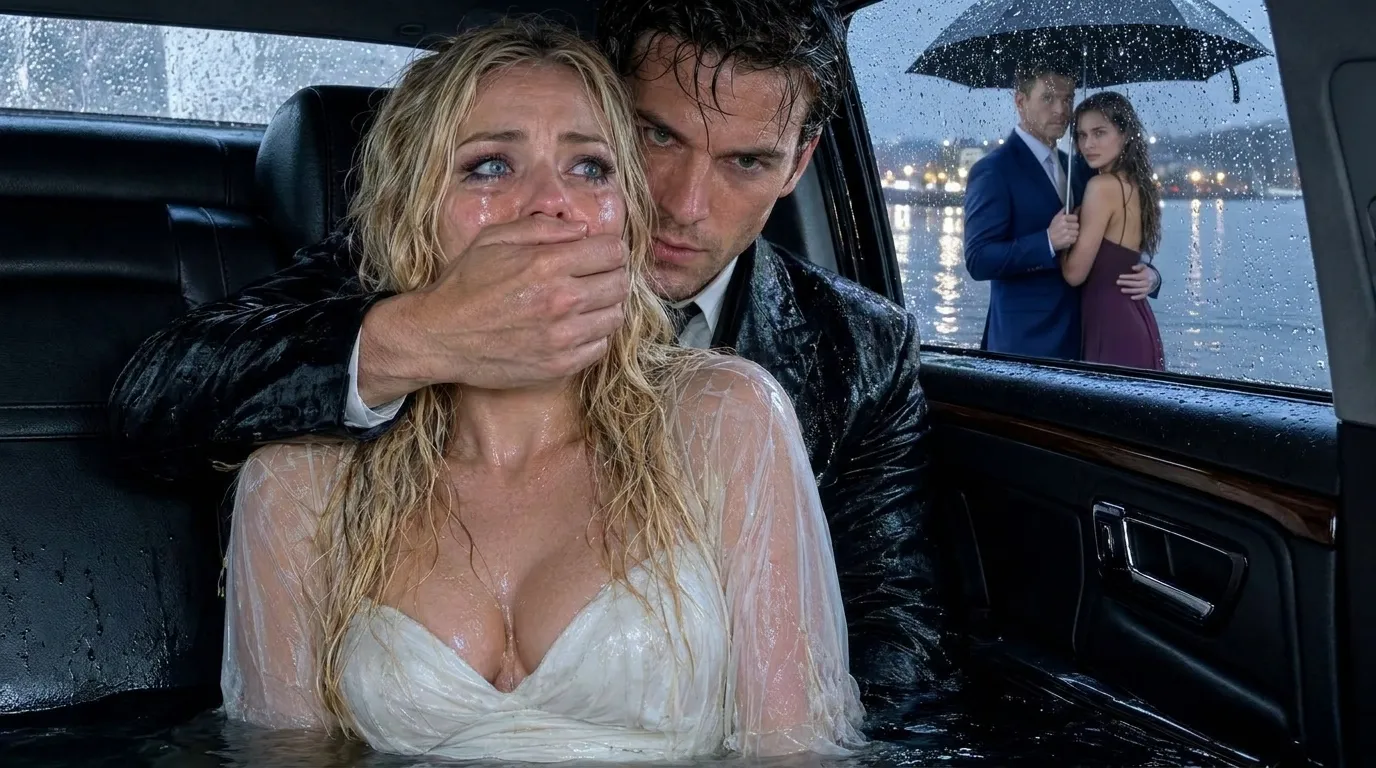
Those were the last words I heard from my husband before he climbed through the SUV window and left my brother and me inside a sinking vehicle.
Everything happened so quickly that my mind kept trying to turn it into an accident.
Garrett was driving along the coastal road toward Savannah Creek.
My brother, Tobias, sat in the back beside the wheelchair he had used since the accident that killed our parents fifteen years earlier.
Then the SUV suddenly veered.
We crashed through the barrier.
The world became water.
When I regained my senses, freezing river water was already spilling across the floorboards.
“Garrett!”
I pulled at my door.
Locked.
“The door won’t open!”
He didn’t answer.
Instead, my husband calmly released his seat belt.
He looked directly at me.
And said:
“Don’t try to open the door, Rosalind. It’s already too late for you.”
Then he lowered the window and swam away.
I screamed after him.
“Tobias is in the back!”
Garrett never turned around.
I fought with my seat belt.
The release button wouldn’t move.
I reached beneath the seat.
My fingers touched metal.
A wire had been looped through the belt mechanism and secured to the frame.
My blood went cold.
This had been prepared.
The water reached my waist.
Then my chest.
I looked through the side window.
Garrett had reached shore.
A woman was waiting beneath an umbrella.
Penelope.
My half sister.
Her pregnancy was impossible to miss.
Garrett wrapped his arms around her.
She touched his face.
Then they both looked toward the river.
Toward us.
Garrett smiled.
That smile destroyed three years of marriage in one second.
Every anniversary.
Every promise.
Every night he brought me warm milk and told me I worked too hard.
Every time I defended him when Tobias said something about Garrett made him uneasy.
All of it became suspect.
“Rosalind…”
Tobias’s voice came weakly from behind me.
I turned.
The water was approaching his face.
“I’m sorry,” I whispered.
“For what?”
“For bringing Garrett into this family.”
I closed my eyes.
Then something slammed into the back of my seat.
Again.
I turned.
Tobias wasn’t sitting anymore.
He was standing.
My brother—the man everyone believed had been unable to use his legs for fifteen years—was standing inside the rapidly flooding SUV.
“Tobias?”
He pulled a compact cutting tool from inside his jacket.
“Later.”
He cut the wire beneath my seat.
Then waited until enough water had entered the vehicle for the pressure against the rear door to weaken.
He shoved.
Once.
Twice.
The door opened.
Tobias grabbed me and pulled me outside.
I tried to kick toward the surface.
He stopped me.
“No.”
“We need air!”
“Garrett is watching.”
He pushed an emergency breathing mouthpiece into my hand from a waterproof pouch concealed beneath his jacket.
“Stay under.”
I stared at him.
“If he sees you alive, he’ll come back.”
So we moved beneath the surface.
Under the old pier.
Between enormous concrete pillars blackened by decades of water.
Only when the road and shoreline were hidden did Tobias finally pull me into a narrow maintenance space where we could breathe.
The instant I could stand, I shoved him.
“Fifteen years!”
He let me.
“You let me believe you were paralyzed for fifteen years!”
His expression filled with pain.
“The injuries were real.”
I stopped.
“I couldn’t walk after the crash. Not for years.”
He looked down at his legs.
“Rehabilitation eventually gave me more back than anyone expected.”
“Then why keep using the wheelchair?”
“Because by the time I could walk again, I knew Mom and Dad hadn’t died in an accident.”
The river seemed to shift beneath us.
“What are you talking about?”
Tobias opened the waterproof pouch.
Inside were copies of old documents.
Photographs.
Bank transfers.
A flash drive.
“Our parents discovered that a group connected to Garrett’s father was siphoning money through subcontractors working with the shipyard.”
I stared at him.
“They were preparing to report it.”
Tobias nodded.
“Three days later, their brakes failed.”
“You were in the car.”
“Yes.”
The crash had killed our parents.
Tobias survived with devastating spinal injuries.
He told me that while recovering in the hospital, he overheard a conversation outside his room.
Garrett’s father speaking to another man.
They thought Tobias was unconscious.
“They were talking about whether I’d seen anything before the crash.”
“Why didn’t you tell me?”
“I was eighteen, Rosalind. I couldn’t move. Mom and Dad were dead. And the people I suspected had money, lawyers, and access to our company.”
His voice broke.
“I thought keeping you away from it was protecting you.”
I wanted to be furious.
Part of me was.
But then I remembered the SUV.
The wire beneath my seat.
Garrett smiling from the shore.
“What does Garrett have to do with his father’s scheme?”
“Everything.”
Tobias had spent years quietly following the financial trail.
Garrett’s relationship with me had not begun randomly.
His family knew who I was before we met.
“They needed access to the family shares.”
My stomach tightened.
“And Penelope?”
“She was recruited later.”
I closed my eyes.
My half sister had always resented how our father structured the company trust.
She owned shares.
But not enough to control anything.
Tobias and I held the largest voting block.
If both of us died in the same accident, Tobias’s trust interest would pass partly to Penelope under the existing family succession language.
My marital estate would place Garrett in position to claim influence over my portion.
Together, they expected to control enough votes to force a restructuring.
“They were going to take the shipyard.”
“Yes.”
I laughed once.
It sounded empty.
“Garrett tried to kill us for a company.”
“No.”
Tobias’s expression darkened.
“For control.”
There was a difference.
Then he asked:
“Do you remember the milk?”
I looked at him.
“What milk?”
“The warm milk Garrett makes you every night.”
I felt something cold move through my stomach.
“What about it?”
“Three weeks ago, you fell asleep at the dining table after drinking half a cup.”
“I was exhausted.”
“That’s what Garrett always tells you.”
“Tobias—”
“You’ve also been forgetting things.”
I tried to argue.
Then stopped.
Because he was right.
Small things.
Conversations.
Emails I didn’t remember sending.
A board consent I could have sworn I never approved.
Garrett constantly reassured me.
“You’re overworked.”
“You need rest.”
“You’re carrying too much.”
Tobias reached into the waterproof pouch and removed a laboratory report.
“I took residue from one of your unfinished cups.”
My hands began shaking.
“And?”
“It contained a prescription sedative.”
“I don’t take anything like that.”
“I know.”
I stared at the page.
“How long?”
“I didn’t know until I started tracing purchases.”
He showed me copies of pharmacy and payment records.
The pattern reached back nearly three years.
Almost exactly to our wedding.
Garrett had been putting small amounts of medication into my nightly milk.
Not enough to put me in a hospital.
Enough to make me deeply sleepy.
Enough to leave me foggy.
Enough to make me question whether I had forgotten something he claimed I’d approved.
“He’s been drugging me.”
“Yes.”
The words barely came out.
Tobias continued carefully.
“While you slept, someone repeatedly accessed your work laptop.”
My pulse jumped.
“What?”
“Your credentials were used late at night to download voting records, trust documents, vendor contracts, and signature files.”
Suddenly I remembered Garrett sitting beside me in bed.
My laptop open.
Him saying:
“I’m just charging it for you.”
Or:
“You left your email open.”
Or:
“You already signed that, remember?”
I had trusted him more than I trusted my own memory.
That realization hurt almost as much as the river.
Tobias pulled out a hidden phone.
“I need to make one call.”
“To who?”
“Someone who has been helping me.”
He contacted an investigator from a financial-crimes unit who had quietly been reviewing the old shipyard records.
Tobias had never had enough evidence to accuse Garrett’s family of our parents’ deaths.
Until now.
Attempted murder changed everything.
Within an hour, we were picked up from the hidden side of the pier by an unmarked vehicle.
The investigator listened while I explained the crash.
She immediately arranged medical examinations and secured emergency warrants for the recovered SUV and our home.
“You cannot contact Garrett,” she told me.
“I want him to know I’m alive.”
“No.”
“Why?”
“Because right now, he believes his plan worked.”
She looked at Tobias.
“That gives us something we did not have yesterday.”
“What?”
“Time to watch what he does next.”
The SUV was recovered before midnight.
Forensic examination confirmed the seat belt had been deliberately secured.
The passenger-door mechanism had been altered.
The vehicle’s data showed a pattern inconsistent with Garrett’s description of suddenly losing control.
His phone records were even worse.
Messages between Garrett and Penelope had been deleted.
They were recovered from backups.
One message had been sent less than an hour before the crash.
BOTH NEED TO BE IN THE CAR.
Another:
AFTER TOMORROW, WE CONTROL THE VOTE.
Then investigators searched our house.
They found the milk.
They found the remaining medication.
They found records showing Garrett had been obtaining it indirectly for years.
They also found copies of my electronic signature and internal company credentials stored on an encrypted drive.
I sat in the interview room staring at those records until Tobias touched my shoulder.
“Rosalind.”
“I slept beside him.”
“I know.”
“I thanked him for taking care of me.”
“I know.”
“I thought I was becoming forgetful.”
Tobias sat beside me.
“That was the point.”
I looked at him.
For the first time since the river, I started crying.
Not because Garrett had tried to kill me.
Because before he tried to kill my body, he had spent years quietly teaching me not to trust my own mind.
Shortly after midnight, Tobias’s phone received an alert from one of his corporate contacts.
An emergency meeting of the shipyard board had been scheduled for eight the next morning.
Garrett was going to announce that Tobias and I were presumed dead after a tragic accident.
Penelope would attend as the surviving sibling.
The agenda included an emergency vote on interim control.
Tobias looked at me.
“He isn’t even waiting for them to recover our bodies.”
I wiped my face.
“No.”
For the first time since the crash, my voice stopped trembling.
“Let him hold the meeting.”