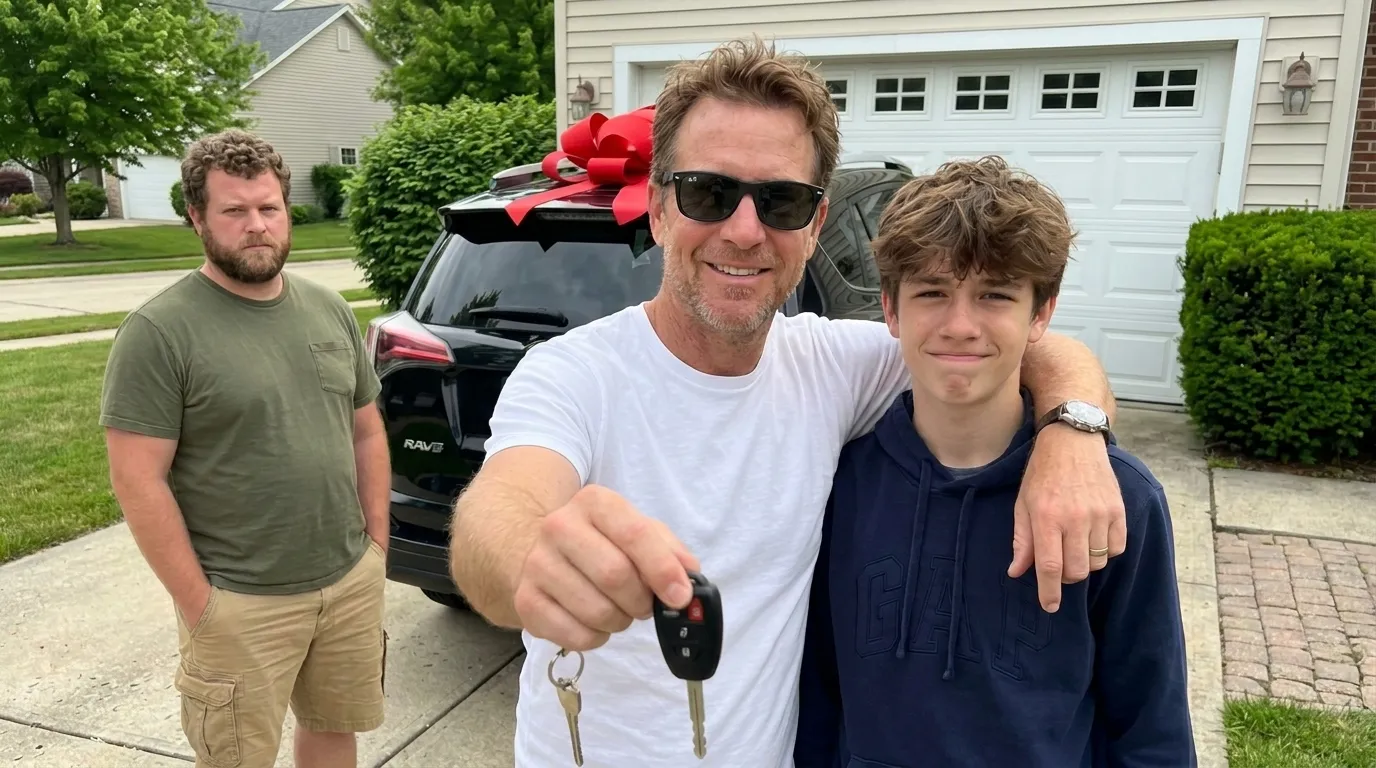
The following month changed our family.
Grant voluntarily restored the thirty-four thousand used for the car.
The dealership accepted the vehicle return because Rebecca negotiated aggressively and because Grant suddenly became extremely cooperative when words like fiduciary breach and criminal referral entered conversations.
He also repaid the previous withdrawals.
With interest.
The trust ended up containing just over one hundred and seventy-eight thousand dollars.
I couldn’t believe the number.
Mom cried again when Rebecca confirmed it.
But money wasn’t the strangest part.
Grant changed.
Not instantly.
Not perfectly.
But noticeably.
He came to a basketball game.
I still spent most of it on the bench.
Afterward, he said, “You didn’t play much.”
“Nope.”
“I wasn’t sure whether mentioning that was rude.”
I laughed.
“It is.”
“Good. Learning.”
He attended a school conference.
He remembered my chemistry grade.
He started texting without trying to impress me.
Sometimes I answered.
Sometimes I didn’t.
He accepted that.
He apologized to Mom.
A real apology.
No excuses.
He apologized to Ray too.
That conversation happened in the garage.
I wasn’t supposed to hear it, but the kitchen window was open.
“I was jealous of you,” Grant said.
Ray responded, “I know.”
“You could pretend you didn’t.”
“I’m not that generous.”
Grant laughed.
Then became quiet.
“I hated that you’d done my job.”
Ray’s answer has stayed with me ever since.
“I didn’t do your job. I just loved the kid who was standing in front of me.”
There was a long silence.
Then Grant said, “That’s worse.”
“Probably.”
Something between them changed after that.
Not friendship.
But respect.
The car disappeared.
I started driving Mom’s twelve-year-old SUV whenever she didn’t need it.
My friends thought I was insane.
“You returned a brand-new car?” Marcus asked.
“It wasn’t really a gift.”
“Still had wheels.”
I laughed.
The trust remained untouched.
I decided any college costs would come from it later.
But something else happened.
I started noticing Ray’s truck.
It was fourteen years old.
The transmission slipped.
The air-conditioning worked only when the vehicle was moving fast enough, which meant traffic in July became a punishment.
One morning, it wouldn’t start.
Ray hit the steering wheel.
“Come on, sweetheart.”
I stared at him.
“Did you call your truck sweetheart?”
“Don’t judge our relationship.”
He got it running.
Barely.
That afternoon, I went to see Rebecca.
There was something I wanted to know.
“Can trust money be used for a vehicle?”
She smiled.
“I believe we’ve established that answer.”
“Not for me.”
Her smile disappeared.
“What are you thinking?”
I explained.
She listened.
Then shook her head.
“No.”
I wasn’t surprised.
The money belonged to me.
The rules protected me.
So I found another way.
I got a job.
Then another.
I worked weekends at a grocery store.
During summer, I helped Marcus’s uncle with landscaping.
The money wasn’t much.
I saved anyway.
Grant noticed.
One Saturday, he asked why I was working so many hours.
“Want something.”
“What?”
“Not telling you.”
He offered money.
I refused.
That mattered.
Maybe to both of us.
A year passed.
Then graduation came.
I got accepted to State.
Not an elite school.
Not glamorous.
But good.
I planned to study civil engineering.
Ray claimed that sounded like “chemistry with bridges,” which was evidence he still didn’t understand science.
The week before graduation, something happened that I didn’t expect.
Grant came to the house.
He asked for Mom.
Then Ray.
Then me.
He placed a folder on the kitchen table.
My stomach dropped.
Folders from Grant had a bad history.
“What is that?” I asked.
He sat down.
“I’ve been meeting with Rebecca.”
Mom frowned.
“About what?”
“Eleanor’s trust.”
My grandmother.
Grant pushed the folder toward me.
“There was another document.”
I didn’t touch it.
“What document?”
“A letter.”
“From Grandma?”
“Yes.”
My heartbeat quickened.
Grant looked terrified.
Not guilty.
Terrified.
“I didn’t know about it.”
“That seems hard to believe.”
“I deserve that.”
He nodded.
“But Rebecca found it in archived estate materials. It was sealed with instructions that it be given to you when you graduated high school.”
I slowly opened the folder.
Inside was a photocopy of a handwritten letter.
Twelve years old.
Eleanor Mercer’s handwriting.
I knew it from birthday cards I’d saved.
Dear Eli,
If you are reading this, then you have reached an age I very much wish I could have lived to see.
There are many things I hope for you, but one matters more than the others.
Do not measure love by what someone leaves you.
Money is useful.
It is not evidence of love.
I read the rest twice.
She wrote about Mom.
She wrote about regretting Grant’s absence.
She wrote that she’d established the trust because she feared her son might not understand responsibility until it was too late.
Then I reached the final section.
And everything I thought I knew changed again.
There is one thing your mother does not know.
I stopped reading.
Mom leaned closer.
“What?”
My hands began trembling.
I continued.
Years ago, when Grant first left, I asked him to return. He refused. I then made an arrangement I have regretted ever since.
My stomach tightened.
I looked at Grant.
He was crying.
“Keep reading,” he whispered.
I did.
I told Grant I would lend him money to start his first business only under one condition: that he begin financially supporting you consistently.
He agreed.
For six months, he did.
Then he stopped.
When I threatened to withdraw my help, he told me something that broke my heart.
I stopped.
Ray leaned forward.
“What?”
My throat tightened.
The next line was short.
He said you were not his son.
Mom shot to her feet.
“What?”
Grant covered his face.
I couldn’t breathe.
Mom stared at him.
“What did you tell her?”
“Marissa—”
“WHAT DID YOU TELL HER?”
He looked at me.
“Eli, please.”
My whole body had gone cold.
“You told your mother I wasn’t yours?”
“I was scared.”
“Scared of what?”
“Responsibility.”
I stood.
“You had a DNA test.”
“No.”
The room froze.
Mom whispered, “What?”
Grant shook his head.
“I never had another one.”
“Then why would you say that?”
“Because my mother was going to cut me off.”
The answer was so ugly it took a second to understand.
He had told his dying mother I wasn’t his child so she would stop demanding that he support me.
Mom’s hand went to her mouth.
Grant continued desperately.
“She didn’t believe me.”
“No kidding,” I said.
“She confronted me. I admitted I was lying.”
I looked back at the letter.
Eleanor had written more.
I knew Grant was lying.
Eli looks exactly as Grant did at that age, but resemblance was not why I knew.
Years earlier, after Grant questioned paternity during an argument, Marissa agreed to testing.
Mom suddenly sat down.
I turned to her.
“You had a test?”
Her face was white.
“Yes.”
“You never told me.”
“You were a baby.”
“Why?”
“Grant accused me of cheating.”
Grant whispered, “I was an idiot.”
Mom ignored him.
“We did the test.”
I looked at the letter.
The result confirmed what Marissa already knew.
Grant is your biological father.
That wasn’t the twist.
I already knew that.
Then came the next paragraph.
And it changed everything.
Because after Grant lied to me again, I altered the trust.
I frowned.
Rebecca had never mentioned that.
I kept reading.
Grant believes he is the sole trustee.
He is not.
“What?”
Grant looked at me.
“I didn’t know either.”
I read faster.
Upon Eli’s seventeenth birthday, oversight authority passes automatically to the secondary trustee named in the attached instrument. This person will have the power to review all transactions, demand reimbursement, freeze withdrawals, and remove Grant if necessary.
I looked at Rebecca’s photocopied attachment.
Secondary trustee:
Raymond Thomas Carter.
I stopped breathing.
Mom gasped.
I turned slowly.
Ray looked more shocked than anybody.
“What?”
Grant wiped his eyes.
“Rebecca confirmed it.”
Ray stared at the document.
“That doesn’t make sense.”
My voice barely worked.
“Grandma named you?”
“I never met her.”
“No,” Grant said.
Everyone looked at him.
He took a long breath.
“My mother made the choice.”
Ray frowned.
“When?”
Grant looked at Mom.
“Years ago.”
Mom shook her head.
“Ray wasn’t in our lives.”
“I know.”
Silence.
Then Grant said something none of us understood.
“She didn’t name Ray Carter.”
He reached into the folder.
“She named whoever Marissa eventually chose to marry.”
Nobody moved.
Grant handed me the original trust clause.
The legal language was dense, but one passage had been highlighted.
Upon the beneficiary’s seventeenth birthday, supervisory authority shall transfer to the lawful spouse of Marissa Hale, should she then be married, provided that said spouse has resided with the beneficiary for not less than twelve consecutive months and accepts fiduciary appointment.
I read it again.
And again.
My grandmother had created a safeguard.
She knew Grant.
She knew herself.
She knew she might not live long enough to protect me.
But she trusted Mom.
So she had trusted the man Mom might one day trust enough to marry.
Ray sat down heavily.
“I had authority over the trust?”
“Technically beginning on Eli’s birthday,” Grant said.
“The day you bought the car,” Mom whispered.
Grant nodded.
Suddenly, Rebecca’s speed made sense.
The records.
The freeze.
The recovery.
Ray hadn’t known his authority existed.
But legally, the moment I turned seventeen, Grant was no longer able to move trust money without eventual review by the man he had mocked in our driveway.
The irony was almost impossible.
Grant had arrived carrying a car purchased from my trust.
He had looked at Ray and said:
Now he knows who his real father is.
All the while, a document written by his own mother had quietly given Ray the legal power to protect my future from him.
Nobody spoke for almost a minute.
Then Ray started laughing.
Not cruelly.
Just helplessly.
Mom laughed next.
Then I did.
Even Grant eventually shook his head.
“My mother had a sense of humor.”
“No,” Mom said.
“She had good judgment.”
Grant accepted that.
Graduation happened three days later.
Mom cried before my name was called.
Cara cried because Mom cried.
Danny denied crying despite photographic evidence.
Grant sat on one side of the row.
Ray sat on the other.
For once, nobody competed.
Afterward, we took pictures.
Mom wanted one with everyone.
Then Grant cleared his throat.
“Actually, could I get one of Eli and Ray?”
Ray looked surprised.
“So you can throw darts at it?”
Grant smiled.
“No.”
He held out my phone.
“I think his grandmother would’ve wanted it.”
So Ray stood beside me.
He put one arm around my shoulder.
Grant took the picture.
That photograph is still on my desk.
But the story didn’t end there either.
Remember Ray’s dying truck?
Two weeks after graduation, it finally surrendered.
Transmission.
The repair cost exceeded what the truck was worth.
Ray came home looking devastated.
Not because he loved the truck.
Because replacing it meant money.
He and Mom spent three evenings looking at used vehicles.
Every option was worse than the last.
On Friday, Grant called me.
“You still saving for that mysterious thing?”
“Maybe.”
“I figured out what it is.”
“No, you didn’t.”
“You’re trying to buy Ray a truck.”
I went silent.
He laughed.
“I’m not completely useless at reading people.”
“Don’t tell him.”
“I won’t.”
Then he said, “Let me help.”
“No.”
“Eli.”
“No.”
“Why?”
“Because I need to do this.”
There was a pause.
Then Grant said something he never would have said a year earlier.
“Okay.”
No argument.
No flexing money.
Just okay.
The following week, I found a used truck.
Eight years old.
Nothing fancy.
Good maintenance history.
One owner.
I had saved a little over six thousand dollars.
It cost fourteen thousand.
I couldn’t do it.
I stood on the dealership lot staring through the window, feeling stupid for ever believing I could.
Then the salesman approached.
“You Eli?”
“Yeah.”
He held out a folder.
“Truck’s paid.”
My stomach dropped.
I immediately thought Grant.
Of course.
I was furious.
“By whom?”
“Don’t know. Check’s already cleared.”
I pulled out my phone.
Grant answered.
“You paid for the truck.”
“No.”
“Don’t lie to me.”
“I’m not.”
“Then who did?”
“I have no idea.”
“Grant.”
“I swear.”
For once, I believed him.
I called Mom.
She knew nothing.
Then Ray.
His phone rang from twenty feet behind me.
I turned.
He was standing at the edge of the dealership lot.
Mom beside him.
Danny and Cara beside her.
“What are you doing here?”
Ray grinned.
“Could ask you the same thing.”
I looked at Mom.
“What is happening?”
She handed me an envelope.
Inside was a check made out to me.
Six thousand three hundred and twelve dollars.
Everything I’d saved.
“What?”
Ray walked toward the truck.
“Your money stays in your account.”
“Who paid for this?”
He opened the driver’s door.
Then looked over the roof at me.
“Your college account.”
I stared.
“What?”
“The little one.”
“The one you and Mom made?”
He nodded.
“You spent it?”
“Some of it.”
“Ray!”
He laughed.
“You were saving to buy me a truck using money you earned because you didn’t want to touch the trust.”
I stared at him.
“So?”
“So your mother and I decided the first money we ever saved for your future could help buy something that keeps me working.”
Mom smiled.
“We added some.”
“That’s insane.”
“Probably.”
I looked at Ray.
“I wanted to buy this for you.”
“And you did.”
“No, I didn’t.”
He pointed to the check in my hand.
“You were willing to.”
Then he tapped his chest.
“That’s the expensive part.”
I laughed.
Then started crying.
Which was embarrassing because Marcus worked two buildings away and would later describe the incident as “emotionally devastating.”
We bought the truck.
Ray still drives it.
I went to college.
The trust paid tuition.
I studied civil engineering.
Grant and I slowly built something that resembled a relationship.
Not a replacement childhood.
Nothing can do that.
But something new.
He showed up.
That became his job.
Not buying.
Not fixing.
Showing up.
When I failed my first calculus exam, he called.
When I got an internship, he drove three hours for dinner.
When I graduated college, both men were there.
Years later, when I got married, the photographer asked about father-son pictures.
I took one with Grant.
Then one with Ray.
Then I asked for one with both.
Grant put his hand on Ray’s shoulder.
“Don’t worry,” he told the photographer. “He’s the real father.”
Ray laughed.
“Shut up.”
Grant grinned.
“I walked into that.”
“Yes, you did.”
People sometimes ask me which one I consider my real father.
For years, I thought there should be one answer.
Now I think that’s the wrong question.
Grant is my biological father.
He gave me my eyes.
My height.
Apparently, my inability to arrive anywhere less than ten minutes late.
He also gave me pain.
And eventually, when he finally learned how, he gave me effort.
Ray gave me something different.
He arrived when I was sixteen.
He couldn’t erase what happened before him.
He didn’t try.
He just started showing up.
Game after game.
Dinner after dinner.
Problem after problem.
He never once demanded the title of “Dad.”
That may be why he earned it.
But there is one final piece of the story.
I didn’t learn it until years later.
After my wedding, Mom gave me a box of old papers.
Birth certificates.
School drawings.
Photographs.
Cards from my grandmother Eleanor.
At the bottom was an envelope I’d never seen.
Inside was a note written by Ray.
Dated two weeks after he married Mom.
Before my seventeenth birthday.
Before the car.
Long before he knew about the trust.
The note wasn’t addressed to me.
It was addressed to Mom.
Apparently, they’d had an argument about money.
Mom had wanted Ray to stop contributing to my future college fund because his child-support payments and household bills were stretching them too thin.
Ray refused.
He wrote:
Marissa,
I know Eli isn’t mine.
I know Danny and Cara need me too.
But I don’t believe love works like a pie where giving one kid more means another gets less.
If we can only save twenty dollars this month, then split what we can.
If it’s zero next month, it’s zero.
But don’t stop the account.
I don’t want him reaching eighteen and thinking nobody planned for him to have a future.
He has spent enough of his life expecting people to leave.
I want there to be at least one piece of evidence that somebody planned to stay.
I read those last lines five times.
Then I sat on the floor of my old bedroom and cried harder than I had at seventeen.
Because that was the lesson Grant’s car accidentally taught all of us.
Fatherhood isn’t DNA.
It isn’t money.
It isn’t a surname engraved on a leather keychain.
It isn’t the person who makes the loudest entrance carrying the most expensive gift.
Sometimes fatherhood is a man sitting at a kitchen table after midnight learning chemistry he doesn’t understand.
Sometimes it’s forty-seven seconds of basketball watched from the bleachers.
Sometimes it’s twenty dollars quietly transferred into a college account.
Sometimes it’s a truck.
Sometimes it’s forgiveness.
Sometimes it’s coming back after you’ve failed.
And sometimes it’s staying when leaving would have been easier.
I still remember my seventeenth birthday perfectly.
The blue car.
Grant’s smile.
The keys in his palm.
Ray standing on the porch.
And those words.
“Now he knows who his real father is.”
Grant had meant them as a victory.
Instead, they started a chain of events that exposed a stolen trust, uncovered my grandmother’s final safeguard, forced a broken man to face what he’d done, and revealed that before any of us knew what was coming, Ray had already made his choice.
The car was returned.
The money was restored.
The keys are long gone.
But the lesson stayed.
Because the most valuable thing I received for my seventeenth birthday wasn’t sitting in the driveway.
It was finally understanding that the people who truly love you don’t need to purchase proof.
They leave evidence everywhere.
In empty bleachers after a losing game.
In kitchen lights burning after midnight.
In twenty-dollar deposits nobody tells you about.
In old notes hidden inside forgotten boxes.
And in one sentence written by a man who never expected me to read it:
I want there to be at least one piece of evidence that somebody planned to stay.
There was.
His name was Ray.
Latest Posts
- My Mother-in-Law Made My Baby Shower About Herself—Then My Husband Stood Up #2
I wanted a small baby shower, but my mother-in-law ignored nearly every request and turned the day into a celebration of becoming a grandmother. I kept swallowing my frustration for one deeply personal reason, until she crossed a line neither my husband nor I could ignore. I was seven months pregnant with our first child, …
- My Son Grew His Hair for His Best Friend’s Wig—Then Her Father Called Me to School
A 14-Year-Old Boy Grew Out His Hair to Make a Wig for a Classmate Who Lost Hers to Cancer – The Next Day, His Mother Was Called to the School, Where the Girl's Father Said, 'You Have No Idea What Your Son Did, Do You?' The gum stuck in my son’s hair nearly ended the …
- 80-Year-Old Woman Spent Seven Days Visiting an Old Friend…
80-Year-Old Woman Spent Seven Days Visiting an Old Friend – She Returned Looking Half Her Size with a Suitcase That Wasn't Hers I almost walked past my mother at the train station. She was standing beside a bench, gripping the handle of an enormous black suitcase. Her gray hair was flattened against her forehead, and …
- The Winning Ticket and the Life My Husband Hid
My Husband Was Lying in a Hospital Bed When I Won 100 Million Dollars, and Then I Heard Him Laughing to His Mistress That I Would Hand Him Every Penny If I Thought He Was Dying. I Hid the Ticket, Called a Lawyer, and Walked Away, Never Imagining That His Fake Illness Was Only the …
- My husband divorced me to marry my own mother. #2
My Husband Divorced Me to Marry My Own Mother My husband divorced me to marry my own mother. Everyone told me to move on, but instead… I showed up at their wedding. And when she said, “I do,” they had no idea what I had already done. When Mark left me, he didn’t even try …