The worst thing my biological father ever gave me wasn’t abandonment.
It was a brand-new car.
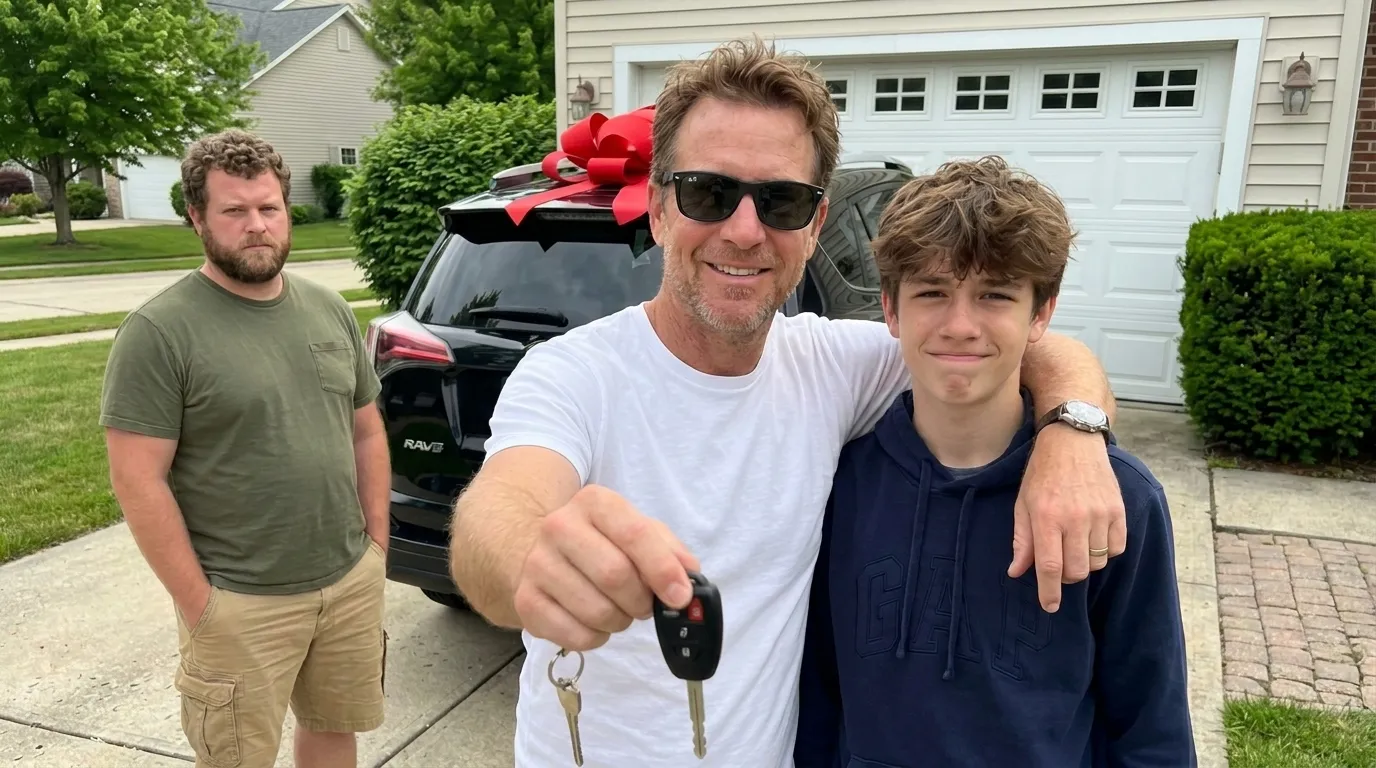
I was standing in our driveway on my seventeenth birthday when he dropped the keys into my hand, smiled toward the man who had actually been raising me, and said the words that made every person on our porch go silent.
“Now he knows who his real father is.”
For a second, nobody moved.
Not Mom.
Not my eleven-year-old stepbrother Danny.
Not nine-year-old Cara.
And especially not Ray.
Ray stood near the porch railing with both hands buried in the pockets of the old gray jacket he’d worn to half my basketball games. He looked down at the concrete as though suddenly fascinated by a crack beneath his boots.
My biological father, Grant, didn’t even try to hide his satisfaction.
He was watching Ray.
Not me.
The car wasn’t a birthday present.
It was a weapon.
And Grant had just aimed it across our driveway.
The car itself was beautiful.
A midnight-blue sedan with eighteen miles on the odometer, leather seats, alloy wheels, a backup camera, and that clean new-car smell people talk about as if luxury has its own perfume.
At seventeen, I should have been losing my mind.
Kids at school drove twenty-year-old Hondas with duct tape on the bumpers. My best friend Marcus had spent an entire summer mowing lawns to buy a rust-colored Ford that sometimes required two people pushing it before the engine decided to cooperate.
And here I was holding keys to a brand-new car.
Grant smiled.
“Go ahead,” he said. “Sit in it.”
I didn’t move.
Mom’s face had become very still.
She had that expression she used whenever she was furious but didn’t want to make things worse.
“Grant,” she said quietly.
“What?”
“You didn’t need to say that.”
He shrugged.
“I didn’t say anything wrong.”
Then he looked at me.
“I’ve missed a lot, Eli. I know that.”
A lot.
That was one way to describe fourteen years.
“I can’t get those years back,” he continued. “But I can start making things right.”
I looked at the keys.
Then at him.
Then at Ray.
Fourteen years of questions rose inside me all at once.
Where were you when I had pneumonia in fourth grade?
Where were you when Mom’s car died and she walked two miles home from work?
Where were you when I waited beside the school office until six because Mom’s shift ran late?
Where were you when I learned to throw a baseball?
Where were you when I stopped asking about you?
I could have said all of it.
I wanted to.
For one hot, ugly second, I wanted to humiliate him in front of everybody.
I wanted him to understand that a car didn’t erase fourteen birthdays.
I wanted him to understand that Ray had done more with a used baseball glove and a kitchen table than Grant could do with thirty thousand dollars.
Then something changed.
Maybe it was Ray refusing to look up.
Maybe it was Danny and Cara watching from the doorway.
Maybe it was the memory of something Ray had told me months earlier.
Never teach somebody a lesson by becoming the kind of person you’re trying to teach.
So I swallowed everything I wanted to say.
Instead, I turned toward the porch.
“Ray.”
He looked up.
“Come here a second.”
Grant’s smile faded slightly.
Ray hesitated.
“Eli, it’s your birthday.”
“I know. Come here.”
He walked down the three porch steps.
I held the keys toward him.
Grant stiffened.
I could feel Mom watching me.
Ray looked at the keys but didn’t take them.
“What are you doing?”
I smiled.
“You taught me to drive.”
“So?”
“So you’re taking the first ride with me.”
The driveway became completely silent.
Then Danny grinned.
Cara clapped.
Mom covered her mouth.
Ray blinked twice.
“You sure?”
“Yeah.”
I looked at Grant.
“My father bought me the car.”
His smile returned.
Then I turned back toward Ray.
“But my dad taught me how to drive.”
That smile disappeared.
And that was the moment everything began.
My biological father left when I was three.
I don’t remember him walking out.
I remember fragments.
A brown suitcase near the front door.
My mother crying in the kitchen after she thought I’d fallen asleep.
A man’s voice.
A slammed door.
The smell of rain.
For years, I wasn’t even sure which memories were real and which I’d manufactured from stories Mom told relatives when she thought I wasn’t listening.
What I do remember clearly is what came after.
Mom and me.
Always Mom and me.
She worked reception at a medical office during the day and cleaned two small insurance offices three evenings a week.
Money was everywhere in our house even though we almost never discussed it.
It existed in grocery-store calculations.
It lived in envelopes on the kitchen counter.
It decided whether the heat stayed at sixty-six degrees or dropped to sixty-two.
It determined whether I could go on school trips.
It chose what cereal we bought.
Mom developed this habit at supermarkets where she’d pick something up, study it, then say, “Actually, we don’t need this.”
By nine, I understood what that sentence meant.
We can’t afford this.
So I learned not to ask.
When other kids wanted video-game systems, I wanted nothing.
When middle-school friends started getting expensive shoes, I told everybody I didn’t care about shoes.
When the basketball team ordered matching travel jackets that weren’t technically required, I said jackets were stupid.
You become strangely good at not wanting things when you’re raised by someone counting every dollar.
Grant occasionally sent birthday cards.
Sometimes Christmas cards.
There were years when nothing came.
When I was eight, I asked Mom whether he loved me.
She was washing dishes.
She didn’t turn around.
“I think your father loves you in the way he knows how.”
Even then, I understood that wasn’t a yes.
By twelve, I stopped asking.
Then, when I was sixteen, Mom met Ray.
He wasn’t dramatic.
There was no movie moment.
He came into the clinic where she worked because he’d cut his hand replacing a broken window at his job.
He needed six stitches.
Mom told me later that he kept apologizing for getting blood on the paperwork.
Three months later, she invited him to dinner.
He showed up with a grocery-store pie and two nervous children.
Danny was eleven.
Cara was nine.
Their mother had primary custody, and they stayed with Ray every other weekend, plus Wednesday evenings.
Our first dinner was awkward.
Danny refused peas.
Cara talked for twenty straight minutes about horses.
I barely spoke.
Ray didn’t try to impress me.
He didn’t call me “buddy.”
Didn’t tell me he hoped we could become friends.
Didn’t perform.
When Mom went into the kitchen, he glanced at me and said, “This is weird, right?”
I stared at him.
Then laughed.
“Yeah.”
“Good. Thought it was just me.”
That was basically how it started.
Seven months later, he and Mom married at the courthouse.
We didn’t suddenly become some perfect family.
We became crowded.
Our little house had three bedrooms.
Mom and Ray had one.
I kept mine.
Danny and Cara shared the third during weekends, which Cara hated because Danny snored.
Five people.
One bathroom.
A refrigerator that emptied twice as fast.
Utility bills.
School supplies.
Shoes.
Dental appointments.
Birthday presents.
Everything became tighter.
And Ray was already paying child support.
I knew because I’d once seen the payment confirmation on the kitchen counter.
It was more money than Mom and I had used for groceries some months.
Yet Ray never once treated me like I was the extra expense.
That mattered more than I knew at the time.
He came to my basketball games even though I was terrible.
And I mean terrible.
Junior year, I spent most of the season sitting so far down the bench that I could practically smell the popcorn stand.
Ray came anyway.
One night, we lost by twenty-three points.
I played forty-seven seconds.
On the ride home, he said, “Your defense looked better.”
I stared at him.
“I touched the floor twice.”
“Strong forty-seven seconds.”
I laughed so hard I almost choked.
The chemistry thing happened a month later.
Chemistry was destroying me.
I needed the class for the science requirement, and I was sitting at a D-minus.
One night around eleven, I shoved the textbook away.
“I’m done.”
Ray looked up from across the kitchen table.
He had work at six the next morning.
“You’re tired.”
“No. I’m stupid.”
“You’re tired.”
“I don’t understand any of this.”
He rotated the textbook toward himself.
The page showed chemical equations.
Ray stared at them.
I watched his face.
“You don’t understand this either.”
“Nope.”
“Then how are you helping?”
“Excellent question.”
I laughed despite myself.
He pointed to the first paragraph.
“Read it again.”
“Ray.”
“Read it.”
So I did.
He stopped me.
“What does that mean?”
“I don’t know.”
“Read that sentence again.”
We went through the chapter one sentence at a time.
He looked things up.
I explained them back.
He got half the terminology wrong.
At 12:46 a.m., I solved the practice problem we’d been stuck on.
Ray raised both hands like we’d won the Super Bowl.
“Look at that!”
I groaned.
“You didn’t do anything.”
“I provided emotional support.”
“You ate pretzels.”
“Also support.”
I got a B-minus in chemistry that semester.
Ray kept the test with the first B I earned pinned to the refrigerator for three weeks.
That fall, he and Mom opened a college account for me.
I didn’t know.
Mom told me accidentally.
She and Ray had started putting in whatever remained each month.
Sometimes fifty dollars.
Sometimes twenty.
Some months nothing.
“You shouldn’t be doing that,” I told her.
“Why?”
“Because we need stuff.”
“So does your future.”
“But Danny and Cara—”
“Have accounts too,” she said.
I went quiet.
Ray had opened them at the same time.
Three kids.
Three accounts.
None impressive.
All equal.
That part almost broke me.
I had spent most of my life expecting to be the person adults left behind. Ray had quietly arranged his finances as though I were one of his children.
He never mentioned it.
Not once.
Which somehow made it mean more.
Then my seventeenth birthday arrived.
And Grant came back with a car.
He had started contacting me more often about six months earlier.
Texts mostly.
How’s school?
Saw your game schedule online.
Proud of you.
Would love to grab lunch.
I responded cautiously.
Mom never told me not to.
Ray never said anything negative about him.
In fact, when I asked Ray what he thought, he surprised me.
“He’s your father.”
“Biologically.”
“Still matters.”
“Does it?”
Ray looked at me for a long moment.
“That part’s your decision.”
Grant took me to lunch twice.
He told me he’d spent years building a business.
Real estate.
Investments.
A small chain of storage facilities.
He talked about bad decisions he’d made when he was younger.
“I wasn’t ready to be a father,” he said.
The sentence bothered me.
Not because it was dishonest.
Because it sounded like parenthood had been a job he’d postponed until his schedule improved.
But I wanted answers badly enough to keep listening.
He said he’d thought about me constantly.
He said shame made it harder to come back.
Then one afternoon, he asked what kind of car I liked.
I laughed.
“I don’t have a kind.”
“Everybody has a dream car.”
“I don’t.”
That was true.
Cars meant payments.
Insurance.
Repairs.
Gas.
I thought in costs before desires.
Two weeks later, he asked again.
I named a model just to end the conversation.
I had no idea he was taking notes.
On my birthday, there it was.
Brand new.