Home did not make everything disappear.
For a while, Lily followed me from room to room. If I stepped outside to bring in the bins, she hurried to the window. At bedtime, she asked where I would be when she woke.
I answered every time.
I also spoke with her pediatrician and arranged counseling. I did not want to mistake silence for recovery simply because it would have been easier for me.
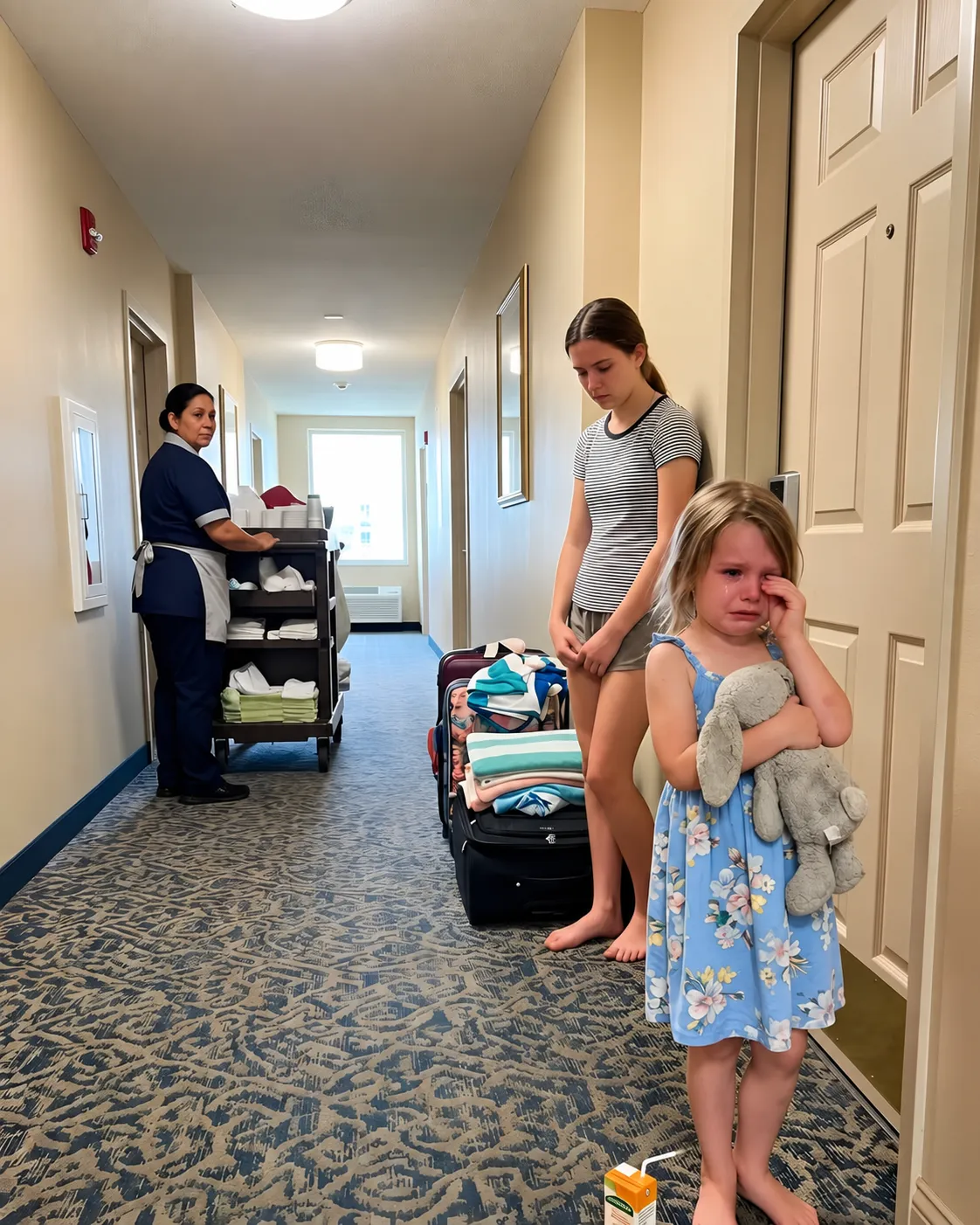
Some nights, Lily talked about the hallway. Other nights, she only wanted her rabbit and the lamp beside her bed.
I learned not to rush either kind of night.
One evening, as I helped her straighten the blanket, she asked whether Daniel would have opened the door.
I had to take a breath before I answered.
“Yes,” I said. “He would have.”
She nodded as though she had been checking something she already knew.
Then she asked, “Would he have been mad at me?”
“No, sweetheart.”
“Because I cried?”
“Especially not because you cried.”
I sat beside her until she fell asleep.
Afterward, I went into the kitchen and cried where she could not hear me—not because I regretted leaving, but because I had trusted people who had taught my daughter to wonder whether she deserved help.
I had to work through my own guilt, too.
I had gone downstairs. I had agreed to the errand. I had believed my mother when she said Lily was resting.
For weeks, I replayed each decision as though finding the exact wrong turn might let me go back and choose differently.
Eventually, I began to separate what I wished I had done from what they had chosen to do.
I should have checked with the desk myself.
They should not have lied.
I wished I had taken Lily with me.
They should not have pushed her outside.
My regret did not transfer their responsibility onto me, and I could not help Lily by accepting the blame they refused to carry.
My parents kept trying to turn the boundary into a negotiation.
My father said enough time had passed.
My mother said families were supposed to forgive.
I told them forgiveness, if it ever came, would not mean leaving Lily in their care.
Then I asked whether they could say plainly that what they had done was wrong.
Not unfortunate. Not misunderstood. Not something that had become worse because I was emotional.
Wrong.
My mother said she was sorry Lily had been frightened.
My father said they should have handled it differently, but Vanessa had been under pressure and I knew how stubborn she could be.
They still wanted her behavior to be an explanation for their own.
I stopped trying to lead them toward the right words.
I reduced our contact to written messages and made it clear that visits were not being arranged. I did not ask Lily to speak to them on the phone. I did not put their feelings in her hands.
Mark sent one apology.
He said he should have helped when he realized Lily was outside. He did not ask me to withdraw the complaint or tell Vanessa that everything was forgiven.
I acknowledged his message, but it did not change the boundary.
An apology could be sincere without making someone safe enough to trust again.
Months passed.
Lily began leaving her bedroom door partly closed when she played. She stopped carrying her rabbit to every meal. One Saturday, she went outside to draw on the patio while I washed dishes, and for several minutes she forgot to check whether I was still there.
I watched her through the kitchen window and let myself be grateful for something so ordinary.
We put her shells in a shallow bowl on the living room shelf.
The pink-edged one sat on top.
She still remembered the hallway. I would never claim that a new routine, a counselor, or a mother’s promise could erase it.
But it was no longer the only thing she remembered about that summer.
She remembered the ocean chasing her feet. She remembered collecting treasure. She remembered that when I found her, we left.
Near the end of that year, she brought her rabbit into the kitchen while I was making pancakes.
I was trying to cut them into stars the way Daniel used to. Mine were no better than his had been.
Lily climbed onto her chair and inspected the plate.
“That one looks like a hand,” she said.
“I’m still learning.”
She smiled.
Then, while I poured a glass of milk, she asked, “Are we still a family if it’s just us here?”
I put the carton down.
“Yes.”
She looked toward the living room shelf, where her shells sat beneath a photograph of Daniel.
“And Daddy?”
“Always.”
She considered that for a moment, then pulled her plate closer.
I sat across from her while she ate.
There was no crowded table, no family photograph to arrange, no need to keep smiling while someone made us feel small.
There was my daughter, safe in her own kitchen, deciding which crooked star to eat first.
For years, I had believed protecting our family meant keeping everyone together, no matter what it cost me.
That summer, I learned that protecting my family could mean picking up a suitcase, taking my child’s hand, and leaving people behind.
Lily had not needed me to win an argument outside that hotel room.
She had needed me to make sure she never had to beg them to open a door again.
And I did.
The End.
Latest Posts
- My Husband Mocked My Postpartum Appearance in His Brothers’ Group Chat—I Stayed Quiet for Five Days
Four months after giving birth, I thought my husband understood why I hardly recognized myself. Then I discovered the cruel joke he'd been sharing with his brothers, along with photos I never knew he'd taken. I kept my discovery secret for five days, determined to make him regret every word. “Dude, you weren't exaggerating 😂” …
- My Stepdaughter Called Me the Help Until My Envelope Changed Everything
The insult came before I’d even finished setting down the peach cobbler. I’d baked it at five that morning in the kitchen of the lake cabin we’d rented, and it was still warm under the foil. The smell of cinnamon followed me across the grass toward the pavilion tables, where thirty-two members of the Cole …
- My In-Laws Gave Their Other Three Children $20,000 for Houses and Gave Us Only a Card Two Years Later, We Bought the Old Miller Place for $41,500
The envelopes were tucked under the Easter plates. Each had a name written on it in my mother-in-law’s round schoolteacher handwriting. Kim opened hers first. She’s the oldest. Divorced two years. Raising two boys in a rented trailer behind the grain elevator. She looked at what was inside the envelope and put her hand flat …
- My Mother-in-Law Told Me to Lose Weight After Giving Me a Dress That Didn’t Fit, but Minutes Later, She Regretted Everything
I couldn’t get it over my hips. I stood in my bedroom in my underwear with the dress bunched around my thighs like a deflated balloon. Midnight blue silk. A designer label I’d only ever seen in magazines. Tiny pearl buttons down the back. Beautiful. And four sizes too small. I pulled. I tugged. I …
- Teen Wore a Dress to His Best Friend’s Funeral—The Family Nearly Had Him Removed Before He Reached the Microphone
My son’s best friend read the eulogy at his funeral in a red dress. I almost had him removed before he reached the microphone. My son Jack died 17 days after his 18th birthday. Cancer. Fourteen months from diagnosis to funeral. We found out late. Too late, as it turned out, and the treatment never …