The manager did not try to minimize what had happened.
He documented my complaint, confirmed that my account had been in good standing the entire day, and repeated that no employee had called my father or asked for my credit card.
That meant the trip downstairs had not been a misunderstanding.
Someone had created a reason to get me away from Lily.
My second call was to the rental car company. The SUV was in my name and paid for with my card, so I ended my family’s permission to use it.
I told the representative that the keys would be returned and that no extension or change could be made without speaking directly to me.
The third call was to the front desk of our new hotel. I asked them not to disclose our room number, transfer calls, or confirm that Lily and I were staying there.
Then I sent one message to Vanessa and my parents.
Lily and I were safe. We would not be returning to the original hotel room. Nobody was to contact Lily or come looking for us. I would reach out when I decided what happened next.
Vanessa immediately began typing. My mother called twice. My father left a voicemail telling me I was punishing everyone over a child’s tantrum.
I did not answer.
Lily was finally asleep, one hand wrapped around her stuffed rabbit and the other resting against my arm as if she needed to make sure I had not disappeared.
For years, my family had depended on me to stay quiet, smooth things over, and keep helping even after they hurt me.
That night, I removed the one thing they had always counted on—my cooperation.
By morning, my parents had to decide whether defending Vanessa was still worth it when the cost belonged to them.
My father’s first message was not about Lily.
He wanted to know how they were supposed to get to the store.
I replied with one instruction: leave the rental keys at the original hotel’s front desk.
He called immediately.
I let it ring.
A few minutes later, my mother wrote that everyone was upset and that we needed to sit down together before things went any further.
I looked at Lily, who was sitting cross-legged on the bed with her rabbit in her lap. She had asked me to leave the bathroom door open while I brushed my teeth.
There would be no meeting.
I told my mother that the keys needed to be at the desk by noon. Then I asked a question I had not been able to stop hearing in my own head.
Why had she told me Lily was resting?
For several minutes, there was no response.
When it came, it was only one sentence.
“We didn’t want you rushing back and making things worse.”
I read it twice.
They had not been confused about where Lily was. My mother had known that telling me the truth would bring me back.
I put the phone facedown.
“What’s wrong?” Lily asked.
“Something the grown-ups need to sort out,” I said. “None of it is your fault.”
She rubbed one of the rabbit’s ears between her fingers.
“Did Grandma know I was outside?”
I sat beside her.
I wanted to give her an answer that would hurt less. I wanted to say Grandma had been asleep, or confused, or in another room too far away to hear.
But Lily had already been surrounded by adults who chose their own comfort over the truth.
“Yes,” I said gently. “She knew.”
Lily looked down.
“Then why didn’t she open it?”
“I don’t have a good answer for that.”
“Was I bad?”
“No.”
I waited until she looked at me.
“You were tired. You needed to rest. Even if you had been upset or noisy, the adults were supposed to keep you safe. They were wrong.”
She leaned into me, and I held her until she was ready to let go.
At noon, the original hotel confirmed that my father had left the keys.
I took Lily with me to collect the SUV. We did not go upstairs. We did not walk past the ice machine.
She stayed beside me in the lobby while the employee handed me the keys, and then we went straight outside.
Before I started the engine, I checked that her seat belt was fastened.
“Are we going back to that room?” she asked.
“No.”
“Ever?”
“Not on this trip.”
Her shoulders lowered a little.
For the rest of that day, I kept things small. Food she liked. A quiet room. No pressure to go swimming, no insistence that we should enjoy ourselves because we had already paid for a vacation.
When she wanted me nearby, I stayed nearby.
That afternoon, the hotel manager called again.
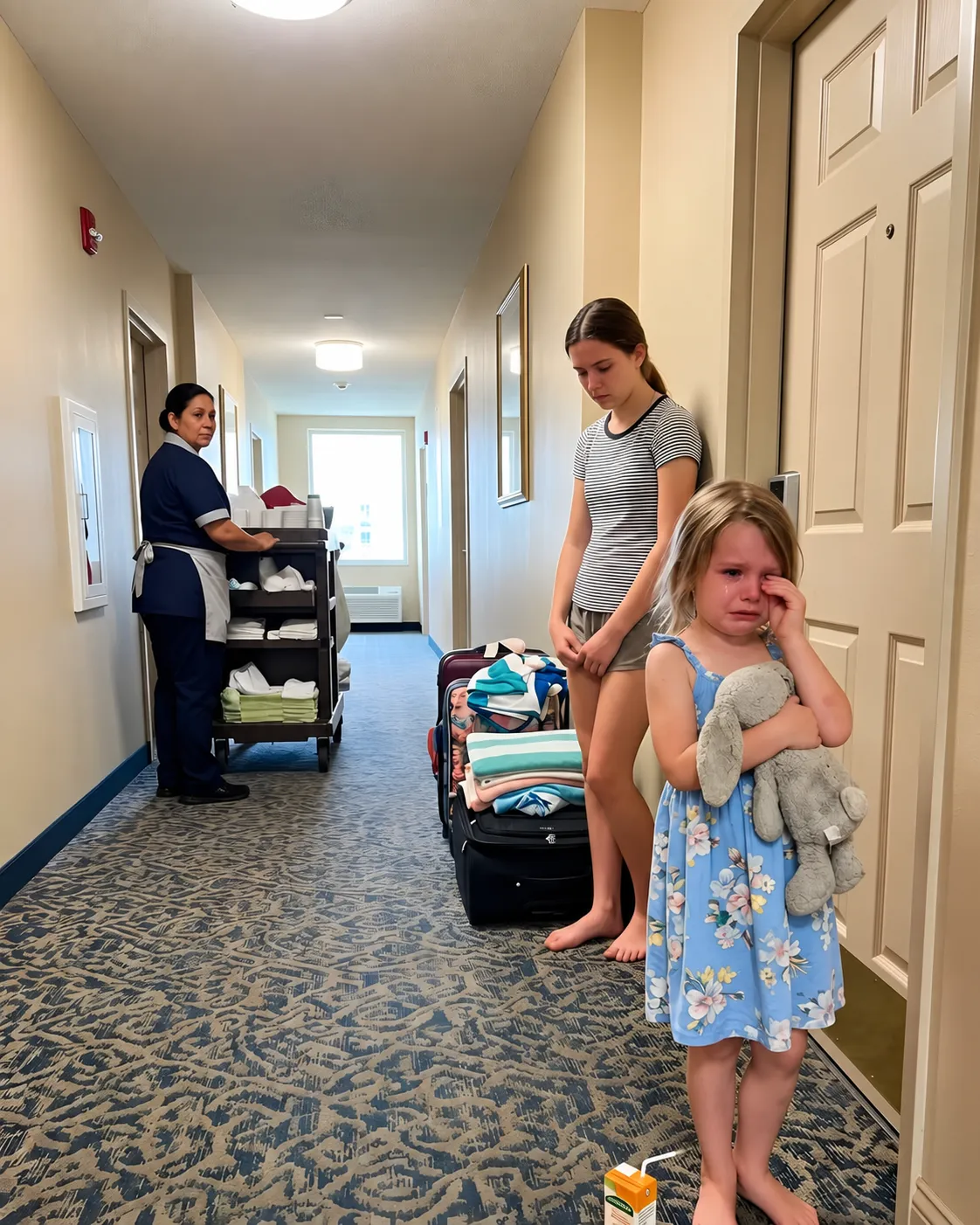
He had spoken with the housekeeper. Her account matched what she had told me in the hallway.
He also acknowledged something I had been struggling to put into words: once an employee realized a young child was alone and unable to get into her room, offering help and then walking away had not been enough.
The situation should have been brought to the front desk immediately.
“We should have intervened sooner,” he said. “I’m sorry we didn’t.”
It was the first apology I had received that did not contain an excuse.
He told me the hotel was documenting the incident and reviewing it with the adults who had occupied the connecting rooms. My unused nights would be refunded, and no one else would be allowed to continue using my room under my reservation.
I asked for written confirmation.
Then I asked him to make sure the report did not describe Lily as having wandered away.
“She didn’t wander,” I said. “She was put outside.”
“I understand,” he answered.
My father finally called at a time when Lily was watching cartoons beside me. I stepped into the bathroom but left the door open.
This time, I answered.
“Your mother is in tears,” he began.
I kept my eyes on the doorway.
“Why did you tell me there was a billing problem?”
“Claire, we need to stop going around in circles.”
“That’s the question I’m asking.”
He was quiet.
Then he exhaled.
“Vanessa wanted a little peace. You were already tense. I thought if you stepped away for a while, everyone could settle down.”
“So the front desk never asked for me.”
“No. But that doesn’t mean—”
“And then you sent me shopping.”
“I was trying to avoid an argument.”
I pressed my hand against the edge of the sink.
“You left my daughter with people who shut her out of a room I paid for.”
“I didn’t know Vanessa was going to do that when I called you.”
That might have been true. It might not have been.
I could not prove what he had known before he made the call, and I was no longer willing to let an argument about those first few minutes hide everything that followed.
“But you knew afterward,” I said. “You saw her outside. You could have opened the door.”
“She needed to calm down.”
“She needed an adult.”
He began to tell me that I was twisting his words.
I ended the call.
There was no hidden billing mistake to uncover. No explanation that made the afternoon harmless.
My father had admitted inventing the problem to get me away. My mother had admitted keeping me away because she did not want me rushing back. Whatever Vanessa had intended at the beginning, they had both chosen to protect her once they knew what she was doing.
That was enough.
Three days after I found Lily in the hallway, the hotel’s written response arrived.
The manager confirmed that there had been no billing issue, recorded the housekeeper’s account, and acknowledged the delay in staff intervention. The refund for my unused nights had been processed.
He also told me that, after reviewing the incident, management had required Vanessa and my parents to check out early. They would not be permitted to make future reservations at that property.
The hotel could decide who stayed there. It could not undo what had happened.
Still, someone outside my family had put the facts in writing without calling them a tantrum or a misunderstanding.
A little later, my mother called.
“We have to leave,” she said.
I could hear movement behind her—the low murmur of voices and something being dragged across a floor.
“You complained until they threw us out.”
“I told them what happened.”
“You could have talked to us first.”
“I did talk to you. I stood in that room holding Lily, and you asked whether I was really leaving over it.”
She began to cry.
For most of my life, that sound had been enough to make me retreat. I would soften what I had said, apologize for my tone, and spend the rest of the conversation helping her feel better.
This time, I waited.
“Your father says you won’t let us use the car,” she said eventually.
“That’s right.”
“How are we supposed to get everything home?”
“You’ll need to arrange your own transportation.”
“We’re your parents.”
“I know.”
She seemed to have no answer for that.
Before we ended the call, I told her that neither she nor my father would be alone with Lily again. There would be no more shared vacations, no visits arranged through Vanessa, and no conversations in which Lily was expected to apologize for what adults had done to her.
“You can’t mean forever,” she whispered.
“I’m telling you what is happening now. I’m not promising you a date when it changes.”
Vanessa sent a message that evening.
She accused me of embarrassing her in front of her boys. She said Mark was upset, the trip had been ruined, and all of it could have been avoided if I had handled things privately.
I read the message once.
There was not a single question about Lily.
I answered with two sentences.
“You pushed my daughter out of her room and refused to let her back inside. Do not contact either of us again.”
Then I blocked her number.
I did not send an announcement to every relative. I did not post the hotel’s report for strangers to argue over. I kept the written response, my family’s messages, and my notes together.
I did not need an audience to make the boundary real.
The following morning, Lily and I packed for home.
She watched me lift the seashell bucket from beside the dresser.
“Are we keeping those?” she asked.
“Of course.”
For a moment, she looked uncertain.
“Even though the holiday was bad?”
I set the bucket on the bed between us.
“You found them,” I said. “They’re yours.”
She reached inside and picked up a small broken shell with a pale pink edge.
“This one was my favorite.”
“Then we’ll put it somewhere special.”
On the way out, she reached for my hand before we entered the hallway.
I held it all the way to the car.