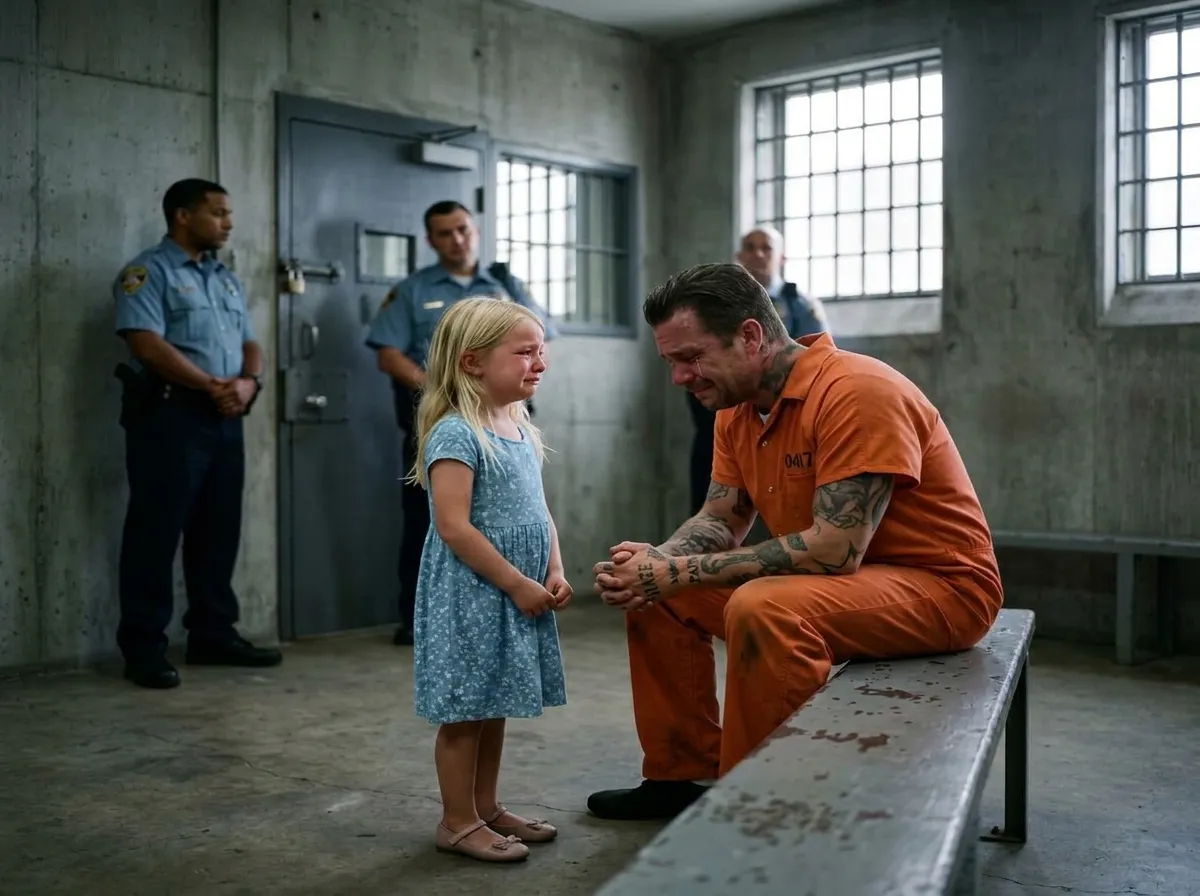
Chloe waited outside the prison with Dana and Mara.
She wore the same pink shoes from the final visit, although the dress had been replaced by jeans and a yellow sweater.
News cameras stood behind a barrier.
Reporters shouted questions as the prison doors opened.
Gavin stepped into the morning light wearing dark trousers, a white shirt, and a borrowed jacket.
For the first time Chloe could remember, he wasn’t dressed in orange.
For the first time in five years, his hands were free.
Chloe stared at him.
Then she ran.
Gavin dropped to his knees before she reached him.
She crashed into his chest, and he wrapped both arms around her.
There were no chains beneath the hug.
No guard waiting to end the visit.
No clock counting down.
Gavin pressed his face into his daughter’s hair and wept openly while cameras recorded from a distance.
Chloe whispered something into his ear.
This time, Gavin laughed through his tears.
“What did she say?” a reporter shouted.
Gavin stood with one arm around his daughter and looked toward the cameras.
“She said I took long enough.”
It was the only statement he gave that day.
The consequences of Elena’s red phone continued for years.
Calvin Mercer was charged with conspiracy, obstruction, evidence tampering, financial crimes, and offenses connected to Elena’s death.
Deputy Aaron Pike faced charges related to the killing, the staged crime scene, and the falsified investigation.
Dr. Malcolm Reed pleaded guilty to altering forensic records and concealing evidence in multiple cases.
The state reopened every conviction connected to Reed’s laboratory.
Several prisoners received new trials.
Others were exonerated.
The governor’s temporary suspension of executions expanded into a formal moratorium while an independent commission reviewed capital cases involving Mercer, Reed, and associated investigators.
The commission’s final report contained hundreds of pages.
But one sentence from its opening was repeated more than any other:
A system entrusted with irreversible power cannot depend upon evidence controlled by people who fear independent review.
The report did not bring Elena back.
It did not restore the men who had already been executed.
And it could not return the years Chloe had spent without either parent.
But it prevented the state from pretending Gavin’s case had been a single mistake caused by one dishonest prosecutor.
The corruption had survived because too many people accepted convenient answers.
A laboratory technician followed an instruction.
A detective ignored a missing phone.
A prosecutor withheld evidence.
A defense attorney failed to challenge a changing witness statement forcefully enough.
A child interviewer labeled Chloe’s memory a trauma response and moved on.
A warden felt uneasy but believed uneasiness alone wasn’t enough to justify another call.
No single person had created the injustice alone.
Too many people had helped it continue.
Eleven months after his release, Gavin received a formal declaration of actual innocence.
The state offered compensation.
He accepted it only after creating a trust for Chloe and contributing part of the funds to independent reviews of questionable convictions.
He never called the money justice.
Justice would have meant Elena sitting beside him at breakfast while Chloe complained about school.
The payment was acknowledgment.
Nothing more.
Rebuilding his relationship with Chloe proved harder than walking out of prison.
Love had survived.
Ordinary familiarity had not.
Gavin didn’t know which cereal she preferred.
He didn’t know that she hated the seams inside certain socks.
He didn’t know she slept with one foot outside the blanket.
He didn’t know she became quiet whenever adults argued.
Or that she hid important objects inside pillowcases because she did not trust drawers.
And Chloe didn’t know her father woke before sunrise and stood beside windows, watching for guards who were never coming.
She didn’t understand why he sometimes froze when a door locked behind him.
She asked why he cut every apple into perfectly equal pieces.
Gavin told her prison taught people to control the few things they could.
They began therapy together.
At first, Chloe answered the counselor’s questions while staring at the floor.
Gavin spoke too much because silence made him afraid he was losing another chance.
The counselor taught them something neither had considered.
Reunion was not the same as repair.
Being father and daughter did not mean they would instantly know how to live together.
They had to learn.
So they started small.
Gavin attended school conferences.
He learned to braid Chloe’s hair badly.
She taught him how to use the television remote and laughed when he accidentally opened the weather app five times.
He made pancakes every Sunday.
The first batch was always burned.
Chloe ate the second.
Some nights, she asked about Elena.
Gavin deliberately told her stories that had nothing to do with the murder.
He told Chloe that her mother sang the wrong words to every song.
That she once drove twenty miles with a birthday cake sitting on the roof of the car.
That she hated folding laundry but loved arranging books by color.
That she bought the red phone because she said black phones looked too serious.
He wanted Chloe to remember Elena as a person.
Not merely as a victim whose final recording had changed the law.
With permission from the new owners of the old house, the wooden moon was removed from Chloe’s former bedroom.
Gavin cleaned it carefully and hung it in her new room.
The hidden cavity remained visible behind a small hinged panel.
One evening, Chloe placed a folded note inside it.
Gavin never opened it.
When she was ready, she showed him.
It said:
Mom, he came home.
On the first anniversary of Gavin’s release, Robert Mitchell visited them.
The former warden arrived carrying a cardboard box.
Inside were copies of the documents clearing Gavin and the visitor log from Chloe’s final visit.
Gavin looked at the line bearing his daughter’s name.
“Why did you keep a copy?”
Mitchell sat quietly for a moment.
“Because that morning changed the way I understood my job.”
He had retired several months earlier.
Now he spoke publicly about the responsibility of prison officials to report unresolved concerns in capital cases.
But he never presented himself as a hero.
Whenever someone praised him for stopping Gavin’s execution, Mitchell corrected them.
“I delayed the process long enough for a child to be heard.”
Then he always added:
“The child stopped it.”
Chloe entered the living room while the two men were talking.
She looked at Mitchell.
“Do you still have the big keys?”
He laughed.
“No.”
“Good.”
Then she returned to her homework.
The men watched her disappear down the hallway.
“She is stronger than she should ever have needed to become,” Mitchell said.
Gavin nodded.
“That’s what everyone says about children after adults fail them.”