It was a gray Thursday morning in early October, the kind that made western Pennsylvania feel washed clean and cold.
Inside Room 204, fluorescent lights hummed while second graders scraped chairs across the floor, clicked pencils, and settled in for math.
Ms. Valerie Kincaid was holding the day’s worksheets when she noticed seven-year-old Lila Mercer.
Not because Lila was making noise.
Because she was working so hard not to.
Lila sat in the third row beside the windows, her pale blue cardigan buttoned neatly and her hands folded whenever they were supposed to be folded.
She was the kind of child adults described as well-behaved.
She never interrupted.
Never grabbed.
Never demanded attention.
But Valerie had been teaching long enough to recognize the difference between quiet and careful.
Lila was careful.
She shifted in her chair once.
Then again.
Her shoulders tightened.
Her knees stayed pressed together beneath the desk.
Each time she moved, pain crossed her face for half a second before she forced it away.
At 8:42, the class bent over math worksheets.
By 8:56, children were lining up to turn them in.
Lila waited until everyone else had gone first.
When she finally stood, she pressed one hand against the edge of her desk and stayed there before taking a step.
One foot.
Pause.
Then the other.
“Lila,” Valerie asked casually, “are you feeling okay this morning?”
For a second, fear crossed the little girl’s face.
Then came a practiced smile.
“I’m fine, Ms. Kincaid. I just need to sit up straight.”
The sentence sounded wrong.
Too polished.
Too prepared.
Valerie started to ask another question.
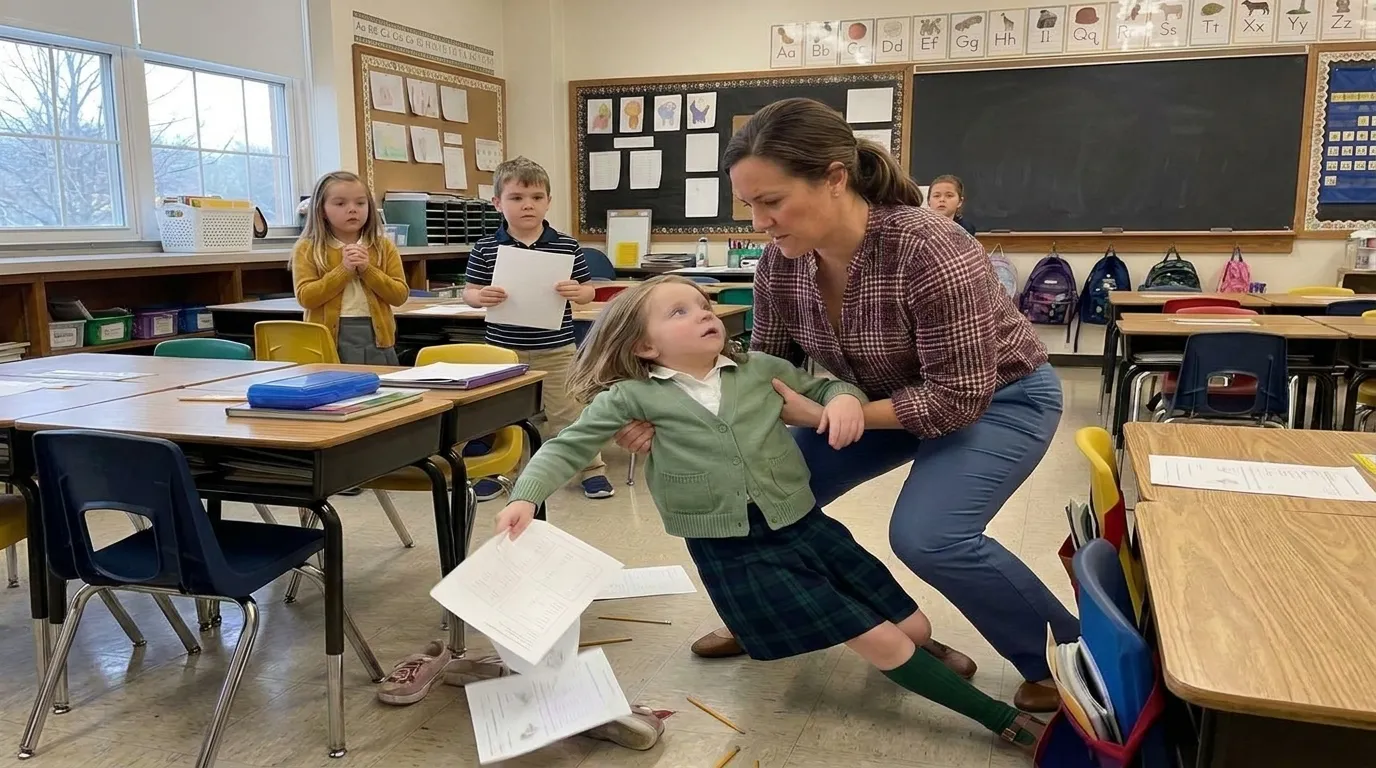
Then the color drained from Lila’s face.
The worksheets slipped from her hands.
Her knees gave way.
Valerie caught her before her head struck the tile.
By 9:03, Lila was lying on the narrow cot in the nurse’s office.
Her blood pressure was low.
The nurse initially mentioned dehydration.
Valerie desperately wanted that to be the explanation.
Then she noticed Lila’s hands gripping the blanket.
Her cardigan had been buttoned incorrectly near the bottom.
One button had missed its hole.
Another pulled awkwardly across her middle, as though something beneath the fabric was pressing against her.
Valerie moved a chair beside the cot.
“Lila, sweetheart, can you tell me what hurts?”
The child stared at the ceiling.
Then slowly turned her head.
“My dad said it wouldn’t hurt…”
Her voice trembled.
“But it does.”
The nurse’s pen stopped.
Valerie kept her voice soft.
“What hurts, sweetheart?”
Lila looked toward the closed door.
Then at the nurse.
Then back at Valerie.
No answer.
So Valerie said the one thing that changed Lila’s expression completely.
“You are not in trouble.”
Tears filled the little girl’s eyes.
Valerie did not ask another leading question.
She did not touch Lila’s clothes.
She did not demand an explanation.
She simply said:
“Thank you for telling me.”
For nearly a minute, nobody spoke.
Then Lila whispered:
“Can you promise Dad won’t come in here?”
Valerie’s stomach tightened.
“I can make sure you stay with safe adults while we get you help.”
Lila swallowed.
“He gets mad when people interfere.”
The nurse quietly moved toward the office phone.
“What happened this morning?” Valerie asked.
Lila looked down at herself.
“He put the belt on again.”
Valerie did not react outwardly.
“What belt?”
“The straight belt.”
That was what Lila called it.
Not because that was its real name.
Because that was what her father told her it was for.
“He says I slouch.”
She sniffed.
“He says people think children with bad posture are lazy.”
“When did he put it on?”
“Before breakfast.”
“Is it still on you?”
Lila nodded.
That explained the strange pull beneath the cardigan.
The nurse immediately stopped treating the situation like routine dehydration.
She contacted the appropriate school administrator and emergency medical services according to protocol.
Lila began crying harder.
“Please don’t tell Dad I told.”
“You did the right thing,” Valerie said.
“He said if I tell people things from our house, they’ll take me away.”
Valerie felt something cold settle inside her.
“Lila, none of this is your fault.”
The child whispered:
“He says that too.”
Valerie frowned.
“What?”
“Before he does it.”
Then Lila repeated the phrase she had apparently heard many times.
“This isn’t punishment. This is helping you.”
The paramedics arrived shortly afterward.
At the hospital, medical staff found a rigid compression device wrapped too tightly around Lila’s lower torso beneath her clothes.
It was not a prescribed medical brace.
It had not come from her pediatrician.
Her father had assembled it himself from a commercial posture-support garment, additional straps, and stiff inserts.
He had tightened it far beyond its intended use.
The pressure had caused extensive bruising, restricted movement, and contributed to Lila’s dizziness and difficulty breathing comfortably.
There was no permanent internal damage.
But the physician was clear.
It had never been appropriate for a seven-year-old child to be forced to wear it that way.
Especially not repeatedly.
And the examination suggested this had not been the first time.
Valerie stood outside the room when a child-protection investigator arrived.
Her name was Dana Pierce.
She spoke briefly with the doctor.
Then with the nurse.
Then she approached Valerie.
“You’re the teacher?”
“Yes.”
“What exactly did Lila disclose to you?”
Valerie repeated the words exactly.
Not what she thought they meant.
Not what she feared.
Exactly what Lila had said.
Dana nodded.
“That matters.”
Then she entered Lila’s room.
By noon, the school contacted Lila’s father.
His name was Aaron Mercer.
He arrived furious.
Not frightened.
Not confused.
Furious.
“I want my daughter.”
The administrator told him Lila was at the hospital and that he would need to speak with investigators.
Aaron immediately demanded to know who had “put ideas in her head.”
That response was documented too.
At the hospital, he tried another approach.
He told police the brace was therapeutic.
Lila had terrible posture.
She complained about everything.
Children exaggerated discomfort.
He had only been trying to help.
Then the physician asked one simple question.
“Who prescribed it?”
Aaron had no answer.
“Which doctor evaluated her?”
Silence.
“Who instructed you to tighten it this way?”
Aaron’s face hardened.
“I’m her father.”
The doctor replied:
“That wasn’t my question.”
For the first time that day, Aaron stopped talking.
The investigation did not begin with assumptions.
It began with records.
That mattered.
The school attendance log showed something Valerie had never noticed until administrators reviewed the previous semester.
Lila had missed eleven mornings.
Always Thursdays.
Always arriving late or not at all.
The school nurse’s logs showed three previous complaints.
Stomach pain.
Dizziness.
Back pain.
Each time, Aaron had explained it away.
She ate too fast.
She slept badly.
She was dramatic.
Then investigators spoke with Lila’s pediatrician.
That changed the case.
Six months earlier, Aaron had brought Lila in complaining that she “stood crooked.”
The doctor examined her.
No spinal abnormality.
No medical reason for a corrective brace.
The pediatrician recommended ordinary stretching, activity, and reassurance.
Aaron had been dissatisfied.
According to the medical notes, he repeatedly asked whether a stronger intervention could “train it out of her.”
The doctor explicitly advised against restrictive devices.
The instruction was written in the chart.
Aaron had ignored it.
But even that did not explain everything.
Dana asked Lila when her father first began using the homemade brace.
“After Mommy left.”
Lila’s mother was not dead.
That surprised Valerie when she learned it.
For nearly a year, Aaron had told the school that Lila’s mother, Megan, had “moved away and wanted no contact.”
There was paperwork in Lila’s file showing Aaron as the primary parent.
But when investigators looked deeper, they discovered an active family-court case.
Megan had not abandoned Lila.
She had been trying to regain regular contact for eight months.
Aaron had repeatedly canceled visits.
Changed meeting locations.
Claimed Lila was ill.
Claimed Lila did not want to see her.
And most importantly, he had begun telling people Megan was unstable.
Dana had seen the pattern before.
One adult controls communication.
Then tells every side a different version.
The child becomes the only person carrying pieces of all the stories.
Megan arrived at the child-advocacy center that evening.
Valerie happened to still be there because investigators needed a supplemental statement from the school.
She saw a woman in a green coat hurry through the entrance.
Megan’s first words were not:
“What did Aaron do?”
They were:
“Where is my daughter?”
When she saw Lila, she dropped to her knees.
Lila froze.
For a second, Valerie worried the child might pull away.
Instead, Lila ran into her mother’s arms.
“Mommy.”
Megan began crying.
“I’ve been trying to see you.”
Lila looked confused.
“Dad said you didn’t want me because I was difficult.”
Megan’s face broke.
“No.”
“He said you have a new family.”
“No, baby.”
“He said you forgot my birthday.”
Megan closed her eyes.
“I was outside your house that day.”
Lila stared at her.
“What?”
“I brought your purple cake.”
Aaron had refused to answer the door.
Then told Lila her mother never came.
The birthday cake had been photographed because Megan’s attorney told her to document missed exchanges.
The picture showed the date.
The house.
The cake.
The truth.
Lila looked at the photograph for a long time.
Then began sobbing.
Not because of the brace.
Not because of the hospital.
Because a child who had spent months believing she was unwanted had suddenly discovered that the person she missed had been trying to reach her all along.
Valerie stepped away.
That moment belonged to them.
But before she left, Lila called:
“Ms. Kincaid?”
Valerie turned.
“Thank you for catching me.”
Valerie smiled.
“Anytime.”
Lila shook her head.
“No.”
She pointed toward her chest.
“I mean before.”
Valerie understood.
Before the floor.
Before the hospital.
Before anyone else knew something was wrong.
She had noticed.
That mattered to Lila.
“I’m glad you told me,” Valerie said.
Lila looked down.
“I almost didn’t.”
“I know.”
“Dad says grown-ups believe him because I’m little.”
Valerie’s expression changed.
“Being little doesn’t make the truth smaller.”
Lila looked up.
That sentence stayed with her.
It stayed with Valerie too.
Aaron was not arrested simply because a teacher became suspicious.
The case developed through medical findings, records, witness statements, and the child-protection investigation.
The homemade restraint device was seized.
Photographs were preserved.
The pediatrician’s warning was documented.
School records established a pattern.
Megan’s custody filings showed Aaron had been systematically interfering with contact.
Then investigators found something else.
Aaron had been recording Lila at home.
Not secretly.
He made her participate.
In one video, Lila sat stiffly on a couch.
Aaron’s voice came from behind the camera.
“Tell the camera why Mommy shouldn’t visit.”
“Because she makes me nervous.”
Another recording:
“Tell the camera who takes care of you.”
“Daddy.”
“Who makes bad choices?”
A pause.
“Mommy.”
The videos were intended for the custody case.
But investigators noticed something.
In several recordings, Lila kept looking slightly to the right of the camera before answering.
Aaron’s voice could be heard prompting her.
Sometimes correcting her.
Once saying:
“No. Say it the way we practiced.”
Megan’s attorney had spent months trying to prove coaching.
Aaron had recorded it himself.
The same was true of his “posture treatment.”
Aaron believed everything he did had an explanation.
He was teaching discipline.
Correcting posture.
Protecting Lila from an unstable mother.
Documenting the child’s preferences.
Helping.
That was the word he used over and over.
But intention does not erase impact.
And calling control “help” does not make it care.
The court issued temporary protections while the criminal and custody matters were reviewed.
Lila was placed with Megan under supervision and support from professionals familiar with reunification and childhood trauma.
At first, Lila did not sleep well.
She asked permission for everything.
“Can I sit on the couch?”
“Yes.”
“Can I take my cardigan off?”
“Yes.”
“Can I have another piece of toast?”
“Yes.”
“Can I close my bedroom door?”
Megan had to leave the room once after that question because she did not want Lila to see her cry.
One evening, Lila spilled a glass of milk.
Milk spread across the table and dripped onto the floor.
Lila went completely still.
Her face lost color.
“I’m sorry.”
Megan grabbed a towel.
“It’s okay.”
“I didn’t mean to.”
“I know.”
“I’ll sit straight.”
Megan stopped.
Slowly, she placed the towel down.
Then crouched beside her daughter.
“Lila.”
The little girl’s breathing became quick.
“You spilled milk.”
Lila nodded.
“That means we clean up milk.”
She waited.
“That’s all?”
“That’s all.”
“No belt?”
Megan’s eyes filled.
“No belt.”
“No standing in the corner?”
“No.”
“No video?”
“No.”
Lila stared.
“Dad said people have to learn.”
Megan reached for her hand but stopped before touching her.
“Can I hold your hand?”
Lila nodded.
Megan took it.
“You are allowed to learn without being hurt.”
For the first time since coming home, Lila leaned forward and rested her head against her mother.
That was how healing began.
Not with a courtroom.
Not with a dramatic speech.
With spilled milk.
A towel.
And an adult proving that mistakes did not require pain.