Federal agents secured the neighborhood before I reached my street.
Marcus wanted me to remain away from the house.
I refused.
“I’m not going in there to fight him.”
“Then what are you doing?”
“Talking.”
“That man may be armed.”
“He wants the key.”
“And?”
“So I give him what he thinks he wants.”
Marcus stared at me.
Then Eleanor’s earlier words returned.
The key was not a bank cipher.
It was an evidence-preservation device.
A trap.
When I walked toward my house, the street looked almost painfully normal.
Blue sky.
Fresh-cut grass.
Sprinklers.
My daughters’ bicycles near the garage.
Clara opened the front door.
She looked calm.
Too calm.
“Sebastian,” she said. “We have a guest.”
Inside, Arthur Sterling sat in my grandfather’s leather chair.
My daughters were near the piano.
Barnaby lay beside them.
Arthur wore an expensive dark suit.
A pistol rested across his lap.
But he spoke like a grandfather visiting for tea.
“Your daughter plays beautifully.”
I ignored him.
“Maya. Chloe.”
Both girls looked at me.
“Take Barnaby outside and check the tomatoes.”
Maya understood immediately that something was wrong.
She took Chloe’s hand.
The three of them went into the backyard.
Clara stayed.
Arthur looked at her.
“Your wife is remarkably composed.”
“She’s tougher than I am.”
Clara glanced at me.
“Debatable.”
Even then, I almost smiled.
Arthur extended his hand.
“The key.”
I removed it from my pocket.
He watched every movement.
Then he said something that made my stomach twist.
“I can establish a trust for your daughters today.”
“I’m not interested.”
“Four million dollars each.”
“No.”
“Education. Homes. Security.”
I looked at him.
“You threatened them ten minutes ago.”
Arthur’s expression hardened.
“I offered you a choice.”
“No. You tried to purchase obedience.”
I placed the titanium key on the table.
His eyes locked onto it.
Then he grabbed it.
From inside his jacket, he removed a secured field terminal.
He inserted the key.
The screen immediately changed.
Not into bank accounts.
Not into passwords.
A federal preservation notice appeared.
The device transmitted the terminal’s identity and location to investigators already monitoring the trust network.
Arthur stared at the screen.
“What did you do?”
“I didn’t do anything.”
Then Eleanor’s voice came from the doorway.
“The key was never yours to use, Arthur.”
He turned.
Eleanor stood there with Marcus and federal agents behind her.
Arthur looked like he had seen a ghost.
“You were supposed to be in the hospital.”
“I was.”
“You nearly died.”
“I did.”
His eyes dropped to the key.
Then back to her.
“You set me up.”
“No.”
Eleanor looked toward me.
“You set yourself up when you decided a dying woman, an employee, and an entire family were expendable.”
Arthur’s face changed.
The polished retired admiral disappeared.
“You think you can take everything from me?”
“I’m not taking anything.”
“The courts will decide what belongs to whom.”
Arthur stood.
The pistol rose with him.
Clara moved closer to me.
Agents reacted instantly.
“Put the weapon down!”
Arthur ignored them.
His eyes stayed on Eleanor.
“I built that trust.”
“You administered it.”
“I protected this family.”
“You controlled it.”
His hand shook.
“You gave our legacy to a nobody.”
Eleanor’s face tightened.
“He is not a nobody.”
Arthur looked toward me with pure contempt.
“A fired marketing employee.”
Eleanor stepped forward.
“No.”
She pointed toward the old brass compass in my hand.
“Our brother’s grandson.”
Arthur froze.
For several seconds, nobody moved.
Then he stared at the compass.
“No.”
Eleanor explained.
Their oldest brother, Arthur Sebastian Mercer-Sterling, had left the family decades earlier after uncovering illegal transactions tied to the maritime businesses.
He became Arthur Miller.
My grandfather.
Arthur Sterling’s face went white.
“You knew?”
“For years.”
“And you watched him?”
“Yes.”
“Why?”
“To see what kind of man he became.”
Eleanor looked at me.
“He worked without expecting inheritance.”
“He helped people when nobody rewarded him.”
“And this morning, when everyone else drove past, he stopped.”
I shook my head.
“I’m not taking an empire because I stopped for someone.”
Eleanor’s expression softened.
“Good.”
Arthur stared at me.
Then at her.
“What?”
“That is why I trust him.”
Arthur’s grip tightened around the pistol.
“You cannot give him what belongs to me.”
Eleanor answered quietly.
“It never belonged to you.”
Arthur raised the weapon.
Federal agents intervened before he could use it.
The pistol fell away.
Arthur was restrained.
Nobody fired.
Nobody died.
My daughters remained safely outside.
And within minutes, the man who had walked into my house believing money, rank, and fear still controlled everyone was being escorted out through my front door.
As agents passed the porch, Arthur looked at me.
“You think you won?”
I shook my head.
“This isn’t a game.”
“You’ll take her money.”
“No.”
His face twisted.
“Everyone takes the money.”
“Maybe that’s why your family ended up like this.”
He stopped speaking.
Then the agents took him away.
The investigation lasted months.
The truth was less theatrical than the threats.
And worse in quieter ways.
Carter Holbrook had helped arrange unauthorized transactions involving trust assets.
Nick had knowingly participated in portions of the attempted Vanguard transfer and helped create false internal stories to isolate me after I missed the presentation.
Investigators also found evidence connected to tampering with Eleanor’s vehicle.
Arthur was linked to the broader attempt to force Eleanor out of control of the trust and move assets before she could intervene.
The cases became complicated.
Lawyers fought.
Accounts were frozen.
Records were examined.
Not every accusation became a charge.
Not every rumor became evidence.
Eleanor insisted on that distinction.
“Proof first,” she told me.
“Always.”
Vanguard survived.
That surprised everyone.
The company itself had real clients.
Real employees.
Young designers and account managers who had done nothing wrong.
I was asked to help stabilize operations while an independent board was created.
Not because I had suddenly become the owner of everything.
Because I knew the clients.
I knew the employees.
And unlike Nick, I knew which people were carrying the company while senior management took credit.
My first decision was simple.
No mass layoffs.
My second:
Overtime had to be paid.
Marcus nearly laughed when I told him.
“You’ve inherited access to a family trust worth more money than you’ll spend in your lifetime and your first concern is overtime?”
“I spent three years being the guy who stayed until nine.”
“Fair.”
Eleanor eventually offered me a formal role in the family trust.
I refused at first.
“I have a family.”
“So do I.”
“I don’t want private aircraft.”
“Neither do I.”
“You were driving a Maybach.”
“That was a terrible mistake.”
I laughed.
It was the first time I had laughed with her.
Eventually, I agreed to serve as an independent trustee overseeing charitable and employee-related programs.
Nothing connected to military intelligence.
Nothing covert.
Nothing requiring me to turn my family home into an operations center.
Clara made that condition very clear.
“You bring one more federal tactical team through my living room,” she told me, “and they’re all taking their shoes off.”
Marcus heard her.
From then on, everyone did.
The fifty-thousand-dollar check Carter had offered me was entered into evidence.
I never deposited it.
My grandfather’s brass compass was repaired.
But I kept the faint mark where the needle had bent.
Some damage deserves to remain visible.
It reminds you what happened.
Nick wrote me once.
Not an apology.
At least, not really.
He blamed Carter.
Pressure.
Fear.
Money.
The market.
Me.
Near the end, he wrote:
You cost me everything because you couldn’t just keep driving.
I read that sentence twice.
Then threw the letter away.
Because he still didn’t understand.
Stopping had not cost him everything.
His own choices had.
Almost a year after the morning on Route 6, I drove that highway again.
Clara sat beside me.
Maya and Chloe were in the back seat.
Barnaby occupied enough space for two additional passengers.
We were heading into the mountains for the weekend.
As we approached the Lookout Mountain curve, Chloe leaned forward.
“Daddy?”
“Yes?”
“Is this where you saved Aunt Eleanor?”
Eleanor had insisted the girls call her Aunt Eleanor despite the technically awkward family generation.
“Yes.”
Maya looked toward the shoulder.
“Were you scared?”
I thought about it.
“Afterward.”
“Not while helping her?”
“Not really.”
“Why?”
I smiled.
“Sometimes you don’t have time to be scared until later.”
Clara looked at me.
“That applies to an alarming number of your decisions.”
“Probably.”
We passed the exact place.
No Mercedes.
No flashing lights.
Just mountain grass moving in the wind.
A few months earlier, Eleanor had asked me the question everyone else eventually asked.
“Would you stop again?”
I had answered without thinking.
“Yes.”
She smiled.
“Even knowing what it cost you?”
That had taken longer.
My job.
My reputation.
The danger to my family.
The months of investigations.
Everything.
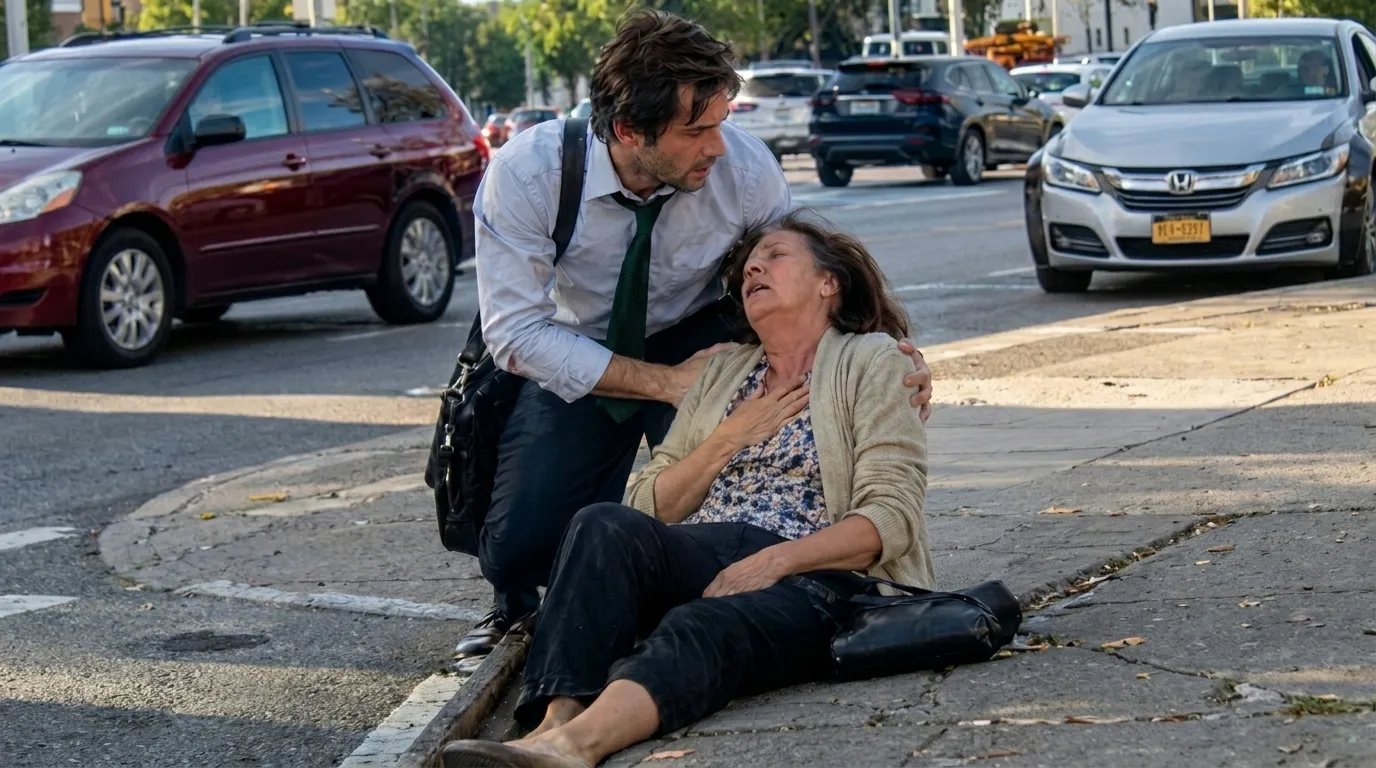
Then I remembered the woman on the gravel.
Her heart stopped beneath my hands.
For forty-eight seconds, everything she had ever been could have ended on the side of a highway while strangers kept driving.
“Yes,” I finally told Eleanor.
“I would still stop.”
Because Nick had been wrong about one thing from the beginning.
Responsibility does not end at the edge of your job description.
A meeting matters.
A paycheck matters.
People depending on you matter.
But sometimes life places another human being directly in front of you and asks a much simpler question:
Will you keep driving?
That morning, I didn’t.
And yes, I lost my job.
But I also learned what kind of company I had been working for.
What kind of people had been controlling it.
Where my grandfather really came from.
And what kind of man I wanted my daughters to remember.
A few weeks after the investigation finally settled, Chloe asked me whether I was going back to the office full-time.
“No.”
“Why?”
“Because I promised you something.”
Her eyes widened.
“The treehouse?”
“The treehouse.”
We built it together that summer.
Nothing luxurious.
No imported wood.
No private architect.
Just cedar boards, screws, a crooked little window, and a roof Clara insisted I redo twice because it leaked.
On the front, Maya painted a sign:
MILLER RESCUE STATION
Eleanor visited the day we finished.
She climbed exactly three steps before announcing that seventy-something-year-old women with cardiac histories did not belong in treehouses.
So we brought her lemonade instead.
She sat beneath the blue spruce watching my daughters argue about who got the top bunk.
Then she looked at me.
“Your grandfather would have liked this.”
“The treehouse?”
“The life.”
I looked toward Clara.
Toward my girls.
Toward Barnaby sleeping in the grass.
Then toward the old brass compass sitting on the porch table beside Eleanor.
For most of my adult life, I thought success meant getting somewhere.
Bigger account.
Better title.
Higher salary.
More important room.
That morning on Route 6 taught me something different.
Sometimes the most important decision you make is not where you are going.
It is whether you are willing to stop along the way.
I lost a job because I stopped for a stranger.
But the stranger lived.
My family stayed safe.
The truth came out.
And when everything finally became quiet again, I realized I had not been thrown out of my life that morning.
I had been thrown out of a place that had convinced me work mattered more than the person I wanted to be.
So when Chloe climbed down from the treehouse and ran toward me with sawdust in her hair, I lifted her into my arms.
“Daddy?”
“Yes?”
“You’re not going back to work today?”
I looked toward the mountains.
Then at my daughter.
“No.”
“Why?”
I smiled.
“Because around here…”
I kissed the top of her head.
“…we don’t drive past the people who need us.”
And for the first time in a very long time, I was exactly where I needed to be.
Latest Posts
- My Husband Mocked My Postpartum Appearance in His Brothers’ Group Chat—I Stayed Quiet for Five Days
Four months after giving birth, I thought my husband understood why I hardly recognized myself. Then I discovered the cruel joke he'd been sharing with his brothers, along with photos I never knew he'd taken. I kept my discovery secret for five days, determined to make him regret every word. “Dude, you weren't exaggerating 😂” …
- My Stepdaughter Called Me the Help Until My Envelope Changed Everything
The insult came before I’d even finished setting down the peach cobbler. I’d baked it at five that morning in the kitchen of the lake cabin we’d rented, and it was still warm under the foil. The smell of cinnamon followed me across the grass toward the pavilion tables, where thirty-two members of the Cole …
- My In-Laws Gave Their Other Three Children $20,000 for Houses and Gave Us Only a Card Two Years Later, We Bought the Old Miller Place for $41,500
The envelopes were tucked under the Easter plates. Each had a name written on it in my mother-in-law’s round schoolteacher handwriting. Kim opened hers first. She’s the oldest. Divorced two years. Raising two boys in a rented trailer behind the grain elevator. She looked at what was inside the envelope and put her hand flat …
- My Mother-in-Law Told Me to Lose Weight After Giving Me a Dress That Didn’t Fit, but Minutes Later, She Regretted Everything
I couldn’t get it over my hips. I stood in my bedroom in my underwear with the dress bunched around my thighs like a deflated balloon. Midnight blue silk. A designer label I’d only ever seen in magazines. Tiny pearl buttons down the back. Beautiful. And four sizes too small. I pulled. I tugged. I …
- Teen Wore a Dress to His Best Friend’s Funeral—The Family Nearly Had Him Removed Before He Reached the Microphone
My son’s best friend read the eulogy at his funeral in a red dress. I almost had him removed before he reached the microphone. My son Jack died 17 days after his 18th birthday. Cancer. Fourteen months from diagnosis to funeral. We found out late. Too late, as it turned out, and the treatment never …