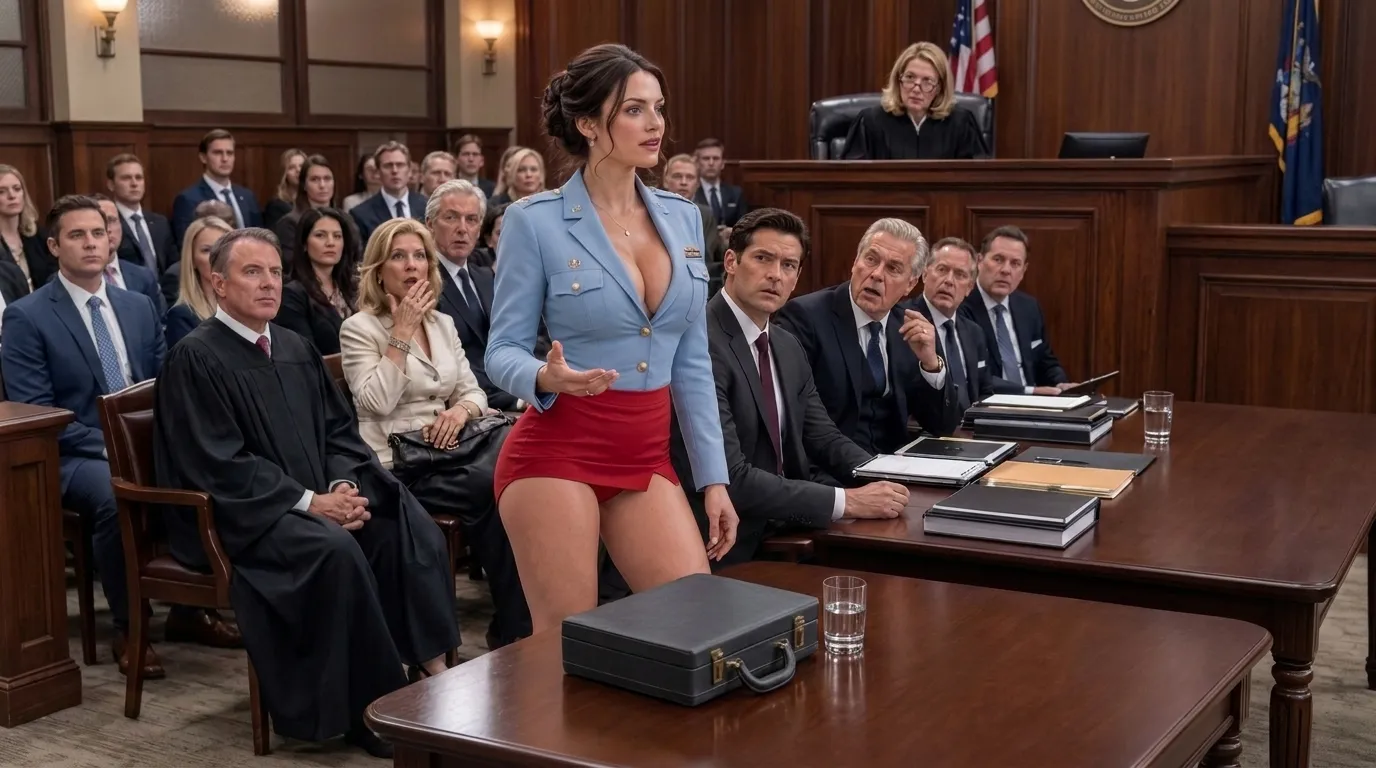
Judge Morrison slowly removed her glasses.
“Lieutenant Colonel?”
“Yes, Your Honor. Army Reserve. Seventeen years of service. For the last nine, I have practiced military justice and federal procurement law.”
She looked down at the folder I had filed that morning.
“You are also admitted to the Court of Appeals for the Armed Forces and federal district court?”
“I am.”
Martin Voss finally found his voice.
“Your Honor, whatever Mrs. Hale does for the military is irrelevant to the validity of her marriage agreement.”
Judge Morrison looked at him.
“It is relevant to whether I need you to explain basic procedure to her.”
Then she turned back to me.
“Grounds for disqualification?”
I opened my briefcase.
“Mr. Voss claims he represents only Preston. But Exhibit Four—the alleged postnuptial agreement—states on page fourteen that Voss Legal Group acted as independent counsel for both parties during negotiation.”
I looked directly at him.
“If that statement is true, Mr. Voss is my former attorney and possesses privileged information material to this dispute.”
I paused.
“If it is false, then the document contains a fabricated representation.”
Judge Morrison turned toward Voss.
“Mr. Voss?”
“Boilerplate language.”
“In a notarized contract?” I asked.
His jaw tightened.
Judge Morrison tapped her pen.
“Mrs. Hale, your fraud allegation?”
I removed a single page.
“The agreement is dated October 18 of last year. It contains what purports to be my electronic signature, witnessed by a notary named Elena Torres.”
I let the silence settle.
“Elena Torres died on August 2—eleven weeks before she supposedly watched me sign it.”
Even Voss looked toward Preston.
I continued.
“The authentication record also lists the IP address used to sign the agreement. That address belongs to Hale Meridian Systems’ executive conference room.”
Another document went onto the table.
“On October 18, I was nine hundred miles away serving on active-duty orders at Fort Bragg. My military access logs, flight records, and a sworn declaration from my commanding officer are attached.”
Voss stood.
“Your Honor, we have not had sufficient opportunity to verify these claims.”
“You filed the exhibit,” I said. “Verification should have happened before you asked this court to enforce it.”
After a thirty-minute recess, Judge Morrison returned.
She disqualified Voss Legal Group from the postnuptial dispute.
She ordered all related electronic records preserved.
She denied Preston’s request to remove me from the marital residence.
And she imposed equal financial restraints on both of us.
The gavel fell.
Nobody laughed.
Outside the courtroom, Graham approached me.
“A uniform and a title don’t change what you are,” he said. “An ungrateful woman who wandered into a life she could never have built.”
I closed my briefcase.
“You’re welcome to try proving that.”
Then I noticed Vivian.
She stood behind him, pale and completely still.
Her right hand rested on the diamond bracelet she wore everywhere.
She touched the largest stone twice.
Then once.
Two short flashes.
One long.
A distress pattern she had once watched me demonstrate at a veterans’ fundraiser.
I gave no sign that I understood.
But for the first time, I wondered whether Vivian’s diamonds were hiding something more than wealth.
I had met Preston eight years earlier during a winter storm at an airport.
He was sitting on the floor beside a dead phone, desperately trying to reach his supposedly dying father.
I had a portable charger.
We talked for six hours while snow buried the runway.
He told me he hated the family business but felt responsible for thousands of employees.
I told him I had joined the Army at eighteen because foster care had taught me that belonging was sometimes something you had to earn.
I did not tell him everything.
I did not tell him about Daniel Reed.
Daniel had grown up beside me in foster care.
He shared food with me when we were children.
Later, he followed me into the Army.
Then he died in a vehicle fire during a training exercise.
Or so I believed.
Burned coffee could still return me to the corridor where I had been asked to identify his body.
I told Preston only that I became a lawyer because helplessness was a language I never wanted to speak again.
When he proposed eleven months later, he promised he wanted a life different from the cold empire in which he had been raised.
For a while, I believed him.
Then Graham offered Preston the CEO position.
We moved into the Hale estate’s gatehouse “temporarily.”
My military work became inconvenient.
My deployments embarrassed Vivian.
Preston began asking me to describe myself merely as a consultant.
“They won’t understand military law.”
“Then explain it.”
“Why create conflict?”
That sentence became the architecture of our marriage.
It excused Vivian seating me near staff at family events.
Graham calling me “Preston’s little organizer.”
Hale Meridian removing my name from compliance work I had helped prepare.
In courtrooms, I fought with precision.
At home, I mistook silence for peace.
The divorce petition changed that.
Because it contained much more than a forged postnuptial agreement.
Buried inside Exhibit Nine was an asset schedule assigning me sole ownership of a consulting company called Aster House Strategies.
I had never heard of it.
Yet according to the records, Aster House had received $14.2 million from Hale Meridian over three years.
The transfers were labeled:
Federal Compliance Services.
My electronic signature appeared on every invoice.
If the forged agreement became enforceable, Aster House would become my separate property.
Along with its taxes.
Its false invoices.
And whatever criminal exposure followed.
Preston was not merely trying to divorce me.
Someone was constructing a firewall between the Hale family and a potential federal investigation.
And they intended to make me that firewall.
For four nights, I mapped transfers, timestamps, and metadata.
Then I saw a code that stopped me cold.
MX-77-104.
It belonged to a military vehicle stabilization system called Sentinel.
Manufactured by Hale Meridian Systems.
The same system installed in the vehicle in which Daniel had supposedly died.
Seventeen years earlier, the Army investigation had blamed driver error.
The stabilization controller had supposedly been inspected and found operational.
But two years earlier, during an unrelated procurement matter, I had seen references to failures involving early Sentinel systems.
Because of my marriage to Preston, I had immediately recused myself and reported the potential conflict through command channels.
Now the issue was no longer simply personal.
I called Colonel Marcus Bell.
“I need to make a protected disclosure.”
He listened without interrupting.
When I finished, he asked:
“Are you safe?”
I looked through the gatehouse window.
A black sedan sat beyond the estate gates.
“Not yet.”
Over the next two weeks, someone attempted to access my military email several times.
Someone entered the gatehouse but appeared to take nothing.
The press received stories claiming I had married Preston for money and had become emotionally unstable.
Then Preston froze our joint bank account despite the court’s restraint order.
I filed a motion.
By lunchtime, Judge Morrison ordered access restored and warned him about contempt.
That evening, Preston came to the gatehouse.
“You can’t be here.”
He walked inside anyway.
“Tell me what you want.”
“The truth.”
“Don’t perform.”
“You came to my house.”
“Our house.”
“Your divorce petition calls it separate property.”
His mouth tightened.
“Fine. Money. How much?”
“You forged my signature.”
“I didn’t.”
“Then your father did.”
Preston glanced toward the windows.
That reaction told me more than his denial.
I placed an Aster House invoice on the table.
“Why is MX-77-104 on this?”
His face lost its color.
“Where did you get that?”
“Discovery.”
“Those files are proprietary.”
“They were attached to your divorce petition.”
He stepped closer.
“Drop the fraud claim. Accept the settlement. You get two million dollars, the gatehouse, and nobody asks questions about Aster House.”
“Questions like why a shell company carrying my name received money connected to a defective military system?”
“You don’t know what you’re talking about.”
“Daniel Reed.”
The name struck him.
He grabbed the back of a chair.
I stared.
“How do you know that surname?”
“You told me.”
“No.”
I stepped closer.
“I never told you his surname.”
Rain hammered the windows.
Finally, Preston whispered:
“There are things my father did before either of us had control.”
“Who else knows?”
“My mother.”
Then he left.
At 2:13 the next morning, an encrypted message appeared on my phone.
LOOK INSIDE THE CLOCK.
I went to the brass anniversary clock Vivian had given us.
Behind the mechanism was a flat metal key.
A safe-deposit key.
Commonwealth Trust.
The account holder was Vivian Hale.
At the second hearing, Preston arrived with new counsel.
Celeste Ward.
Unlike Voss, she did not underestimate me.
She introduced Aster House invoices and tried to suggest I had secretly controlled the company.
I responded with the Army’s unclassified certification proving I had disclosed the Hale Meridian conflict years earlier and had been screened from related procurement matters.
Her first attack failed.
Then I called Hale Meridian’s CFO.
Warren Pike.
“Who approved payments to Aster House?”
“The executive office.”
“Which executive?”
“Mr. Graham Hale.”
“Who gave you the banking instructions?”
Warren swallowed.
“Mr. Preston Hale.”
“And what bank received the funds?”
“Commonwealth Trust.”
“Account ending 3118?”
“Yes.”
I placed Vivian’s key on the table.
“Who provided the beneficial ownership certification claiming that account belonged to me?”
His eyes moved toward Graham.
Judge Morrison’s voice hardened.
“Answer the question.”
“Mrs. Vivian Hale.”
The courtroom erupted.
Graham jumped up.
“That is a lie!”
Judge Morrison ordered him to sit.
I looked at Vivian.
The distress signal.
The hidden key.
The clock.
Either she had helped frame me—
or she had been trying to tell me why.
“Your Honor, the respondent calls Vivian Hale.”
Preston turned.
“Don’t.”
His mother heard him.
And still walked toward the witness stand.
Vivian took the oath.
Up close, her polished appearance was beginning to crack.
Beneath the diamond bracelet was a yellowing bruise around her wrist.
“Did you provide Aster House documents to Warren Pike?”
“Yes.”
“Did I authorize that?”
“No.”
“Did I know Aster House existed?”
“Not to my knowledge.”
“Then why did you provide documents bearing my signature?”
Vivian looked toward Graham.
“My husband told me to.”
Graham stared at her.
“Why was Aster House created?”
“To receive money that could not remain on Hale Meridian’s books.”
Graham jumped to his feet.
“You stupid woman!”
Bailiffs moved instantly.
Vivian flinched.
Judge Morrison ordered Graham removed from the courtroom.
As he passed her, he said:
“You know what happens now.”
Vivian straightened.
“Yes.”
Her voice grew stronger.
“Now people hear me.”
After the doors closed, I continued.
“Why did you help him use my identity?”
Tears filled her eyes.
“Because before you, he used mine.”
For twenty-three years, Graham had routed questionable payments through charities and businesses connected to Vivian.
He kept signed letters.
Edited recordings.
Even a psychiatric evaluation arranged through a physician connected to Hale Meridian.
“He told me if I ever left, Preston would testify that I was unstable.”
I looked toward my husband.
He stared at the floor.
“When did Aster House begin?”
“Three years ago.”
“Why my name?”
Vivian answered quietly.
“Because Graham believed federal investigators would find a military lawyer believable as someone with access and opportunity.”
The career they had mocked was the identity they intended to weaponize.
“Why hide the key inside my clock?”
“The safe-deposit box contains copies. Payment records. Testing reports. Everything I managed to take.”
“And the bracelet?”
Vivian touched the largest diamond.
Then twisted it.
A thin metal key slid from the setting.
“A second key.”
The bracelet everyone thought symbolized her privilege had actually been part of an escape plan.
Judge Morrison suspended the divorce proceedings.
She placed disputed assets under temporary supervision.
Sealed portions of the record.
And referred the evidence for investigation.
As Vivian was taken for a protected interview, she grabbed my hand.
“I am sorry.”
I did not know whether I wanted to forgive her or hate her.
So I asked the one question that mattered.
“What happened to Daniel Reed?”
Her fingers went cold.
“The box,” she whispered.
“The answer is in the box.”
The next morning, Commonwealth Trust opened the safe-deposit box under federal authority.
Army investigators, defense investigators, and federal prosecutors were now involved.
Colonel Bell assigned independent counsel to me because I had become a witness.
My attorney was Major Naomi Chen, one of my former students.
“You understand that you cannot prosecute or independently investigate any part of this.”
“I know.”
“And you cannot keep doing discovery yourself.”
“I know.”
“Amelia.”
I looked at her.
“I know.”
Giving up control was harder than facing Voss.
Law had always been how I turned fear into action.
Now I had to wait while other people investigated the death that had shaped my life.
During that waiting, Preston offered to cooperate.
We met in a federal conference room with both attorneys present.
“My father learned who Daniel was before our wedding,” Preston said.
“How?”
“Background check.”
“On me?”
“On everyone who entered the family.”
Even our love story had apparently been investigated.
“Daniel’s accident involved a first-generation Sentinel controller,” Preston continued. “The unit overheated during high-speed turns. Hale Meridian knew. The testing officer knew. They altered the report.”
“How many people?”
“Eleven confirmed. Maybe more.”
My stomach tightened.
“And you knew when you married me?”
“Not initially. My father told me after our engagement.”
“So you let me marry into the family connected to burying his case.”
“I loved you.”
I stared at him.
“Love without truth is possession.”
He said he had spent years trying to protect me.
Naomi cut in.
“By putting a shell company with potential criminal exposure in her name?”
“That wasn’t my plan.”
“Your signature transmitted the banking instructions,” I said.
Preston rubbed his face.
“My father said Aster House was insurance. Then an internal whistleblower copied the Sentinel records.”
“Who?”
“We didn’t know.”
“My father panicked. He wanted the company moved into your name through the postnup. Then he wanted me to divorce you before subpoenas arrived.”
“And you agreed.”
“He threatened to make my mother take the blame if I didn’t.”
Every Hale betrayal was explained as protection.
I asked the question I needed answered.
“Did you forge my signature?”
Preston went still.
Then:
“Yes.”
Seven years ended inside one word.
He admitted copying my signature certificate from an old mortgage record.
Admitted sending the banking instructions.
Admitted signing a divorce affidavit despite knowing parts of it were false.
Naomi asked:
“Who received the Aster House money?”
“My father controlled most of it.”
“Who else?”
Preston looked directly at me.
“Daniel Reed.”
I stopped breathing.
“Daniel is dead.”
Preston’s expression changed.
“That is what you were told.”