Three days later, Gene called Brandon thirty-seven times.
He answered none.
She called me eight times.
I answered once.
Her first sentence was:
“You need to fix what your daughter caused.”
I hung up.
Patrick drove to Gene’s house with a forensic accountant.
The preliminary review took four days.
The full accounting took almost six weeks.
Gene had not simply withdrawn from Holly’s education account.
She had built an entire accounting system around the assumption nobody would challenge her.
Arthur’s original beneficiary schedule included Holly by name.
Gene’s private spreadsheet replaced Holly with one word:
RESERVE
Whenever trust money was allocated to Holly, Gene redirected it.
Sometimes toward other grandchildren.
Sometimes toward herself.
Part of the family beach rental.
The new patio.
Christmas gifts.
Even the gold bracelet Gene wore during brunch.
All partially funded through money that should have remained for Holly.
Then auditors found the fake debt ledger.
For years, Gene had told relatives Brandon owed her $30,000 from a business crisis.
There had never been a loan.
Instead, she created handwritten entries implying Brandon owed the trust.
Those fake debts helped disguise withdrawals she had made herself.
Several dates matched times Brandon had actually given Gene money to pay taxes and expenses.
She turned his help into evidence against him.
“She wasn’t only excluding Holly,” Brandon told me after Patrick called.
“She was preparing to blame me.”
If the trust amendment surfaced, Gene intended to say Brandon had taken the missing money.
Arthur’s letter explained why he had anticipated something like that.
Gene had done something similar decades earlier.
Not with money.
With people.
When Brandon was seventeen, his cousin Rebecca suddenly disappeared from family gatherings.
Gene told everyone Rebecca had insulted Arthur and refused to apologize.
The family accepted the story.
Years later, shortly before Arthur died, Rebecca visited him in hospice.
She brought letters.
Birthday cards.
Christmas cards.
Apologies for an argument that had never actually happened.
Gene had intercepted them all.
Why?
Because Rebecca challenged Gene publicly at Thanksgiving twenty-five years earlier.
One disagreement.
One bruised ego.
And Gene edited Rebecca out of the family.
Arthur wrote:
“Your mother’s greatest weapon is not anger. It is editing.”
Then:
“She edits stories until the person who hurt her disappears and the person she favors becomes innocent.”
And finally:
“Do not let her edit Holly.”
That was exactly what Gene had been doing.
One missing photograph.
One wrong label.
One place card.
One trust distribution.
Until someday everyone might remember Holly as someone who had never really belonged.
Arthur had seen it.
And built paperwork strong enough to prevent it.
Arthur’s letter contained a paragraph addressed directly to Holly.
Brandon and I decided she was old enough to hear three sentences.
That evening, she sat between us.
“Grandpa Art wrote something for you,” Brandon said.
“For me?”
“Yes.”
He read:
“Dear Holly, if you ever wonder whether you were mine to love, the answer is yes.”
Her eyes filled.
“Adults make family complicated because we are foolish. Children usually understand it first.”
Then:
“If anyone ever gives you less love because of where you came from, that tells you something about them, not about you.”
Holly leaned against Brandon.
“Did Grandpa Art know Grandma Gene was mean?”
Brandon answered carefully.
“He knew Grandma sometimes made choices that hurt people.”
“Is she going to jail?”
“No.”
The family attorneys negotiated repayment and civil remedies while reserving other rights.
Gene was permanently removed as trustee.
Patrick and an independent fiduciary took control.
Gene had also violated Arthur’s house-occupancy conditions.
She would lose the right to remain indefinitely.
But Arthur had made sure she would not become homeless.
She had six months to relocate.
Her personal inheritance was enough for a comfortable condominium.
That fact made Brandon angrier, not happier.
She had never needed Holly’s money.
She wanted control.
Gene asked to see Holly in February.
We said no.
Again in March.
No.
Then a handwritten letter arrived.
The envelope said:
HOLLY HALE
Her full name.
Gene admitted she had been jealous of Arthur’s relationship with Holly.
She admitted the Guest place card was intentional.
She admitted the candle was not an oversight.
She bought it after purchasing everyone else’s gifts.
She knew exactly what message she was sending.
Then she wrote:
You did not ruin Christmas. I did.
Holly listened.
“Do I have to forgive her?”
“No.”
“Will Dad be sad if I don’t?”
Brandon answered from the doorway.
“No.”
Holly thought.
“I forgive her a little.”
“A little?”
“She can have a little now.”
“What about the rest?”
“She has to earn it.”
At seven years old, Holly had created healthier boundaries than generations of adults around Gene.
Gene moved out in May.
The family home was eventually sold according to Arthur’s trust.
That was when we learned one last thing.
Arthur had not left Holly the house.
Gene had assumed he had.
So had some relatives.
Instead, Arthur had left Holly something personal.
The detached garage and narrow parcel behind it.
His watch-repair workshop.
The place where Holly had tea parties with him.
The place she first called him Grandpa Art.
Different grandchildren received different sentimental property.
A fishing boat.
A piano.
Tools.
And Holly received:
“The place where she first called me Grandpa.”
Because Holly was seven, Brandon and Patrick held the parcel in trust.
We drove there one afternoon.
The house was empty.
The old dining room looked strangely small.
Then we walked into Arthur’s workshop.
It still smelled faintly of cedar and machine oil.
His workbench remained against the wall.
Holly noticed something behind a cabinet.
A photograph.
The missing sunflower picture.
The original Gene claimed had been destroyed.
Arthur had written on the back:
HOLLY — AGE 5
BEST ASSISTANT I EVER HAD
Brandon sat on Arthur’s stool and cried.
Years of anger seemed to leave him at once.
Holly wrapped her arms around him.
“Dad?”
“I’m okay.”
“Grandpa Art chose us.”
Brandon shook his head gently.
“No.”
She frowned.
“He reminded me that I had already chosen you.”
That summer, we restored Arthur’s workshop.
Not as a museum.
Arthur would have hated that.
Half became a workshop.
Half became a reading room.
Holly insisted on a tea table.
We framed the sunflower photograph.
Then Holly asked us to frame something else.
The Christmas tag.
TO BRANDON’S GIRL
I hated the idea.
“Why keep that?”
Holly shrugged.
“Because Grandma Gene was wrong.”
“You want to remember it?”
“No.”
She pointed toward Arthur’s photograph.
“I want people to see that she was wrong.”
So the tag stayed.
Not as a wound.
As evidence.
Almost a year after that Christmas, Patrick found Arthur’s old video camera.
Arthur had recorded everything.
Birthdays.
Vacations.
Graduations.
Hours of crooked ceilings and questions about whether the red light meant the camera was working.
One tape was labeled:
CHRISTMAS — FAMILY MESSAGE
It had been recorded three months before Arthur died.
We watched it together.
Arthur appeared on-screen inside his workshop.
Thin.
Tired.
Alive.
“If you’re watching this, somebody found my terrible filing system.”
Brandon laughed.
Arthur explained that he had rewritten the trust and expected arguments.
Then he spoke about each grandchild.
Not their inheritance.
Who they were.
Finally:
“Now, Holly.”
Our daughter sat straighter.
Arthur smiled.
“Holly came into this family through a side door.”
Then:
“That is how some of the best people arrive.”
Holly grinned.
“She is not biologically related to me. This appears extremely important to one person.”
Arthur paused.
“Gene.”
The room became silent.
“I hope you never hear this part, because I hope you changed before I died.”
He looked directly into the camera.
“You spent our marriage terrified that loving someone else somehow reduced the love available to you.”
Arthur spoke about Gene competing with her children’s spouses.
Resenting grandchildren who preferred another lap.
Treating affection as ranking.
Then he said:
“Holly is not your threat.”
He leaned closer.
“She is your test.”
Brandon closed his eyes.
“If you can love a child who gives you no status, no bloodline, no claim to ownership, perhaps you will finally understand what family is.”
Then Arthur reached off-screen.
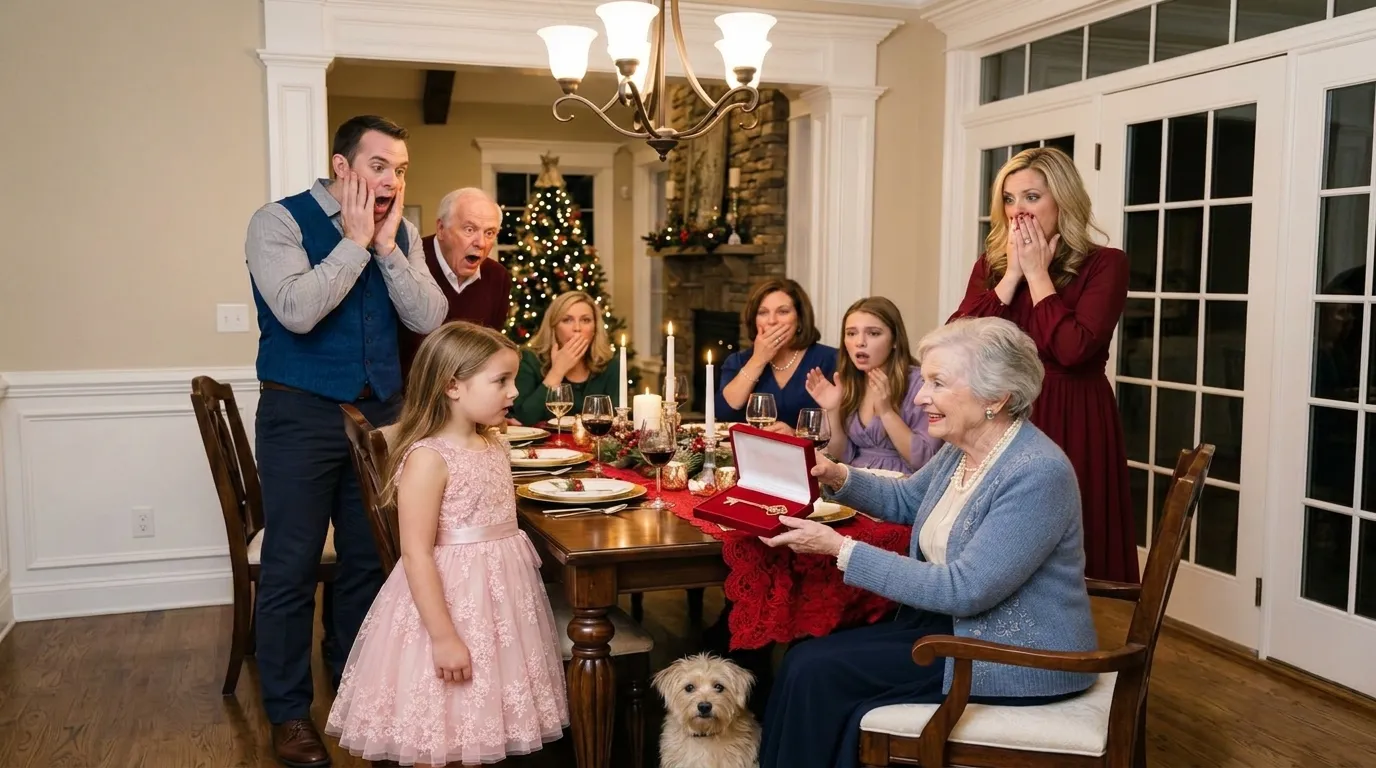
And placed a small red velvet box on the workbench.
My hand flew to my mouth.
Holly whispered:
“That’s my box.”
Arthur said:
“If Gene continues excluding Holly after I’m gone, Brandon, put the safe-deposit key inside this box.”
Brandon stared.
Then Arthur gave the instruction that shocked us.
“Do not give it to Gene.”
He smiled.
“Give it to Holly.”
I looked at Brandon.
“You knew?”
“No.”
Arthur continued:
“Let the child decide whether enough is enough.”
Those were almost exactly the words Brandon had told Holly.
Then Arthur gave one final warning:
“The key will not remove your mother from the family.”
Pause.
“Her choices will.”
The video ended.
For a while, nobody spoke.
Then Holly asked:
“So Grandpa Art planned the red box?”
“Looks like it,” Brandon whispered.
“Then Dad copied him.”
We all laughed.
Maybe father and son had simply understood each other more deeply than either realized.
And suddenly the red box felt different.
It had never been revenge.
Arthur had not left a weapon.
He left a boundary.
And put the final choice into the hands of the child everyone underestimated.
The following Christmas looked nothing like Gene’s old celebrations.
No chandelier.
No silver napkin rings.
No elaborate gift ceremony.
We celebrated inside Arthur’s workshop.
Patrick brought chili.
Diane brought cornbread.
Every gift was capped at twenty dollars.
Holly wore jeans and an oversized Christmas sweater.
She made place cards herself.
Every seat had a name.
Including Gene’s.
Gene arrived last.
She stood outside holding a wrapped package.
Holly looked at Brandon and me.
Neither of us moved.
Her decision.
She opened the door.
“Hi, Grandma Gene.”
Gene looked nervous.
“Hello, Holly.”
Her eyes found the wall.
Arthur’s photograph.
The sunflower picture.
Then the framed tag.
TO BRANDON’S GIRL
Gene stopped.
“That was ugly of me.”
Holly nodded.
“Yes.”
Gene almost smiled.
“I deserved that.”
“No,” Holly said.
Gene looked confused.
Holly pointed toward the framed tag.
“You deserved to learn.”
Gene’s eyes filled.
“I’m still learning.”
Holly accepted that.
Gene handed her the present.
No tablet.
No cash.
No jewelry.
A wooden box.
Gene had found it among Arthur’s belongings.
Inside were tiny watch gears, springs, screws, and repair tools.
On the lid were five engraved letters:
HOLLY
Nothing else.
Holly ran her fingers over her name.
“Thank you.”
Gene started crying.
Holly hugged her.
Only briefly.
But genuinely.
Later, I found Brandon near Arthur’s workbench.
“You okay?”
“Yes.”
“What are you thinking about?”
“The night Holly asked if I would always be her dad.”
“I remember.”
“I hated that Mom made her question it.”
“So did I.”
Then he looked toward Holly.
“Maybe we were asking the wrong question.”
“What question?”
“Whether Holly deserved to belong to us.”
He smiled.
“Maybe the real question was whether we deserved to belong to her.”
Outside, Holly called:
“Grandma! Come help me!”
Gene pointed at herself.
“Me?”
“Yes!”
Within seconds Holly handed her a snowball.
Soon Gene’s perfect coat had snow across one shoulder.
A year earlier, she would have been furious.
Now she laughed.
A real laugh.
The family never returned to what it had been.
That was the point.
Gene never became the unquestioned center again.
Patrick remained co-trustee with an independent professional.
Every account was transparent.
Every grandchild—including Holly—received exactly what Arthur intended.
Gene repaid the missing funds from her own inheritance.
Brandon never accepted repayment for the money he had spent saving the house.
“That was for Dad,” he told me.
“Not her.”
And Holly?
She kept the cheap candle.
Years later, when the wax cracked and the label faded, it remained in the bottom drawer of Arthur’s workbench.
Beside the red velvet box.
Beside the brass key.
Not because Holly needed proof that Gene once rejected her.
She had something much more important.
Proof that rejection had never defined her.
At seven years old, Holly had walked through a Christmas dining room filled with adults afraid to challenge one woman.
She placed a red box on the table.
She did not scream.
She did not demand money.
She did not demand a house.
She simply forced everybody to stop pretending.
Gene thought that box contained a key capable of taking away her home.
She was wrong.
It opened something much more dangerous.
The truth.
And once the truth entered our family, Gene could no longer decide who belonged.
Because Arthur’s final gift had never really been money.
Or property.
Or even the workshop.
It was one lesson strong enough to survive him:
Family is not the person who gets to decide whether you are worthy of a place at the table.
Family is the person who makes sure your name is already there.
THE END
Latest Posts
- My Mother-in-Law Made My Baby Shower About Herself—Then My Husband Stood Up #2
I wanted a small baby shower, but my mother-in-law ignored nearly every request and turned the day into a celebration of becoming a grandmother. I kept swallowing my frustration for one deeply personal reason, until she crossed a line neither my husband nor I could ignore. I was seven months pregnant with our first child, …
- My Son Grew His Hair for His Best Friend’s Wig—Then Her Father Called Me to School
A 14-Year-Old Boy Grew Out His Hair to Make a Wig for a Classmate Who Lost Hers to Cancer – The Next Day, His Mother Was Called to the School, Where the Girl's Father Said, 'You Have No Idea What Your Son Did, Do You?' The gum stuck in my son’s hair nearly ended the …
- 80-Year-Old Woman Spent Seven Days Visiting an Old Friend…
80-Year-Old Woman Spent Seven Days Visiting an Old Friend – She Returned Looking Half Her Size with a Suitcase That Wasn't Hers I almost walked past my mother at the train station. She was standing beside a bench, gripping the handle of an enormous black suitcase. Her gray hair was flattened against her forehead, and …
- The Winning Ticket and the Life My Husband Hid
My Husband Was Lying in a Hospital Bed When I Won 100 Million Dollars, and Then I Heard Him Laughing to His Mistress That I Would Hand Him Every Penny If I Thought He Was Dying. I Hid the Ticket, Called a Lawyer, and Walked Away, Never Imagining That His Fake Illness Was Only the …
- My husband divorced me to marry my own mother. #2
My Husband Divorced Me to Marry My Own Mother My husband divorced me to marry my own mother. Everyone told me to move on, but instead… I showed up at their wedding. And when she said, “I do,” they had no idea what I had already done. When Mark left me, he didn’t even try …