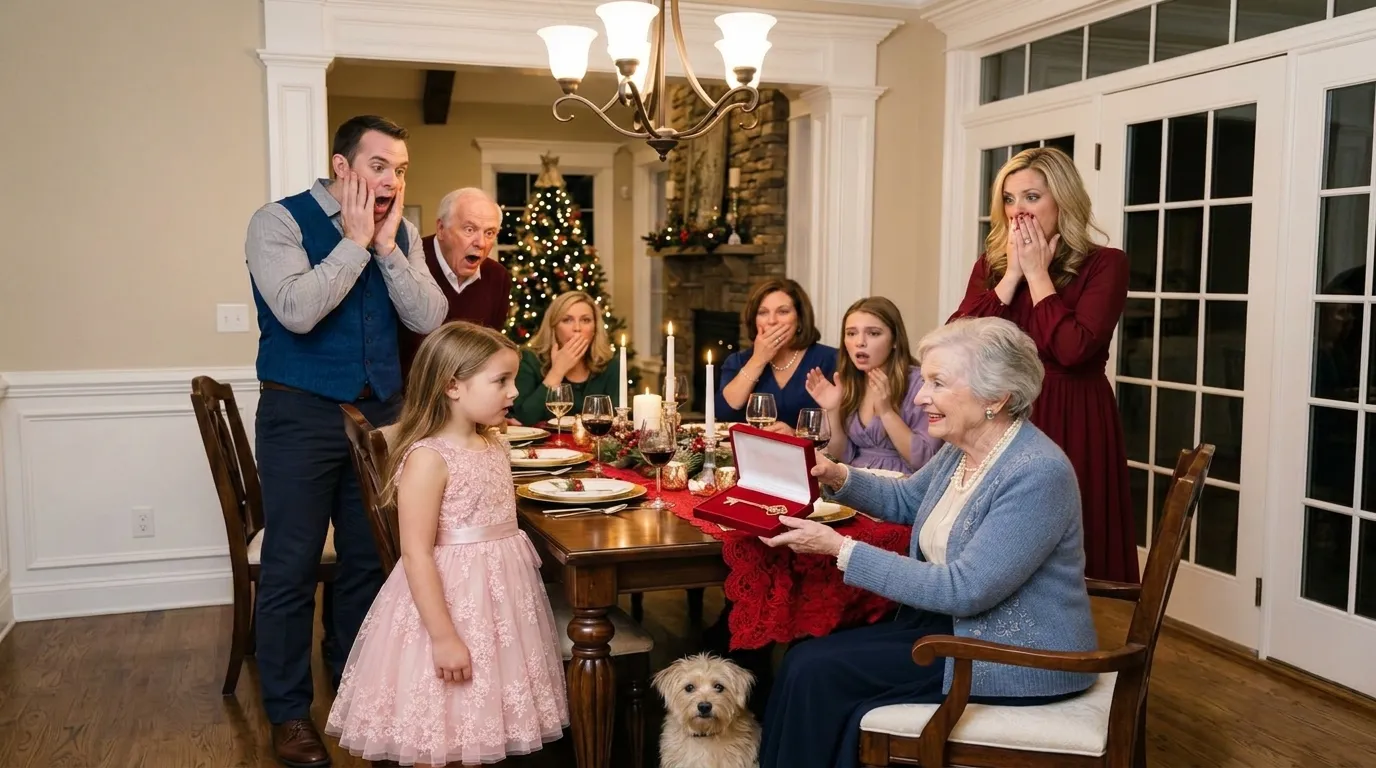
The first words on the card were:
BOX 417 WAS OPENED YESTERDAY.
Gene’s scream seemed too large for the quiet dining room.
She dropped the card.
The brass key bounced against the white tablecloth and stopped beside her untouched coffee.
“What did you do?” she whispered.
Brandon didn’t move.
For the first time since I had known him, his mother looked genuinely afraid of him.
Not because he was shouting.
He wasn’t.
Because he was calm.
“Nothing you didn’t know might happen,” he said.
Aunt Diane looked confused.
Brandon’s older brother, Patrick, had gone completely still.
“What is Box 417?” Diane asked.
“None of your business,” Gene snapped.
Brandon placed the fallen card beside the key.
“It belonged to Dad.”
The room changed.
Arthur Hale had been dead almost two years.
He had been Gene’s opposite.
Quiet.
Patient.
The kind of man who repaired watches in the garage and kept peppermint candies in his coat.
When Brandon and I married, Holly was four.
Arthur crouched to her height at the reception.
“I’m Grandpa Arthur. Unless you have a better name for me.”
Holly thought carefully.
“Can I call you Grandpa Art?”
Arthur smiled.
“Best name I’ve ever had.”
Gene hated it.
At the time, I didn’t understand why.
Brandon rested a hand on Holly’s shoulder.
“The bank called three weeks ago. They were reviewing Dad’s old safe-deposit arrangements.”
Gene’s face turned white.
“You had no authority.”
“Yes, I did.”
“No.”
“I’m the successor trustee.”
Patrick frowned.
“Successor trustee of what?”
Gene stood abruptly.
“This brunch is over.”
Nobody moved.
“Everybody out!”
Holly flinched.
Brandon felt it.
“No.”
Gene stared at him.
He pointed toward Holly’s place card.
GUEST
“You wanted an audience when you humiliated a seven-year-old. You can have the same audience for the truth.”
Then he removed a thick cream envelope.
Across the front, in Arthur’s shaky handwriting:
FOR BRANDON AND HIS DAUGHTER HOLLY
Patrick whispered:
“What the hell?”
Holly looked at Brandon.
“Grandpa Art wrote my name?”
“Yes, sweetheart.”
Gene slammed her hand on the table.
“She was not his granddaughter!”
The words exploded through the room.
Holly lowered her chin.
Brandon stepped in front of her.
“My father disagreed with you.”
Gene looked around desperately.
“Arthur was sick.”
Brandon opened the envelope.
“No. He anticipated you saying that.”
Inside was a letter.
A physician’s competency statement.
A notarized trust amendment.
And signatures from independent witnesses.
“Dad made sure nobody could claim he was confused.”
Gene whispered:
“Stop.”
Brandon continued.
“Yesterday the bank released Box 417.”
He looked at her with grief rather than anger.
“And now I know why Dad went to so much trouble.”
“Why?”
“Because he was afraid of you.”
Arthur’s letter was seven pages long.
Brandon read only the beginning.
“To my son Brandon: if you are reading this, then either I misjudged your mother, or I understood her perfectly.”
Gene closed her eyes.
“I hope I misjudged her.”
Then:
“During the last year, I watched Gene repeatedly separate Holly from the other children.”
Arthur wrote about Gene correcting him whenever he called Holly his granddaughter.
About Holly’s photograph disappearing from the family mantel twice.
About Gene insisting privately that blood was blood and Brandon would eventually remember where his loyalty belonged.
Then came:
“She is wrong.”
Brandon swallowed.
“A child does not become family because adults share DNA. A child becomes family when someone stays for the fever, learns the bedtime story, shows up for the school play, ties the shoe, packs the lunch, and keeps showing up when showing up is inconvenient.”
Holly’s eyes filled.
Brandon continued:
“If my son calls Holly his daughter, I call her my granddaughter.”
Patrick looked away.
Diane covered her mouth.
Gene dismissed it.
“Arthur was emotional.”
Patrick turned sharply.
“Mom.”
“What? He was dying!”
“And apparently he saw something the rest of us ignored.”
Patrick looked at Brandon.
“What did Dad change?”
“The Hale Family Trust.”
“Our inheritance?”
“Partly.”
Gene cut in.
“Your father never intended—”
Brandon raised the document.
“He amended it eleven months before he died.”
Patrick glanced at Holly.
“Dad named her?”
“Yes.”
“As a beneficiary?”
“Equal to every other grandchild.”
Whispers spread around the table.
Gene’s jaw tightened.
Arthur had created education accounts for every grandchild.
Gene loved mentioning them.
She had repeatedly told everyone that Arthur made sure his “real grandchildren” would never struggle with college.
Years earlier, when Brandon asked whether Holly should have something similar, Gene laughed.
“She has her biological father’s family for that.”
Holly’s biological father had died when she was two.
Gene knew.
Patrick looked at Brandon.
“So Holly has had an account this whole time?”
“She was supposed to.”
Gene looked toward the doorway.
Brandon noticed.
“What happened to it?”
Patrick asked.
Brandon placed another sheet on the table.
“When Dad died, Mom became acting trustee.”
“As his wife,” Gene said.
“For the original version. Not after Dad’s amendment.”
He placed the amendment down.
“Dad removed Mom as sole trustee.”
Patrick frowned.
“Who replaced her?”
“You and me jointly.”
Patrick stared.
“Me?”
“Yes.”
“I was never told.”
“I know.”
Patrick slowly turned toward Gene.
“You told me Dad left you in control until you died.”
“That was what he wanted.”
Brandon shook his head.
“That was what you told everybody he wanted.”
Patrick stared at her.
“Did you know the amendment existed?”
Silence.
“Mom?”
“Yes!”
Holly jumped.
Gene pressed both hands against the table.
“Yes, I knew.”
“Then why didn’t you tell us?”
“Because your father was punishing me.”
“With his own estate?”
“He humiliated me!”
Brandon reached into the folder.
“No. He protected everyone else.”
He removed the bank statements.
Gene stopped talking.
Patrick read the first page.
“What is this?”
“Holly’s allocation.”
His face changed.
“There’s nothing in it.”
“No.”
“But Dad designated $120,000.”
“Yes.”
Patrick looked directly at Gene.
“Where did it go?”
Nobody looked at Holly.
Everyone looked at Gene.
Finally she whispered:
“I distributed it.”
“To whom?”
Her gaze drifted around the Christmas table.
The iPads.
The cash envelopes.
The watches.
The gift cards.
And suddenly Brandon understood.
“You used Holly’s trust money.”
“Brandon—”
“You used money Dad left Holly to buy things for the grandchildren you considered legitimate.”
Holly stared at her six-dollar vanilla candle.
Patrick slowly opened the cash envelope Gene had given his son.
He removed five crisp hundred-dollar bills.
Then laid them on the table as though they had become poisonous.
Gene started talking quickly.
“I was going to replace it.”
“With what?” Brandon asked.
“My own money.”
“You don’t have your own money.”
Patrick looked up.
“What does that mean?”
Gene glared.
“Do not discuss my finances.”
Brandon almost laughed.
“You’ve spent five years discussing mine.”
Three years earlier, Gene had been eight months behind on the mortgage.
“The bank had started foreclosure proceedings,” Brandon said.
Patrick looked around.
“This house?”
“Yes.”
“But Dad nearly paid it off.”
“Mom borrowed against it.”
“For Dad’s medical care,” Gene said.
“Dad’s care was covered.”
“Then what was the money for?” Patrick demanded.
Brandon answered.
“Trips. Jewelry. Club dues. The kitchen remodel. The car.”
Gene pointed at him.
“You have no right!”
“I paid the arrears.”
Patrick turned.
“You?”
“And the property taxes.”
“How much?”
“About $78,000 over three years between arrears, taxes, insurance, and repairs.”
Gene protested.
“He offered!”
“I did. I wanted to keep Dad’s house from being lost.”
Patrick looked stunned.
“Mom told everyone she was helping you.”
“I know.”
“She said you borrowed thirty thousand dollars.”
“That never happened.”
For years Gene had portrayed Brandon as irresponsible while privately taking his money.
Then Gene turned toward Holly.
“This is because of you.”
I stood so fast my chair hit the wall.
“Do not blame her.”
Gene ignored me.
“A family is being torn apart because everyone is suddenly afraid of upsetting one little girl.”
Brandon stepped between them.
“No.”
His voice was quiet.
“This family is being torn apart because we spent years pretending your cruelty was a personality.”
“I am not cruel!”
“You bought five grandchildren electronics and cash, then gave one seven-year-old a six-dollar candle labeled ‘Brandon’s Girl.’”
“I bought her something.”
“You bought yourself plausible deniability.”
Gene’s expression twisted.
“You always choose them over me.”
Not Holly.
Them.
Me and Holly.
Brandon stared at her.
“This was never really about blood.”
Gene looked away.
“You don’t treat Patrick’s wife this way. Or Diane’s husband.”
Silence.
“You hate Holly because Dad loved her.”
Something broke inside Gene.
“He changed because of her!”
Holly whispered:
“Because of me?”
“No, sweetheart,” I said immediately.
But Gene kept going.
“Before that child came along, Arthur listened to me.”
Patrick interrupted.
“Mom, stop.”
“He did! Then it was Holly this, Holly that. Grandpa Art. Tea parties. Sunflowers on the mantel. She climbed into his lap like she belonged there.”
“She did belong there,” Brandon said.
Gene slammed the table.
“I was his wife!”
Nobody answered.
Then the truth spilled out.
“He changed his will because of her.”
Patrick stared.
“You knew?”
“Of course I knew.”
“How?”
“He told me.”
Two weeks before Arthur amended the trust, he told Gene she had spent her entire life ranking people.
Her sons.
Their spouses.
The grandchildren.
Everyone.
Then he said Holly had taught him something.
Gene whispered:
“She never asked who deserved the biggest cookie.”
I remembered Arthur’s last Christmas.
Five-year-old Holly had received one iced gingerbread star.
She broke it in half.
Then gave Grandpa Art the larger piece.
Gene looked toward Holly.
“He said a five-year-old understood family better than I did.”
For one second, I saw shame on her face.
Then Patrick asked:
“What else did Dad change?”
Gene’s face emptied.
Brandon looked at the final document from Box 417.
Patrick read over his shoulder.
“Dad placed the house into a separate trust.”
Gene closed her eyes.
“Mom has lifetime occupancy,” Patrick continued.
“Yes,” Gene whispered.
“But occupancy terminates if she knowingly conceals trust amendments, misappropriates beneficiary funds, or refuses to cooperate with successor trustees.”
Silence.
“Arthur would never have enforced that,” Gene said.
Brandon touched the red velvet box.
“No.”
Then he looked at her.
“But he knew I would.”
The brass key was not the true threat.
Proof was.
Box 417 proved Arthur had anticipated exactly this.
Gene admitted using approximately $43,000.
The preliminary audit suggested the unreconciled amount had once reached roughly $68,000, with portions later replaced.
Then another discovery surfaced.
Some of the replacement money came from relatives Gene had been deceiving.
Diane had been sending Gene $800 every month because Gene claimed the house insurance had dramatically increased.
Gene deposited part of Diane’s money into the trust shortly before annual reporting.
“You told me you were struggling,” Diane said.
“I was!”
“With what?”
“To maintain everything!”
Diane gestured around the expensive dining room.
“Then stop maintaining this!”
That shocked everyone.
Diane had always been the person who translated Gene’s behavior.
Cruelty became stress.
Control became concern.
Insults became:
“That’s just Gene.”
That morning, Diane stopped translating.
Holly had remained quiet.
Then she stood.
“I don’t want your house.”
Everyone turned.
“I don’t want Grandpa Art’s money either.”
My heart broke.
She looked at Gene.
“I wanted you to write my name.”
Nothing in Arthur’s documents hit as hard as that sentence.
Gene stared.
Holly picked up the place card.
GUEST
“I know you know my name because Grandpa Art wrote it.”
She pointed toward the card.
“You could have written Holly.”
Then:
“It has five letters.”
Her own name had five too.
“I’m not hard to spell.”
Brandon turned away.
His shoulders shook.
Gene whispered:
“Holly…”
It was the first time all morning she had used her name.
Holly noticed.
“So you do know it.”
Gene started crying.
Holly did not hug her.
She did not comfort her.
Children are too often expected to reward adult remorse immediately.
Holly simply returned to our side.
Brandon said:
“Pack your things.”
Gene looked up.
“You’re leaving?”
“Yes.”
“But we haven’t settled this.”
“We’re not settling trust misappropriation over cinnamon rolls.”
Twenty-three minutes later, we were at the front door.
Gene called after Brandon.
“You cannot remove me from my own home.”
He looked back.
“I’m not doing anything today.”
Relief flashed across her face.
Then:
“The trust attorney will.”
He closed the door.