The DNA results arrived four days later.
Probability of paternity: greater than 99.99 percent.
Noah and James were my sons.
I printed the report.
Then I sat alone in my office and cried.
Not from surprise.
From confirmation.
There was no longer any legal or emotional space for my mother to hide inside phrases like possibly, maybe, or that woman’s claim.
The boys were mine.
They had always been mine.
I had simply been absent from their lives because other adults made choices for all of us.
Rachel moved quickly after that.
But not recklessly.
The original trust documents were secured.
Independent handwriting experts examined both disputed signatures.
The notarial records were requested.
Emails involving Caroline Price were preserved.
My mother was formally instructed not to alter, destroy, or remove trust records.
For the first time in decades, Vance family affairs were being examined by people my mother did not control.
Caroline contacted Rachel before anyone contacted her.
Fear apparently made honesty arrive quickly.
She requested her own attorney.
Then she gave a sworn statement.
My mother had instructed her to intercept communication from Evelyn.
Caroline had accepted letters sent to me and returned none.
She had told Evelyn I refused her calls.
She had participated in preparing the false declaration concerning my heirs.
And she had notarized a signature she had not personally witnessed me sign.
I read her statement twice.
Then I put it down.
I expected rage.
Mostly I felt exhausted.
Caroline had worked around me for years.
She knew my schedule.
My phone calls.
My travel.
She had watched me grieve Evelyn.
And still she had carried out my mother’s instructions.
When Rachel asked whether I wanted to speak with Caroline, I said no.
There are moments when an explanation does nothing but give the person who hurt you another opportunity to occupy your time.
The trust dispute was referred to independent counsel and trustees.
My mother’s authority over Vance Family Holdings was suspended while the records were reviewed.
She called me fourteen times that day.
I answered the fifteenth.
“You did this.”
Her voice shook with fury.
“No.”
“You turned the trustees against me.”
“I showed them documents.”
“Your father trusted me.”
“Dad created the descendant clause because apparently he didn’t trust any one person with permanent control.”
Silence.
Then:
“You are going to destroy this family over Evelyn.”
I looked through my office window.
Noah and James were in the garden.
James had persuaded one of my groundskeepers to help build a small wooden hotel for insects.
Noah was trying to climb a tree after I specifically told him not to.
I smiled despite myself.
“This family?”
“Yes.”
“My sons are family.”
She said nothing.
“So is their mother.”
“They are after your money.”
That sentence finally ended something inside me.
I had spent forty-four years allowing my mother to interpret everyone else’s motives for me.
“No.”
I said it quietly.
“You don’t get to tell me what people want anymore.”
“Marcus—”
“And until the investigation is finished, you will not contact Evelyn or the boys.”
“They are my grandchildren.”
“You spent six years making sure nobody knew they existed.”
She stopped speaking.
I ended the call.
The trust review took months.
There was no dramatic boardroom confession.
Real accountability involved forensic examination, depositions, attorneys, accounting records, and long stretches where nothing seemed to happen.
But facts accumulated.
The forged declaration had prevented the automatic transfer of voting interests.
The fake settlement had been prepared through entities my mother controlled.
Payments had been authorized to make the offer to Evelyn appear legitimate, although Evelyn never accepted them.
Communications showed Eleanor repeatedly discussing the need to resolve the “heir issue” before my fortieth birthday.
That phrase made me physically ill.
Heir issue.
Noah and James had spent their first five years as a problem in somebody else’s spreadsheet.
Eventually, the trustees invalidated the declaration.
My sons’ protected interest was restored according to the estate documents.
Not to me.
Not to Evelyn.
To them.
Exactly as my father had intended.
My personal voting position changed as a result.
My mother no longer controlled the family holding company.
I did.
But the first thing I did with that control was something Eleanor never expected.
I amended the governance structure so I could not simply become the next version of her.
Independent directors were added.
Family trusts received separate professional oversight.
No one person—me included—would again be able to hide major decisions behind the phrase family business.
Daniel stared at the proposal.
“You’re voluntarily limiting your own power.”
“Yes.”
“Your mother is going to hate this.”
“That stopped being a decision-making factor.”
He smiled.
“Good.”
The Boston acquisition disappeared.
Blackwood Capital moved on.
For a few weeks, I wondered whether I had destroyed the biggest business opportunity of my career.
Then I realized something.
I had spent my adult life measuring importance in rooms full of people talking about valuations.
Forty-six million dollars.
Portfolio growth.
Market share.
Legacy.
Meanwhile, two boys had been learning to ride bicycles without me.
Some losses could be recovered.
Others could not.
I stopped pretending they belonged on the same spreadsheet.
The legal consequences for my mother were serious, but I refused to turn the ending into revenge.
There were civil claims.
Trust litigation.
Regulatory questions surrounding the false notarization and documents.
Caroline cooperated fully.
My mother eventually resigned from every active role within Vance Family Holdings as part of the resolution of the internal disputes.
Other legal matters continued separately.
I did not attend every hearing.
I learned that accountability did not require me to sit in every room where somebody faced the consequences of hurting me.
Eleanor asked to see me six months later.
I almost refused.
Then I decided there was one thing I wanted to understand.
We met in Rachel’s conference room.
Neutral territory.
My mother looked older.
Not physically fragile.
Just smaller without a board, assistants, trustees, and family members rearranging themselves around her.
She sat across from me.
“I loved you.”
I believed her.
That was what made everything harder.
“I know.”
“I thought Evelyn would separate you from everything generations of our family built.”
“So you separated me from my children instead.”
Her face tightened.
“I did not know there were twins.”
“One baby would have been acceptable to erase?”
She looked down.
“No.”
“But you did it.”
“Yes.”
There was no defense left.
I asked:
“Why didn’t you tell me after they were born?”
“I had gone too far.”
That was the first answer she gave me that felt completely honest.
She clasped her hands.
“If I told you after a year, I would lose you.”
“So you waited six.”
“Yes.”
“And lost me anyway.”
Tears appeared in her eyes.
“Yes.”
I sat back.
“I want you to understand something.”
She looked at me.
“Evelyn did not take me away from you.”
My mother cried silently.
“You did.”
I stood.
She whispered my name.
I stopped at the door.
“Will I ever meet them?”
For a long time, I said nothing.
“They are not a reward for your remorse.”
“I know.”
“If that ever happens, it will be because Evelyn, the boys, and I agree it is healthy for them.”
She nodded.
I left.
That was the first boundary I ever gave my mother without feeling guilty for hurting her.
Evelyn did not move into my house.
That surprised everyone except Evelyn.
“I spent six years building a life,” she told me. “I’m not trading it for yours overnight.”
Fair.
So I learned Queens.
Not from behind a tinted window.
I learned the grocery store where James always begged for a chocolate bar.
The playground where Noah fell from the monkey bars and got his eyebrow scar.
The pediatrician’s office.
Their school.
The pizza place where the owner knew Evelyn’s order before she spoke.
I bought nothing without asking.
I did not replace the blue suitcase.
I wanted to.
The safety pin bothered me every time I saw it.
But I finally understood the suitcase belonged to Evelyn.
One afternoon, she looked at me staring at it.
“You want to buy me luggage so badly it’s causing you physical pain.”
I laughed.
“Yes.”
“Fine.”
“Really?”
“You can buy me one suitcase.”
I smiled.
“Reasonable budget?”
She narrowed her eyes.
“Marcus.”
“Normal-person suitcase.”
“Correct.”
The first gift she allowed me to give her cost eighty-nine dollars.
I had closed hotel deals worth tens of millions with less nervousness.
The twins did not immediately call me Dad.
I never asked them to.
At first I was Marcus.
Then Mr. Marcus when James decided plain Marcus sounded disrespectful.
Then Noah started calling me Dad by accident.
He had fallen asleep during a movie.
I carried him toward his bedroom.
Half awake, he murmured:
“Dad, my blanket.”
I stopped walking.
Evelyn stood in the hallway.
We looked at each other.
Neither of us said anything.
I got the blanket.
The next morning Noah remembered.
He looked embarrassed.
“You don’t have to call me that,” I told him.
“What do you want me to call you?”
I thought about it.
“Whatever feels true.”
A week later, he called me Dad again.
This time awake.
James waited another four months.
Then one evening I arrived late because a meeting ran over.
He opened the apartment door with his arms folded.
“You said six.”
“I know. I’m sorry.”
“It’s six forty-three.”
“I know.”
He stared at me for several seconds.
Then:
“Dads are supposed to call when they’re late.”
My heart stopped.
I crouched.
“You’re right.”
He immediately looked nervous, as if he had revealed too much.
“So are you?”
“Am I what?”
“My dad.”
I swallowed.
“If you want me to be.”
He threw his arms around my neck.
That was the day I became their father.
Not the day the DNA result arrived.
Evelyn and I were harder.
Love had survived somewhere underneath everything.
Trust had not.
We went to counseling.
We fought.
I apologized.
She became angry that I apologized too much.
She accused me of trying to use guilt as a shortcut.
She was right.
I wanted forgiveness because forgiveness felt like movement.
She wanted proof.
So I learned patience.
A year after JFK, we were sitting in her kitchen after the boys went to bed.
She slid something across the table.
One of my old unopened letters.
“I read it.”
My heart tightened.
“What did it say?”
“You asked me to come home.”
I closed my eyes.
“I wrote that in almost all of them.”
“I know.”
She had eventually read every letter.
“Does it help?”
“No.”
I opened my eyes.
She smiled sadly.
“But it hurts differently.”
Then she reached across the table and took my hand.
That was enough.
Two years after we found each other, Evelyn and the boys moved with me—not because I asked them to become part of the Vance world, but because we created something new.
We kept her apartment for another year.
The boys wanted both homes.
I understood.
Children who had spent years with very little certainty deserved to know no door was disappearing behind them.
Evelyn eventually returned to nonprofit work.
Not for my family foundation.
Never there.
She joined an organization providing housing and legal support to single parents experiencing workplace or housing retaliation.
I donated once.
She returned the donation.
“Why?”
“Too many strings can come attached to money.”
“There were no strings.”
“I know.”
She smiled.
“That’s why you can donate again next year when I believe you.”
I laughed.
She let me donate the following year.
Three years after JFK, Noah and James turned eight.
We held their birthday in Chicago.
Small.
Friends.
Cake.
No press.
No Vance board members.
My mother was not invited.
Not yet.
After the boys opened their gifts, James disappeared upstairs.
He came back holding an old brown envelope.
The one Evelyn had carried for six years.
My letters.
He placed it on the table.
“Mom says these are sad.”
I looked at Evelyn.
She shrugged.
“He asked.”
James pulled out the forged settlement.
“What’s this?”
I sat beside him.
“A lie.”
“Grandma’s lie?”
“Yes.”
Noah climbed into the chair beside him.
“Why did she do it?”
There are questions children deserve truthful answers to without inheriting adult hatred.
So I said:
“She cared too much about controlling things that were not hers to control.”
“Like us?”
“Yes.”
James frowned.
“Nobody owns people.”
Evelyn smiled.
“No.”
He looked at me.
“Did you know?”
“No.”
“Did you look for us?”
The question hurt.
“I looked for your mom at first.”
“At first?”
I nodded.
“Then I stopped.”
“Why?”
“Because I was hurt, and I believed something without checking whether it was true.”
Noah considered that.
“That was dumb.”
I laughed.
“Yes.”
Very dumb.
James asked:
“Will you stop looking for us again?”
“No.”
“Even if Mom gets mad at you?”
Evelyn raised an eyebrow.
“Especially then.”
The boys laughed.
Then James tore a tiny corner from the photocopied settlement.
I stopped him.
“Hey.”
“It’s fake.”
“Yes.”
“Then why keep it?”
I looked at Evelyn.
For years, that document had been evidence of everything stolen from us.
Suddenly, I understood James’s question.
Why give a lie permanent space simply because it once had power?
I took the paper.
Then I tore it in half.
Noah’s eyes widened.
We tore it again.
And again.
Until Marcus James Vance’s forged signature became scraps.
We kept the original safely with the legal records.
But that copy?
That copy went into the trash.
My mother eventually met the boys.
Not because she demanded it.
Because, after years of therapy and distance, Evelyn and I decided the boys were old enough to choose.
They agreed to one lunch.
Eleanor arrived twenty minutes early.
No pearls.
No assistant.
No driver waiting at the door.
When Noah walked in, she started crying.
He looked at me.
“Is she okay?”
My mother laughed through tears.
“Yes.”
James studied her carefully.
“You’re Grandma Eleanor?”
“Yes.”
“The one who did the bad documents?”
The restaurant went very quiet.
Evelyn nearly choked on her water.
My mother closed her eyes.
Then she answered:
“Yes.”
“Why?”
She could have softened it.
She could have blamed family pressure.
My father.
Legacy.
Fear.
Instead she said:
“Because I thought what I wanted mattered more than what everyone else had the right to choose.”
James nodded.
“That was bad.”
“Yes.”
Then he returned to his menu.
Children sometimes handled truth more cleanly than adults.
That lunch did not restore my mother.
It did not erase six years.
But she came again months later when the boys asked.
Then again.
Always on our terms.
Never alone at first.
Never with control.
If she wanted a place in their lives, she had to learn the thing she once denied Evelyn.
A place is given through trust. It is not seized through power.
Five years after the day at JFK, I flew with Noah and James to Boston.
Not for the acquisition I had canceled.
That estate belonged to somebody else by then.
Daniel once asked whether I regretted losing it.
I looked at my sons arguing over the window seat.
“No.”
The company survived without that property.
It grew differently.
Slower in some years.
Better in others.
I had once believed the biggest deal of my career would determine my legacy.
I was wrong.
At the airport, Noah asked:
“Is this where you found us?”
“No. That was JFK.”
James corrected him.
“Dad didn’t find us. We found Dad because his flight broke.”
I smiled.
“That is disturbingly accurate.”
Evelyn, standing beside me, laughed.
The old sound.
The one I remembered from before all of this.
I slipped my hand into hers.
She did not pull away.
Our relationship had never returned to what it was six years earlier.
I was grateful.
That version of us had trusted love to protect itself.
This version understood love needed truth, boundaries, and the courage to verify what someone else claimed.
Before boarding, I looked down at the boys.
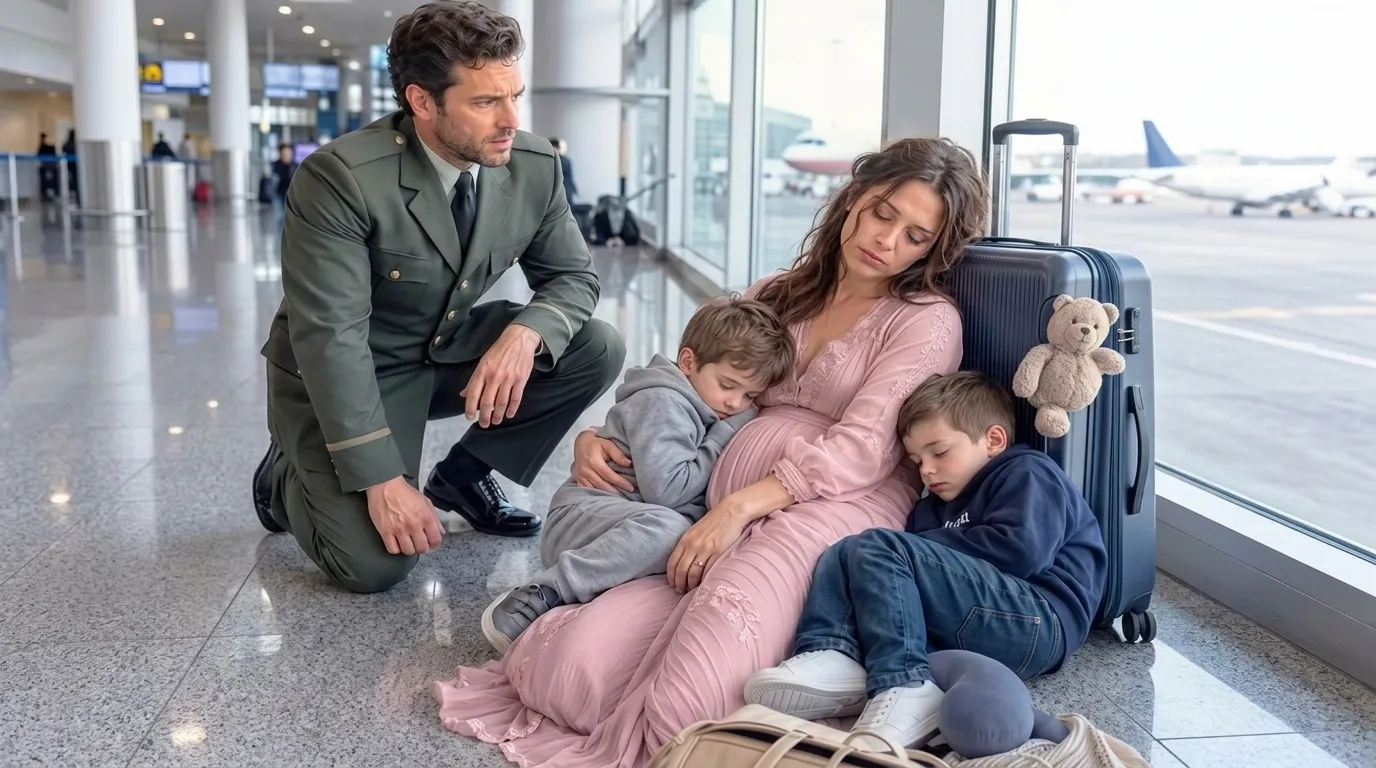
Five years earlier, I had seen them sleeping beside a battered suitcase and thought my career had been ruined because an airplane was delayed.
Now I understood.
The delay had not cost me the biggest deal of my life.
It had returned the biggest part of my life that somebody else had taken.
I lost Boston.
I lost my mother’s version of our family.
I lost the comforting lie that Evelyn had abandoned me.
But I found my sons.
I found the woman I should never have stopped searching for.
And I found something inside myself that no trust, hotel, board seat, or family name had ever given me.
The ability to decide what mattered before somebody else decided it for me.
Years earlier, my mother had said:
“Their mother should’ve known her place.”
She had been right about only one thing.
Evelyn did have a place.
It was beside the children she had raised alone.
Beside the man who finally learned to listen before believing what powerful people told him.
And, when she chose it freely, beside me.
Noah reached for my hand as our boarding group was called.
James grabbed Evelyn’s.
“Dad?”
“Yeah?”
“Don’t miss this flight.”
I laughed.
“Not a chance.”
And this time, when the four of us walked toward the gate—
nobody in my family got to decide where any of us belonged.
THE END.
Latest Posts
- My Husband Mocked My Postpartum Appearance in His Brothers’ Group Chat—I Stayed Quiet for Five Days
Four months after giving birth, I thought my husband understood why I hardly recognized myself. Then I discovered the cruel joke he'd been sharing with his brothers, along with photos I never knew he'd taken. I kept my discovery secret for five days, determined to make him regret every word. “Dude, you weren't exaggerating 😂” …
- My Stepdaughter Called Me the Help Until My Envelope Changed Everything
The insult came before I’d even finished setting down the peach cobbler. I’d baked it at five that morning in the kitchen of the lake cabin we’d rented, and it was still warm under the foil. The smell of cinnamon followed me across the grass toward the pavilion tables, where thirty-two members of the Cole …
- My In-Laws Gave Their Other Three Children $20,000 for Houses and Gave Us Only a Card Two Years Later, We Bought the Old Miller Place for $41,500
The envelopes were tucked under the Easter plates. Each had a name written on it in my mother-in-law’s round schoolteacher handwriting. Kim opened hers first. She’s the oldest. Divorced two years. Raising two boys in a rented trailer behind the grain elevator. She looked at what was inside the envelope and put her hand flat …
- My Mother-in-Law Told Me to Lose Weight After Giving Me a Dress That Didn’t Fit, but Minutes Later, She Regretted Everything
I couldn’t get it over my hips. I stood in my bedroom in my underwear with the dress bunched around my thighs like a deflated balloon. Midnight blue silk. A designer label I’d only ever seen in magazines. Tiny pearl buttons down the back. Beautiful. And four sizes too small. I pulled. I tugged. I …
- Teen Wore a Dress to His Best Friend’s Funeral—The Family Nearly Had Him Removed Before He Reached the Microphone
My son’s best friend read the eulogy at his funeral in a red dress. I almost had him removed before he reached the microphone. My son Jack died 17 days after his 18th birthday. Cancer. Fourteen months from diagnosis to funeral. We found out late. Too late, as it turned out, and the treatment never …