That should have frightened me more than it did.
Dad was not a man who smiled when people cheated him.
He didn’t shout either.
He didn’t threaten lawsuits.
He didn’t pound counters or make dramatic speeches about respect.
For almost thirty years, my father, Thomas Bennett, had repaired swimming pools across three counties. He had been stiffed by wealthy homeowners, restaurant owners, apartment managers, and once by a church deacon who spent forty minutes explaining why paying half an invoice was apparently what Jesus would have wanted.
Dad had learned two things.
Get everything in writing.
And never argue with someone who had already made the mistake you needed them to make.
I should have remembered that the afternoon Melissa Vale stood beside her enormous swimming pool and told him she wasn’t paying.
Instead, I was terrified.
Because Melissa’s husband was my boss.
And she knew it.
I had worked for Richard Vale for almost four years.
Vale Development Group occupied the upper three floors of a steel-and-glass building downtown, and Richard had built a reputation as the kind of businessman newspapers described as “relentless.”
Employees used other words.
He was fifty-two, impeccably dressed, always calm in public, and capable of making grown executives look ashamed of themselves without raising his voice.
Richard wasn’t cruel every day.
That would have been easier.
He could be charming.
Generous, even.
He remembered birthdays. He sent flowers when an employee lost a parent. He once paid a junior accountant’s hospital deductible without telling anyone.
But Richard believed loyalty traveled in only one direction.
Toward him.
I had learned to navigate that contradiction carefully.
I was thirty-one, a project coordinator, and the salary was better than anything else I could have found locally. After my mother died when I was nineteen, Dad had spent years telling me not to choose a career based on fear.
Unfortunately, rent companies did not accept courage as payment.
So I worked hard.
Richard trusted me.
At least I thought he did.
Then, one Monday in May, he stepped into my office and noticed the photograph on my desk.
Dad was standing beside one of his service trucks.
“You said your father does pools, right?”
“Repairs and restoration. Mostly residential now.”
Richard nodded.
“Mine looks like a swamp.”
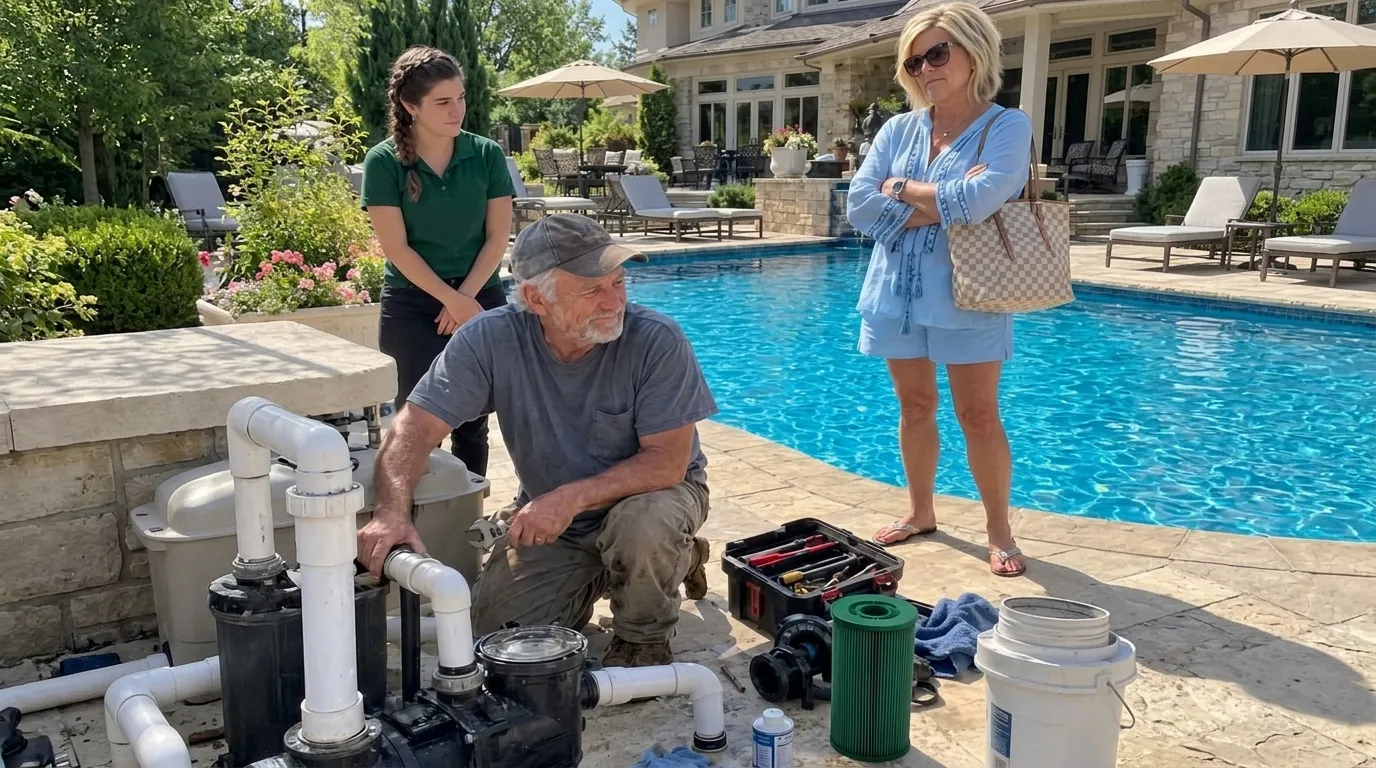
Three days later, Dad was standing behind Richard’s two-million-dollar home.
The property sat behind iron gates on nearly four acres of wooded land outside Bellhaven.
The pool was enormous.
Unfortunately, its water was dark green.
Dad spent almost two hours inspecting everything.
He tested pressure, ran cameras through the pipes, opened access panels, inspected the drains and pump housing, then finally sat down and wrote out his estimate.
“Pump’s failing,” he said. “Two return lines are damaged. Filter housing is cracked. Somebody patched one underground line before, and they did a terrible job.”
“How terrible?” Richard asked.
“Temporary repair that became permanent.”
Dad turned the estimate toward him.
“Parts and labor: $7,800.”
Richard barely hesitated.
“Do it.”
“I need authorization first.”
Richard laughed.
“You don’t trust me?”
“I don’t trust anybody for seventy-eight hundred dollars.”
Then Melissa appeared.
She looked at the figure.
“Seven thousand eight hundred dollars?”
Dad calmly explained the work.
Melissa interrupted.
“Can’t you just make the water blue?”
Dad stared at her.
“Sure. It’ll turn green again when the broken equipment stops working.”
Richard laughed.
Melissa didn’t.
Dad handed them several pages.
The estimate.
Underground-access authorization.
Unexpected-site-condition provisions.
Permission to photograph and document concealed infrastructure uncovered during repairs.
Mechanic’s-lien language.
Ownership representations.
Dad was particular.
“Both signatures?” Melissa asked.
“The property is jointly titled.”
Richard signed.
Melissa sighed and signed too.
At the time, it seemed boring.
Later, those signatures changed everything.
The first three days went normally.
On Thursday, something changed.
I stopped by after work and found Dad and his longtime employee, Luis Ortega, kneeling near an exposed section beside the deep end.
Beneath the modern deck was an older concrete structure.
Luis pointed his flashlight downward.
“That’s not part of this pool.”
“No,” Dad said.
“What is it?”
Dad brushed dirt from something pale.
“Tile.”
Old blue-and-white ceramic tile.
Beneath another layer of fill was curved concrete and a stone channel disappearing under Richard’s modern swimming pool.
That evening, Dad drove to the county archives.
The next day, he returned carrying an old folder.
When I asked what he had found, he only said:
“Finish line first.”
By Tuesday, Richard’s pool was perfect.
The water was so clear you could see every grate at the bottom.
Dad prepared the final invoice.
$7,800.
Exactly what Richard had approved.
No extra charges.
Melissa took the invoice.
Then frowned.
“For this?”
Dad calmly showed her the signed estimate.
She barely looked at it.
Then she turned toward me.
“Emma, surely you can explain to your father that Richard has been extremely good to you.”
“My employment has nothing to do with Dad’s invoice.”
“It has everything to do with relationships.”
Dad slowly closed his folder.
Melissa smiled.
“My husband employs your daughter. She’s been given opportunities plenty of people would kill for.”
Then she said:
“I’d be careful about how hard you want to push this.”
I felt sick.
She was threatening my job.
“Dad, I can talk to Richard.”
Dad didn’t answer.
He looked across the crystal-clear pool.
Then smiled.
“Okay.”
Melissa’s confidence returned.
“I’m glad we understand each other.”
As soon as Dad and I reached his truck, I exploded.
“Why didn’t you argue?”
“Because I don’t need to.”
“She owes you almost eight thousand dollars!”
“Yep.”
Then he looked back toward the house.
“Tomorrow morning, they’re going to understand why I made sure both of them signed everything.”
At 7:46 the next morning, Dad called.
“Get over here.”
Twenty minutes later, I reached Richard’s property.
Two police cruisers were outside.
A county vehicle was parked behind them.
Richard was arguing with a man in a gray suit.
Melissa looked pale.
Dad stood beside the pool gate.
And beside him was an elderly woman holding a thick leather folder.
She walked directly toward me.
“You work for Richard Vale?”
“Yes.”
Her eyes studied me.
Then she whispered:
“My God. You have Laura’s eyes.”
My heart stopped.
Laura was my mother.
“How do you know her?”
She removed a yellowed document.
WHITFIELD SPRINGS PROPERTY TRUST.
The parcel number matched Richard’s house.
“This property belonged to my family,” she said.
Richard shouted:
“That document is seventy years old!”
The county official answered calmly.
“It remains recorded.”
Dad explained that the excavation authorization required him to document concealed site conditions.
Then the elderly woman showed me an old photograph.
My mother stood beside a tiled fountain.
The tile was identical to what Dad had uncovered.
Beside Mom stood the elderly woman.
And between them was a younger man.
“Who is he?”
“My husband,” she whispered. “Your grandfather.”
I stared at her.
“My grandmother is dead.”
“No.”
Dad looked at me.
“Emma, Eleanor Whitfield is your grandmother.”
The world seemed to tilt.
My mother had believed Eleanor wanted nothing to do with her.
Eleanor had believed exactly the same thing about Laura.
Both women had lived most of their lives inside a lie.
Whitfield Springs had once been a therapeutic resort built around an artesian spring.
There was a bathhouse.
Gardens.
A restaurant.
A large blue-and-white tiled mineral pool.
My mother was born there.
By the late 1980s, however, the business was failing.
A young attorney named Charles Vale began advising Eleanor’s parents.
Richard’s father.
Charles refinanced debts.
Handled taxes.
Arranged loans.
Eventually, documents showed the Whitfields had defaulted.
The property was sold.
The family received almost nothing.
Six months later, Charles acquired the land through a holding company.
The original buildings were demolished.
The mineral pool was filled.
But Dad’s repair work had uncovered part of it.
And beside the old stone channel, Dad discovered a steel box.
Inside were old ledgers, bank records, survey maps, letters, and the original trust agreement.
The land could be sold.
The buildings could be sold.
But the artesian spring and its water rights could not be transferred outside the Whitfield Springs Property Trust.
The beneficiaries were Eleanor and her descendants.
Richard laughed.
“A spring? This circus is about water?”
The county official didn’t laugh.
Because Richard’s upcoming Bellhaven Ridge project depended heavily on those historical water rights.
Four hundred homes.
Commercial areas.
Artificial lakes.
A private golf course.
Projected value:
More than $300 million.
I had worked on the project myself.
I remembered the permit documents.
The resource statements.
The legal exhibits.
Richard had claimed his family controlled those rights.
If Eleanor’s trust still owned them, the entire project could be affected.
I looked at Richard.
“You included Whitfield Springs in Bellhaven Ridge’s water allocation.”
He glared at me.
“Emma, don’t say another word.”
Dad’s expression hardened.
Then Eleanor revealed something else.
Dad already knew her.
They had been corresponding for nineteen years.
After my mother died, Dad had found old letters.
Letters my mother had never received.
Eleanor had written to Laura for years.
Charles Vale had told Eleanor that Laura wanted nothing to do with her family.
Meanwhile, Laura received messages suggesting Eleanor blamed her for abandoning them.
Charles had separated them.
Dad discovered one questionable letter after Mom died and eventually contacted Eleanor.
They compared records.
Some letters were genuine.
Others were not.
But by then Charles was dead, evidence was missing, and neither Dad nor Eleanor had enough proof to fight.
Until the pool excavation uncovered the steel box.
Dad’s invoice still went unpaid.
So he filed a mechanic’s lien.
Richard’s attorney responded with a $10,000 check and a confidentiality agreement.
The additional $2,200 was described as inconvenience compensation.
Dad read the agreement once.
Then put it through the shredder.
The check went back.
Within days, Bellhaven Ridge financing paused.
A lender demanded proof of the water rights.
Two city permits were suspended.
Then the story reached the press.
HISTORIC TRUST DOCUMENTS FOUND BENEATH DEVELOPER’S LUXURY POOL
Richard called me that evening.
He offered me my job back.
A promotion.
A raise.
Then $250,000 for my possible interest in the trust.
That was when I asked him:
“Did you know who I was?”
Silence.
“You knew.”
“Emma—”
“When?”
He sighed.
“The day I hired you.”
My stomach dropped.
He had recognized my father’s name from old Vale records.
He knew I was Laura Whitfield’s daughter.
He hired me anyway.
Then put me on Bellhaven Ridge.
A development using rights tied to my own family.
“You used me.”
“You were good at your job.”
“That isn’t an answer.”
“No,” he admitted. “It isn’t.”
I hung up.
Dad found me sitting on the kitchen floor.
When I told him what Richard had admitted, he closed his eyes.
Then he confessed that when Richard asked him to repair the pool, the address had felt familiar.
He had seen it in Eleanor’s records.
He accepted the job partly because he wanted to see the property where my mother’s family had lost everything.
He had not known he would find the old tile.
Or the box.
Or the spring.
He had simply wanted closure.
Then Dad reached into his pocket.
He placed a small brass key in my hand.
It had been found inside the steel box.
“We didn’t know what it opened,” he said.
“Until today.”