For the next four days, nothing happened publicly.
That was deliberate.
News reports described the attack as an apparent home invasion connected to a personal dispute.
Daniel’s name appeared.
Kessler’s did not.
The two attackers remained in custody.
The investigation around Sentinel Ridge appeared unchanged.
Then Kessler made his mistake.
He contacted Daniel.
Not directly.
Through an attorney who believed he was carrying a protected message concerning a business matter.
Daniel had already agreed to cooperate.
The message was simple:
Keep the Army out of it. This stays about the girl.
Investigators now had what they needed to intensify the case.
Still, I did nothing.
I stayed with Violet.
The swelling around her face slowly began to ease.
She could sit up.
Then stand.
The first time she walked ten steps down the hospital corridor, I walked beside her without touching her.
She hated being helped unnecessarily.
Even then.
“You’re hovering.”
“I am not.”
“You’re practically breathing for me.”
“I’m a father. It’s contractual.”
She almost smiled.
Then stopped.
“Dad?”
“Yeah?”
“Are you going to kill them?”
The question stopped me.
Not because I intended to.
Because I realized what she had heard throughout my childhood stories.
Army.
Rangers.
Deployments.
Bad men.
Operations.
To a sixteen-year-old, perhaps justice and revenge had started sounding too similar.
“No.”
She studied me.
“Really?”
“Really.”
“Even after what they did?”
I sat beside her.
“Especially after what they did.”
She frowned.
“Why?”
“Because they already took enough from us.”
I looked at her bruised hands.
“They don’t get to take who I am too.”
That was the promise I made to Violet.
And to myself.
Colonel Adrian Kessler was arrested eleven days after Violet woke.
No tactical showdown.
No midnight revenge.
He walked out of Sentinel Ridge’s Chicago office carrying a laptop bag and found federal agents waiting beside his car.
The charges that followed grew from the financial investigation, obstruction allegations, and evidence tied to Daniel and the attack.
Sentinel Ridge immediately announced that Kessler had acted without corporate authorization.
Investigators did not simply accept that statement.
They followed the records.
Executives were interviewed.
Accounts were examined.
Contracts were reviewed.
The inquiry eventually uncovered a larger fraud involving diverted military equipment, falsified shipping records, shell vendors, and improper payments.
Not every person suspected was charged.
Not every rumor became evidence.
That mattered to me.
I had spent too much of my career watching assumptions become mistakes.
The case had to be built on what could be proved.
Daniel ultimately admitted his role in arranging access to my house and helping facilitate the theft attempt.
The two men who entered the house also entered pleas after cooperating.
Kessler fought the case.
For months.
His attorneys argued that Daniel acted independently.
They said Daniel used Kessler’s name to reduce his own punishment.
Then prosecutors introduced financial records.
Communications.
Contractor access logs.
The intermediary message.
And finally—
Violet.
I fought against her testifying at first.
“I don’t want her inside that courtroom.”
Her attorney looked at me.
“She’s sixteen, Ethan. She gets a voice in this too.”
Violet made the decision herself.
“I want to.”
“You don’t owe anybody that.”
“I know.”
“You don’t have to prove you’re brave.”
“I know.”
“Then why?”
She looked directly at me.
“Because he thinks I’m just the girl who happened to come home.”
That silenced me.
At trial, Violet did not give a dramatic speech.
She answered questions.
Carefully.
She described walking into the house.
Hearing voices near my office.
Seeing two men.
Hearing Daniel’s name.
Then hearing Kessler’s.
She admitted when she could not remember something.
When the defense attorney pressed her about details, she said:
“I don’t know.”
Again:
“I don’t remember.”
Again.
Then:
“But I remember that name.”
The defense attorney asked:
“How can you be certain?”
Violet looked toward Kessler.
“Because after I woke up in the hospital, I spent weeks wishing I didn’t.”
The courtroom went quiet.
The physical-attack case and the larger financial case moved on different tracks, but together the evidence ended Kessler’s career and exposed the scheme he had tried to protect.
He and the others involved faced substantial criminal consequences.
Sentinel Ridge lost contracts and underwent outside oversight while investigators determined how much of the misconduct extended beyond Kessler.
Daniel went to prison too.
Harper was not charged with participating in the attack.
Investigators found no evidence that she knew what Daniel intended when she gave him the code.
That did not mean everything between us returned to normal.
For months, Harper could barely look at Violet.
“I gave him the number.”
Violet eventually answered:
“You believed him.”
“I should’ve checked.”
“Yes.”
Harper looked surprised.
Violet continued:
“You should have.”
There was no instant forgiveness.
No hug designed to make everyone watching feel better.
Just truth.
Harper apologized without demanding that Violet comfort her.
And over time, that mattered.
The alarm code changed.
Then the entire system changed.
For months afterward, Violet would stop whenever the keypad beeped.
I noticed.
She hated that I noticed.
Eventually, one evening, she walked into the house carrying groceries.
The alarm began its entry countdown.
Beep.
Beep.
Beep.
Violet stopped.
I was in the kitchen.
I started toward her.
She held up one hand.
“I’ve got it.”
Then she entered the new code herself.
The alarm disarmed.
Green light.
READY.
She stared at it for a second.
Then put the groceries on the counter.
“Dad?”
“Yeah?”
“Can we stop treating this house like a crime scene now?”
I looked around.
For months, I had kept things almost exactly as they had been.
The hallway table.
Her backpack hook.
The chair near the door.
Part of me had confused preservation with protection.
Evidence had already been collected.
The trial was over.
Violet wanted her house back.
“Yes.”
That weekend, we changed everything.
Not because the old things were bad.
Because we were allowed to choose what came next.
Violet painted the hallway wall a color I hated.
Bright yellow.
“That’s terrible.”
“It’s cheerful.”
“It looks radioactive.”
“Good.”
She laughed.
We moved the table.
Replaced the rug.
Hung her birthday photographs.
Her sixteenth birthday had happened in the hospital.
No party.
No candles at home.
So six months late, she decided she wanted one.
Nothing enormous.
Just friends.
Pizza.
Music.
A cake she designed herself.
Purple icing.
Sixteen candles.
And one extra.
“What’s the extra one?”
She shrugged.
“For being here.”
I turned away before she saw my face.
She saw anyway.
“Dad.”
“I’m fine.”
“You’re crying.”
“Army eyes.”
“That’s not a thing.”
“It is now.”
She laughed.
Then handed me the lighter.
I lit all seventeen candles.
EPILOGUE
A year after the attack, I returned from another assignment.
This time, Violet knew I was coming.
No surprise.
No rideshare from the end of the street.
She was waiting on the porch before I even stepped out of the car.
“Dad!”
I dropped my bag.
She ran toward me.
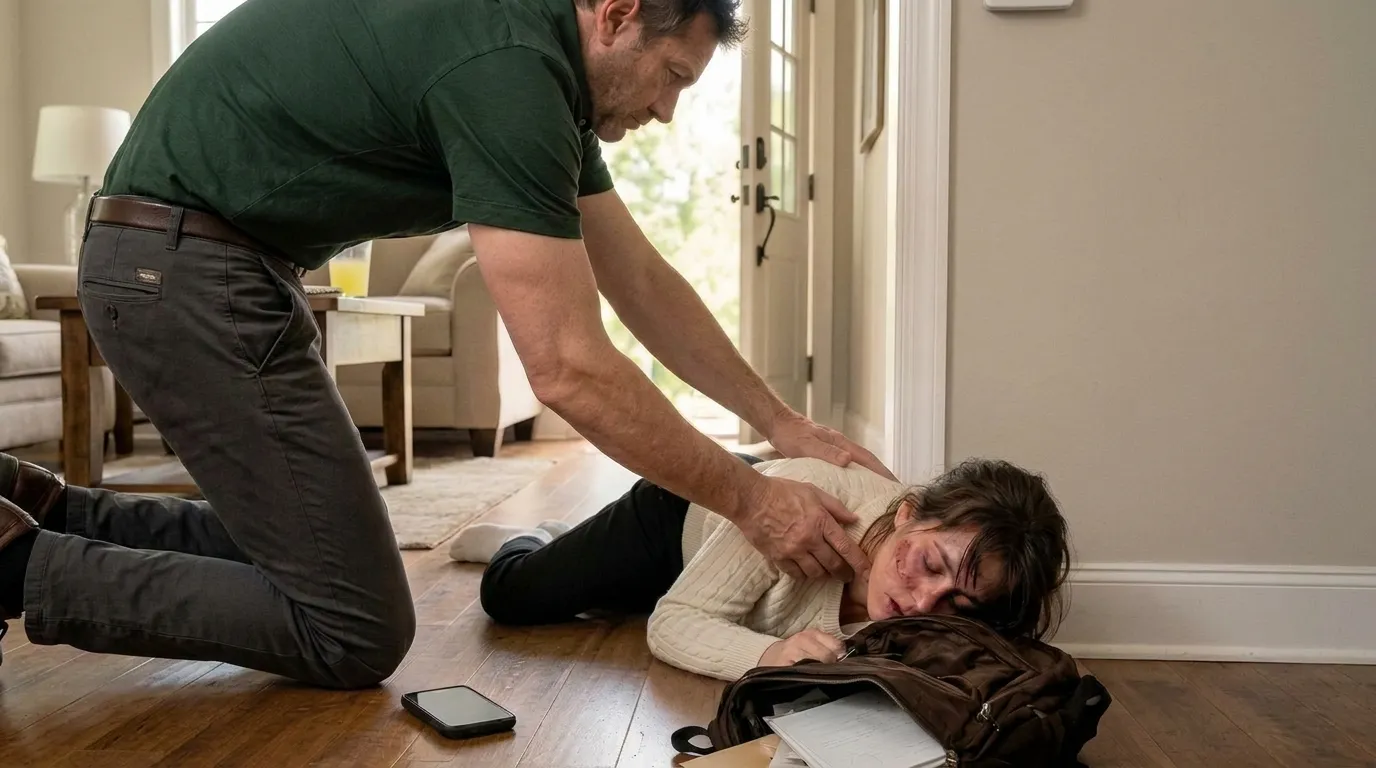
For one brief second, the old hallway flashed through my mind.
Her sneaker.
The backpack.
Her hand on the floor.
Then she hit me with a hug hard enough to make me step backward.
“You’re late.”
“Four minutes.”
“I counted.”
“Of course you did.”
She had turned seventeen three days earlier.
The bruises were gone.
A small scar near her hairline remained.
She hated when people stared at it.
Sometimes she covered it.
Sometimes she didn’t.
That decision belonged to her.
Inside, the hallway was yellow.
Still terrible.
Still hers.
Her backpack hung from the hook.
The alarm keypad glowed green.
Violet punched in the code and looked at me.
“You know what’s funny?”
“What?”
“They thought the alarm code gave them control.”
I put my duffel down.
“For a few minutes, it did.”
She shook her head.
“No.”
Then she looked at me.
“It just told us where to start looking.”
I smiled.
She had learned something I wished she had never needed to know.
But she had also learned something better.
The people who hurt her did not get the final word.
Not Daniel.
Not the men he hired.
Not Kessler.
Not the company whose secrets mattered more to them than a child standing in a hallway.
For months after the attack, people kept asking me how I stopped myself from going after them.
They assumed restraint meant I had become less angry.
I hadn’t.
I remembered everything.
But Violet had survived because, on the worst afternoon of my life, I forced my hands to remain useful.
That became the rule afterward too.
Useful.
Not reckless.
Evidence instead of vengeance.
Police instead of pursuit.
A courtroom instead of a weapon.
A father instead of a soldier.
That was the war I actually had to win.
Not against Daniel.
Not against Kessler.
Against the part of me that believed hurting them would somehow repair what they had done to Violet.
It would not.
Nothing could erase that hallway.
But something else could become larger than it.
Her seventeenth birthday.
The ugly yellow wall.
Her backpack hanging where it belonged.
Her complaints about school.
The music coming from her bedroom when I asked her twice to turn it down.
Her future.
Violet walked toward the kitchen.
“Come on. Harper brought dinner.”
“What is it?”
“Tacos.”
“Good tacos?”
“She said good tacos.”
“That wasn’t my question.”
Violet laughed.
I followed her.
Then stopped once and looked back toward the front door.
The alarm light remained green.
A year earlier, I had stared at the same word—
READY
—and understood someone inside our circle had betrayed us.
Now I finally understood something else.
A house is not safe because nobody bad ever enters it.
A life is not safe because nothing terrible ever happens.
Safety is knowing that when something does happen, the truth will not be buried to protect the people responsible.
Daniel believed my absence made our home vulnerable.
Kessler believed my daughter was merely an obstacle between him and a file.
Both men were wrong.
Because Violet had survived.
She had remembered.
She had spoken.
And I had listened.
I picked up my duffel.
Then walked into the kitchen where my daughter was waiting.
For the first time since that afternoon—
I did not look back.
The End.
Latest Posts
- My Husband Mocked My Postpartum Appearance in His Brothers’ Group Chat—I Stayed Quiet for Five Days
Four months after giving birth, I thought my husband understood why I hardly recognized myself. Then I discovered the cruel joke he'd been sharing with his brothers, along with photos I never knew he'd taken. I kept my discovery secret for five days, determined to make him regret every word. “Dude, you weren't exaggerating 😂” …
- My Stepdaughter Called Me the Help Until My Envelope Changed Everything
The insult came before I’d even finished setting down the peach cobbler. I’d baked it at five that morning in the kitchen of the lake cabin we’d rented, and it was still warm under the foil. The smell of cinnamon followed me across the grass toward the pavilion tables, where thirty-two members of the Cole …
- My In-Laws Gave Their Other Three Children $20,000 for Houses and Gave Us Only a Card Two Years Later, We Bought the Old Miller Place for $41,500
The envelopes were tucked under the Easter plates. Each had a name written on it in my mother-in-law’s round schoolteacher handwriting. Kim opened hers first. She’s the oldest. Divorced two years. Raising two boys in a rented trailer behind the grain elevator. She looked at what was inside the envelope and put her hand flat …
- My Mother-in-Law Told Me to Lose Weight After Giving Me a Dress That Didn’t Fit, but Minutes Later, She Regretted Everything
I couldn’t get it over my hips. I stood in my bedroom in my underwear with the dress bunched around my thighs like a deflated balloon. Midnight blue silk. A designer label I’d only ever seen in magazines. Tiny pearl buttons down the back. Beautiful. And four sizes too small. I pulled. I tugged. I …
- Teen Wore a Dress to His Best Friend’s Funeral—The Family Nearly Had Him Removed Before He Reached the Microphone
My son’s best friend read the eulogy at his funeral in a red dress. I almost had him removed before he reached the microphone. My son Jack died 17 days after his 18th birthday. Cancer. Fourteen months from diagnosis to funeral. We found out late. Too late, as it turned out, and the treatment never …