The next morning, I woke before sunrise on the hotel sofa.
My phone contained forty-three missed calls.
Twenty-one from Khloe.
Several from unfamiliar numbers.
Two from Julian.
His messages moved from furious to strangely polite.
First, I had “destroyed the family.”
Then he requested “a reasonable conversation.”
Finally, he suggested everyone had become emotional and should simply reset.
I blocked him.
No speech.
No argument.
Just one button.
I didn’t block Khloe.
I muted her.
There was a difference.
She was still my sister.
But being family did not give her immediate access to me.
By noon, Harrison had organized a supervised inventory process.
Julian and Khloe’s belongings would be photographed and collected during scheduled visits.
Anything disputed would be documented rather than argued about.
The financial review continued.
And it became worse.
The first $78,000 was only what Harrison could identify quickly.
Over the following weeks, accountants uncovered additional withdrawals, charges, subscriptions, transfers, and accounts connected to Mom’s information.
The documented losses eventually crossed $100,000.
Mom blamed herself.
“I should have noticed.”
I printed one statement and placed it in front of her.
The pattern was obvious once someone knew to look.
It started small.
Groceries.
Gas.
Household expenses.
Then slightly larger purchases.
Then withdrawals.
Then luxury expenses.
“They didn’t begin by taking everything,” I told her.
“They trained you to accept each next step.”
Her therapist later explained the same pattern more clearly.
Control often begins as convenience.
Let me handle the bill.
Give me the password.
I’ll make the appointment.
You’re tired.
I’ll keep the card.
Eventually the person being “helped” stops being asked.
Mom hated thinking of herself as someone who had been exploited.
It made her feel foolish.
Her therapist asked whether she would call another sixty-two-year-old woman foolish for trusting her daughter and son-in-law.
Mom immediately said no.
“Then why are you the only person who doesn’t deserve the compassion you would give someone else?”
Mom cried for twenty minutes.
I had my own lesson to learn.
For years, I had believed money could compensate for distance.
I bought the house because I wanted her safe.
I sent thousands because I wanted her comfortable.
But safety required more than transfers.
I had called and asked:
“Everything okay?”
She said yes.
And I accepted the easiest answer.
That did not make Julian and Khloe’s actions my responsibility.
But I could still acknowledge that I had missed what was happening.
Two truths could exist together.
They had exploited my mother.
And I had failed to notice that she was disappearing behind rehearsed smiles.
I couldn’t rewrite those years.
I could only pay attention now.
Three weeks later, Khloe asked to meet me.
We chose a quiet café.
She arrived without makeup or a designer bag.
Her hair was tied back.
“I left Julian.”
I said nothing.
“I’m not telling you because I expect sympathy.”
Still nothing.
Then she whispered:
“I keep hearing Mom say, ‘You watched.’”
Her eyes filled.
“She was right.”
I waited.
“At first, I convinced myself Julian was just helping her manage things.”
She stared at the table.
“Then I liked the lifestyle.”
That was the first truly honest thing she said.
“When I realized how bad everything had become, stopping meant losing the life I had built. So I told myself Mom was fine.”
She looked up.
“That was cowardice.”
“Why didn’t you stop him?”
“I don’t know.”
I appreciated that more than another excuse.
“Do you expect me to forgive you?”
“No.”
“Mom?”
“No.”
“Then what do you want?”
Khloe started crying.
“I want to become someone who would deserve forgiveness someday, even if neither of you ever gives it to me.”
Tears were easy.
Change wasn’t.
So I told her Mom did not want contact yet.
She nodded.
I told her she had been removed from Mom’s financial, medical, and emergency information.
She nodded again.
I told her rebuilding trust could take years.
“I know.”
The investigation continued independently.
Julian claimed many of the expenses had been gifts.
He said Mom willingly allowed them to manage her finances.
He even described the cleaning she had done as her:
“personal preference.”
When Mom read that phrase, she laughed.
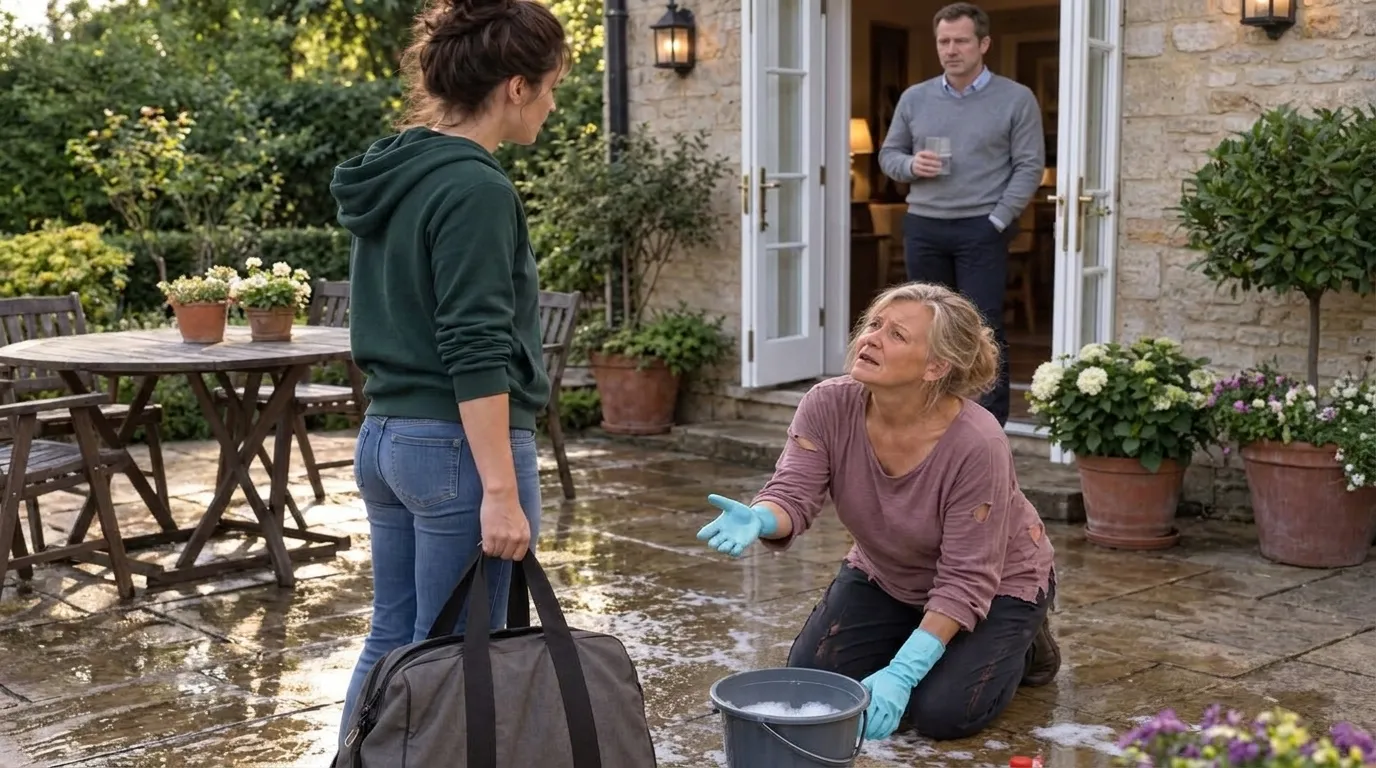
“Apparently my dream retirement was scrubbing grease while a forty-year-old man drank twelve-year-old scotch.”
I stared at her.
Then we both started laughing.
Pain had occupied so much space that sometimes the body demanded another emotion.
That afternoon Mom asked me to take her shopping.
Not for jewelry.
Gardening gloves.
Julian had removed her vegetable beds because he thought they looked “provincial.”
Mom bought wooden planters.
Tomatoes.
Basil.
Peppers.
Rosemary.
And an enormous straw hat.
“I look ridiculous.”
“Perfect.”
We rebuilt the backyard first.
The exact place where I had found her kneeling became the first place she reclaimed.
We removed the decorative stones that hurt her knees.
Raised garden beds went in.
The outdoor kitchen remained.
But everything surrounding it became hers.
We never found the scrub brush I had thrown into the yard.
I never looked.
I wanted grass to grow over it.
Then we changed the inside.
After the documented property process was completed, most of Julian’s furniture disappeared.
Mom kept one enormous leather chair.
“Why that?”
She sat in it and put her feet up.
“Because it’s comfortable.”
“Julian loved that chair.”
Mom smiled.
“Then this is revenge.”
Family photographs returned to the walls.
Dad’s chipped mug returned to the kitchen.
My crooked wooden angel went near the entryway.
Mom placed an old photograph of the three of us—me, Khloe, and Mom—on the wall.
I noticed Khloe was still included.
Mom saw me looking.
“I’m not erasing her.”
She paused.
“I’m just not opening the door yet.”
That became our rule.
Boundaries did not require rewriting history.
Two months after my return, Mom finally entered the master bedroom.
We had repainted it.
New furniture.
Blue curtains.
Simple lamps.
A quilt covered in wildflowers.
I waited outside while she walked in.
She touched the dresser.
Opened the closet.
Then sat on the bed.
“Well?”
She looked around.
“It’s quiet.”
“You always liked quiet.”
“No.”
She pressed her hands against the quilt.
“This is different.”
I waited.
“Before, quiet meant I was trying not to upset anyone.”
Her eyes filled.
“This quiet means nobody is allowed to frighten me here.”
I cried.
Eventually, I changed my work arrangement too.
Dubai had given me a career I loved.
I wasn’t ashamed of those years.
But success was supposed to create freedom—not permanent distance.
My firm moved me into a role with shorter overseas assignments and more remote work from Texas.
Mom protested.
“Do not sacrifice your career for me.”
“I’m not staying because you’re helpless.”
“Then why?”
“Because I missed my life.”
That stopped her.
Khloe continued sending letters.
Mom left the first few unopened.
Then one Sunday she finally read one.
“She says she started therapy.”
“Do you believe her?”
Mom folded the letter.
“I believe she wrote that she started therapy.”
It was a careful answer.
She had learned not to confuse words with evidence.
Months later, Mom finally wrote back.
Eleven words:
I love you. I am not ready. Keep doing the work.
Khloe framed it.
I thought that was excessive.
But perhaps she needed a reminder that forgiveness wasn’t a prize she could demand after enough apologies.
Julian’s professional life collapsed faster than the legal case moved.
His company placed him on leave after reviewing claims involving the house and certain client expenses.
Later, he left the company entirely.
I never asked whether he resigned or was terminated.
I deliberately stopped caring.
The financial matter eventually produced restitution and formal acknowledgment of unauthorized activity, along with additional consequences through the proper legal process.
Harrison gave me advice I never forgot.
“Courts handle accountability. Your job is making sure he never controls your family again.”
Mom donated part of her first restitution payment to an organization that helped older adults facing financial exploitation.
“Maybe someone else will recognize themselves sooner than I did.”
With another portion, she bought a piano.
She had stopped playing after Dad died.
The first song she attempted sounded terrible.
She missed notes.
Stopped.
Swore softly.
Started over.
“You are not allowed to criticize,” she called toward me.
“I paid for your piano lessons.”
“I quit after six months.”
She pointed at me.
“Exactly. Financial abuse started with you.”
I laughed so hard I nearly fell off the stairs.
Our house became noisy again.
Neighbors visited.
Mom joined a gardening group.
She started a book club that appeared to spend more time drinking tea and complaining about books than reading them.
Most importantly, she learned to say no.
No, she didn’t want visitors.
No, she wasn’t lending money.
No, she wasn’t sharing passwords.
No, she wasn’t signing anything yet.
No, she needed time to think.
Seven months after I came home, Mom asked whether she could meet Khloe.
“That’s your decision.”
“I want you there.”
We met in the backyard beside Mom’s tomato plants.
Khloe arrived alone.
No flowers.
No gifts.
No dramatic gesture.
Mom sat in Julian’s old leather chair, which we had dragged outside because she still found the situation funny.
Khloe nearly laughed when she saw it.
Mom noticed.
“You’re allowed.”
They both smiled uncertainly.
Finally, Khloe began.
“I want to apologize without asking you to make me feel better.”
Mom nodded.
“I chose comfort.”
Khloe’s voice shook.
“I chose my marriage. I chose avoiding conflict. And every time I chose those things, I was choosing them over you.”
Mom listened.
“Julian hurt you. But I helped make it possible.”
Then Mom asked one question.
“If Natalie had not come home that afternoon, when would you have stopped?”
Khloe’s face collapsed.
“I don’t know.”
Mom closed her eyes.
It was the hardest possible answer.
And probably the most truthful.
Mom did not say she forgave Khloe.
But when Khloe stood to leave, Mom touched her wrist.
“You may come for lunch next Sunday.”
Khloe nodded quickly.
Then Mom added:
“You are not moving in.”
Khloe laughed through her tears.
“I wouldn’t even ask to use the bathroom without written permission.”
“Don’t become ridiculous,” Mom said.
“Just become trustworthy.”
That was their beginning.
A year after I returned, Mom turned sixty-three.
She wanted a birthday party at home.
Family.
Neighbors.
Gardening friends.
Diane.
Harrison.
Even Martin.
Khloe came early.
“What can I do?”
Mom pointed toward the kitchen.
“For once, you can slice vegetables.”
The backyard no longer resembled the place where I had found her kneeling.
Tomato vines climbed wooden frames.
Basil filled the air.
Fairy lights hung above the patio.
And we hired people to serve and clean because Mom decided her birthday gift to herself was doing absolutely nothing she didn’t want to do.
Near sunset, someone dropped a napkin beside her chair.
Mom instinctively leaned down.
My body reacted before my mind did.
“Mom, leave it.”
Everyone looked at me.
Mom slowly sat back.
For one second, that old image flashed through my mind.
The bucket.
The brush.
Her red hands.
Then Mom smiled.
“Relax, Natalie.”
She lifted her lemonade.
“I know.”
Khloe watched from beside the garden.
Mom leaned back and said:
“The maid is out back.”
Everyone went silent.
Then she added:
“Actually, no she isn’t. We hired professionals.”
The patio erupted in laughter.
I laughed until I cried.
Mom had taken the cruelest sentence Julian had used against her and stripped it of its power.
One year earlier, I had found her on her knees on those stones.
Now she sat surrounded by people who knew exactly whose home this was.
Later, after everyone left, we remained outside beneath the lights.
“Good birthday?”
“Very.”
She looked toward the garden.
Then asked:
“Do you regret coming home that day?”
“Never.”
“I regret hiding everything from you.”
“We’ve discussed that.”
“Let me finish.”
She took my hand.
“I thought silence kept my daughters together.”
Her voice softened.
“Instead, silence gave bad behavior somewhere to live.”
Then she told me something I hadn’t expected.
“You were always the strong one. Khloe was the soft one. Maybe I protected her too much.”
She looked at me.
“And maybe I expected you to survive everything because you usually did.”
That hit deeply.
Sometimes being known as strong becomes another way people overlook your needs.
“When Julian shut the door in my face,” I admitted, “I thought I had failed you.”
“You bought me a house.”
“That isn’t what I mean. I thought six years away meant I had surrendered my place here.”
Mom squeezed my hand.
“A place in someone’s life isn’t measured in miles.”
She rested her head against my shoulder.
“It’s measured by whether you come when the truth finally reaches you.”
Two years passed before Mom gave Khloe another key to the house.
Mom handed it to her herself.
“This key opens my house,” she said.
“It does not open my finances, my decisions, my privacy, or my boundaries.”
Khloe closed her fingers around it.
“I understand.”
By then, she had spent two years proving she could hear the word no without punishing the person saying it.
We never returned to our old family relationship.
I’m grateful.
The old one contained too many doors nobody was allowed to close.
As for Julian, I never saw him again.
Years later, someone told me he had moved to another state.
I changed the subject.
He had already taken enough time from us.
I refused to let hatred become another room he occupied without paying rent.
Indifference turned out to be the only eviction he could never contest.
Sometimes when I walk through Mom’s house now, I still remember that first afternoon.
The bucket.
The scrub brush.
Her red hands.
Julian’s robe.
The front door closing in my face.
A healed place can still contain the shadow of what happened there.
It just doesn’t have to belong to that shadow forever.
Then I hear Mom playing the piano.
Or yelling from the garden because a squirrel is attacking her tomatoes.
Or Khloe laughing in the kitchen during Sunday lunch.
And the old image fades.
Not because we forgot.
Because we created enough better memories that the worst one no longer occupies the largest room.
The deed remains in my name.
Mom wants it that way.
The locks have been changed more than once because hardware wears out.
Passwords change.
Accounts move.
Emergency contacts get updated.
Life does not stay safe simply because you protected it once.
Safety requires maintenance.
So does trust.
But one thing has never changed again.
Nobody in that house has ever called my mother the maid.
And nobody ever will.
THE END.
Latest Posts
- My Husband Mocked My Postpartum Appearance in His Brothers’ Group Chat—I Stayed Quiet for Five Days
Four months after giving birth, I thought my husband understood why I hardly recognized myself. Then I discovered the cruel joke he'd been sharing with his brothers, along with photos I never knew he'd taken. I kept my discovery secret for five days, determined to make him regret every word. “Dude, you weren't exaggerating 😂” …
- My Stepdaughter Called Me the Help Until My Envelope Changed Everything
The insult came before I’d even finished setting down the peach cobbler. I’d baked it at five that morning in the kitchen of the lake cabin we’d rented, and it was still warm under the foil. The smell of cinnamon followed me across the grass toward the pavilion tables, where thirty-two members of the Cole …
- My In-Laws Gave Their Other Three Children $20,000 for Houses and Gave Us Only a Card Two Years Later, We Bought the Old Miller Place for $41,500
The envelopes were tucked under the Easter plates. Each had a name written on it in my mother-in-law’s round schoolteacher handwriting. Kim opened hers first. She’s the oldest. Divorced two years. Raising two boys in a rented trailer behind the grain elevator. She looked at what was inside the envelope and put her hand flat …
- My Mother-in-Law Told Me to Lose Weight After Giving Me a Dress That Didn’t Fit, but Minutes Later, She Regretted Everything
I couldn’t get it over my hips. I stood in my bedroom in my underwear with the dress bunched around my thighs like a deflated balloon. Midnight blue silk. A designer label I’d only ever seen in magazines. Tiny pearl buttons down the back. Beautiful. And four sizes too small. I pulled. I tugged. I …
- Teen Wore a Dress to His Best Friend’s Funeral—The Family Nearly Had Him Removed Before He Reached the Microphone
My son’s best friend read the eulogy at his funeral in a red dress. I almost had him removed before he reached the microphone. My son Jack died 17 days after his 18th birthday. Cancer. Fourteen months from diagnosis to funeral. We found out late. Too late, as it turned out, and the treatment never …