I Bought My Mom a $600,000 House—Then My Brother-in-Law Called Her “The Maid.” By That Night, I Took Back Everything. Tell Me: Did I Go Too Far?
At exactly nine, the doors of the three vehicles opened almost together.
Harrison stepped from the first wearing a charcoal suit and carrying a leather folder.
A locksmith climbed from the second van.
From the third came a private security officer and a woman carrying a notary case.
Julian stared at them.
Then at me.
“What is this?”
His voice became louder because several guests had gathered behind him on the porch.
“Natalie, whatever tantrum you’re having, bringing hired muscle into a family dispute is ridiculous.”
Harrison walked past me.
“Julian Mercer?”
Julian lifted his chin.
“My name is Harrison Vance. I represent Natalie Bennett, the sole legal owner of this property.”
Julian’s smile changed.
It didn’t disappear completely.
But uncertainty entered it.
Then Khloe appeared behind him wearing a silver dress I recognized immediately.
I had bought that dress for Mom’s sixtieth birthday dinner in Paris.
Mom had felt guilty wearing something expensive, so I mailed it home to her.
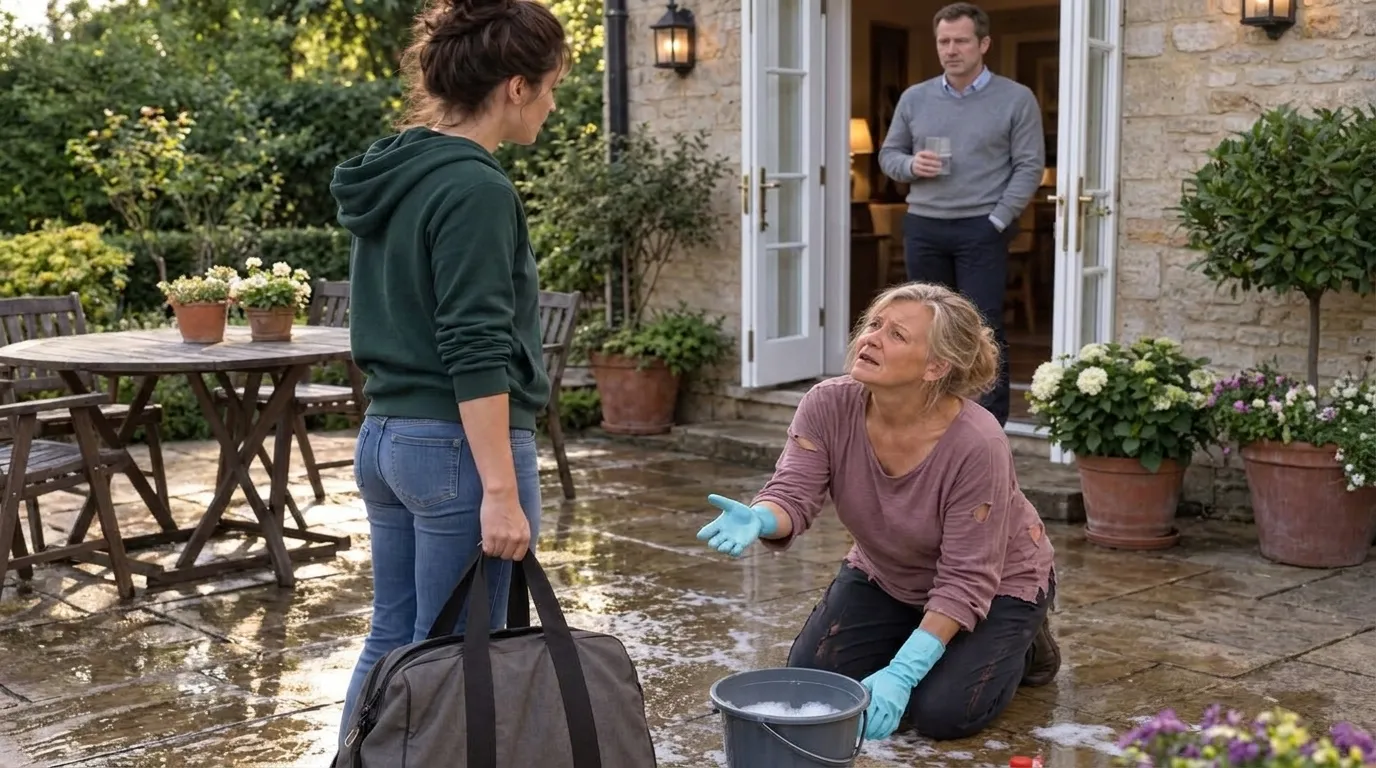
Now my sister stood in my mother’s dress, inside my mother’s home, while Mom rested at a hotel because her knees hurt from scrubbing the patio.
I looked around.
Champagne.
Catered food.
Candles.
Mom had apparently spent the afternoon cleaning for a party she wasn’t even invited to attend.
“Everyone go inside,” Julian ordered.
Nobody moved.
Harrison opened his folder.
“Natalie has no intention of pretending occupancy law doesn’t exist simply because your behavior has been unacceptable.”
Julian laughed triumphantly.
“See?”
“I’m not finished,” Harrison said.
The laugh disappeared.
“Your residency here is not the only issue we reviewed this afternoon.”
Khloe’s expression changed.
Harrison continued.
“We found unauthorized financial activity involving Martha Bennett’s accounts, credit cards, personal information, and electronic signatures.”
The porch went silent.
Over twenty-three months, more than $78,000 of the money I had sent Mom had been transferred, withdrawn, charged, or redirected toward expenses that had nothing to do with her.
Restaurants.
Designer clothing.
Golf memberships.
Luxury vehicle payments.
Weekend trips.
An expensive wine subscription.
Even a private chef.
Mom had been eating canned soup several nights a week because Khloe told her groceries had become too expensive.
Julian immediately said, “Martha gave us permission.”
I unlocked my phone.
Earlier that evening, Mom had personally spoken with the bank and identified which transactions she recognized.
And which she didn’t.
Khloe folded her arms.
“Mom said we could use the card sometimes.”
“For groceries,” I replied.
“Not for a $4,800 handbag. Not for Julian’s golf dues. Not your spa membership. Not a Cabo anniversary trip.”
One of Julian’s guests stepped closer.
His name was Martin.
I recognized him from photographs.
Julian’s regional director.
“You said you bought this place after the Houston project,” Martin said.
Julian nearly spilled his drink.
“Martin, this isn’t what it sounds like.”
Martin looked at me.
“Whose house is this?”
“Mine.”
I pointed toward Harrison’s folder.
“One cash purchase. My name is the only name on the deed.”
Harrison handed Julian a copy.
“Your name appears nowhere.”
Then he produced something worse.
Three months earlier, someone had used Mom’s Social Security number to open a credit account.
The mailing address was my house.
The email attached to the application belonged to Julian.
Payments were being drawn from the account I funded for Mom.
She had never heard of the credit line.
Khloe sank into a chair.
“Julian…”
“Anyone can type an email address,” he snapped.
“Correct,” Harrison said. “Which is why the bank is also reviewing device records.”
For once, Julian had nothing to say.
Khloe looked at me.
“I didn’t know about the credit account.”
Maybe she didn’t.
But I looked at her and asked something simpler.
“Did you know Mom was cleaning your bedroom?”
She looked away.
“Did you know she slept in the room beside the garage?”
Silence.
“Did you know you’re wearing her dress?”
Khloe touched the fabric.
“Natalie, please. Things got complicated.”
“Complicated?”
I laughed.
“You moved into a house I bought so our mother could retire. You took her bedroom. You took her cards. You used her money. And you convinced her she might become homeless if she told me.”
Guests started leaving.
Julian watched them with growing fury.
That seemed to bother him more than the financial records.
Then he shouted:
“Everybody get off my property!”
Someone actually laughed.
I stepped closer.
“Say that again.”
He realized his mistake.
“I meant our property.”
“No. You didn’t.”
Then headlights appeared.
A sedan pulled in.
My mother was in the passenger seat.
I hurried toward her.
“You should be resting.”
She squeezed my hand.
“Yes, I should.”
Then she looked at the house.
“But I’ve spent two years being afraid of that place. I want to leave it tonight without being afraid.”
Mom wore clean slacks and a blue blouse.
Her knees were wrapped beneath the fabric.
She walked slowly.
But upright.
Khloe immediately began crying.
“Mom.”
My mother stopped in front of her.
Her eyes moved toward the silver dress.
“I wondered where that went.”
Khloe covered her mouth.
“I’m sorry.”
Mom stared at her.
Then said two quiet words.
“You watched.”
Khloe dropped her hands.
Mom continued.
“He was cruel. But you watched.”
Her voice trembled.
“You watched him remove my chair because he said it looked cheap. You watched him box up my photographs. You watched me sleep beside the garage. You watched me clean before your friends came.”
“I was scared of losing my marriage,” Khloe whispered.
Mom looked at her.
“So you decided I could lose my dignity instead.”
Julian finally snapped.
“Nobody forced her to do anything! She liked helping. She said she wanted to contribute.”
Mom flinched.
I stepped forward.
Harrison gently touched my arm.
Mom answered first.
“I contributed by raising two daughters after their father died.”
Julian went quiet.
“I contributed by working nights so they could eat.”
Her voice strengthened.
“I sold my wedding ring when Natalie needed tuition.”
She looked around the house.
“When my daughter bought me this place, I thought perhaps I had finally contributed enough.”
Then she looked directly at Julian.
“You taught me that some people will take until you disappear.”
Nobody defended him.
Mom turned toward Harrison.
“Show them.”
Harrison removed printed messages recovered from an old backup.
They were between Khloe and Julian.
In one, Julian complained that Mom was “playing helpless” because she refused to hand over a card.
Khloe replied that she would “talk her down.”
Another message discussed keeping me from visiting until Julian had finished:
“fixing the paperwork.”
I turned toward Khloe.
“What paperwork?”
She looked at Julian.
Mom spoke quietly.
“Tell her.”
Khloe’s shoulders collapsed.
“Julian wanted you to add me to the deed.”
My mouth went dry.
“What?”
“He wanted Mom to tell you it was for estate planning.”
“And then?”
Khloe wiped her face.
“Once my name was on it, he wanted us to refinance.”
Julian immediately interrupted.
“That was only a discussion.”
Khloe turned on him.
“You had forms prepared.”
His face changed.
“You told me Natalie had more money than she could ever spend. You said the house was wasted in one person’s name.”
For six years, I had carried guilt about living overseas.
Every birthday I missed.
Every Thanksgiving video call.
Every time Mom said she wished I were closer.
Julian had relied on that guilt.
He assumed I would keep sending money without looking closely enough at what was happening.
Harrison handed him another document.
“This is a voluntary surrender and property-access agreement. You and Khloe may leave tonight, retain supervised access later to collect your remaining belongings, and acknowledge that neither of you has an ownership interest in the property.”
Julian stared at it.
“And if I don’t sign?”
“Then Natalie will use the formal legal process required for possession.”
Harrison paused.
“Separately, Martha may proceed regarding the unauthorized credit account, use of her personal information, and disputed financial activity.”
Julian looked toward Martin.
Apparently hoping his boss might rescue him.
Martin only shook his head.
“Don’t call me tomorrow.”
Julian blinked.
“Martin—”
“You told clients you owned this house. You hosted company events here under that representation. We’ll discuss that through counsel.”
That was what finally broke Julian’s composure.
He threw his empty glass into the grass.
Security stepped forward immediately.
Harrison calmly held out a pen.
“I recommend making the next decision carefully.”
Khloe signed first.
Her hand shook.
“I’m sorry,” she whispered.
Mom looked at her.
“You will have to become sorry. Saying it is only the first day.”
Julian refused for seven more minutes.
He threatened lawsuits.
Business contacts.
Tax investigations.
Media stories.
He even threatened to accuse me of abandoning Mom while living abroad.
Harrison gave the same answer every time.
“You are free to discuss that with your attorney.”
Eventually, Julian understood something.
Intimidation only works when someone agrees to be intimidated.
At 9:23 p.m., he signed.
They packed overnight bags while security remained nearby.
Their larger possessions would be collected later under an arranged process.
Khloe walked toward the driveway wearing Mom’s silver dress.
Then she stopped.
She looked down at herself.
Without saying anything, she returned inside, changed clothes, folded the dress carefully, and left it on the sofa.
Julian came out last.
The silk robe was gone.
He wore jeans and a wrinkled shirt.
At the gate, he turned toward me.
“You think money makes you powerful.”
I looked at Mom.
“No.”
Then I looked back at him.
“Knowing what belongs to you does.”
I closed the gate.
Only after the voluntary surrender was completed did the locksmith begin.
Front door.
Patio doors.
Garage entrance.
Side gate.
Smart keypad.
Remote access.
Every code changed.
Every old digital key removed.
Then I changed the rest.
Khloe and Julian were removed from property alerts, utility permissions, service authorizations, and the household security dashboard.
Then we started rebuilding Mom’s control over her own life.
Email password.
Phone PIN.
Bank verification.
Insurance account.
Medical portal.
Pharmacy contacts.
Credit monitoring.
Emergency contacts.
When I opened her medical profile, my hand stopped.
First emergency contact:
Julian.
Second:
Khloe.
My own name was nowhere.
Mom looked over my shoulder.
“They said you were too far away to help.”
Six years overseas had made me distant.
But never absent.
I deleted Julian.
Mom decided Khloe should also be removed for now.
I entered myself first.
Mom chose her old friend Diane as her local contact.
When I clicked Save, Mom placed her hand over mine.
“I should have called you.”
I shook my head.
“And I should have asked better questions.”
Near midnight, the house was finally silent.
Mom stood in the living room.
“It doesn’t feel like mine anymore.”
“Then we change it.”
She looked around at Julian’s dark furniture, bar cart, enormous television, and abstract paintings.
“All of it?”
I smiled.
“Everything you hate.”
Mom laughed.
Then the laugh became a sob.
I pulled her against me.
She apologized for lying during our video calls.
For letting Khloe stay.
For being weak.
After the third apology, I stopped her.
“You survived them. That isn’t weakness.”
Before we left for the hotel, Mom asked to see the master bedroom.
She stood in the doorway.
“That used to be my room.”
“It still is.”
She shook her head.
“Not yet.”
She wanted everything belonging to Khloe and Julian removed before she stepped inside again.
I understood.
Changing a lock doesn’t instantly erase what happened behind the door.
As we walked downstairs, we noticed a cardboard box hidden behind a bench.
Inside were Mom’s framed photographs.
Knitted blankets.
Recipe books.
Dad’s old chipped coffee mug.
And a wooden angel I had made when I was nine.
They had boxed up her memories to make room for themselves.
Mom lifted Dad’s mug.
“Your father hated this thing.”
I laughed.
“He used it every morning.”
“That’s why I kept it.”
I carried the box into the living room.
The house had cost me six hundred thousand dollars.
But that battered mug was the first thing that made it feel like Mom’s home again.