Treatment began quickly.
The first weeks were brutal.
Gwen was exhausted.
She became nauseated.
Some days she barely spoke.
Other days she apologized for needing help.
Every time she did, I stopped her.
“You don’t apologize for surviving.”
She would look at me.
Then nod.
Slowly, I began learning everything that had happened while I was away.
Margaret had treated every transfer from me as though it belonged to the entire family.
She told Gwen that because I was overseas, she knew what I “really wanted.”
Whenever Gwen asked for money, Margaret demanded explanations.
Receipts.
Proof.
Permission.
Paige helped reinforce it.
If Gwen complained, they accused her of being ungrateful.
If she tried to contact me about finances, they reminded her how dangerous distraction could be while I was deployed.
That was how they controlled her most effectively.
Not by locking a door.
By making Gwen believe that protecting me required keeping me ignorant.
“I thought you had enough to worry about,” she told me one evening from her hospital bed.
“You should have told me.”
“I tried.”
I looked at her.
“How many times?”
She hesitated.
“Enough.”
“What happened?”
“Sometimes calls didn’t connect. Sometimes your mother was there. Paige told me you were exhausted and didn’t need another problem.”
I closed my eyes.
Gwen reached for my hand.
“I should have tried harder.”
“No.”
I looked at her.
“That part belongs to me too.”
“What do you mean?”
“I created a system where everybody communicated through everybody else.”
I swallowed.
“I sent money. I asked whether things were okay. Then I accepted whatever answer came back because it was easier than looking closer.”
“You were deployed.”
“That explains distance.”
I squeezed her hand.
“It doesn’t explain everything.”
For years, I had believed providing financially was enough.
I had mistaken transfers for presence.
Sacrifice for attention.
Intentions for results.
I could not change those four years.
But I could change what happened next.
The legal process moved forward in parallel with Gwen’s treatment.
The accounting eventually showed how much money had been diverted from its intended purpose.
Assets purchased with disputed funds became part of the recovery process.
The expensive lifestyle Margaret and Paige had treated as permanent suddenly became fragile once every payment had to be explained.
The house itself became part of the financial dispute.
After reviewing the funding history and ownership records, my attorney advised that selling the property would provide the cleanest separation.
I agreed.
Margaret reacted as though I had betrayed her.
“That is our home!”
“No,” I said quietly. “It became the place where my wife was sent to sleep in a storage room.”
“We’re family.”
“So is Gwen.”
“She turned you against us.”
“No.”
I looked at my mother.
“She barely had enough strength to stand when I came home. She didn’t need to turn me against anyone. I had eyes.”
Paige became furious.
“You’re choosing her over your own blood?”
I stared at my sister.
“I’m choosing the person who was sick and needed help over the people who used her weakness to make their lives more comfortable.”
Paige said nothing.
Neither did Margaret.
For years, I had imagined that if betrayal ever entered my family, it would arrive loudly.
It didn’t.
It came through small decisions.
One transfer.
One lie.
One ignored request.
One cruel comment.
One more day when everybody assumed Gwen could endure a little longer.
That was how people were broken.
A little at a time.
And that was also how Gwen began healing.
A little at a time.
There was no miraculous morning when she woke completely well.
Treatment was difficult.
There were setbacks.
Tests.
Appointments.
Long nights.
Days when fear returned.
But she was no longer fighting alone.
And she was finally receiving consistent medical care.
Over the following months, her strength slowly returned.
Her face filled out.
She began walking farther.
Eating better.
Laughing occasionally.
The first time I heard her laugh again, I was sitting beside her during breakfast.
I had burned the toast.
Completely.
She stared at it.
“What happened?”
“I made breakfast.”
“That wasn’t my question.”
I looked at the blackened bread.
“Army training has limitations.”
She laughed.
I stopped moving.
She noticed.
“What?”
“Nothing.”
“You’re staring.”
“I missed that sound.”
Her smile faded slightly.
Then she reached across the table and touched my hand.
“I did too.”
Eventually, the financial proceedings required Margaret and Paige to account for the money and property involved.
Funds and assets that could legally be recovered were pursued.
The disputed house was sold.
That decision surprised Gwen.
“You sold it?”
“Yes.”
“But you paid for most of it.”
“That doesn’t mean I want it.”
“Why?”
I thought of the storage room.
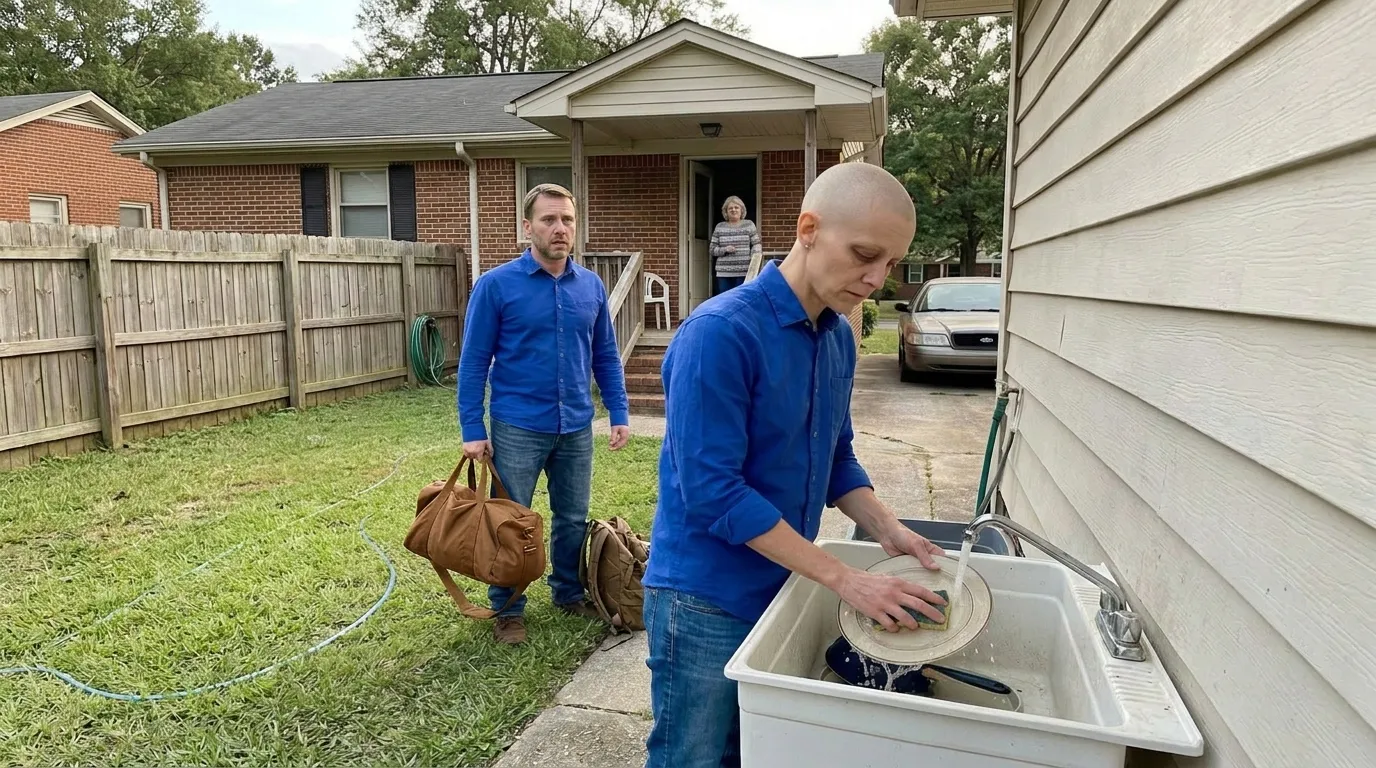
The basin behind the house.
Her cap.
The cuts on her scalp.
“I don’t want our future built inside a place where you learned how little they thought you mattered.”
She looked down.
Then quietly said:
“Thank you.”
We bought something smaller.
Quieter.
A peaceful home away from the old family conflict.
Nothing designed to impress anyone.
A porch.
A small garden.
A kitchen Gwen actually liked.
And enough space for us to breathe.
For months, Margaret tried to contact me.
Some messages were angry.
Others sounded apologetic.
Many mixed both together.
She blamed Paige.
Paige blamed Margaret.
Both blamed stress.
Confusion.
Money.
Misunderstandings.
Anything except the choices that had brought us there.
I did not respond immediately.
I was not interested in revenge.
But forgiveness did not require immediate access.
Gwen never pressured me either way.
“That’s your mother,” she said once.
“Yes.”
“You can love her and still need distance.”
I looked at her.
“When did you become wiser than me?”
“I had four quiet years to practice.”
That sentence hurt.
But she smiled when she said it.
Her hair began growing back.
At first, it was barely visible.
Soft dark fuzz along her scalp.
Then short strands.
Then enough that one morning she stood in front of the bathroom mirror and touched it carefully.
I watched from the doorway.
“What?”
she asked.
“Nothing.”
“You’re doing that staring thing again.”
“I like it.”
“My hair?”
“You.”
She rolled her eyes.
“That was terrible.”
“I’ve been overseas four years. My material is rusty.”
She smiled at herself in the mirror.
Then became quiet.
“I thought it might never grow back.”
I stepped beside her.
“I would have loved you without it.”
“I know.”
She looked toward me.
“I just wish I had known that when I was sitting behind the house thinking I looked broken.”
I turned her gently toward me.
“You didn’t look broken.”
She gave me a skeptical expression.
“You nearly attacked three people the first day you saw me.”
“Emotionally, maybe.”
She laughed.
Then her eyes filled.
“I was scared you wouldn’t recognize me.”
That shattered something inside me.
I wrapped my arms around her carefully.
“I would recognize you anywhere.”
This time, she believed me.
Months passed.
Then came the appointment neither of us dared discuss beforehand.
More scans.
More blood work.
A long wait beneath fluorescent lights.
The oncologist entered carrying the results.
Gwen immediately grabbed my hand.
The doctor sat.
“The treatment has responded very well.”
I stopped breathing.
Gwen stared.
“What does that mean?”
“It means we’re seeing exactly the kind of response we hoped for.”
He continued explaining monitoring, follow-up care, and what still needed to happen.
I heard perhaps half of it.
Gwen began crying.
So did I.
Not because everything was guaranteed.
Nothing was.
But because hope had become larger than fear.
Outside the medical center, Gwen stood in the sunlight.
Her hair moved slightly in the wind.
Not long.
Not yet.
But hers.
She closed her eyes.
“What are you thinking?”
I asked.
“That I’m hungry.”
I laughed.
“That’s it?”
“I’ve had cancer. I’m allowed to prioritize lunch.”
“Fair.”
We found a small restaurant nearby.
Nothing expensive.
No celebration planned.
Just the two of us sharing food.
Halfway through lunch, Gwen looked at me.
“What are you going to do about Margaret and Paige?”
“I don’t know.”
“You should decide for yourself.”
“I know.”
Then she added:
“But don’t decide because of me.”
I frowned.
“They hurt you.”
“Yes.”
“And?”
“And I don’t want them controlling another decision in our lives, even indirectly.”
That stayed with me.
Eventually, I agreed to meet Margaret.
Alone.
Public place.
No Paige.
My mother looked older when she arrived.
Not dramatically.
But the confidence was gone.
For several minutes, neither of us spoke.
Finally, she said:
“I’m sorry.”
I waited.
She started explaining.
I raised one hand.
“If the apology needs an explanation before it can stand on its own, it probably isn’t ready.”
Her eyes filled.
She looked down.
Then tried again.
“I’m sorry for what I did to Gwen.”
I remained quiet.
“I’m sorry I used your money as though sending it made it mine.”
Still quiet.
“I’m sorry I believed being your mother gave me more authority over your marriage than your wife had.”
That was closer.
Then:
“And I’m sorry that when she was sick, I cared more about proving I was right than whether she was frightened.”
For the first time, I felt something inside me loosen.
Not disappear.
Loosen.
“I appreciate you saying that.”
“Can you forgive me?”
“I don’t know yet.”
She cried.
I let her.
Once, that would have made me immediately soften.
Now I understood that someone’s discomfort did not create an emergency I was required to fix.
“What about Gwen?”
“She decides whether she wants contact with you.”
Margaret nodded.
“And Paige?”
“That is Paige’s responsibility.”
I stood.
“Mom, I love you.”
Her face crumpled.
“But loving you does not mean pretending none of this happened.”
“I know.”
“I hope you do.”
Then I left.
Paige took longer.
Much longer.
Her first apology came through text.
I guess I’m sorry everything got so out of control.
I did not answer.
Her second blamed Margaret.
I did not answer.
Months later, Gwen received a handwritten letter.
She showed it to me but did not let me read it.
“That’s yours,” I said.
“I know.”
“Do you want to talk about it?”
“Not yet.”
She placed it in a drawer.
Weeks passed.
Then one evening she said:
“Paige finally apologized.”
“What did she say?”
Gwen smiled faintly.
“She stopped explaining.”
That was all I needed to know.
We never rebuilt the old family.
I’m glad.
The old family required Gwen to disappear so other people could remain comfortable.
What we built afterward was smaller.
More careful.
More honest.
When my military service finally ended, I came home permanently.
No surprise arrival this time.
Gwen knew exactly when my flight landed.
She was waiting.
Her hair had grown to her shoulders.
She wore it loose.
The first time I saw her standing beyond the arrivals gate, I stopped walking.
She smiled.
“Are you going to stand there all day?”
I dropped my bag.
Then crossed the distance between us.
Four years earlier, I had imagined that homecoming a thousand times.
None of those imagined versions looked like this.
Because the woman waiting for me was not the same woman I had left.
And I was not the same man who had left her.
We had learned what money could not protect.
What silence could destroy.
What family could become when love was confused with entitlement.
And what marriage required when life became more difficult than either person expected.
Years later, when I think about those nearly $100,000 I sent home, I don’t think first about the house.
The truck.
The jewelry.
Or what was eventually recovered.
I think about $150.
The amount Gwen received for her hair.
Because that was the number that finally taught me the difference between providing and protecting.
I had sent almost one hundred thousand dollars home believing money proved I was taking care of my wife.
But when she needed three hundred dollars to find out whether she had cancer—
she couldn’t reach me.
She couldn’t reach the money.
She couldn’t even trust the people living in the house I had helped pay for.
So she sold part of herself.
Not for luxury.
Not for attention.
For a chance to survive.
I can never give those months back to her.
I can never undo the storage room.
Or the insults.
Or the moment I removed that cap and saw the cuts across her scalp.
But I can make sure she never again doubts whether she has someone standing beside her.
Gwen’s hair gradually grew back.
Dark.
Healthy.
Soft against her shoulders.
And we built a new life together.
Not because justice magically erased everything that happened.
It didn’t.
Not because money solved the damage.
It couldn’t.
But because Gwen survived long enough to choose what came next.
And this time—
she would never have to face it alone.
Latest Posts
- My Husband Mocked My Postpartum Appearance in His Brothers’ Group Chat—I Stayed Quiet for Five Days
Four months after giving birth, I thought my husband understood why I hardly recognized myself. Then I discovered the cruel joke he'd been sharing with his brothers, along with photos I never knew he'd taken. I kept my discovery secret for five days, determined to make him regret every word. “Dude, you weren't exaggerating 😂” …
- My Stepdaughter Called Me the Help Until My Envelope Changed Everything
The insult came before I’d even finished setting down the peach cobbler. I’d baked it at five that morning in the kitchen of the lake cabin we’d rented, and it was still warm under the foil. The smell of cinnamon followed me across the grass toward the pavilion tables, where thirty-two members of the Cole …
- My In-Laws Gave Their Other Three Children $20,000 for Houses and Gave Us Only a Card Two Years Later, We Bought the Old Miller Place for $41,500
The envelopes were tucked under the Easter plates. Each had a name written on it in my mother-in-law’s round schoolteacher handwriting. Kim opened hers first. She’s the oldest. Divorced two years. Raising two boys in a rented trailer behind the grain elevator. She looked at what was inside the envelope and put her hand flat …
- My Mother-in-Law Told Me to Lose Weight After Giving Me a Dress That Didn’t Fit, but Minutes Later, She Regretted Everything
I couldn’t get it over my hips. I stood in my bedroom in my underwear with the dress bunched around my thighs like a deflated balloon. Midnight blue silk. A designer label I’d only ever seen in magazines. Tiny pearl buttons down the back. Beautiful. And four sizes too small. I pulled. I tugged. I …
- Teen Wore a Dress to His Best Friend’s Funeral—The Family Nearly Had Him Removed Before He Reached the Microphone
My son’s best friend read the eulogy at his funeral in a red dress. I almost had him removed before he reached the microphone. My son Jack died 17 days after his 18th birthday. Cancer. Fourteen months from diagnosis to funeral. We found out late. Too late, as it turned out, and the treatment never …