The silence inside that damp storage room felt heavier than any battlefield I had ever stepped onto.
For four agonizing years, I had endured long deployments while holding onto the belief that every dollar I sent home was helping build a safe future for my wife, Gwen.
Instead, returning home without warning had revealed something I could barely process.
My mother, Margaret, and my sister, Paige, had been living comfortably while Gwen became sick, malnourished, isolated, and forced to sleep in a dark storage room.
Gwen sat beside me on the thin mattress, her trembling hands resting softly in mine.
She explained that doctors had discovered the tumor five months earlier.
By then, Margaret had taken control of nearly every financial arrangement connected to the household, repeatedly telling Gwen that I had placed her in charge.
When Gwen desperately asked for money to see a specialist, my mother refused to give her even a few hundred dollars.
Instead, she accused Gwen of pretending to be sick so she could steal my military pay.
Paige helped keep her isolated.
Calls were monitored.
Questions were discouraged.
Messages never reached me.
And the money I continued sending home somehow never became available when Gwen needed medical care.
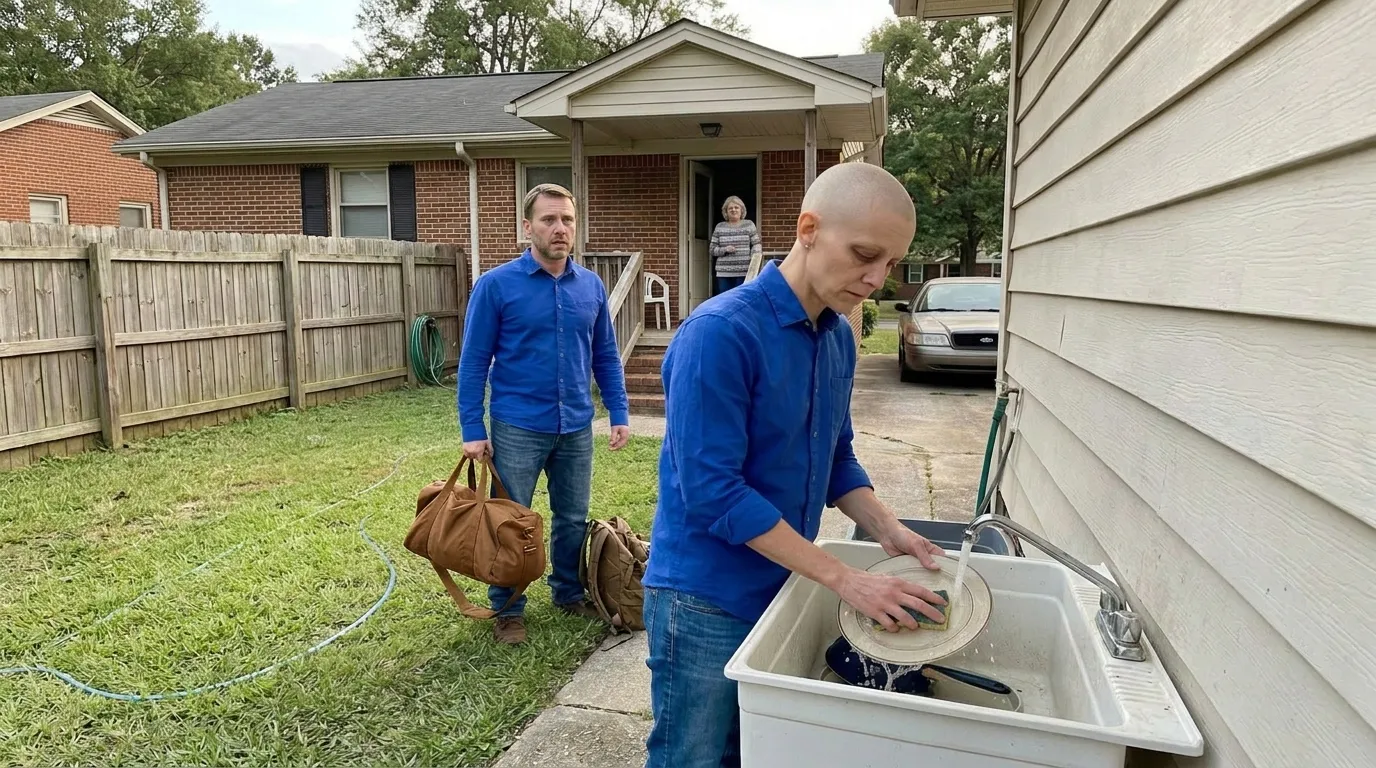
Left with almost nothing, Gwen finally cut off her own long hair and sold it.
The $150 she received helped pay for transportation and the biopsy that confirmed she was seriously ill.
I sat there listening while anger moved through me like fire.
But I knew exploding immediately would accomplish very little.
If Margaret and Paige realized I understood what had happened, they could hide documents.
Move money.
Destroy records.
Invent explanations.
So I forced myself to remain calm.
I stroked Gwen’s shaved head gently, wrapped my heavy jacket around her shoulders, and whispered:
“Just hold on until tomorrow night.”
She looked at me.
“What are you going to do?”
“Make sure nobody can do this to you again.”
As the sun began rising, I quietly left the storage room and allowed Gwen to rest.
Upstairs, the house remained silent.
Everywhere I looked, I saw evidence of where my money had gone.
Modern furniture.
Expensive appliances.
Decorations.
Electronics.
Outside, Paige’s brand-new truck sat in the driveway.
I stood there for several seconds, breathing slowly.
By eight that morning, Margaret and Paige were sitting in the dining room drinking expensive coffee.
When I walked in smiling, Margaret immediately began talking about how much the property had increased in value.
She claimed managing my finances had been a tremendous burden.
Yet she sounded remarkably enthusiastic about helping manage the additional $400,000 I had mentioned the previous evening.
“We should transfer it into the joint family trust account I created,” Margaret said, sliding a pen across the table.
Paige nodded eagerly.
She talked about another vehicle.
Travel.
Shopping.
Renovations.
They were so focused on money that neither noticed my phone recording the conversation.
I pulled out a chair.
“Before I move anything,” I said, “I need all the financial paperwork from the past four years.”
Margaret’s face changed.
Only briefly.
“What paperwork?”
“Bank statements. Property documents. Account records. Anything involving the money I sent home.”
“For taxes?”
“Exactly.”
That seemed to reassure her.
She smiled.
“Of course.”
Within an hour, I had gathered enough documents to take to an attorney.
Sitting in his office later that morning, I watched him review statements, receipts, transfers, and property records.
He became increasingly quiet.
Finally, he looked up.
“There are serious problems here.”
“How serious?”
He pointed toward several transactions.
Money I had sent for household expenses had been diverted.
Accounts I believed were being used for Gwen and the home appeared to have funded purchases benefiting Margaret and Paige.
Then he showed me documents carrying signatures that appeared to authorize Margaret to exercise control over assets.
I stared at them.
“I didn’t sign those.”
“You’re certain?”
“Absolutely.”
He nodded slowly.
“Then we need to preserve every record and determine exactly how these documents were created and used.”
I leaned forward.
“How much?”
“We need a complete accounting, but based on what you’ve brought me, a substantial portion of the money you sent home appears to have been redirected.”
Nearly four years.
Almost $100,000.
While Gwen had sold her hair for a biopsy.
The attorney advised me not to confront Margaret or Paige until the financial records were secured.
He also began taking steps to protect accounts and preserve evidence.
My next concern was Gwen.
I went directly to a regional medical center and arranged for her to be evaluated through the health coverage available to us.
The doctors moved quickly.
Blood work.
Imaging.
A full oncology consultation.
I sat beside Gwen throughout everything.
For years, I had imagined that when I finally came home, we would spend our first day together somewhere peaceful.
Instead, we sat beneath hospital lights while a doctor explained treatment options.
Her condition was serious.
But there was still reason to move forward with treatment.
I looked at Gwen.
For the first time since I found her behind the house, I saw something besides exhaustion in her face.
Hope.
Not certainty.
Hope.
That was enough.
Later that afternoon, I returned to the house with medical transport arranged for Gwen and the legal process already underway to preserve the relevant financial records.
Margaret and Paige rushed onto the porch.
“What is going on?” Margaret demanded.
I walked past her.
Straight toward the storage room.
Gwen was sitting on the mattress waiting.
I crouched beside her.
“Ready?”
She nodded.
I helped her stand.
She was so weak that I eventually lifted her carefully into my arms.
When I carried her outside, sunlight reached her face.
Her eyes closed.
Tears rolled slowly down her cheeks.
The medical team helped her into the vehicle.
Behind me, Paige demanded:
“Where are they taking her?”
“To get treatment.”
Margaret stepped closer.
“She doesn’t need all this drama.”
I turned.
For the first time, I allowed them to see the anger I had been holding back.
“She has cancer.”
Paige’s face changed.
Margaret looked away.
“You knew,” I said.
Neither answered.
“You both knew.”
Margaret finally spoke.
“She exaggerated everything.”
“She sold her hair to pay for a biopsy.”
“That was her decision.”
“No.”
My voice remained low.
“That was the result of decisions other people made for her.”
Margaret folded her arms.
“What exactly are you accusing us of?”
“I’m not discussing accusations with you.”
I held up the legal documents.
“The financial records are being reviewed. Relevant accounts and transfers are being preserved. From this moment forward, neither of you makes another decision involving my money or Gwen’s care.”
Paige stared at me.
“What about the four hundred thousand?”
There it was.
Even then.
Even with Gwen being taken for cancer treatment.
She was thinking about the money.
I looked directly at her.
“There is no four hundred thousand.”
Her mouth opened.
“What?”
“I made it up.”
Margaret’s face went pale.
“Why?”
“To see what mattered to you.”
Silence.
“You both gave me the answer.”
Margaret began crying.
“How could you trick your own mother?”
I stared at her.
“How could my wife sell her hair for medical care while you wore jewelry bought with money I sent home?”
That stopped her.
The financial investigation continued.
Records had to be reviewed properly.
Ownership had to be established.
Transfers had to be traced.
Documents had to be authenticated.
There was no dramatic moment where everything simply became mine again with one signature.
Real legal processes rarely work that way.
But the evidence kept building.
Money I had sent for household support had funded expensive personal purchases.
Vehicles.
Furniture.
Clothing.
Other expenses that had nothing to do with Gwen’s needs.
Some transactions had been made under authority I had never knowingly granted.
My attorney began the appropriate civil process to recover what could be recovered and referred the questionable documents and transfers for further investigation.
For the first time, Margaret and Paige were forced to explain themselves to people they could not intimidate with family guilt.
And while they dealt with that—
I stayed with Gwen.
That was where I belonged.