The following summer, Melissa invited me back for the Fourth of July.
I almost refused.
For three days, the invitation sat unanswered.
Then Chloe called.
“You don’t have to come.”
I smiled.
“Hello to you too.”
“I mean it. You don’t owe anybody a normal Fourth of July.”
“When did you become this wise?”
“Trauma.”
I laughed.
Then she said:
“But I’d like to see you.”
So I went.
I arrived at 3:50 p.m.
Same old blue sedan.
Same driveway.
This time, nobody said anything about where I parked.
Chloe met me before I reached the porch.
She hugged me hard.
Melissa approached next.
“I’m glad you came.”
“I almost didn’t.”
“I know.”
No defense.
That helped.
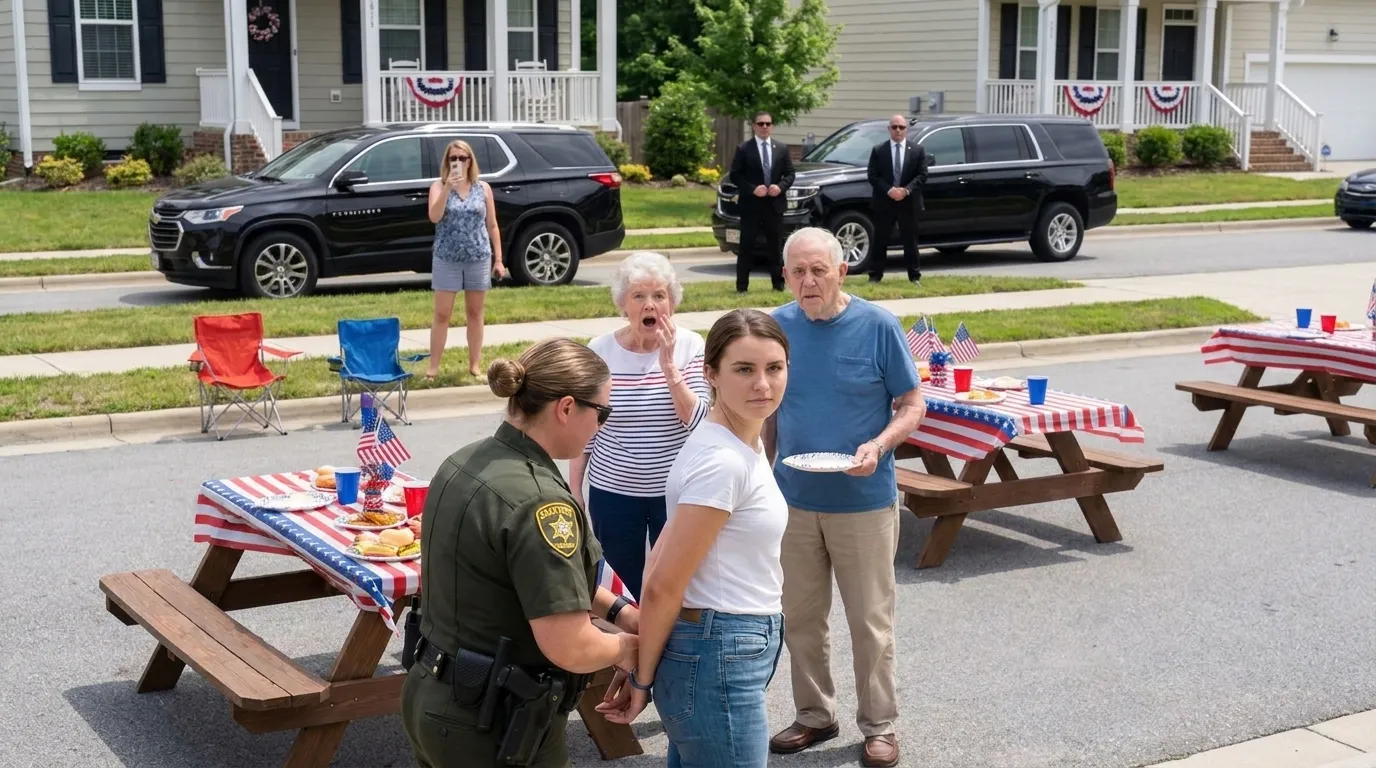
The yard looked almost identical.
Same grill smoke.
Same flags.
Same yellow potato-salad bowl.
Same sprinkler.
But the picnic table was new.
I noticed immediately.
Melissa saw me looking.
“I couldn’t keep the old one.”
I nodded.
People were almost painfully polite.
Aunt Denise offered lemonade as though I were visiting royalty.
Uncle Ray called me “General.”
“Sarah is fine.”
“Right.”
He nodded.
“Sarah.”
Mom sat under the maple tree.
She did not wave me over.
Did not create a scene.
She simply nodded.
That was better.
Brad was not there.
Nobody mentioned him for almost an hour.
Near sunset, Chloe and I sat on the porch steps while fireworks began popping somewhere down the street.
“Do you miss when they didn’t know?” she asked.
“Yes.”
She looked surprised.
“Really?”
“Being underestimated can be useful.”
“Did it hurt?”
“Yes.”
“Both can be true?”
“Most important things are.”
She nodded.
Then touched her phone case.
“I still have the card.”
“I know.”
“I don’t know if I should keep it.”
“Does having it make you feel safer?”
She thought.
“Not exactly.”
Then:
“It makes me feel like someone trusted me with something real.”
“Then keep it.”
The fireworks grew louder after dark.
Children ran with sparklers.
Adults pulled chairs together.
The porch flag caught flashes of red, white, and blue.
Everything looked like family again.
For once, it almost felt like it.
Not repaired.
Not innocent.
But more honest.
That was enough for one night.
People later asked why I had allowed my family to underestimate me for so long.
They imagined truth as something simple.
As though identity were a name tag I had simply forgotten to wear.
They did not understand that some lives are built around silence for reasons larger than pride.
Some information cannot be shared merely because the people around you are curious.
Some secrecy protects the same people who resent you for keeping it.
And sometimes the hardest part of having power is deciding not to use it when someone smaller tries to hurt you.
For more than twenty years, my relatives mocked me because they thought I had failed to become anything significant.
Then Brad turned that joke into something physical.
He believed he was teaching me respect.
Instead, he learned something about authority.
A badge did not make every decision correct.
A uniform did not turn humiliation into law.
And frightened relatives staying quiet did not turn wrongdoing into truth.
But there was still one thing I needed to do.
I needed to decide what came after people discovered my rank.
Because respect based entirely on rank would only be another version of the same failure.
I did not want my relatives treating me better because black SUVs had appeared.
I wanted them to understand they should have treated Sarah—the ordinary woman in jeans—with dignity before they knew anything else.
That became the boundary.
When relatives tried to ask for details about my career, I declined.
When Uncle Ray wanted to know whether I had “people following me everywhere,” I changed the subject.
When someone asked what classified operations I had participated in, I smiled.
“Still classified.”
My job remained my job.
My family knew only what they needed to know.
My rank.
That Brad had crossed a serious line.
That Chloe had used an emergency contact exactly as instructed.
Nothing more.
In a strange way, that helped.
They had to learn to respect boundaries without being given the exciting story behind them.
Brad eventually wrote to me.
I recognized his handwriting before I opened the envelope.
The first letter was terrible.
He wrote about humiliation.
His career.
How frightened he had been when federal personnel arrived.
How one “bad moment” had destroyed everything he worked for.
I stopped reading.
Three weeks later, another envelope arrived.
Shorter.
This one said:
Sarah,
I keep wanting to explain why I did it. Every explanation sounds worse when I write it down.
You were not threatening me. You were not resisting. I wanted everyone watching to see me as the person in control.
I continued.
I used my badge inside a family argument because I knew nobody there would stop me.
That sentence mattered.
Not enough for forgiveness.
But enough to show the truth had finally reached him.
The last line read:
I am sorry for hurting you.
I folded the letter.
I never answered.
Not because forgiveness was impossible.
Because apologies do not purchase access.
Sometimes they simply mark the beginning of someone else’s work.
Two years after that Fourth of July, Chloe graduated from college.
The whole family attended.
Brad did not.
My mother sat beside me.
Melissa sat on the other side.
When Chloe crossed the stage, we all stood.
She later found me near the reception tent.
“I brought something.”
She held out the matte-black emergency card.
I looked at it.
“Why?”
“I think I’m ready to give it back.”
“You sure?”
“Yes.”
She smiled.
“I don’t need it to remember that you trusted me.”
I took the card.
Then she added:
“And I finally understand what you meant.”
“About what?”
“The emergency.”
I waited.
She said:
“You told me to use it when I couldn’t trust the person standing closest to me.”
“Yes.”
“I thought you meant Brad.”
“I did.”
“But it was also everyone else.”
I looked at her.
She had grown sharper in the years since the cookout.
Not cynical.
Clear.
“That day,” she continued, “everybody was waiting for somebody else to decide what was right.”
I nodded.
“And you trusted me to decide.”
“Yes.”
She smiled.
“That might be the most important thing anybody ever gave me.”
I placed the card inside my wallet.
A few months later, I retired.
The ceremony was intentionally small.
There were speeches I had no desire to hear.
Medals I accepted because refusing would have created more attention.
People I had served beside for years.
Men and women whose full stories I still could not tell.
My family attended.
Mom cried.
Melissa cried.
Uncle Ray looked genuinely stunned when he finally understood how long I had served at senior levels.
But the moment I remember most came afterward.
Chloe walked over.
She looked at the decorations on my uniform.
Then at me.
“Still Sarah?”
I smiled.
“Always.”
That was what my family had needed to learn.
My rank explained why the SUVs came.
It did not explain why Brad was wrong.
Brad was wrong before anyone knew who I was.
He was wrong when I was simply the cousin in faded jeans.
He was wrong when everyone thought I shuffled paperwork.
He was wrong before anyone heard the words major general.
The truth of my career only removed the excuse they had been using to overlook me.
It did not create my dignity.
Years later, the scar near my cheek disappeared completely.
The marks on my wrists faded too.
The picnic table was long gone.
Brad’s badge was no longer part of family mythology.
But every Fourth of July, when I heard fireworks and smelled charcoal smoke, I remembered 4:17 p.m.
The nod.
Chloe stepping away.
The call.
Brad asking:
“Who’s in charge now?”
And my answer.
Not shouted.
Not dramatic.
Just true.
“Enjoy the feeling while it lasts.”
For years, my family believed restraint meant weakness.
They thought silence meant I had nothing important to say.
They thought an ordinary car, faded jeans, and a quiet voice meant there was nothing underneath worth respecting.
They were wrong.
But the lesson was not that I secretly outranked Brad.
The lesson was not that I could call powerful people.
It was not even that three black SUVs could change the balance of a backyard in less than five minutes.
The lesson was much simpler.
No one should need to be powerful before their boundaries matter.
No one should need a title before their pain is taken seriously.
No one should need armed authority arriving at the curb before a family finds the courage to say:
Stop.
At the next Fourth of July cookout, I sat beneath the maple tree beside Mom.
A child ran through the sprinkler.
Melissa shouted from the grill.
Chloe carried lemonade across the lawn.
My blue sedan was parked in the same driveway.
Mom looked at it.
Then at me.
For a second, I thought she might make a joke.
Instead, she said:
“You parked perfectly.”
I laughed.
“So I’ve been told.”
She smiled.
Then became quiet.
“I’m glad you came back.”
I looked across the yard.
“So am I.”
The family was not perfect.
Brad’s absence remained noticeable.
Some relationships never recovered fully.
Others became better because pretending was no longer possible.
And I had stopped believing reconciliation required forgetting what happened.
Sometimes family survives because people finally learn which behavior will no longer survive inside it.
The sun went down.
Fireworks began.
Red light crossed the yard.
Then white.
Then blue.
I watched Chloe laughing beside the porch.
For twenty years, my family had believed I was a failure because they did not know what I did.
Eventually, I realized that said far more about them than it ever had about me.
That Fourth of July, Brad believed he had handcuffed the least important person in the yard.
He wanted to teach me who had authority.
Instead, he taught everyone else something they should have understood long before the SUVs arrived.
Restraint can look exactly like weakness—
until the countdown ends.
The End.
Latest Posts
- My Husband Mocked My Postpartum Appearance in His Brothers’ Group Chat—I Stayed Quiet for Five Days
Four months after giving birth, I thought my husband understood why I hardly recognized myself. Then I discovered the cruel joke he'd been sharing with his brothers, along with photos I never knew he'd taken. I kept my discovery secret for five days, determined to make him regret every word. “Dude, you weren't exaggerating 😂” …
- My Stepdaughter Called Me the Help Until My Envelope Changed Everything
The insult came before I’d even finished setting down the peach cobbler. I’d baked it at five that morning in the kitchen of the lake cabin we’d rented, and it was still warm under the foil. The smell of cinnamon followed me across the grass toward the pavilion tables, where thirty-two members of the Cole …
- My In-Laws Gave Their Other Three Children $20,000 for Houses and Gave Us Only a Card Two Years Later, We Bought the Old Miller Place for $41,500
The envelopes were tucked under the Easter plates. Each had a name written on it in my mother-in-law’s round schoolteacher handwriting. Kim opened hers first. She’s the oldest. Divorced two years. Raising two boys in a rented trailer behind the grain elevator. She looked at what was inside the envelope and put her hand flat …
- My Mother-in-Law Told Me to Lose Weight After Giving Me a Dress That Didn’t Fit, but Minutes Later, She Regretted Everything
I couldn’t get it over my hips. I stood in my bedroom in my underwear with the dress bunched around my thighs like a deflated balloon. Midnight blue silk. A designer label I’d only ever seen in magazines. Tiny pearl buttons down the back. Beautiful. And four sizes too small. I pulled. I tugged. I …
- Teen Wore a Dress to His Best Friend’s Funeral—The Family Nearly Had Him Removed Before He Reached the Microphone
My son’s best friend read the eulogy at his funeral in a red dress. I almost had him removed before he reached the microphone. My son Jack died 17 days after his 18th birthday. Cancer. Fourteen months from diagnosis to funeral. We found out late. Too late, as it turned out, and the treatment never …