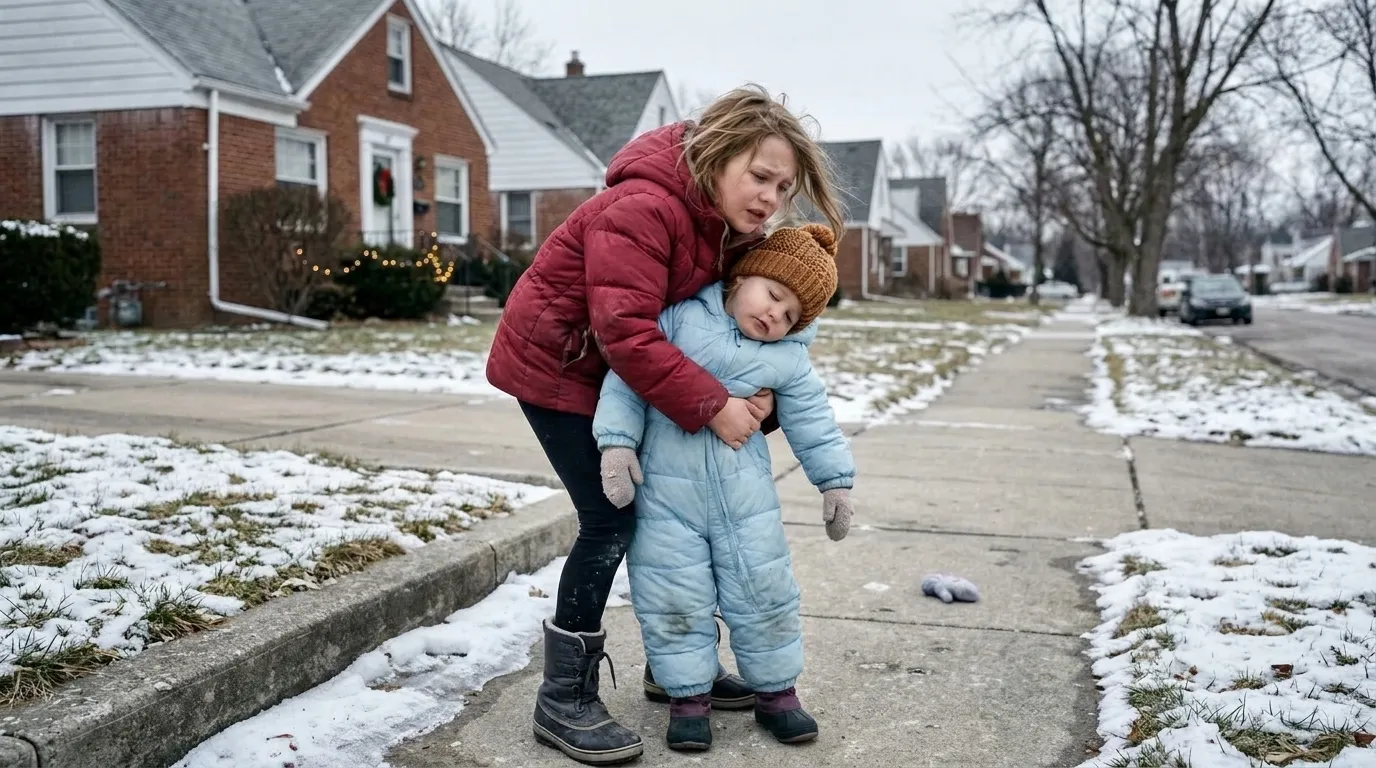
My mother arrived at the hospital the next morning carrying two red gift bags.
One for Emily.
One for Sophie.
Security stopped her.
I refused to see her.
She called seventeen times.
I blocked her.
My father called once.
“I’m sorry.”
“No, you aren’t.”
“Yes, I am.”
“You’re sorry they got hurt. You’re not sorry you let them leave.”
He started crying.
“I didn’t think—”
“No. You did think.”
That mattered.
“You came outside. You saw them. You heard Emily ask for help.”
“I know.”
“You chose Mom’s anger over two children.”
“I know.”
For the first time, I heard genuine remorse.
It didn’t change my decision.
“You will not see them.”
“Rachel…”
“Not now.”
“How long?”
“I don’t know.”
“I’m their grandfather.”
“You were their grandfather at 7:06 that night.”
Silence.
Then he whispered:
“Your mother will fall apart.”
Even now, he was thinking about her.
“Then take care of her.”
I ended the call.
Sophie left the hospital two days later.
Emily stayed one additional night.
Her fingers and toes recovered.
No permanent tissue damage.
The doctor said she had been lucky.
I hated that word.
Luck was a driver noticing two small figures near a drainage ditch.
Luck was him stopping.
Luck was Emily remembering my number.
Luck should never have been part of my children surviving Christmas.
Daniel remained hospitalized four more days.
So we celebrated Christmas on December 30.
A nurse found a tiny artificial tree.
Someone brought cookies.
Daniel wore a ridiculous Santa hat.
Halfway through the evening, Emily said:
“This Christmas is better.”
“Better than what?”
“The other one.”
“Why?”
“Because everybody is here.”
Daniel cried first.
Then I did.
Even Sophie cried because everyone else was crying.
Emily rolled her eyes.
“Why is everybody crying?”
Daniel laughed.
“Family tradition.”
And somehow, all of us laughed.
My parents eventually faced child-endangerment and neglect-related charges.
Reality was quieter than dramatic stories.
My father cooperated and pleaded guilty.
My mother fought everything.
Her attempt to delete the doorbell footage made matters worse.
She told relatives I had destroyed the family.
She called me vindictive.
She claimed the hospital exaggerated what had happened.
Then she said Emily had “always been dramatic.”
That sentence ended several relationships for her.
My aunt Carol called me.
“I’m done with her.”
“You don’t have to pick sides.”
“I’m not.”
Her voice hardened.
“I’m picking the children.”
Some relatives defended my mother.
“She made a mistake.”
“Christmas is emotional.”
“She’s from a different generation.”
I eventually stopped explaining.
People who needed an explanation for why you don’t put an eight-year-old and a three-year-old outside in freezing weather were not people I needed close to my daughters.
Then, three months later, Michael asked to meet.
I almost refused.
But his lawyer said he had evidence.
Daniel and I agreed to meet at a neutral attorney’s office.
Michael did not ask to see my daughters.
He placed an envelope on the table.
Inside were years of letters from my mother.
She had been giving him money.
Helping him move.
Helping him find work.
Helping him stay out of sight.
One letter dated back to the month I made her promise Michael would never be around my children.
It read:
Rachel is being ridiculous. I told her I agreed because it is easier than fighting her. She will calm down eventually.
Another said:
You can come Christmas Eve after the girls leave. She never needs to know.
My stomach turned.
My mother had been hiding him from me for years.
Daniel asked Michael:
“Why give us these?”
“Because Linda is saying I caused what happened.”
He looked down.
“I’ve done enough wrong without taking hers.”
Then he said:
“When the girls knocked, I told her to let them in.”
“We heard that.”
“I offered to leave.”
My breath stopped.
“What?”
“I said the children could come inside and I would go out the back.”
“What did she say?”
“No.”
“Why?”
“Because Emily might see my truck and tell you I had been there.”
Even Michael leaving was not enough.
My mother wanted no evidence.
No questions.
No possibility that her lie would be exposed.
Then Michael told me my father had argued with her afterward.
“He told Linda to go get the girls.”
“Why didn’t he?”
Michael looked at the table.
“Because she told him if he brought them back, she would leave him.”
My father had chosen his marriage.
Again.
Not because he believed my daughters were safe.
Because he was afraid of my mother.
That explained his weakness.
It did not excuse it.
Sometimes understanding is not forgiveness.
Sometimes it simply tells you exactly what kind of weakness caused the damage.
My father wrote Emily a letter.
He did not ask me to give it to her.
He sent it through our attorney with a note:
Only when Rachel and Daniel believe she is ready. If that day never comes, I understand.
Six months passed.
Then Emily asked:
“Does Grandpa know what he did?”
“Yes.”
“Is he sorry?”
“I think so.”
“Did he say sorry to me?”
I asked if she wanted to read his letter.
She did.
I sat beside her.
It began:
Dear Emily,
You asked me for help, and I did not help you.
No excuses.
No blame placed on Grandma.
He wrote:
I saw you and Sophie outside. I knew you were too young to be alone. I knew I should bring you inside or drive you somewhere safe. I chose not to because I was afraid of making your grandmother angry.
Emily stopped.
Her eyes filled.
Then she continued.
That was cowardly.
You were eight years old and showed more courage taking care of Sophie than I showed protecting either of you.
I am sorry.
You do not have to forgive me. You do not have to visit me. You do not have to answer this letter.
Then came the line that broke me.
Adults sometimes tell children they must forgive because family is important. That is not fair. Family was important when you were on my porch, and I forgot that.
Emily cried.
So did I.
The final line read:
If you ever speak to me again, I will be grateful. If you never do, I will understand why.
She folded it.
“What are you feeling?” I asked.
“Sad.”
“Anything else?”
“Mad.”
“That makes sense.”
Then:
“Can I still love Grandpa even if I don’t want to see him?”
“Yes.”
She put the letter in her drawer.
She did not answer for another year.
Then one day, she drew him a picture.
Nothing more.
He cried when he received it.
If their relationship ever became something again, it would be rebuilt one inch at a time.
On Emily’s terms.
My mother never wrote that kind of apology.
She blamed stress.
Then Michael.
Then my father.
Then me.
Finally, she wrote:
I am sorry things went so far.
That wasn’t enough.
Because “I am sorry things went so far” is not the same as:
I shut the door.
I knew you were children.
I knew you were lost.
I chose my pride anyway.
She never reached that point.
Maybe she never would.
I had spent my childhood trying to make my mother understand my pain.
I refused to make my daughters inherit that job.
Two years passed.
Daniel fully recovered.
Sophie remembered almost nothing about that Christmas.
We were grateful.
Emily remembered.
But she also remembered the man who stopped his car.
His name was Marcus Hale.
He had been driving home after a night shift when he saw Emily near the road.
We found him.
The next Christmas, he came to our home.
Emily hugged him so tightly he cried.
Marcus became part of our lives.
Not because blood made him family.
Because action did.
When Emily was ten, she brought home a school essay.
The assignment:
WHAT COURAGE MEANS TO ME
She wrote:
I used to think courage meant not being scared.
Then one Christmas my little sister got too tired to walk and I was scared a lot.
I carried her because she was smaller than me.
Then I got tired too.
A man stopped his car and helped us. My mom says he was brave because he stopped when he could have kept driving.
My dad says I was brave because I kept going.
I think Sophie was brave because she trusted me.
Then came the line that stayed with me forever:
I think courage means doing the right thing even when someone else might get mad.
I cried over that sentence at the kitchen table.
Daniel read it and cried too.
Emily walked in.
“Again?”
I laughed.
“Yes.”
“You guys cry a lot.”
“Apparently.”
She smiled.
Then went upstairs.
Daniel sat beside me.
“She understands it.”
“Yes.”
“Better than they did.”
I knew exactly who he meant.
My parents had spent years talking about respect.
Loyalty.
Family.
Boundaries.
But Emily understood at eight years old what they had forgotten in sixty years:
Family is not the person whose anger you fear most.
Family is the person whose safety you refuse to sacrifice just to keep the peace.
Five years after that Christmas, we drove past my parents’ old house.
They no longer lived there.
My father had eventually separated from my mother.
He lived alone across town.
Emily saw him occasionally.
Sophie knew him cautiously.
My mother had moved away.
We had no contact.
The house had new owners.
Christmas lights lined the roof.
A wreath hung on the door.
Sophie, now eight herself, looked through the window.
“Is that the house?”
“Yes.”
“The one Emily walked from?”
“Yes.”
Emily was thirteen now.
She sat quietly in the passenger seat.
“You okay?” I asked.
She looked at the house.
Then shrugged.
“Yeah.”
A moment later she said:
“It looks smaller.”
I understood.
Some places become enormous in childhood because of what happened there.
Then you grow.
And eventually you realize the building itself never had power.
The people inside were simply supposed to protect you.
And failed.
Sophie asked:
“How far did you carry me?”
Emily smiled.
“Too far.”
“Was I heavy?”
“Very.”
“I was three!”
“You were still heavy.”
They started arguing.
Normal sisters.
Normal laughter.
I watched them in the mirror.
Alive.
Warm.
Safe.
Daniel took my hand.
We drove on.
That Christmas evening, our house filled with people.
Marcus came.
Aunt Carol came.
Daniel’s family came.
My father did not.
That was Emily’s choice that year.
He respected it.
At six o’clock, someone knocked.
Sophie ran toward the door.
Then stopped.
“Who is it?”
“I don’t know.”
She looked through the window.
“Delivery.”
Then she opened the door.
Such a small thing.
A child opening a door without fear.
That was what I wanted.
Children who knew they could call me.
Children who knew they were allowed to question adults.
Children who understood that family peace never required sacrificing their safety.
Later, Emily sat beside me near the tree.
“Mom?”
“Yes?”
“Do you still feel bad?”
“About what?”
“Dropping us there.”
The guilt returned instantly.
“Yes.”
She nodded.
“I knew.”
“How?”
“You get that face.”
“What face?”
“The guilty face.”
I smiled sadly.
Then she leaned against me.
“You didn’t know.”
“I should have.”
“You called Grandma.”
“Yes.”
“You texted.”
“Yes.”
“You thought we were safe.”
“Yes.”
Emily looked at the Christmas lights.
Then said:
“You always tell me not to take blame for choices other people make.”
I swallowed.
“Yes.”
“So…”
She raised one eyebrow.
“So maybe you should listen to yourself.”
The tears came immediately.
Emily groaned.
“Oh no.”
I laughed.
“Too late.”
She hugged me.
And as I held the little girl who was no longer little, I finally accepted what I had spent years telling her.
I had not put my daughters into the cold.
I had brought them to a door I believed would open.
My parents closed it.
That distinction mattered.
Because guilt can become another locked house if you live inside it long enough.
And I was finished teaching my daughters to live behind locked doors.
That Christmas had begun with my eight-year-old carrying her three-year-old sister through freezing darkness.
For years, I believed the worst part was the cold.
It wasn’t.
The worst part was that two children stood outside a house filled with adults—
and not one of those adults had enough courage to open the door.
But the best part came later.
Emily grew up knowing exactly what courage looked like.
Sometimes it looked like carrying your little sister.
Sometimes it looked like stopping your car.
Sometimes it looked like admitting you failed.
And sometimes, perhaps most importantly—
it looked like refusing to sacrifice a child just to avoid making an adult angry.
People sometimes asked whether I forgave my mother.
I never gave them the answer they wanted.
Because forgiveness was never the point.
The point was what my daughters learned.
Love is not proven by how much cruelty you are willing to excuse from family.
Love is proven by what you are willing to protect from it.
And every Christmas after that, our front door remained lit.
Not because everyone was welcome.
They weren’t.
But because the people who belonged inside—
never had to wonder whether we would open it.
THE END
Latest Posts
- My Husband Mocked My Postpartum Appearance in His Brothers’ Group Chat—I Stayed Quiet for Five Days
Four months after giving birth, I thought my husband understood why I hardly recognized myself. Then I discovered the cruel joke he'd been sharing with his brothers, along with photos I never knew he'd taken. I kept my discovery secret for five days, determined to make him regret every word. “Dude, you weren't exaggerating 😂” …
- My Stepdaughter Called Me the Help Until My Envelope Changed Everything
The insult came before I’d even finished setting down the peach cobbler. I’d baked it at five that morning in the kitchen of the lake cabin we’d rented, and it was still warm under the foil. The smell of cinnamon followed me across the grass toward the pavilion tables, where thirty-two members of the Cole …
- My In-Laws Gave Their Other Three Children $20,000 for Houses and Gave Us Only a Card Two Years Later, We Bought the Old Miller Place for $41,500
The envelopes were tucked under the Easter plates. Each had a name written on it in my mother-in-law’s round schoolteacher handwriting. Kim opened hers first. She’s the oldest. Divorced two years. Raising two boys in a rented trailer behind the grain elevator. She looked at what was inside the envelope and put her hand flat …
- My Mother-in-Law Told Me to Lose Weight After Giving Me a Dress That Didn’t Fit, but Minutes Later, She Regretted Everything
I couldn’t get it over my hips. I stood in my bedroom in my underwear with the dress bunched around my thighs like a deflated balloon. Midnight blue silk. A designer label I’d only ever seen in magazines. Tiny pearl buttons down the back. Beautiful. And four sizes too small. I pulled. I tugged. I …
- Teen Wore a Dress to His Best Friend’s Funeral—The Family Nearly Had Him Removed Before He Reached the Microphone
My son’s best friend read the eulogy at his funeral in a red dress. I almost had him removed before he reached the microphone. My son Jack died 17 days after his 18th birthday. Cancer. Fourteen months from diagnosis to funeral. We found out late. Too late, as it turned out, and the treatment never …