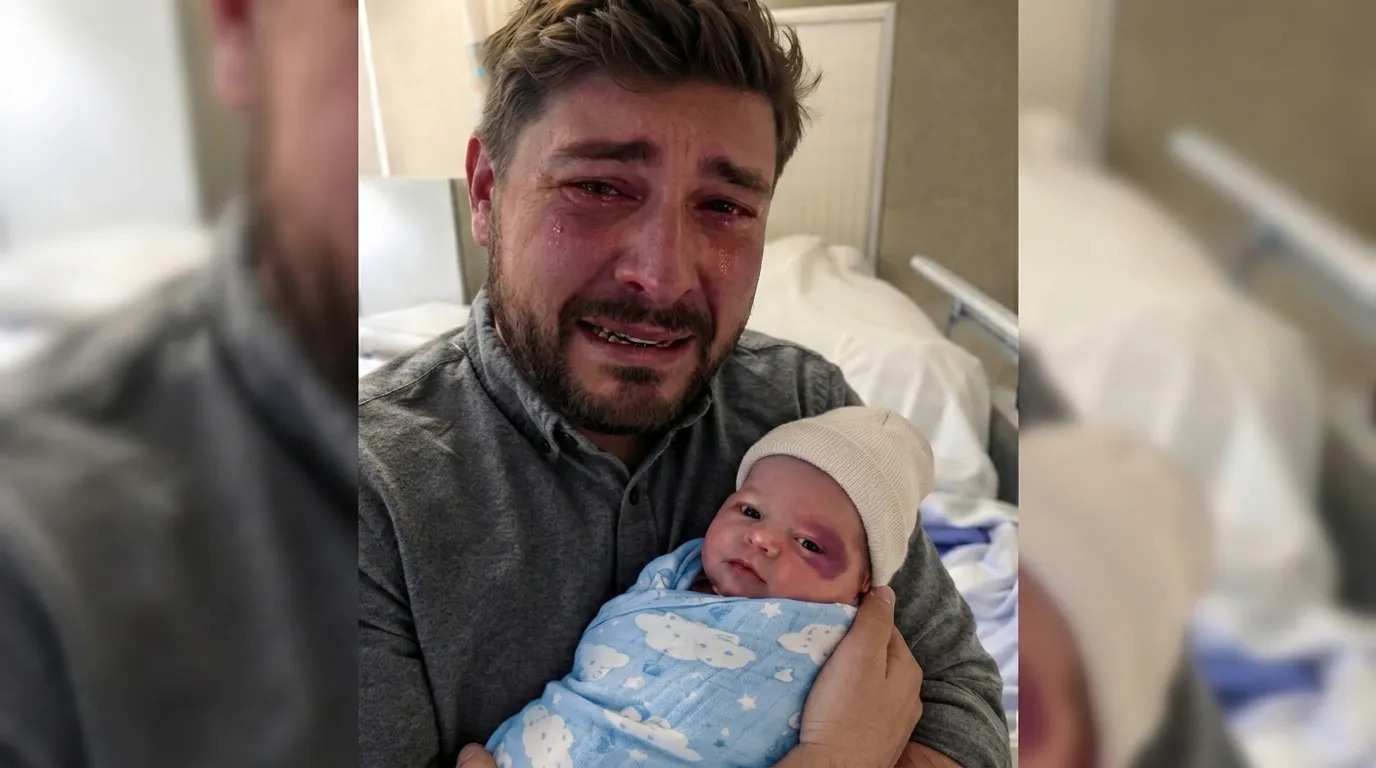
The first time my husband looked at our newborn daughter, he looked as though he had just seen a ghost.
I had imagined that moment for years.
I imagined Ethan standing beside me with tears in his eyes, holding the baby we had fought so hard to have.
I imagined laughter.
Relief.
A thousand beautiful versions of that moment.
I never imagined fear.
Ethan and I had been married for four years.
Before that, we had dated for two.
He was the kind of man people trusted immediately.
Quiet.
Thoughtful.
The person who remembered birthdays, noticed when someone looked tired, and stopped to help strangers on the roadside.
When we struggled to have a baby, I watched the disappointment slowly settle into him.
Every month another pregnancy test came back negative.
Every month he held me and said:
“We’re okay, Emma.”
Then one morning, after years of waiting, I sat on our bathroom floor staring at three positive pregnancy tests.
Ethan found me there.
He thought something terrible had happened.
Then I handed him the test.
“Are you serious?”
I nodded.
He fell to his knees and cried.
“We’re having a baby.”
“We are.”
“A real baby?”
I laughed through my tears.
“Yes.”
During the pregnancy, he was incredible.
He cooked when food smells made me sick.
Drove me to appointments.
Talked to my stomach.
When we learned we were having a girl, I wanted the name Lily.
I had loved the name since childhood.
Ethan went strangely quiet when I suggested it.
I noticed.
But then he smiled.
“Lily,” he repeated.
“You like it?”
His smile had sadness inside it.
“Yes.”
I should have asked why.
I didn’t.
Months later, after twenty-one exhausting hours of labor, our daughter arrived.
Healthy.
Strong.
Perfect.
When Ethan entered the room the following morning, his face was full of happiness.
Until he looked into Lily’s bassinet.
Then the flowers dropped from his hand.
“Why didn’t you tell me?”
“Tell you what?”
“Look at her.”
I didn’t understand.
Then someone opened the hospital door.
A woman stood there.
Dark hair.
Pale face.
Eyes already wet with tears.
Ethan froze.
“Claire…”
The woman stepped inside.
“So you finally told her.”
I looked between them.
“Who is she?”
Ethan sat down.
“Claire Bennett.”
Claire answered the next question herself.
“Ethan and I were engaged ten years ago.”
My chest tightened.
I had known Ethan had relationships before me.
I had never known he had been engaged.
Then he told me why he had hidden it.
They had been expecting a daughter.
Their baby never came home.
“She was stillborn,” Ethan whispered.
Claire looked toward the floor.
“She was supposed to be named Lily.”
I stared at him.
Our daughter.
Lily.
“You knew.”
“Yes.”
“And you let me choose the same name without telling me?”
His eyes closed.
“You loved it. I told myself it was just a name.”
“But it wasn’t.”
“No.”
Claire stepped toward the bassinet but carefully kept her distance.
“Our daughter had a small birthmark behind her left ear.”
My hand immediately went to the same place on my Lily.
There it was.
Tiny.
Faint.
A curved mark I had barely thought about.
“That could mean nothing,” I said.
Claire nodded.
“It could.”
Then she opened her bag.
“But this doesn’t.”
She placed a hospital file on my blanket.
The documents were ten years old.
Different dates.
Different departments.
Different signatures.
One page said:
BABY GIRL BENNETT — DECEASED.
Another, created only hours later, said:
INFANT FEMALE — TRANSFERRED TO TEMPORARY CARE.
My pulse accelerated.
“What is this?”
Ethan looked sick.
“The reason I’ve spent years wondering whether my first daughter really died.”
I stared at him.
“You knew?”
“I suspected.”
“For how long?”
“Before I met you.”
I felt betrayed all over again.
“And you never told me?”
“I tried to convince myself I was wrong.”
Claire continued.
“Six months after the delivery, Ethan found the first conflicting record.”
They investigated.
Quietly.
The hospital said the transfer entry was a clerical mistake.
Then the physical archive mysteriously lost several pages.
The obstetrician who signed the stillbirth report retired overseas.
The nurse who remembered the baby refused to talk.
Eventually, Claire and Ethan’s grief destroyed their relationship.
Claire blamed Ethan for obsessing.
Ethan blamed himself for not protecting their daughter.
He started drinking.
Then left Chicago.
Years passed.
Then he met me.
“I thought that chapter was over,” Ethan said.
“You mean you hoped it was.”
“Yes.”
Claire opened another folder.
“Three weeks ago, I got access to something new.”
A neonatal blood sample had been retained from their daughter.
Years later, the same genetic fingerprint had appeared in a pediatric database under another child’s identity.
My stomach dropped.
“You’re saying she lived?”
Claire’s voice trembled.
“At least long enough to have medical testing years after they told us she died.”
“Where is she?”
“We don’t know yet.”
Then Claire looked toward my Lily.
“When Ethan told me you were delivering here, I came because this is the same hospital.”
I turned toward my husband.
“You told her I was here?”
He nodded reluctantly.
“I contacted her after your labor became complicated.”
“Why?”
“Because I panicked.”
His voice broke.
“Ten years ago, Claire went into this hospital with a healthy baby and came out without one.”
He looked at Lily.
“Yesterday, when they took me out of your delivery room, I thought history was happening again.”
That was why he had looked terrified.
Then he noticed Lily’s birthmark.
The same unusual mark his first daughter had.
Not proof.
But enough to tear open everything he had buried.
I looked at my sleeping newborn.
Then at Claire.
“What do we do?”
Claire answered immediately.
“We find her.”
The hospital administration initially called the discrepancies historical documentation errors.
That explanation lasted less than a day.
Because Dr. Elaine Mercer, the physician who had cared for me during delivery, quietly reviewed the archived records herself.
Then she came to our room with the hospital’s legal officer.
Her expression was serious.
“We found an irregularity.”
Ethan stood.
“What kind?”
“The identification number associated with Claire’s daughter was used again.”
Claire went pale.
“When?”
“Two years after the reported stillbirth.”
“For what?”
“A pediatric cardiology screening.”
Claire grabbed the bed rail.
“She was alive.”
Dr. Mercer nodded carefully.
“The record strongly suggests a living child was tested under a different name.”
“Which name?”
The legal officer hesitated.
“We cannot disclose another patient’s identity without appropriate authorization.”
Claire started crying.
“That is my daughter.”
“I understand.”
“No, you don’t!”
Dr. Mercer stepped closer.
“We have notified state authorities.”
Ethan’s voice hardened.
“Authorities?”
“And the hospital’s current administration has preserved all remaining records.”
I asked:
“Are you saying somebody stole their baby?”
Dr. Mercer chose her words carefully.
“I’m saying the records are serious enough that law enforcement needs to determine whether an unlawful transfer occurred.”
That distinction mattered.
We did not know yet.
But we were finally going to find out.
Within forty-eight hours, investigators found a connection.
Ten years earlier, the hospital had worked with a small private adoption organization called New Horizons Family Services.
It no longer existed.
The organization claimed to help mothers who voluntarily surrendered infants.
But several archived files contained irregularities.
Missing consent forms.
Contradictory medical records.
Signatures that could not be verified.
And one former hospital administrator appeared repeatedly.
Dr. Malcolm Shaw.
He had supervised obstetric administration the year Claire delivered.
He had also signed the order transferring Claire’s daughter out of neonatal care.
But he had never signed her death certificate.
That document bore another physician’s electronic signature.
A physician who told investigators she had never seen the baby.
The case widened.
Claire was not the only mother.
Seven other families had similar discrepancies.
Babies reported as lost during complicated deliveries.
Private transfers.
Records altered afterward.
Not all cases proved wrongdoing.
But enough did.
And the trail finally led to one child.
A ten-year-old girl living in Wisconsin.
Her name was Sophie Carter.
She had been adopted as an infant by Rebecca and Michael Carter.
Her adoption papers identified her biological mother as an anonymous young woman from Illinois.
But DNA testing told a different story.
Claire was her mother.
Ethan was her father.
When the result arrived, Claire collapsed into a chair.
Ethan simply stared at the page.
For ten years, they had mourned a daughter who had been alive only three hours away.
I expected them to demand that Sophie be returned immediately.
They didn’t.
That surprised me.
Claire cried and said:
“She has parents.”
Ethan nodded.
“People who raised her.”
The Carters had no idea the adoption was fraudulent.
They had paid a licensed agency.
Passed background checks.
Waited almost four years for a child.
They believed everything was legal.
They loved Sophie.
And Sophie loved them.
The truth did not create one grieving family.
It created two.