The SUV doors shut with a heavy, final sound.
Bevis Morgan did not ask Elias to calm down. He did not tell him to think clearly. He only handed him a second tablet and said, “Your house is three minutes out. Ironclad has the exterior. County is on the way. CPS is two blocks behind them.”
Elias nodded once.
That was all.
He slid into the back seat, buckled in, and stared at the dark road ahead while the city lights streaked across the rain-slick windshield. His jaw was locked so tight it hurt. His hands were steady, but only because he had spent twenty years training them to be.
The attorney stayed on speaker.
“Colonel,” she said, “do not enter alone. Let the officers lead. We have the footage, the audio, the social media post, and the neighbor statement. That is enough to justify immediate intervention.”
Elias looked out the window.
His house was close enough now that he could see the porch light glowing through the trees.
Close enough to see the place where Matilda had been standing barefoot in the cold.
Close enough to see the place where Bonnie had blocked her from coming back inside.
“Understood,” he said.
The SUV turned into the driveway behind two county cruisers and one Ironclad unit. Flashing lights washed over the front of the house, over the wet pavement, over the windows that had once looked warm from the outside.
The front door opened before anyone knocked.
Josephine stepped onto the porch with her phone in her hand, her face pale when she saw the vehicles.
Then she saw Elias.
The phone lowered slowly.
For one second, nobody spoke.
Then Bonnie appeared behind her, still wearing the same hard expression from the video, as if she had not expected consequences to arrive before morning.
Vanessa, Brooke, and Erin were visible in the hallway behind them, all of them suddenly quiet.
An officer stepped forward. “Ma’am, we need everyone to remain where they are.”
Josephine blinked fast. “What is this? Why are there police at my house?”
Elias got out of the SUV.
He did not raise his voice. He did not have to.
“Where is Matilda?”
Josephine’s mouth opened, then closed again.
Bonnie answered instead. “She’s inside. She’s fine.”
Elias looked at her with a coldness that made even the officer beside him glance over.
“No,” he said. “She was crying on the driveway in bare feet while you kept her out. Then she was crying in the laundry room. So I’m asking again. Where is my daughter?”
That question changed the air.
The county officer turned toward Josephine. “We need to locate the child now.”
Josephine’s eyes flicked toward the hallway.
That was enough.
Bevis saw it too. He gave a short nod to the Ironclad team, and one of them moved immediately toward the back of the house while the officer stayed with the adults on the porch.
Elias stepped forward, but the attorney’s voice came through the speaker again.
“Colonel, stay where you are until the child is seen.”
He stopped.
The seconds dragged.
Then, from somewhere deeper in the house, came a small sound.
A sob.
Not loud. Not dramatic.
Just one broken breath from a child who had cried too long.
Elias’s face changed again, and this time nobody missed it.
A moment later, the back door opened and a female officer came out carrying Matilda.
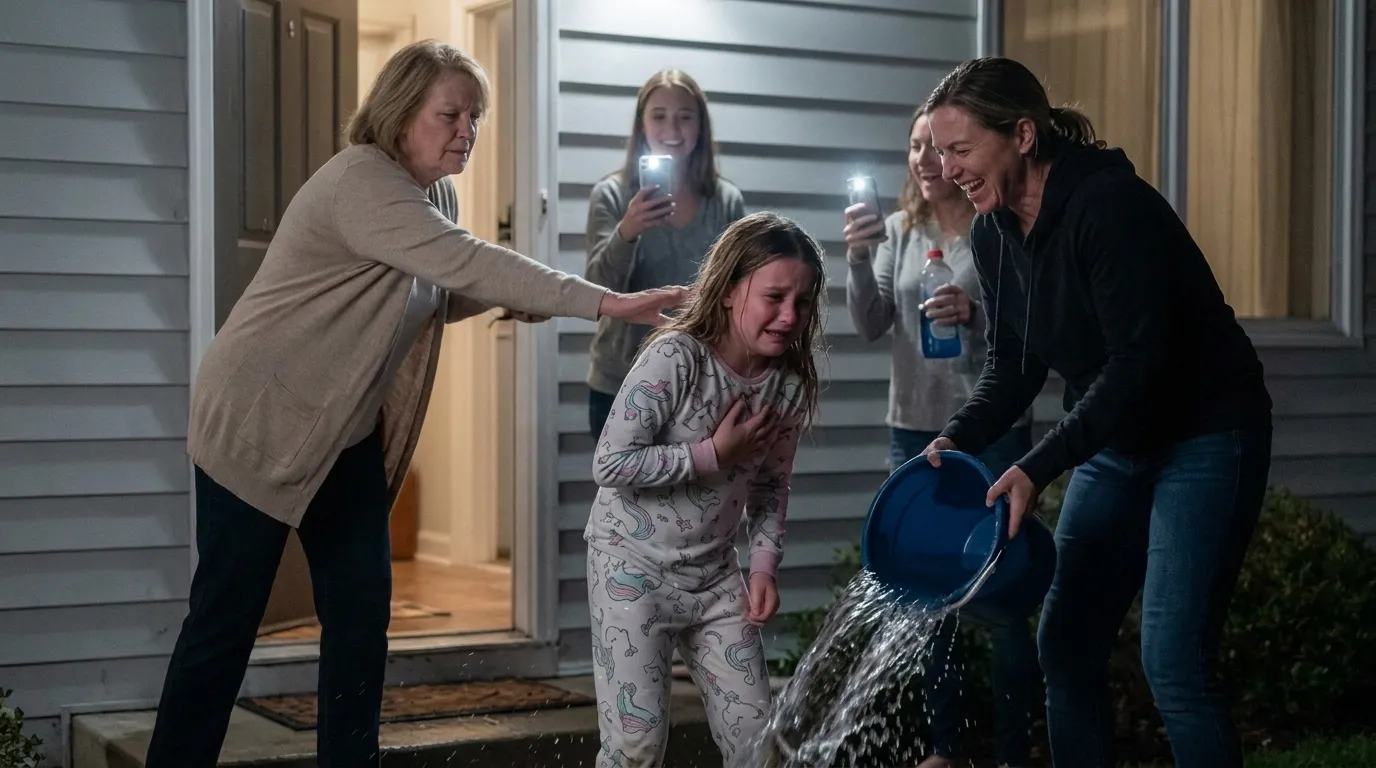
She was wrapped in a blanket, her unicorn pajamas damp at the cuffs, her hair tangled against her cheeks. Her face was blotchy from crying. She looked smaller than Elias remembered, smaller than she should have looked at eight years old.
The instant she saw him, she reached out.
“Daddy.”
Elias crossed the space between them so fast the officer barely had time to shift her hold. He took Matilda carefully, one arm under her knees, the other around her back, and pressed his forehead to hers.
“I’m here,” he said, voice rough now. “I’ve got you.”
Matilda clung to his shirt with both hands.
“Grandma said you weren’t coming,” she whispered. “Mom said I had to stay outside until I learned a lesson.”
Elias closed his eyes for one brief second.
Then he opened them again and looked at the porch.
Josephine had gone white.
Bonnie looked offended, as if the child repeating it made the truth less acceptable.
The officer holding the phone recorder asked, “Did anyone force her outside?”
Matilda answered before anyone else could.
“Grandma did. Mom filmed it. My aunts laughed.”
No one on the porch spoke.
Not Josephine. Not Bonnie. Not Vanessa, Brooke, or Erin.
The county officer turned to the adults. “You are all being separated for statements.”
Josephine finally found her voice. “This is ridiculous. It was discipline. She was being dramatic.”
Elias turned so slowly it seemed the entire porch held its breath with him.
“Dramatic?” he repeated.
Josephine flinched, but he did not move closer.
He only looked at her the way a man looks at something he no longer recognizes.
“You recorded my daughter crying and posted it online,” he said. “You let your mother block her from coming inside. You laughed.”
“I didn’t laugh,” Josephine said too quickly.
Brooke made a small sound beside her, and Erin stared at the ground.
Bevis, standing near the SUV, lifted the tablet. “The video says otherwise.”
The officer took the tablet, glanced at the screen, and handed it to the county detective who had just arrived.
That detective looked from the footage to Josephine, then to Bonnie, then to the sisters.
“Turn over your phones,” he said.
Josephine’s hand tightened around hers.
“No,” she said.
The detective’s expression did not change. “Then we will take them.”