More urgently, Raymond’s medical treatment was now under independent scrutiny.
He was transferred out of Dr. Wallace’s exclusive care.
His condition began improving.
Slowly.
First his hands.
Then his arms.
Eventually, he could sit upright.
The first time Christopher saw him out of bed, he stopped in the doorway.
Raymond was sitting in an armchair with a cane beside him.
“Uncle?”
“Hello, Christopher.”
Christopher looked as though he’d seen a dead man.
“What are you doing?”
“Recovering.”
Christopher’s eyes immediately moved toward me.
“She did this.”
Raymond almost smiled.
“Yes. Nora committed the terrible crime of noticing I wasn’t dead.”
“She’s manipulating you.”
“No.”
Raymond’s expression changed.
“I’ve spent weeks listening while people spoke around me as though I were furniture.”
Christopher went silent.
“I heard you discussing my estate,” Raymond continued. “I heard you asking how quickly things could be settled after my death. And I heard enough about my medical condition to know that investigators should hear the rest.”
Christopher looked toward Harrison.
“What investigators?”
“The ones reviewing what happened to me.”
Nobody arrested Christopher in the drawing room.
There was no theatrical confession.
The investigation took months.
Medical records were reviewed.
Financial transactions were examined.
Experts analyzed Raymond’s treatment.
Dr. Wallace’s records became especially important.
Investigators eventually found evidence that medication had been administered outside the treatment Raymond had supposedly been receiving, along with communications that raised serious questions about why.
Christopher obtained his own attorney.
So did Dr. Wallace.
What followed happened through interviews, warrants, hearings, and eventually criminal proceedings.
I testified only about what I personally witnessed.
I didn’t need to know every detail.
I knew enough.
Raymond had been helpless.
People he trusted had treated his helplessness as an opportunity.
Eventually, serious charges were proven against both men.
Raymond never celebrated.
“Christopher was family to me,” he told me one afternoon.
“You don’t have to forgive him.”
“I know.”
He looked toward the garden.
“But prison doesn’t return the months I spent trapped inside my own body.”
By then, Raymond was walking again.
Not perfectly.
He still used a cane when tired.
But he was alive.
That was when I told him Theodore and I should leave.
He frowned.
“Why?”
“You don’t need a live-in caregiver anymore.”
“That is true.”
“And I don’t want you feeling that you owe us something.”
Raymond nodded.
“Then we’ll do this properly.”
He offered me a formal position with normal hours and a salary if I wanted to stay.
If I preferred to leave, he would respect that too.
No enormous check.
No mansion suddenly placed in my name.
No reward for saving the millionaire.
Just a choice.
Then he placed an envelope on the desk.
Inside were the completed DNA results and supporting records Harrison’s investigators had located.
Brandon was Raymond’s biological son.
Theodore was his grandson.
Raymond stared at the papers.
“I missed twenty-nine years.”
“He may not want you in his life.”
“I know.”
“He left his own child.”
“I know that too.”
“Then what are you going to do?”
Raymond folded the report.
“Tell him the truth.”
They found Brandon several weeks later.
Raymond went to see him alone.
When he returned, I didn’t ask what happened.
The next morning, he finally told me.
“He slammed the door in my face.”
“I’m sorry.”
Raymond smiled faintly.
“Ten minutes later, he opened it again.”
That was how their relationship began.
Not with a tearful embrace.
With ten uncomfortable minutes on opposite sides of a closed door.
Then came text messages.
Short phone calls.
Longer ones.
Eventually, Brandon asked about Theodore.
Later, he asked about me.
Several months after that, he visited.
When he walked into Raymond’s living room, nobody knew quite what to say.
Brandon looked at his father.
Then at his son.
Then at me.
“I didn’t come here expecting forgiveness.”
“Good,” I said. “Because you don’t have it yet.”
He nodded.
“I understand.”
That was the first honest conversation we’d had in a long time.
Nothing became perfect afterward.
Brandon didn’t transform overnight into a wonderful father.
Raymond couldn’t recover the decades he’d lost.
I couldn’t forget being abandoned with a three-month-old baby.
But nobody demanded that the past disappear before we could attempt something better.
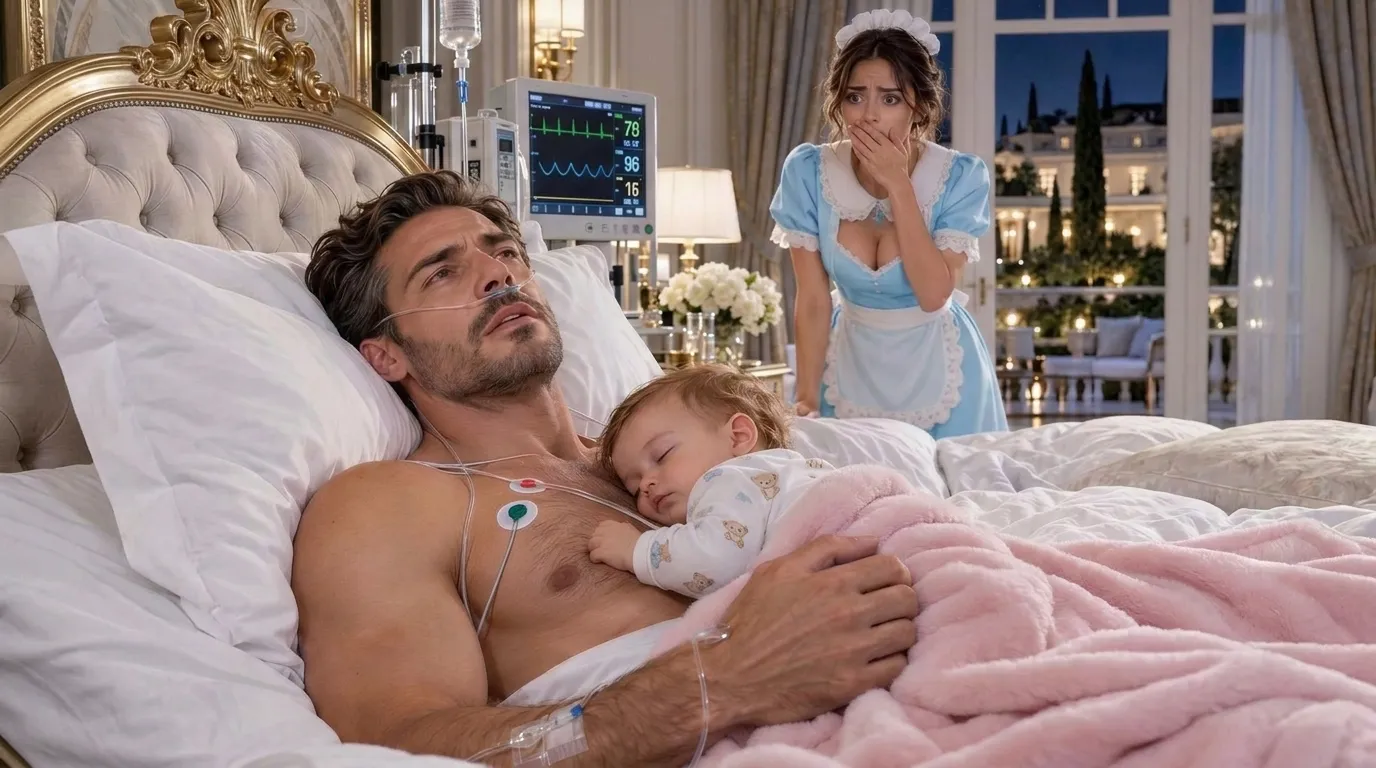
The following spring, Theodore fell asleep in Raymond’s arms in the garden.
His cheek rested against the same place on Raymond’s chest where I’d placed him that first terrifying night.
Raymond froze.
“He’s asleep.”
“Then don’t move.”
He smiled.
“I’ve already spent enough of my life unable to move.”
Across the garden, Brandon was helping plant a young tree.
Raymond watched him for a while.
“I spent my entire life thinking legacy meant leaving behind money,” he said.
I looked at Theodore sleeping against him.
“And now?”
“Now I think it means leaving people something worth growing.”
That night months earlier, I’d entered Raymond’s room because my baby wouldn’t stop crying.
I thought I was placing Theodore on the chest of a dying man.
Instead, a hand reached for a blanket.
Then another life began moving again.
Not perfectly.
Not all at once.
Just enough to tell us it wasn’t over yet.
Latest Posts
- My Husband Mocked My Postpartum Appearance in His Brothers’ Group Chat—I Stayed Quiet for Five Days
Four months after giving birth, I thought my husband understood why I hardly recognized myself. Then I discovered the cruel joke he'd been sharing with his brothers, along with photos I never knew he'd taken. I kept my discovery secret for five days, determined to make him regret every word. “Dude, you weren't exaggerating 😂” …
- My Stepdaughter Called Me the Help Until My Envelope Changed Everything
The insult came before I’d even finished setting down the peach cobbler. I’d baked it at five that morning in the kitchen of the lake cabin we’d rented, and it was still warm under the foil. The smell of cinnamon followed me across the grass toward the pavilion tables, where thirty-two members of the Cole …
- My In-Laws Gave Their Other Three Children $20,000 for Houses and Gave Us Only a Card Two Years Later, We Bought the Old Miller Place for $41,500
The envelopes were tucked under the Easter plates. Each had a name written on it in my mother-in-law’s round schoolteacher handwriting. Kim opened hers first. She’s the oldest. Divorced two years. Raising two boys in a rented trailer behind the grain elevator. She looked at what was inside the envelope and put her hand flat …
- My Mother-in-Law Told Me to Lose Weight After Giving Me a Dress That Didn’t Fit, but Minutes Later, She Regretted Everything
I couldn’t get it over my hips. I stood in my bedroom in my underwear with the dress bunched around my thighs like a deflated balloon. Midnight blue silk. A designer label I’d only ever seen in magazines. Tiny pearl buttons down the back. Beautiful. And four sizes too small. I pulled. I tugged. I …
- Teen Wore a Dress to His Best Friend’s Funeral—The Family Nearly Had Him Removed Before He Reached the Microphone
My son’s best friend read the eulogy at his funeral in a red dress. I almost had him removed before he reached the microphone. My son Jack died 17 days after his 18th birthday. Cancer. Fourteen months from diagnosis to funeral. We found out late. Too late, as it turned out, and the treatment never …