Right at my Purple Heart ceremony on the military base, my stepmother stormed the stage and smashed a steel chair across my arm, snapping my bone with a sickening crack. She shrieked before 300 witnesses: “You’re still nothing but trash in a costume, you whore!” My father cowardly stared at his shoes while my stepbrother snickered. As I collapsed in agony, a three-star general stepped forward to shield me, then revealed who I really was…
The Medal She Couldn’t Take Away
Chapter 1: The Weight of Steel and Silence
Bone is a peculiar architecture. For decades, it feels permanent, an unbreakable scaffolding holding up your life. Then a single, violent fraction of a second changes everything.
The sharp crack of my own radius giving way was louder to me than the polite applause filling the Fort Bragg auditorium.
One second, I was standing off to the side of the stage at my own Purple Heart ceremony, offering my right arm to help an elderly, decorated Vietnam veteran steady his balance.
The heavy wool of my dress blues felt suffocating under the harsh theatrical lighting, but I was proud.
I had survived.
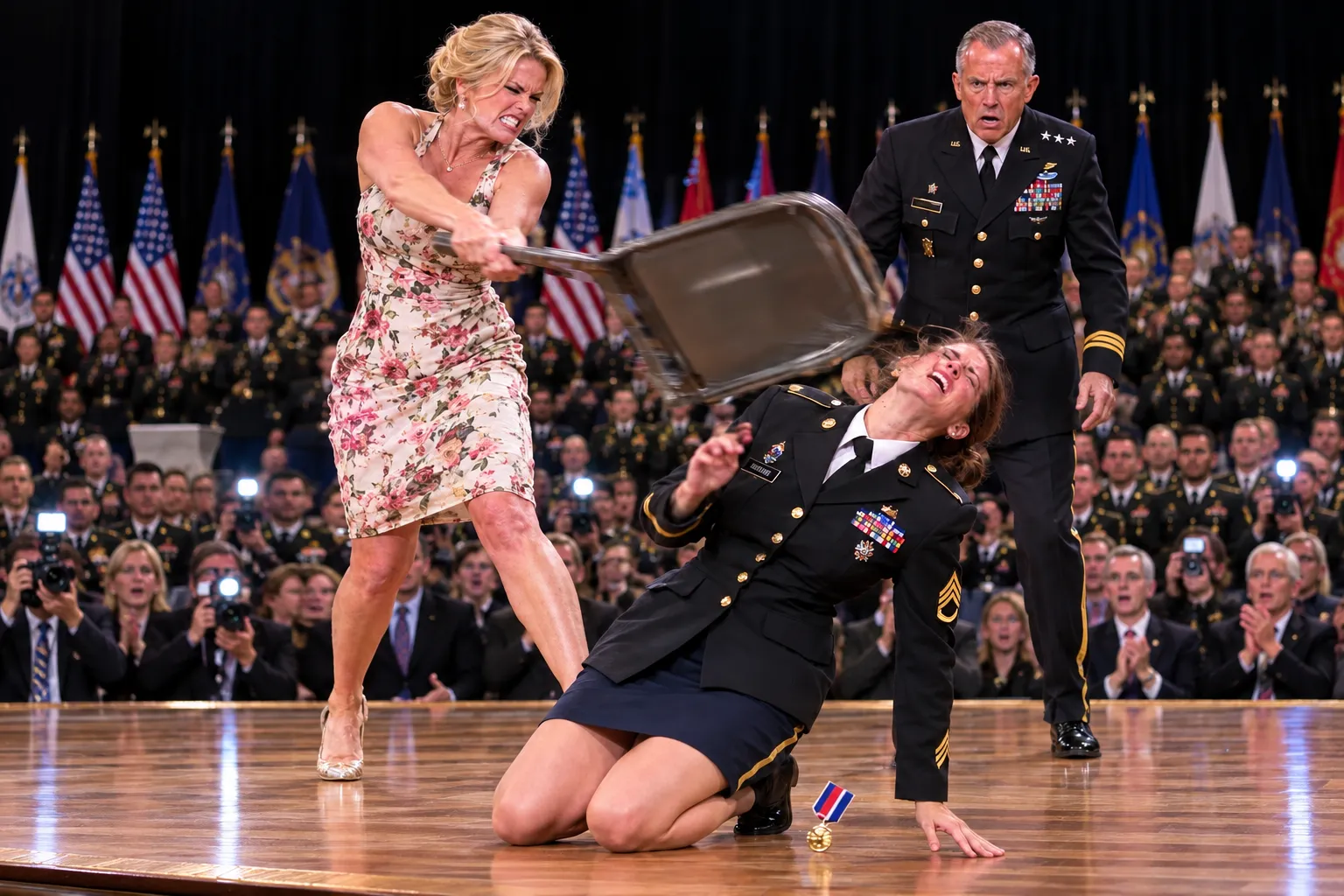
The next second, a heavy metal folding chair came crashing down across my left forearm.
Pain shot from my wrist into my shoulder. The force of the blow buckled my knees.
The gleaming brass-and-purple medal that had been meticulously pinned to my lapel less than ten minutes earlier tore loose, striking the polished oak floorboards with a dull ping as I collapsed.
Looming over me, still gripping the bent steel frame of the chair, was my stepmother, Linda.
Her features were contorted with fury. Her knuckles were white from the strain.
“You’re still nothing but trash in a costume!” she shrieked, her voice carrying through the grand hall.
The entire auditorium, filled with three hundred people, plunged into absolute silence. The applause died in the span of a single heartbeat.
Then she spat the venomous insult she had been throwing at me behind closed doors since my seventeenth birthday.
“You tramp.”
Nobody breathed.
Only moments before, this room had been a sea of standing ovations. Mayors, local officials, families, and soldiers I had served beside were gathered to honor actions most civilians couldn’t begin to fathom.
Men and women wearing ribbons that represented unimaginable nightmares were now frozen in shock, their eyes fixed on the woman in the floral dress holding a weapon.
But I wasn’t looking at the horrified crowd. I wasn’t even looking at Linda.
I was staring desperately at the third row.
I was watching my father.
He had seen every moment of it. He had watched his wife stalk down the aisle, lift that steel chair, and swing it hard enough to break my arm.
Through the blurring tears of pain, I waited for him to shoot out of his seat. I waited for him to scream her name, to rush to my side, to finally utter one protective sentence:
That is my daughter.
Instead, his shoulders slumped. He slowly lowered his gaze, finding immense fascination in the toes of his polished dress shoes.
Beside him, my twenty-two-year-old stepbrother leaned back in his seat and let out a low, amused chuckle.
That subtle, mocking sound hurt worse than the injury.
Because in that excruciating moment on the floor, the defining illusion of my entire life evaporated.
Linda had never been the sole architect of my misery. My father had spent twenty years handing her the blueprints and looking the other way.
The pain in my arm surged again, a deep, nauseating throb that made the room spin.
I instinctively pulled the injured limb against my chest, realizing with cold panic that my fingers would no longer obey me. The edges of my vision darkened.
Then a large, steady hand settled onto my uninjured right shoulder.
I looked up.
Standing above me was Lieutenant General Robert Hayes. Three silver stars gleamed on his lapels.
Just minutes ago, he had been offering me a warm, paternal smile as he fastened the Purple Heart to my chest. Now, all warmth had left his expression, replaced by a glacial fury.
He looked at Linda. He looked at the chair still in her hands.
Then his steel-gray eyes locked directly onto my father in the third row.
“She is not trash,” the General whispered.
But in the dead quiet of the room, the words carried the force of an artillery shell.
Chapter 2: The End of the Living Room Rules
Linda recoiled, freezing as if she had only just noticed him.
General Hayes took a slow, deliberate step toward her, his posture radiating authority.
“She is the soldier who carried wounded Americans out of burning wreckage while heavy ordnance was still raining down around her.”
The silence deepened.
“And you,” Hayes continued, his voice dropping an octave, “just assaulted her at her own commendation ceremony.”
Linda’s jaw worked, opening and closing, but no sound came out.
Without breaking eye contact with my stepmother, General Hayes gave a slight tilt of his chin toward the heavy double doors at the rear of the hall.
Instantly, two Military Police officers stepped into the center aisle. Their boots struck the wood in measured unison as they marched toward the stage.
It was only then, watching the armed MPs close the distance, that Linda seemed to catch up with reality.
This was not our suburban living room.
This wasn’t a tense Thanksgiving dinner where she could hurl plates and scream insults while everyone stared at their mashed potatoes and pretended not to notice.
She had just committed a felony assault on a uniformed service member in a room packed with witnesses, combat veterans, and a three-star general.
The remaining fight drained from her hands. She dropped the chair.
It hit the floor with a hollow, metallic clang that made me flinch.
“I… I didn’t mean to break anything,” she stammered, her eyes darting around for an exit.
General Hayes stared at her.
“You swung a reinforced steel chair at her skull. She blocked it with her arm.”
“She provoked me! She’s disrespectful!”
In the third row, my stepbrother’s smirk vanished. My father finally lifted his head, his face pale with fear.
The MPs reached the front.
“Ma’am,” the lead officer commanded, his hand resting near his duty belt. “Step away from the service member immediately.”
Linda pointed a manicured finger at me.
“You can’t do this! I am her stepmother!”
The MP didn’t blink.
“Your familial status does not change the instruction, ma’am. Step back.”
“She humiliated me by not inviting us properly!” Linda screeched, her voice cracking into its familiar register.
An almost frantic urge to laugh bubbled in my throat, but it was swallowed by a fresh wave of nausea.
General Hayes crouched beside me, his dress uniform settling against the floor.
“Do not move that left arm, Sergeant,” he ordered gently.
“I know, sir,” I gasped, cold sweat beading on my forehead.
“Are you dizzy?”
“A little. Room’s spinning.”
His jaw tightened.
Over his shoulder, someone called for the medical team. Because of the elderly veterans in attendance, two combat medics were already stationed in the wings.
They sprinted across the stage, trauma bags slapping against their thighs.
But Linda couldn’t stop. She always used words as a smokescreen when she felt control slipping from her grasp.
“You military people just don’t understand her!” Linda shouted as the second MP kicked the metal chair out of the way. “She plays the innocent victim, but she’s been doing this her entire life!”
General Hayes rose slowly to his full height.
“Doing what, exactly?”
Linda looked around, realizing that three hundred pairs of eyes were fixed on her.
Any rational person would have stopped. But Linda had never been rational when she was losing control.
“Making everyone think she’s special!” she spat. “You think she earned that medal? You think being wounded was heroic? She probably did it for the attention!”
A strange expression washed over the General’s weathered face. It was no longer just anger. It was total, staggering disbelief.
“You genuinely believe,” Hayes asked, his tone dangerously soft, “that sustaining blast injuries in a combat zone was a stunt for attention?”
Linda’s face flushed crimson.
“I’m talking about the whole charade! The uniform, the medals, this stupid ceremony! She just wants to prove she’s better than her own family!”
At that moment, my father finally found his legs. He stood up.
But it wasn’t to shield me.
“Linda,” he whispered frantically, stepping into the aisle. “Linda, please, maybe we should just go.”
The lead MP turned toward my father.
“Nobody involved in this incident is leaving these premises until formal statements are documented and the threat is secured.”
My father dropped back into his seat.
And somewhere beneath the pain of my fractured bones, something deep inside me went completely, peacefully still.
Because I recognized the exact shade of fear on his face.
For twelve years, my father had fed me a steady diet of excuses. He told me Linda was just “highly emotional.” He insisted she “didn’t process things normally.”
He demanded that I, a child, be the “mature one.”
When I was sixteen, she threw my entire backpack into a rainstorm because I was twenty minutes late from volleyball practice. My father told me to apologize for causing her anxiety.
When I was seventeen, she called me filthy for wearing a fitted dress to prom. He said she was just being protective.
When I enlisted at eighteen, seeking an escape, she laughed at my uniform and called it a Halloween costume.
He sat in his armchair, reading the paper, and said absolutely nothing.
The military had been my salvation.
The Army didn’t care who got the bigger bedroom or whose biological child I was. The Army demanded only one thing:
Do the job.
So I did. I became exceptional at it.
But doing the job had almost cost me everything.
“Ma’am?” A medic’s voice pulled me back. “I need to cut the sleeve.”
I nodded weakly.
The shears sliced through the heavy blue wool. My forearm was already badly swollen and bruised.
“Obvious compound fracture,” the medic muttered to his partner.
“No kidding,” I ground out between clenched teeth.
“She’s exaggerating the pain!” Linda bellowed, resisting the distance the MPs were putting between us. “She has always been a hypochondriac!”
General Hayes turned away from me to face the crowd, and I saw his shoulders set.
The air in the room seemed to change.
“Since you are determined to reduce her sacrifice and service to a mere costume,” Hayes said, his voice vibrating with command, “perhaps it is time you learn exactly whose ceremony you just desecrated.”
Chapter 3: The Smoke and the Saints
The auditorium was so silent you could hear the hum of the fluorescent lights.
Panic seized my chest, briefly overriding the pain in my arm. I knew exactly what General Hayes was about to do, and I desperately didn’t want it.
“Sir, please—” I croaked.
Hayes turned his head slightly, raising a single gloved hand. It wasn’t an order to be quiet; it was a fatherly plea for me to let him carry the burden.
He faced the crowd, his posture rigid.
“The official citation read here today was heavily redacted. The full, classified account of the action associated with this Purple Heart was purposely omitted from public record.”
My father squinted, genuine confusion cutting through his fear. Linda crossed her arms, looking defiant but uncertain.
“The account was shortened strictly at her request,” Hayes continued, his voice echoing off the high ceilings. “She did not want a spectacle. She insisted that the focus of today’s gathering remain squarely on the soldiers from her unit who did not come home.”
My throat closed up.
The polished floorboards of the auditorium dissolved.
Suddenly, I wasn’t in North Carolina anymore. I was back in the blinding, suffocating dust of the Korangal Valley.
I could taste the copper of my own blood and the acrid sting of burning diesel fuel.
I was back beside the smoking remains of a shattered Humvee, hearing Sergeant Collins cry out for his mother while I frantically pressed both hands against a wound in his thigh, trying to stop the bleeding from his femoral artery.
I squeezed my eyes shut, willing the phantom smell of cordite to fade.
“During an ambush on her convoy,” General Hayes said, “her vehicle was struck by an improvised explosive device. She sustained a traumatic brain injury and severe shrapnel wounds from the initial blast debris. By all military protocols, she had every right to remain behind the armor and wait for extraction.”
The room collectively held its breath.
“She did not,” Hayes stated.
He extended a hand toward the front row of folding chairs.
“She repeatedly, willfully exposed herself to heavy enemy machine-gun fire to drag wounded personnel from the burning wreckage.”
A chair scraped against the floor. One of the men in the front row stood up.
I recognized the broad shoulders instantly.
Daniel Mercer.
He leaned heavily on a polished wooden cane now. He had been a vibrant, athletic twenty-three-year-old when I found him critically wounded in the dirt.
Daniel turned to face my family in the third row. His voice was thick with unshed tears.
“She came back into the fire for me.”
Linda stared at him, her mouth slightly open.
Daniel struck the rubber tip of his cane against the floor for emphasis.
“My legs were crushed. I was burning. She dragged me forty yards while bullets were hitting the dirt around her boots.”
Another veteran, missing his left arm, stood up beside Daniel.
Then a third veteran, a woman, stood.
“She came back for all of us,” Daniel said, his voice breaking.
I swallowed hard, tears finally spilling over my eyelashes and mixing with the cold sweat on my cheeks.
This was precisely why I had fought the public narrative. I didn’t want to be elevated into a myth.
There were others who fought just as hard, who suffered just as much, who came home in flag-draped aluminum boxes and never got ceremonies.
But Hayes wasn’t finished dismantling my stepmother’s version of reality.
“And when she was finally medevaced,” the General added, the ghost of a proud smile touching his lips, “she argued fiercely with the flight medics, demanding they take another soldier in her place because she deemed her own wounds secondary.”
A soft, tearful ripple of laughter moved through the soldiers in the crowd.
“That sounds much worse when you say it out loud, sir,” I managed to whisper.
“It was infinitely more annoying when you were doing it, Sergeant,” Hayes replied, never taking his eyes off Linda.
The tension broke for a fraction of a second.
But Linda, incapable of reading the room, destroyed it.
“So what?” she spat, though her voice wavered with a desperate, cornered panic.
Every head turned back to her.
“So she did the job she signed up for! That doesn’t make her a saint! Why is everyone acting like she’s a hero?”
Daniel Mercer’s voice cut through the air before the General could respond.
“Because some of us get to kiss our children goodnight only because she refused to leave us in the dirt.”
That finally silenced her.
The crushing weight of reality had broken through.
The lead MP stepped toward her.
“Ma’am, place your hands behind your back.”
Linda’s eyes widened.
“What? No. No, you aren’t listening to me.”
“You are being detained in connection with an aggravated assault. Hands behind your back.”
“Absolutely not!” she shrieked, backing away.
My father leaped up, his hands raised in a gesture of peace.
“Officer, please! Surely this can be handled privately!”
There it was.
The little phrase that had defined my entire childhood.
Privately.
As if cruelty and abuse were acceptable as long as the neighbors couldn’t hear the screaming.
General Hayes slowly turned toward my father.
“Sir, your wife just fractured a soldier’s arm with a steel chair in front of three hundred witnesses on a federal installation. There is no ‘privately.’”
“She just lost her temper!” my father pleaded, rubbing his sweating forehead. “Linda is under a tremendous amount of stress lately!”
I couldn’t help it. A bitter laugh escaped my throat.
My father froze.
He looked down at me. Really looked at me, for the first time that day.
My arm was encased in a temporary splint. My beautiful uniform was ruined, stained with sweat and cut to pieces.
The Purple Heart lay on the bloodstained floor.
And still, his instinct was to explain away her violence.
“Dad,” I said, my voice eerily calm.
He flinched.
“Don’t, sweetheart. Let me fix this.”
“You don’t get to explain her to me anymore,” I said, my voice rising, vibrating with two decades of repressed grief. “You don’t get to call silence peace. It wasn’t peace. You were just trying to keep Linda happy, and you gladly let me carry the cost!”
My father looked suddenly ancient. His shoulders caved.
He looked frantically at the horrified crowd, the embarrassment finally overriding his denial.
“I love you,” he whispered.
“Maybe you do,” I replied, feeling nothing but a profound emptiness. “But love that never protects, never speaks up, and never shows up when it actually matters… doesn’t feel like love to the person bleeding.”
He looked away.
The MPs secured the steel cuffs around Linda’s wrists.
She began struggling.
“This is your fault!” she screamed at me as they escorted her backward up the aisle. “You wanted to destroy this family!”
“No, Linda,” I said softly, though the acoustics carried it to her. “You just did something in broad daylight that you’ve been doing in the dark for years.”
The heavy oak doors of the auditorium slammed shut behind her.
And for the very first time in my life, Linda’s screaming faded away without my father demanding that I chase after her and apologize.