I Cleaned the Same Woman’s House for Eight Years — Before She Moved Away, She Asked Me to Come Back One Final Time Without My Cleaning Supplies
When Mrs. Whitaker asked me to come back without bringing any cleaning supplies, I assumed she probably had a few old dishes, clothes, or household things she wanted to give me.
I even made room in the back seat of my car.
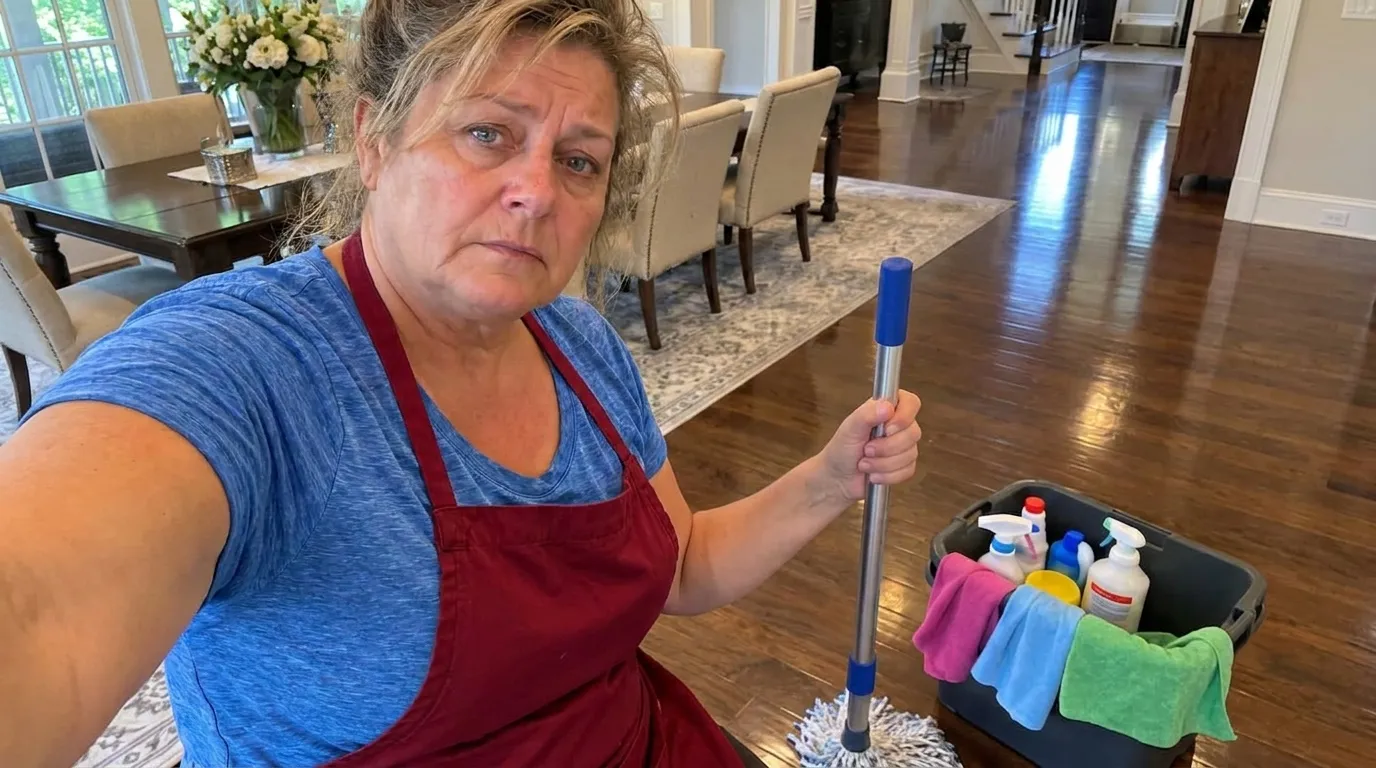
For eight years, I had cleaned her house every Thursday.
I knew which drawer in the kitchen always got stuck. Which towels were only for guests. And exactly where every photograph belonged after I finished dusting.
To Mrs. Whitaker, I figured I was simply Carly.
The woman who arrived at nine in the morning and disappeared before two.
At least, that was what I’d always assumed.
She had never treated me badly.
She paid me on time. She left the air conditioning running whenever she went out while I cleaned. And she always remembered to ask about my daughter.
But we weren’t exactly friends.
We didn’t call each other during the week. We didn’t meet for coffee.
I had a key to her home, but I still felt like I needed permission before taking a glass from her kitchen cabinet.
When I first began working for Mrs. Whitaker, my daughter, Willa, was only nine.
I had recently separated from Willa’s father and was taking every cleaning job I could fit between school drop-off and pickup.
Money was tight.
Some weeks, frighteningly tight.
Mrs. Whitaker had found one of the handwritten advertisements I’d posted around town and called me.
What began as another cleaning job quickly became the one appointment I knew I could count on every single week.
Every Thursday. Same time. Same house.
For eight years.
Then, a few weeks ago, Mrs. Whitaker told me she was moving away to live closer to her daughter.
“I’m tired of having an entire upstairs I never even use,” she joked.
I laughed with her.
But when the day came to clean her house for the final time, it affected me more than I expected.
The rooms looked strangely empty.
There were pale rectangles on the walls where family photographs had hung for years. The calendar that had always been beside the refrigerator was gone. Half the cabinets were empty.
I kept reaching toward familiar objects before remembering they’d already been packed.
When I finished, I gathered my supplies and walked toward Mrs. Whitaker.
Then I placed her house key in her hand.
She looked at it for a moment. Instead of keeping it, she gently folded my fingers back around the key.
“Not yet.”
I frowned.
“What do you mean?”
“Come back Friday at eleven.”
I immediately assumed she needed help after the movers finished.
“Do you want me to clean once everything is out?”
“No.”
She paused.
“And don’t bring your cleaning supplies.”
I must have looked completely confused.
Mrs. Whitaker smiled.
“I’m asking you to visit me, Carly.”
Visit.
Not work.
I couldn’t remember ever hearing her say that before.
So Friday morning, I put on a pair of jeans that didn’t have bleach stains and a blouse I normally saved for Willa’s school events.
I even stopped and bought cookies because arriving empty-handed somehow felt wrong.
When I reached the house, most of the furniture was already gone.
The living room was nearly empty. Boxes lined the hallway.
But Mrs. Whitaker had deliberately left the kitchen table and two chairs.
There were sandwiches waiting for us.
On actual plates.
“Sit down,” she said.
I hesitated.
She smiled.
“I know you usually eat lunch in your car.”
That stopped me.
I hadn’t realized she’d ever noticed.
I slowly sat across from her.
For the next half hour, we talked.
Not as employer and cleaner.
Just as two people.
She told me about the apartment she was moving into near her daughter. She asked about Willa’s senior year.
She remembered which colleges my daughter had been considering.
She even remembered that Willa wanted to study nursing.
That surprised me almost as much as anything else.
When we’d finished eating, habit took over.
I stood and began stacking the plates.
Mrs. Whitaker immediately reached across the table and placed her hand over mine.
“Leave those.”
I looked at her.
For eight years, I’d never left dirty dishes sitting on that table.
Then she stood.
“There’s something I need to show you.”
Her voice sounded different now.
More serious.
She walked toward the hallway and motioned for me to follow.
I expected another box. Maybe some furniture she didn’t want to take with her.
Instead, Mrs. Whitaker stopped beside a small cabinet near the stairs.
She opened the top drawer.
Then she removed a thick envelope with my name written across the front.
Carly.
My stomach tightened.
“What is that?”
She didn’t answer immediately.
She simply held the envelope against her chest and looked at me in a way she never had during all those Thursdays I’d spent inside her home.
Then she said quietly:
“You’ve spent eight years taking care of this house, Carly. But I don’t think you ever realized how much attention I was paying to what was happening in yours.”
I froze.
She placed the envelope in my hands.
It was much heavier than a letter should have been.
“Mrs. Whitaker…”
“Open it.”
I looked down at my name. Then back at her.
And when I finally pulled open the envelope and saw the first document inside, I had to sit down.
Because suddenly I understood why Mrs. Whitaker hadn’t asked her cleaning lady to come back that Friday.
She had asked me to come back as something else entirely.
Chapter 1: The Watermark on Parcel Nine
The envelope in my hands did not contain a severance check, a deed to a secondhand sedan, or an affectionate farewell letter written on pastel stationery.
Inside was a packet of eighty-four-pound unbleached blue vellum, cold and heavy as rolled lead. It was tied at the center with olive-drab military parachute cord and sealed with a dry, raised stamp that pressed through the fiber like a thumbprint in soft clay.
My knees reached the bottom step of the staircase before my brain could register the command to sit.
The first page was not handwritten.
Across the vellum, in the stark typography of a wartime government document, ran classification headers followed by the current custodial entries:
UNITED STATES DISTRICT COURT // SPECIAL ADMIRALTY CHANCERY
WAR POWERS DOCKET: 44-NAV-0010 // CLASSIFIED CONTINUITY DIRECTRIX
SURVEY TRACT: PARCEL NINE // SOUTHWESTERN CONTINENTAL APERTURE
PRIMARY CUSTODIAN: COLONEL CLARA ELEANOR MERCER — HEREDITARY LINEAL
LINEAL HEIR: WILLA ELEANOR MERCER
LEGAL DEED OF RECORD: THE ARTHUR MERCER SOVEREIGN LINEAL CHARTER — 1944
SPECIAL RESTRICTION: 70-YEAR SPENDTHRIFT COVENANT, RECORDED 1956
REVERSION: MIDNIGHT AT THE CLOSE OF OCTOBER 2, 2026
Beneath the legal description lay an official certified birth certificate issued by the Naval Medical Center in San Diego, California.
The mother of record was not Carly Evans, the woman who posted handwritten flyers on bulletin boards in laundromats and grocery stores.
The mother of record was:
COLONEL CLARA ELEANOR MERCER
DIRECTOR OF SPECIAL INFRASTRUCTURE INTERDICTION
UNITED STATES ARMY SPECIAL OPERATIONS COMMAND
MASTER CHANCERY AUDITOR // DEPARTMENT OF DEFENSE
And the child:
WILLA ELEANOR MERCER
BORN: OCTOBER 14, 2008
DIRECT LINEAL BENEFICIARY // CONDUIT TEN ESCROWS
The hallway around me did not blur. It crystallized into sixty tons of polar diamond.
“Mrs. Whitaker…”
My voice was a paper-thin rasp.
“What… what is this? Where did you get my personnel records?”
Mrs. Whitaker did not look like a seventy-four-year-old grandmother downsizing to an apartment near her daughter anymore.
The slightly rounded, domestic posture she had worn for eight years—the woman who joked about having too many upstairs rooms and reminded me to drink water during the summer heat—disappeared in a single breath.
Her spine straightened. Her chin lifted.
Her faded blue eyes hardened into the unblinking slate-gray look of a flag officer accustomed to underground command rooms.
She reached up and unpinned the antique silver floral brooch from her woolen cardigan.
Beneath the flower, resting flat against her chest, was an unpolished circular piece of hand-machined naval brass: an antique surveyor’s transit pin. Its miniature vernier was etched with fine graduations.
USN-44-MERCER-CONDUIT-TEN
MASTER CHANCERY TRUSTEE: MAJOR GENERAL ELEANOR WHITAKER-MERCER
UNITED STATES NAVY CORPS OF ENGINEERS — RETIRED
Strapped to her left wrist, advancing with its deliberate, unhurried cadence—
Tack… tack… tack…
—was my grandfather Arthur Mercer Senior’s restored 1956 Admiralty Gold Chronometer.
“My name is not Margaret Whitaker, Carly,” she said softly.
Her voice had no domestic softness left.
“I am Major General Eleanor Mercer.”
“Your late grandfather Arthur Mercer Senior’s youngest sister.”
“Your great-aunt.”
“And for eight years, Colonel Mercer…”
She looked down at me sitting on the stairs.
“…I have been your perimeter guard.”
Chapter 2: The Reverse Perspective of an Eight-Year Watch
The silence in the half-empty house was overwhelming.
Every Thursday.
Four hundred and sixteen Thursdays.
Eight years of arriving at nine in the morning, scrubbing the kitchen island, polishing the brass fixtures on the stair rail, vacuuming the braided wool rugs, and eating a tuna sandwich alone in my front seat while checking my bank account to make sure sixteen dollars remained for Willa’s school lunch card.
“You knew?” I whispered.
The tears that had never come during eight years of cleaning other people’s bathrooms finally welled behind my eyes.
“You knew who I was the whole time?”
I had known the identity I kept hidden. I had known the financial network I was watching.
What I had not known was who stood beside me, what lay beneath this house, or whose title I had been protecting.
“I surveyed this ground forty years ago with your grandfather, Clara,” General Eleanor Mercer answered, stepping toward the stairs.
“In nineteen-forty-four, under Title Fifty War Powers, your grandfather, Chief Master Surveyor Arthur Mercer Senior, was commissioned by the Department of the Navy to bore forty miles of subterranean pre-Cambrian crystalline schist beneath North America.”
“He built Conduit Ten.”
“The classified, electromagnetic-shielded, pressurized analog command artery running eighty feet beneath this continent, connecting the naval communications redoubts at Great Lakes and Norfolk to the nuclear retaliatory continuity crypts beneath the Supreme Court of the United States.”
“Inside that conduit were placed forty-eight titanium transit cylinders containing the physical, analog mechanical targeting release matrices for our nation’s strategic nuclear deterrent.”
“No digital hack could touch them.”
“No foreign satellite could blind them.”
“They are physical, unhackable, eternal.”
General Mercer reached down and extended her hand to pull me up.
“And this house—Parcel Nine on the bluff—is not merely a suburban home.”
“It sits directly atop Valve Station Ten, the Southwestern Continental Aperture.”
“The primary overland surface access hatch, hydraulic ventilation manifold, and emergency cryogenic staging terminal for forty miles of classified defense bedrock running eighty feet beneath this cellar.”
“Under Section Fourteen-B of the 1944 Mercer Sovereign Lineal Charter, the underlying fee-simple title belongs exclusively to Arthur Mercer’s direct biological descendants who hold active master chancery commissions.”
“Unto you, Colonel Clara Mercer.”
“And through you… unto Willa.”
She turned toward the empty kitchen.
“Nine years ago, your ex-husband, Julian Monroe Sterling-Vance—the favored nephew of Chief Justice Arthur Sterling-Vance—discovered that Willa carried Arthur Mercer Senior’s geodetic transit birthmark above her left ear.”
“Eight years ago, Julian divorced you, had his offshore corporate attorneys freeze your marital assets in Vaduz, Liechtenstein, and left you with nine-year-old Willa in a rented duplex. He calculated that absolute poverty would force you to surrender parental custody to his family syndicate.”
“Because under the archaic statutory provisions of your grandfather’s charter, if an active commissioned lineal custodian is reduced to domestic penury, surrenders physical possession of the sovereign homestead, and yields custody of the lineal heir to a civilian conservator before the expiration of the seventy-year spendthrift restriction…”
She paused.
“…the entire sixty-billion-dollar sovereign defense title defaults to the civilian conservator as statutory receiver for the court.”
General Mercer pulled a heavy leather-bound docket from the bottom of the cabinet.
Thud.
“I helped keep those handwritten index cards on the laundromat bulletin boards eight years ago, Clara,” Aunt Eleanor revealed.
“I didn’t hire a cleaning lady.”
“I brought the commissioned heir back inside her own gate.”
“Every Thursday you cleaned this house, your weekly wage was being matched ten-to-one into an unindexed sovereign admiralty escrow account.”
“Every Thursday you dusted those cabinets, you were maintaining the surface perimeter of Valve Station Ten.”
“And today—Friday, October second, twenty-twenty-six…”
Aunt Eleanor checked the chronometer.
“…is the final statutory deadline.”
“Midnight tonight, Clara.”
“The seventy-year spendthrift restriction expires in twelve hours.”
“Julian Vance believes you are an impoverished domestic cleaner who will spend tonight packing up a broom in a borrowed car.”
“He believes Willa will take out student loans to attend nursing school.”
“And at zero-two-hundred hours tomorrow morning in Washington…”
Her expression hardened.
“…his uncle, Chief Justice Arthur Sterling-Vance, has convened an extraordinary emergency session inside the West Conference Room beneath One First Street to execute the master conveyance deed.”
“Forty miles of nuclear defense bedrock transferred to The Valkyrie Trust for sixty billion dollars in carried interest.”