The following Saturday, we went to the youth center.
Caleb almost backed out in the parking lot.
“We can leave,” I told him.
He stared at the building.
“No.”
“You’re sure?”
“I don’t know.”
I smiled despite myself.
“That’s very honest.”
He sighed. “Let’s just go.”
Marcus was waiting inside.
He had apparently told a few people we were coming.
“A few” turned out to be nearly twenty.
Some were current teenagers. Others were young adults who had once attended the program.
A young woman named Tasha was the first to approach us.
She couldn’t have been older than twenty.
“You’re David’s son?”
Caleb nodded.
She smiled.
“He was an amazing man. And annoying too.”
Caleb blinked.
I laughed before I could stop myself.
Tasha grinned.
“No, seriously. He would not let anything go. I was fourteen, and I posted everything online. My school, where I lived, where I was going after class. Your dad kept telling me it wasn’t safe.”
“What happened?” Caleb asked.
“I told him he was old.”
Caleb smiled.
“That also sounds like him.”
Tasha’s expression became serious.
“Then some grown man started messaging me pretending to be sixteen. Your dad helped me figure out what was happening before I met him.”
My smile vanished.
“He helped my mom report everything,” she continued. “I hated admitting he was right.”
Another young man named Jordan told Caleb that David had helped him after classmates created a fake account to humiliate him.
“I didn’t want to go back to school,” Jordan said. “Your dad sat with me right over there.”
He pointed toward a battered couch.
“He told me, ‘Don’t let cruel people get to you. They want you to hide because of something they did. They are the ones who should be ashamed.’”
Caleb listened to every word.
He learned more about his father.
Jordan continued.
“He helped me talk to my school. He kept checking on me too.”
One person after another told us stories.
David taught them how to lock down accounts.
He helped parents understand apps their kids were using.
He showed teenagers how edited pictures could distort their ideas about their bodies.
He talked openly about anxiety, comparison, and the way a screen could make you feel surrounded and completely alone at the same time.
Then Marcus brought out an old guitar.
“Here was the other half of his program.”
Caleb frowned. “Music?”
“Sometimes. Especially when everyone was tired of listening to lectures.”
A boy near the back called out, “He wasn’t that good.”
Everyone laughed.
Caleb laughed too.
A real laugh.
I hadn’t heard one like it from him in months.
On our drive home, he didn’t say anything for ten minutes.
Then he asked, “Do you think Dad knew those people would remember him?”
“I don’t know.”
“I didn’t.”
I glanced at him.
He was watching houses pass outside the window.
“I thought when somebody died, everything they did just… stopped.”
“They stop being here physically,” I said carefully. “But their impact doesn’t disappear.”
Caleb nodded.
That evening, he ate dinner at the table.
Three days later, I came home and found his friend Noah sitting in our living room.
I nearly embarrassed Caleb by reacting too strongly.
“Hi, Noah! Nice to see you here.”
Caleb glared at me.
“Ew, Mom.”
“What?”
“You’re being weird.”
“I only said hello.”
“You said it like he’d returned from war.”
Noah tried not to laugh.
After that, changes came slowly.
Caleb didn’t transform overnight.
He still had bad days.
Sometimes Father’s Day came up, and he shut down.
Sometimes I’d find him sitting with David’s guitar without playing it.
But he started talking again.
His teacher emailed me because Caleb had volunteered to lead a class project.
He joined a weekend soccer group.
He started helping me cook, mostly because he claimed my pasta sauce needed “serious intervention.”
One night, while we were chopping onions, he said, “Dad used to burn these.”
“He burned everything.”
“He said it was caramelized.”
“He was a liar.”
Caleb laughed so hard he had to put the knife down.
Months later, the youth center held a community fundraiser.
Marcus asked Caleb if he wanted to perform.
His first answer was no.
Then, two weeks later, he changed his mind.
The night of the fundraiser, I stood near the back of the room.
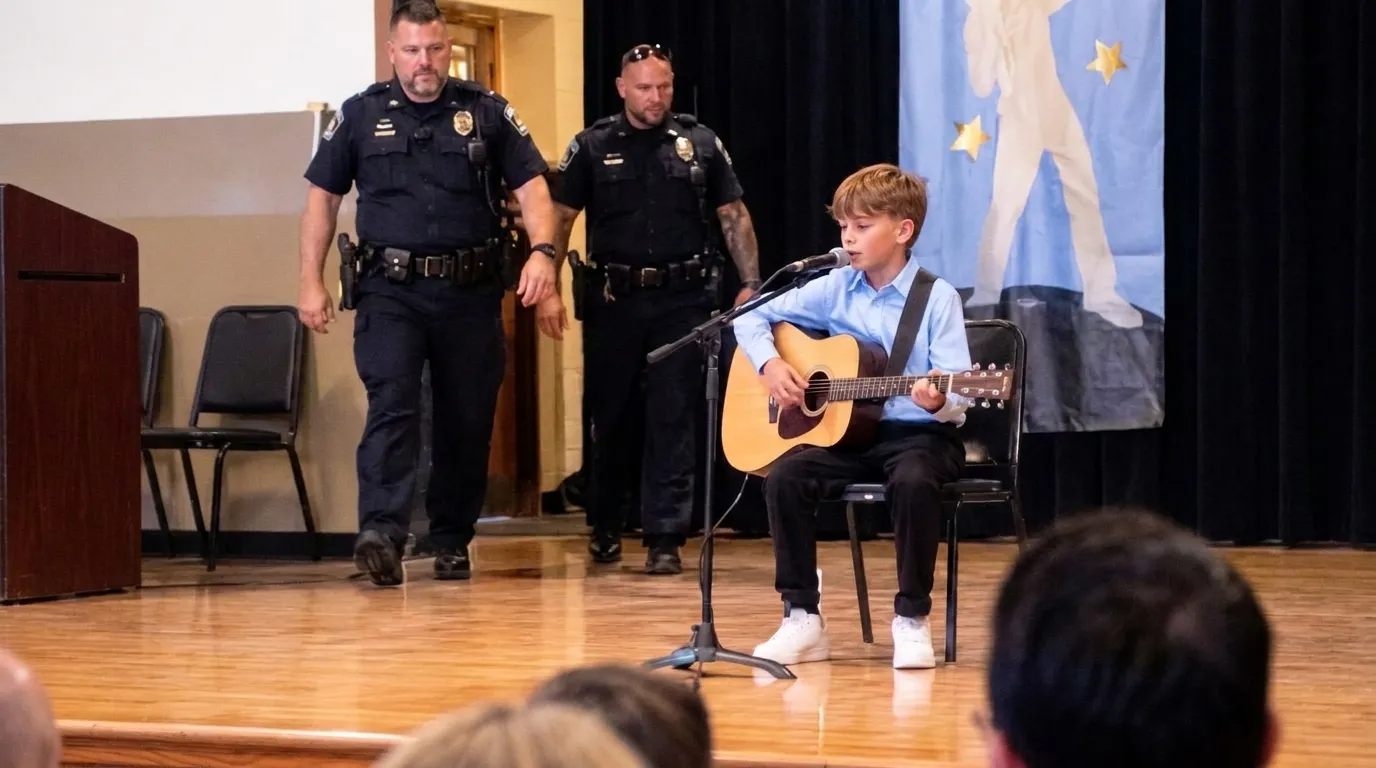
Caleb walked onto the small stage carrying David’s guitar.
Marcus was beside me.
“Think he’ll make it through?” he whispered.
“I don’t know.”
Caleb adjusted the microphone.
He looked nervous.
Then he saw me.
This time, he didn’t look toward the ceiling.
He smiled.
“This was my dad’s favorite song,” he told the room. “I used to think it made me sad because he was gone.”
He paused.
“Now I think it reminds me he was here.”
Then he started playing.
His voice didn’t break.
He didn’t stop halfway through.
When the chorus came, several people in the room quietly joined him.
I cried anyway.
Of course I did.
But Caleb didn’t.
He stood beneath those lights and sang his father’s song all the way to the end.
And for the first time in three years, watching my son remember David didn’t feel like watching him disappear into grief.
It felt like watching him come back to life.
Latest Posts
- My Husband Mocked My Postpartum Appearance in His Brothers’ Group Chat—I Stayed Quiet for Five Days
Four months after giving birth, I thought my husband understood why I hardly recognized myself. Then I discovered the cruel joke he'd been sharing with his brothers, along with photos I never knew he'd taken. I kept my discovery secret for five days, determined to make him regret every word. “Dude, you weren't exaggerating 😂” …
- My Stepdaughter Called Me the Help Until My Envelope Changed Everything
The insult came before I’d even finished setting down the peach cobbler. I’d baked it at five that morning in the kitchen of the lake cabin we’d rented, and it was still warm under the foil. The smell of cinnamon followed me across the grass toward the pavilion tables, where thirty-two members of the Cole …
- My In-Laws Gave Their Other Three Children $20,000 for Houses and Gave Us Only a Card Two Years Later, We Bought the Old Miller Place for $41,500
The envelopes were tucked under the Easter plates. Each had a name written on it in my mother-in-law’s round schoolteacher handwriting. Kim opened hers first. She’s the oldest. Divorced two years. Raising two boys in a rented trailer behind the grain elevator. She looked at what was inside the envelope and put her hand flat …
- My Mother-in-Law Told Me to Lose Weight After Giving Me a Dress That Didn’t Fit, but Minutes Later, She Regretted Everything
I couldn’t get it over my hips. I stood in my bedroom in my underwear with the dress bunched around my thighs like a deflated balloon. Midnight blue silk. A designer label I’d only ever seen in magazines. Tiny pearl buttons down the back. Beautiful. And four sizes too small. I pulled. I tugged. I …
- Teen Wore a Dress to His Best Friend’s Funeral—The Family Nearly Had Him Removed Before He Reached the Microphone
My son’s best friend read the eulogy at his funeral in a red dress. I almost had him removed before he reached the microphone. My son Jack died 17 days after his 18th birthday. Cancer. Fourteen months from diagnosis to funeral. We found out late. Too late, as it turned out, and the treatment never …