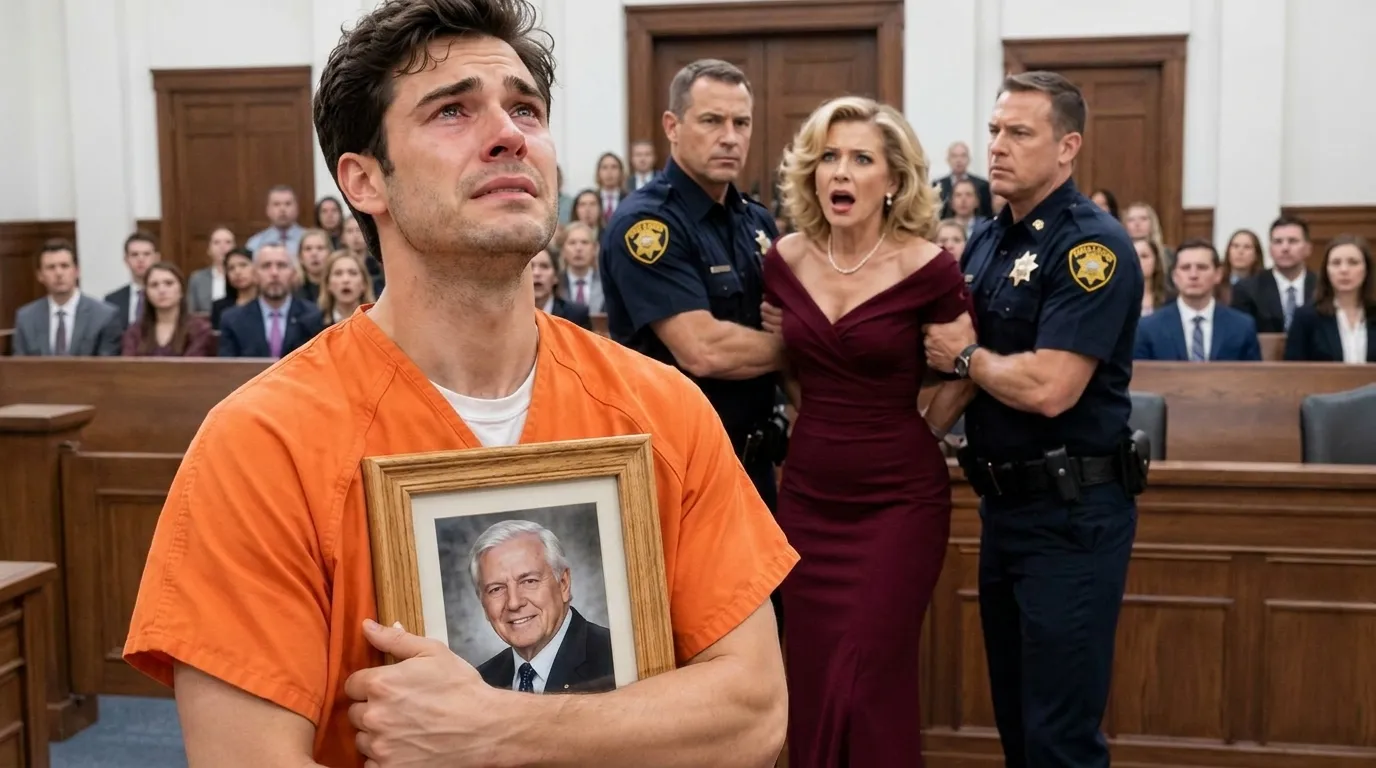
Camden Dennis was charged.
Not only for the old laundering conspiracy.
Not only for manipulating records connected to my prosecution.
But for Claire’s death and the decades of obstruction that followed.
His attorneys argued that he never intended to kill her.
That may have mattered to the exact charges.
It did not change what mattered to me.
Claire had threatened to expose him.
He drugged her.
She died.
Then he spent years rewriting the story.
Dad had always told me:
“The truth always finds a way out.”
He had been right.
He simply never expected it to come for him too.
Detective Vale’s cooperation exposed more shell companies and several officials who had protected the laundering network.
His plea did not erase the gun in our garden or the evidence he helped fabricate against me.
He received a substantial prison sentence.
Carter fought his charges longer.
He claimed Dad had made him into what he became.
Perhaps there was truth in that.
But the evidence showed Carter had willingly expanded the laundering system, threatened me, participated in my framing, and tried to arrange my death after my release.
He was convicted on multiple fraud, conspiracy, laundering, and violent-offense counts.
For once, he had nobody else’s identity available to hide behind.
Reagan’s case was harder for me.
She cooperated.
She admitted helping Carter create the false story around Dad’s death.
She admitted threatening me at the house because Carter told her my return would destroy them all.
She admitted putting something in Dad’s tea.
But investigators confirmed that Carter had supplied it while telling her it would merely make Camden too sick to attend a meeting.
Reagan had already learned enough about Claire’s death to suspect Camden was responsible.
Part of her wanted to frighten him.
Part of her wanted revenge.
Part of her was still being manipulated by Carter.
None of those things made her innocent.
She faced legal consequences for her own actions.
Before sentencing, she asked me to meet her.
I almost refused.
Then I went.
Not because she was my biological mother.
Because I wanted to understand whether biology changed anything.
It didn’t.
She sat across from me.
“You were my son before you knew I was your mother.”
I said nothing.
“I thought giving you up was the worst thing I would ever do.”
“It wasn’t.”
Her eyes filled.
“No.”
“You came back into my life and still chose fear over me.”
“Yes.”
“You stood in the doorway after I lost three years of my life and threatened to send me back.”
“I know.”
“Why?”
She looked down.
“Because if you came inside, you might have found Claire’s portrait.”
“What was in it?”
“The letter.”
“You knew?”
“Not exactly. But Carter was terrified of that portrait.”
I stared at her.
“So that’s why it disappeared.”
“Yes.”
“Why send it to Unit 108?”
“Camden did.”
Of course he had.
Dad had been curating the truth even while pretending to expose it.
Reagan whispered:
“I’m not asking you to call me Mom.”
“Good.”
“I’m not asking you to forgive me.”
“Good.”
“But I am sorry.”
I believed her.
That surprised me.
I also learned that believing someone’s remorse did not obligate me to restore a relationship.
“I hope you become better than what you did.”
She cried.
“Is that all?”
“For now.”
I stood.
“Maybe forever.”
And I left.
The house in Silver Lake became part of the civil proceedings.
Dad’s old ownership structures, Carter’s fraudulent transfers, and Reagan’s claims had to be untangled.
Eventually, the court restored the property to Dad’s estate subject to restitution claims.
As the wrongfully convicted heir and a victim of the scheme, I could have fought to keep it.
I didn’t.
I walked through it once after investigators released the property.
The gray paint.
The black door.
The marble furniture.
Almost everything familiar was gone.
Then I reached the wall where Claire’s portrait had once hung.
I stood there for several minutes.
Three years in prison had taught me that a building could hold you without owning you.
That house did not feel like home anymore.
So I sold it.
Part of the proceeds went toward resolving lawful restitution and estate obligations.
The remainder that ultimately came to me became something simpler.
A small home.
No gates.
No marble.
No room I was afraid to enter.
I hung Claire’s portrait in the hallway.
Under it, I placed Dad’s old brass clock.
Not because I forgave him.
Because history did not become safer simply by pretending it never happened.
The clock still stopped at 4:17.
I never repaired it.
My wrongful-conviction case resulted in compensation.
People congratulated me.
That always felt strange.
Money could reimburse lost wages.
Legal expenses.
Some of the practical damage.
It could not return three birthdays.
Three Christmases.
The funeral I thought I missed.
The nights I stared at a cell ceiling wondering whether my father believed I was a thief.
Compensation was not restoration.
But I accepted it.
Refusing it would not bring the years back either.
Then I did something Dad would probably have understood better than anyone.
I hired forensic accountants.
Independent ones.
We reconstructed every legitimate and illegitimate piece of Dennis Industrial Systems.
The company survived, though under court supervision and eventually new management.
I refused to become its CEO.
Instead, I sold most of my recovered interest after the investigations were complete.
For most of my life, the company had been treated like a family inheritance.
By then, I understood that inheritance could contain poison as easily as value.
One year after my release, I returned to Pinecrest Cemetery.
The same maple tree stood over Claire’s grave.
A different groundskeeper was trimming grass nearby.
No disguise.
No secret envelope.
No father waiting to reveal another lie.
I sat beside Claire’s headstone.
“I’m sorry.”
The words felt strange.
“You tried to tell the truth.”
Wind moved through the leaves.
“I wish you’d gotten to leave.”
I placed a photograph beside the stone.
Claire and me when I was ten.
Her arms around my shoulders.
Both of us laughing.
For years, I had obsessed over biological truth.
Reagan was my biological mother.
Camden was my biological father.
Carter was my biological half-brother.
None of those facts told me who had actually been a parent.
Claire had.
She packed my lunches.
Sat beside me when I was sick.
Helped with homework.
Taught me to drive.
Argued with Dad when he was unfair.
Loved me without asking what I could do for her.
Camden once told me blood mattered because family was permanent.
He was wrong.
Love was not proven by permanence.
It was proven by what someone did with the power they had over you.
Claire used hers to protect me.
Dad used his to choose for me.
Again.
And again.
And again.
Months later, I received a letter from Camden in federal custody.
I almost threw it away.
Instead, I opened it.
There were no explanations this time.
No claims that prison had saved me.
No arguments about necessity.
The first line said:
I spent my life confusing protection with control.
I kept reading.
When I was afraid, I made decisions for everyone else and called them sacrifices.
I decided Claire needed to sleep instead of leave.
I decided you needed prison instead of the truth.
I decided Reagan needed fear instead of honesty.
Then:
Every time, I told myself I was protecting my family.
I was protecting my ability to control what happened next.
I stopped reading for a moment.
Then finished.
You do not owe me forgiveness.
You do not owe me visits.
You do not owe me the role of your father simply because I am the man whose name appears on your birth certificate.
The final line was:
If you build a life after me, please build one where nobody has to lose their freedom for someone else to feel safe.
I folded the letter.
I did not answer.
But I kept it.
Not because it repaired anything.
Because for the first time, my father had written the truth without attaching a plan to it.
Two years after Oakwood, I began working with a nonprofit that helped people rebuild their lives after wrongful convictions.
At first, I handled financial records.
Credit repair.
Frozen accounts.
Employment documentation.
Housing problems.
The boring things nobody sees when someone walks out of prison.
Then one afternoon, a young man sat across from me.
He had been released after six years.
His family had disappeared.
His first question was not about money.
“Do you ever stop feeling like somebody can send you back?”
I knew exactly what he meant.
“Not immediately.”
He stared at the table.
“But?”
“But one day you realize the door isn’t locked.”
He looked up.
“And that’s enough?”
“No.”
I smiled faintly.
“But it’s a beginning.”
Three years after my release, I drove past the old Silver Lake house.
A family I didn’t know lived there now.
There were bicycles near the porch.
A dog sleeping behind the fence.
And beside the driveway—
rose bushes.
I pulled over.
For a moment, I remembered Dad tending his roses.
Claire calling us inside for dinner.
Carter laughing before either of us understood what resentment would turn him into.
Reagan entering our lives carrying secrets.
A childhood that contained love and lies in equal measure.
Then I looked at the front door.
It was no longer black.
The new owners had painted it red.
I laughed.
Not because anything was funny.
Because the house had finally stopped being ours.
That felt like freedom.
On the anniversary of my exoneration, I returned one last time to Unit 108.
The storage company was closing the building.
The manager asked whether I wanted everything cleared.
I looked around.
Dad’s chair.
Old records.
Boxes.
The video camera.
The brass clock had already gone home with me.
Claire’s portrait too.
There was nothing else I wanted.
Then I noticed the original yellow envelope on the desk.
The one Dad had arranged for me to receive at Pinecrest.
I unfolded the first page.
Son, if you’re reading this, Reagan has already started lying to you.
I almost laughed.
Dad had written the sentence as though he were the one person telling the truth.
That was the final lesson.
People rarely build their lies entirely from fiction.
Dad had been right about Reagan.
Right about Carter.
Right about Vale.
Right that I had been framed.
Right that my life had been in danger.
And still—
he had lied about himself.
Truth could be used as camouflage too.
I put the letter through the shredder.
Not because I wanted to erase him.
Because I no longer needed his instructions.
When I stepped outside, evening had settled over the parking lot.
For the first time since Oakwood, I had no key from Dad in my pocket.
No storage unit.
No hidden service door.
No secret clock waiting to open something else.
Just my own house key.
One ordinary key.
To one ordinary front door.
I held it in my palm and smiled.
Three years earlier, I had come home from prison believing freedom meant walking outside the gates.
It didn’t.
Freedom came much later.
It came when my conviction was erased.
When Carter could no longer threaten me.
When Vale could no longer rewrite evidence.
When Reagan’s biology stopped meaning obligation.
When Camden’s love stopped meaning obedience.
When I finally understood that I did not need to solve one more family secret before I was allowed to live.
I had spent years waiting for the truth to give me back the life that lies had taken.
The truth couldn’t do that.
Nothing could.
But it gave me something else.
A life that belonged to me from that moment forward.
Dad had once said:
“The truth always finds a way out.”
He was right.
It came out of the storage unit.
Out of Carter’s ledger.
Out of Claire’s hidden letter.
Out of Reagan’s confession.
Out of Dad’s own mouth.
And finally—
out of me.
I stopped carrying everyone else’s version of who Finnley Dennis was.
Not a thief.
Not an ex-con.
Not Camden’s protected son.
Not Reagan’s abandoned child.
Not Carter’s rival.
Just Finnley.
I put my own key into my own front door.
Turned it.
Walked inside.
And closed it behind me.
Not because anyone had ordered me out.
Not because someone was trying to keep me in.
But because, finally—
I was home.
THE END
Latest Posts
- My Husband Mocked My Postpartum Appearance in His Brothers’ Group Chat—I Stayed Quiet for Five Days
Four months after giving birth, I thought my husband understood why I hardly recognized myself. Then I discovered the cruel joke he'd been sharing with his brothers, along with photos I never knew he'd taken. I kept my discovery secret for five days, determined to make him regret every word. “Dude, you weren't exaggerating 😂” …
- My Stepdaughter Called Me the Help Until My Envelope Changed Everything
The insult came before I’d even finished setting down the peach cobbler. I’d baked it at five that morning in the kitchen of the lake cabin we’d rented, and it was still warm under the foil. The smell of cinnamon followed me across the grass toward the pavilion tables, where thirty-two members of the Cole …
- My In-Laws Gave Their Other Three Children $20,000 for Houses and Gave Us Only a Card Two Years Later, We Bought the Old Miller Place for $41,500
The envelopes were tucked under the Easter plates. Each had a name written on it in my mother-in-law’s round schoolteacher handwriting. Kim opened hers first. She’s the oldest. Divorced two years. Raising two boys in a rented trailer behind the grain elevator. She looked at what was inside the envelope and put her hand flat …
- My Mother-in-Law Told Me to Lose Weight After Giving Me a Dress That Didn’t Fit, but Minutes Later, She Regretted Everything
I couldn’t get it over my hips. I stood in my bedroom in my underwear with the dress bunched around my thighs like a deflated balloon. Midnight blue silk. A designer label I’d only ever seen in magazines. Tiny pearl buttons down the back. Beautiful. And four sizes too small. I pulled. I tugged. I …
- Teen Wore a Dress to His Best Friend’s Funeral—The Family Nearly Had Him Removed Before He Reached the Microphone
My son’s best friend read the eulogy at his funeral in a red dress. I almost had him removed before he reached the microphone. My son Jack died 17 days after his 18th birthday. Cancer. Fourteen months from diagnosis to funeral. We found out late. Too late, as it turned out, and the treatment never …