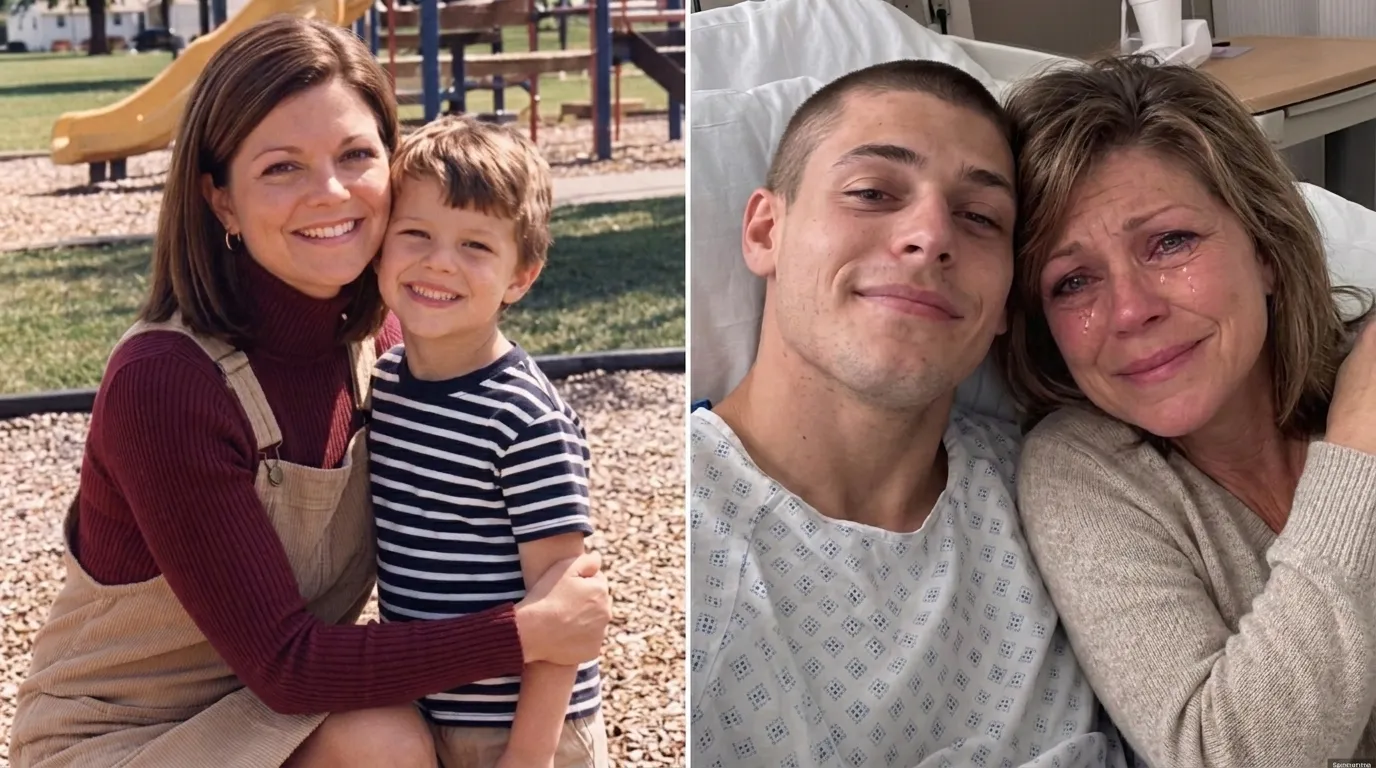
Two years after Caleb’s death, I finally sold our house.
People were surprised.
I wasn’t.
The house had become too full of ghosts.
Not frightening ghosts.
Beautiful ones.
Which were sometimes harder to leave.
Before moving, I went into Caleb’s bedroom one last time.
Most of his belongings had been packed.
His photographs remained on the wall.
I removed them slowly.
The river.
A railway station.
An old man feeding pigeons.
A little girl running through sprinklers.
Then I reached the final photograph.
I had never noticed it before.
It was a picture of our dining room.
Daniel’s empty chair stood at the head of the table.
Caleb had photographed it in afternoon light.
On the back, he had written something.
“An empty chair is only proof that somebody once sat there.”
Beneath that:
“It is not an instruction to stop inviting people in.”
I sat on the floor and cried.
Then I laughed.
“Okay, Caleb.”
I packed the photograph.
My new house was smaller.
Two bedrooms.
A tiny garden.
The dining table barely fit six.
Rebecca came for Thanksgiving.
Emma brought dessert.
Sofia brought wine.
Anthony came with his wife.
Samantha arrived late because she had worked late at school.
Noah brought flowers.
Halfway through dinner, Emma looked at the chair beside me.
It was Daniel’s chair.
The same wooden chair I had kept empty for so many years.
I had brought it with me.
But it was no longer empty.
Noah was sitting in it, arguing with Anthony about football.
I stared at the chair.
Emma noticed.
Her expression softened.
“You okay?”
I nodded.
Outside, evening light faded across the garden.
Inside, people laughed.
Plates moved around the table.
Someone spilled gravy.
Rebecca complained.
Anthony denied responsibility.
And beneath all of it, if I concentrated, I could hear Emma laughing.
Strong.
Alive.
Her hand rested casually over her chest.
Sometimes people ask whether hearing Caleb’s heart inside Emma made losing him easier.
It didn’t.
Nothing makes losing a child easier.
There are mornings when I still reach for my phone before remembering he cannot answer.
There are nights when I would trade every revelation, every lawsuit, every newspaper article, every piece of truth just to hear him shout from upstairs that we are out of cereal.
Grief does not disappear when something meaningful grows from it.
Both things exist.
The pain.
And the meaning.
I used to believe motherhood meant keeping your child safe.
Then I believed it meant refusing to let him die.
Caleb taught me something else.
Sometimes motherhood means accepting that your child has become brave enough to make choices you cannot make for him.
Sometimes love means opening your hand.
And sometimes the person you spend your whole life trying to save becomes the person who saves everyone else.
Dr. Mercer gave Caleb DNA.
That was all.
Daniel gave him a father.
I gave him a home.
And Caleb gave the rest of us something none of us expected.
Truth.
Family.
A second chance.
Before my nineteen-year-old son died, I thought his life had been stolen before it truly began.
I was wrong.
Caleb’s life did not end at nineteen.
Part of it continued every time Emma stepped onto a dance floor.
Part of it continued whenever Anthony attended another clear medical scan.
Whenever Samantha celebrated another birthday.
Whenever one of those families stopped blaming themselves for something done to them decades earlier.
Whenever I allowed another person to sit in Daniel’s chair.
And perhaps that was the final thing Caleb had been trying to teach me from the very beginning.
A heart is not valuable because it keeps one person alive forever.
No heart can do that.
A heart is valuable because of everything it sets in motion while it is beating.
Caleb’s beat for nineteen years inside my son.
Then it beat inside his sister.
But long before the surgeons carried it from one operating room to another, Caleb had already given away the most important pieces of himself.
His courage.
His forgiveness.
His stubborn belief that truth mattered.
His refusal to let strangers face terrible things alone.
Those pieces went everywhere.
And unlike a human heart, they did not have to belong to only one person at a time.
Sometimes, when Emma visits, she still catches me looking at her chest.
She rolls her eyes.
“You’re doing it again.”
“Doing what?”
“Listening without the stethoscope.”
“I am not.”
“You are.”
Then she smiles.
And every time she does, I think of the frightened eighteen-year-old girl in that hospital bed.
The stranger whose mother stood at my son’s funeral holding a letter.
The girl I almost resented simply because she had survived.
I could not have known then that Caleb had already decided what she would become to me.
Not my replacement child.
Not a living memorial.
Not a walking piece of my son.
Family.
One evening, years later, Emma and I visited Caleb’s grave.
She placed fresh flowers beside the stone.
Then she sat in the grass.
“I wish I’d had more time with him.”
“So do I.”
“He was annoying.”
“Extremely.”
“He thought he knew everything.”
“Definitely my child.”
She laughed.
Then she became quiet.
“Do you ever wonder why it worked?”
“What?”
“All of it.”
I looked at her.
“The timing. The matching. The fact that his heart could come to me.”
“Yes.”
“Do you think it was fate?”
Years earlier, I would have said yes.
I would have needed to.
Now I wasn’t sure.
“Maybe.”
Emma waited.
I looked at Caleb’s name carved into stone.
Then at the young woman beside me.
“But I think Caleb would say fate gets too much credit.”
She smiled.
“That sounds like him.”
“He did the work.”
“Yes.”
“He found you.”
“Yes.”
“He investigated Mercer.”
“Yes.”
“He made the request.”
“Yes.”
“He wrote the letters.”
Emma nodded.
I touched the top of the gravestone.
“Maybe miracles aren’t always things that happen to us.”
Emma looked at me.
“Maybe sometimes they’re things people decide to do.”
For a while, neither of us spoke.
The sun dropped behind the trees.
Emma finally stood.
“You ready?”
I looked once more at Caleb’s grave.
For years after Daniel died, leaving a cemetery felt like abandoning him.
After Caleb died, the feeling returned.
But now I understood.
Leaving was not abandonment.
Living was not betrayal.
I stood.
Emma slipped her arm through mine.
We walked toward the gate.
Halfway there, she suddenly stopped.
“What?”
She smiled mischievously.
“Race you.”
“You have had a heart transplant.”
“My cardiologist says exercise is encouraged.”
“Your cardiologist did not say race middle-aged women through cemeteries.”
“Scared?”
“Absolutely not.”
She started running.
“Emma!”
Her laughter drifted back toward me.
I followed more slowly.
And then, because life is strange and cruel and beautiful and much shorter than we imagine, I began running too.
Past the stones.
Past the grief.
Past the place where I had once believed my life had ended.
Emma reached the gate first.
She turned around, breathless, triumphant, one hand pressed against her chest.
And somewhere beneath that hand, my son’s heart was racing.
Not because he had returned.
Not because death had been defeated.
But because nineteen years had been enough for Caleb Carter to leave behind something stronger than the secret that created him.
He left behind proof that family is not determined by the blood someone gives you.
It is determined by what you choose to give each other after the truth is known.
And finally, after years of empty chairs, sealed letters, hospital rooms, graves, lies, and goodbyes, I understood what my son had known before any of us.
He had not given Emma his heart because she was his sister.
She became his sister because when he discovered she was alone and afraid, he chose not to walk away.
And that choice—not the DNA report, not Dr. Mercer, not the clinic, not biology—was the inheritance Caleb left behind.
The only inheritance that truly mattered.
Latest Posts
- My Husband Mocked My Postpartum Appearance in His Brothers’ Group Chat—I Stayed Quiet for Five Days
Four months after giving birth, I thought my husband understood why I hardly recognized myself. Then I discovered the cruel joke he'd been sharing with his brothers, along with photos I never knew he'd taken. I kept my discovery secret for five days, determined to make him regret every word. “Dude, you weren't exaggerating 😂” …
- My Stepdaughter Called Me the Help Until My Envelope Changed Everything
The insult came before I’d even finished setting down the peach cobbler. I’d baked it at five that morning in the kitchen of the lake cabin we’d rented, and it was still warm under the foil. The smell of cinnamon followed me across the grass toward the pavilion tables, where thirty-two members of the Cole …
- My In-Laws Gave Their Other Three Children $20,000 for Houses and Gave Us Only a Card Two Years Later, We Bought the Old Miller Place for $41,500
The envelopes were tucked under the Easter plates. Each had a name written on it in my mother-in-law’s round schoolteacher handwriting. Kim opened hers first. She’s the oldest. Divorced two years. Raising two boys in a rented trailer behind the grain elevator. She looked at what was inside the envelope and put her hand flat …
- My Mother-in-Law Told Me to Lose Weight After Giving Me a Dress That Didn’t Fit, but Minutes Later, She Regretted Everything
I couldn’t get it over my hips. I stood in my bedroom in my underwear with the dress bunched around my thighs like a deflated balloon. Midnight blue silk. A designer label I’d only ever seen in magazines. Tiny pearl buttons down the back. Beautiful. And four sizes too small. I pulled. I tugged. I …
- Teen Wore a Dress to His Best Friend’s Funeral—The Family Nearly Had Him Removed Before He Reached the Microphone
My son’s best friend read the eulogy at his funeral in a red dress. I almost had him removed before he reached the microphone. My son Jack died 17 days after his 18th birthday. Cancer. Fourteen months from diagnosis to funeral. We found out late. Too late, as it turned out, and the treatment never …