It started on a Sunday—the kind of quiet Sunday that feels like the whole world is moving a little slower before Monday arrives.
My name is Luke.
I’m thirty-eight, divorced, and raising my ten-year-old son, Caleb, on my own.
Caleb is the quiet type. He loves books, drawing, science, and anything that lets him disappear into his imagination. Back then, he still believed that adults were mostly fair and that family meant people who would always make room for you.
That belief started changing at a family lunch I hadn’t even planned to attend.
My younger brother, Gavin, had recently received a promotion at his corporate law firm, and he decided to celebrate at an expensive waterfront restaurant.
Gavin had always been proud of being an attorney.
Very proud.
He could somehow work the words “my firm” or “one of my clients” into almost any conversation.
His wife, Naomi, was similar in her own way. She had mastered the art of saying cruel things with a smile and then pretending everyone else was too sensitive if they didn’t laugh.
Caleb and I had planned to spend Sunday at the science museum.
Then my mother called.
“Your brother would really appreciate it if you came by, even if it’s only for dessert.”
I hesitated.
She immediately added, “Luke, he’s still your brother.”
That sentence had been used on me so many times that I already knew how the conversation would end.
So I gave in.
I put on a collared shirt, helped Caleb button his, and drove nearly forty-five minutes toward the coast.
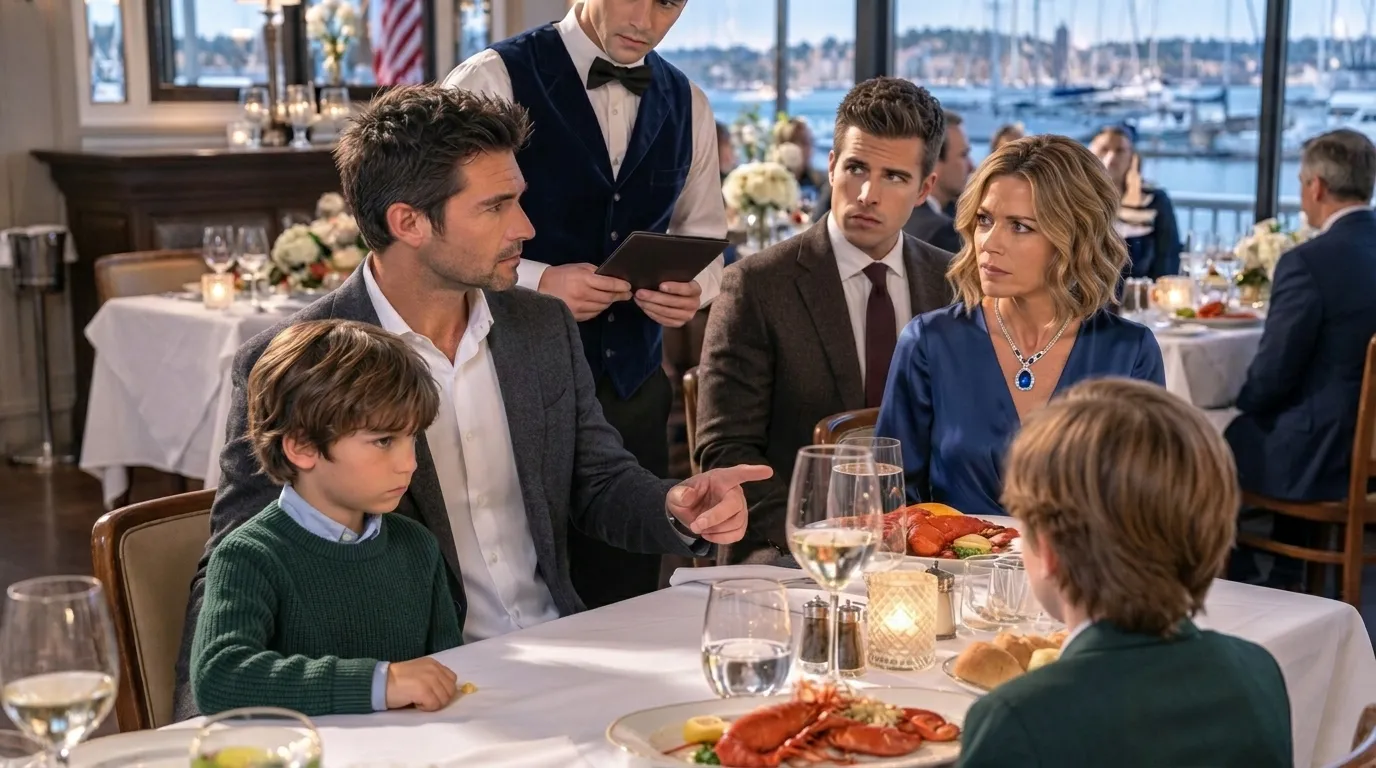
The restaurant looked exactly like the sort of place Gavin would choose.
White tablecloths.
Floor-to-ceiling windows overlooking the water.
Servers in formal uniforms.
No children’s menu anywhere in sight.
By the time we arrived, everyone else had already started eating.
The long table was covered with expensive appetizers and half-empty wineglasses.
Gavin was talking loudly near the center.
Naomi sat beside him with sunglasses resting on her head like a crown.
Their twin boys, Grant and Carter, were playing with crab legs as if they were toy swords.
My sister Jenna sat near the opposite end.
Dad was looking at his phone.
Mom waved us over.
There was only one chair left near the corner.
I pulled it out for Caleb.
Then I noticed something.
There was no plate.
No fork.
No napkin.
Nothing had been set for him.
Gavin finally noticed us.
“You actually came.”
“Mom asked me to,” I replied.
Naomi barely looked up.
“We didn’t know whether you two were coming, so we didn’t order anything for you.”
Caleb glanced at me.
The rest of the table continued eating as though nothing unusual had happened.
A waiter approached.
“Would you like a menu, sir?”
Before I could answer, Naomi spoke.
“One should be enough. Caleb probably already ate.”
Then she gave a small laugh.
“He’ll be fine. He’s used to going without.”
Nobody said anything.
A few people smiled awkwardly.
My son lowered his eyes.
He didn’t argue.
He didn’t look angry.
He simply began rubbing a tiny breadcrumb between his fingers.
That hurt more than if he had cried.
“I’d like two menus,” I said.
The waiter hesitated.
“One for the young gentleman as well?”
I looked directly at Naomi before answering.
“Yes. And bring him what I usually order when we’re at the Four Seasons.”
Suddenly, the table became very quiet.
Gavin’s expression changed.
Naomi finally looked directly at me.
I didn’t explain myself.
I simply gave Caleb a small wink.
There was something my family had never understood about me.
They thought I was struggling.
And for years, I had never bothered correcting them.
Growing up, Gavin and I had been close.
I was the older brother who helped him with homework, defended him when other kids bothered him, and occasionally took the blame when he broke something.
But somewhere between college and adulthood, our roles changed.
Gavin followed the path everyone respected.
Law school.
Corporate firm.
Expensive suits.
Professional titles.
I chose technology consulting.
I started my own company.
For several years, things were difficult.
Apparently, my family decided those early struggles defined the rest of my life.
Mom once told me, “Luke, you’ve always chosen the difficult path.”
Maybe I had.
But the difficult path eventually became profitable.
Very profitable.
I simply never advertised it.
I drove a normal car.
I didn’t wear designer clothes.
I didn’t post screenshots of business deals online.
I invested instead.
I saved.
I built.
And I focused on Caleb.
Because I didn’t display my money, my family assumed there wasn’t much to display.
I let them.
Until that lunch.
The waiter returned with silverware for Caleb and treated him with more kindness than several members of his own family had.
Caleb studied the menu carefully.
“Want to split a steak?” I asked.
“With that sauce you like?”
“Béarnaise.”
He nodded.
“Yeah.”
Gavin watched us.
“I didn’t realize you were a Four Seasons person.”
I took a sip of water.
“There are probably quite a few things about me you don’t know.”
He gave an uncomfortable laugh.
“You always did like being fancy.”
There it was.
His attempt to put me back into the role he understood.
The impractical brother.
The unusual one.
The one who supposedly never quite figured life out.
I leaned back.
“You know what I like even more?”
He waited.
“Not needing to explain myself.”
Mom immediately tried to redirect the conversation.
“Can we please not turn Gavin’s celebration into some discussion about money? He worked very hard for this promotion.”
“I agree,” I said. “He deserves to celebrate. I just wish everyone sitting here had been made to feel welcome.”
That was the moment the mood truly changed.
They didn’t like being challenged.
Especially not by me.
But I was tired of pretending the problem didn’t exist.
When the check arrived, Gavin grabbed it.
“My treat.”
“Thanks,” I said. “I’ll get the next one.”
Naomi laughed.
“There’s going to be a next one?”
I looked at her.
She stopped smiling.
Caleb and I left a few minutes later.
Halfway through the parking lot, he pulled gently on my sleeve.
“Dad?”
“Yeah?”
“Why doesn’t Aunt Naomi like us?”
I crouched beside him.
The question was far too serious for a ten-year-old.
“Some people feel more comfortable when they believe they’re better than somebody else,” I said. “But you need to understand something.”
He looked at me.
“You are not less than anybody at that table.”
He nodded slowly.
Then he took my hand.
Over the following weeks, I began noticing things I had previously trained myself to ignore.
The family group chat celebrated everything Gavin’s children did.
Soccer games.
School projects.
Birthdays.
New haircuts.
Meanwhile, Caleb brought home a nearly perfect report card.
My mother responded with a thumbs-up emoji.
That was it.
I could handle being overlooked.
I was an adult.
But Caleb was beginning to notice.
Then Gavin and Naomi announced a family weekend in the mountains.
They had rented an eight-bedroom cabin surrounded by pine forest.
Naomi sent a cheerful message to the family group.
There would be wine by the fireplace.
Games.
A scavenger hunt for the children.
A full weekend of “family memories.”
Everyone was invited.
My parents.
Jenna and her fiancé.
Our uncle.
Gavin and Naomi’s twins.
Caleb and me.
I messaged Naomi privately.
“Anything you want us to bring? Food? Snacks?”
She replied almost immediately.
“We should have everything. Maybe bring some books for Caleb. He’s not really an outdoors kid anyway, right?”
I ignored the comment.
We arrived Friday evening.
The cabin was beautiful.
Huge windows overlooked the mountains.
There was a stone fireplace in the living room and enough bedrooms for everyone.
The kitchen looked fully stocked.
Then Caleb opened the refrigerator.
One shelf had been labeled:
GRANT AND CARTER—KIDS’ SNACKS.
Juice.
Cheese.
Fruit.
Granola bars.
Caleb quietly closed the door.
I caught Naomi watching him.
“Should we have brought food specifically for Caleb?” I asked.
“Oh, no,” she said casually. “Those labels are just so the twins don’t argue. Caleb can find something in the pantry.”
I checked.
There were some old rice cakes and two cans of lentils.
That evening, Gavin grilled an enormous seafood dinner.
Salmon.
Scallops.
Lobster.
The entire place smelled incredible.
Caleb sat beside me.
As plates were passed around, Naomi stopped when she reached him.
“Oh. I forgot. Does he even eat seafood?”
“He does.”
She looked down at the remaining food.
“Well, Gavin portioned everything out already. Maybe Caleb can share something with somebody.”
Gavin barely reacted.
Then Naomi smiled.
“He’ll survive. Like I said before, he’s used to going without.”
This time, a few people actually laughed.
I looked at my son.
Again, no reaction.
That frightened me more than tears would have.
He was getting used to being humiliated.
I stood.
“I’ll be back.”
Gavin looked confused.
“Where are you going?”
“Getting dinner.”
I drove thirty minutes into town.
I found the best steakhouse I could.
I ordered two filet mignons, mashed potatoes, asparagus, and cheesecake.
Then I drove back.
Naomi wrinkled her nose when I entered carrying the bags.
“What did you buy?”
“Dinner.”
“For whom?”
“My son.”
I plated everything for Caleb and sat beside him while he ate.
Nobody said much.
But after that, the atmosphere changed.
The remarks became less subtle.
The twins started teasing Caleb whenever they thought I couldn’t hear.
They mocked his books.
His clothes.
The way he spoke.
At one point, I walked into the hallway and saw them throwing Caleb’s sketchbook between them.
“Did you get this from a thrift shop?” one of them laughed.
Caleb simply reached out and took it back.
I confronted Gavin.
“They’re bullying him.”
He shrugged.
“They’re kids, Luke.”
Naomi added, “Maybe Caleb should learn to defend himself. If he reacted differently, they might leave him alone.”
I almost packed our bags that night.
But Caleb asked me not to.
“Can we stay until Sunday? I want to finish the big puzzle.”
So we stayed.
Later, I found him curled under the blankets holding his sketchbook against his chest.
The following afternoon, Naomi organized the scavenger hunt.
For the first time all weekend, Caleb looked excited.
He grabbed a pencil and headed toward the door.
Naomi stopped him.
“Oh, Caleb, the teams are already made.”
He looked around.
“Can I just do it by myself?”
“That wouldn’t really be fair. Everyone else already started.”
“I don’t care if I win.”
She smiled.
“Maybe next time.”
I stepped forward.
“Let him participate.”
Naomi shrugged.
“House rules.”
Caleb walked outside and sat alone on the back deck.
I watched him staring into the trees.
Then I walked over to Gavin.
“We’re leaving.”
He rolled his eyes.
“You’re seriously doing this again?”
“I’m doing what I should’ve done months ago.”
“You’re overreacting.”
“No. I’ve been underreacting for years.”
He smirked.
“So you’re going to pack up and storm out because Caleb didn’t get to play a game?”
I looked him straight in the eye.
“No. I’m going to make sure I never forget what happened here.”
He laughed.
He thought it was another dramatic statement.
It wasn’t.
I packed the car before sunrise the following morning.
Caleb barely spoke.
Halfway down the mountain, I heard him from the back seat.
“Dad?”
“Yes?”
“Did I do something wrong?”
I pulled the car over.
For several seconds, I couldn’t answer.
“No.”
My voice cracked despite my effort to control it.
“You didn’t do anything wrong.”
“Then why don’t they want me there?”
I turned around.
“They’re the ones who got this wrong, Caleb. Not you.”
He nodded.
But I could see that he wasn’t convinced.