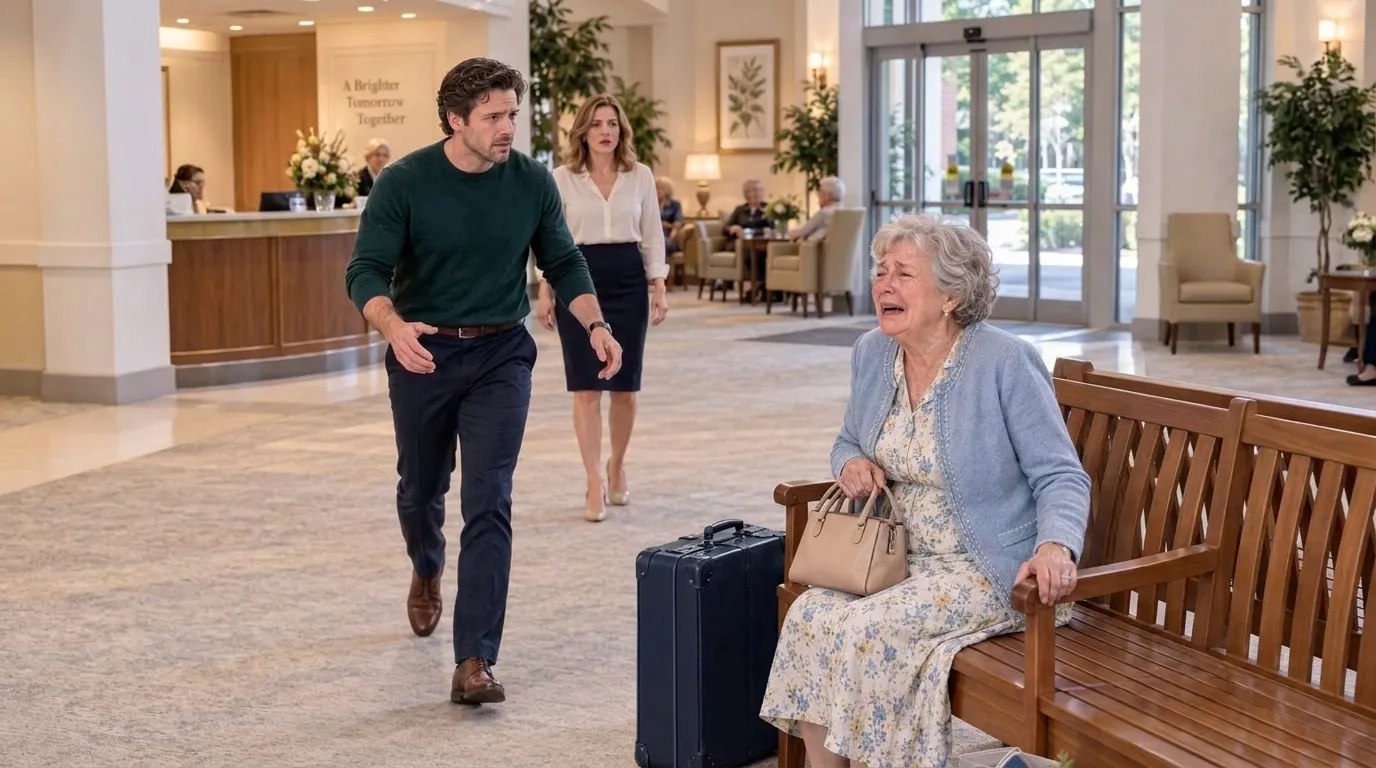
The silence inside Grandma Eleanor’s house felt heavier than any argument.
My father stood in the middle of the living room looking at the woman who had raised him.
The woman who packed his lunches.
The woman who sat beside his hospital bed when he had pneumonia at eleven.
The woman who had given him everything she could.
And somehow, years later, he had convinced himself that leaving her alone in a nursing facility was an act of responsibility.
That was the part I struggled to understand.
People rarely become cruel overnight.
First, they create a story that makes what they are doing sound reasonable.
My father’s story was simple.
He wasn’t abandoning Grandma.
He was “making arrangements.”
He wasn’t taking money.
He was “handling expenses.”
He wasn’t taking control.
He was “helping.”
But Grandma knew the difference.
Now everyone else did too.
My father looked at the property papers.
Especially the one bearing my name.
His expression changed.
Not because he was hurt.
Because he understood he had lost control.
“You knew about this?” he asked Grandma.
“Yes.”
“How long?”
“Long enough.”
His face tightened.
“You let me believe you were helpless.”
Grandma almost smiled.
“No, Arthur.”
She shook her head.
“You let yourself believe I was helpless.”
That sentence landed harder than anything else.
Because it was true.
My father had spent months underestimating the woman who had survived decades before him.
My mother finally spoke.
“Ivan, your father was under pressure.”
I looked at her.
“Pressure?”
She wiped her eyes.
“The house. Repairs. The business.”
“So you decided Grandma should pay?”
“No. We thought she would want to help.”
Grandma looked directly at her.
“Did you ask me?”
Silence.
That was the answer.
They hadn’t asked.
Because asking would have given Grandma the right to say no.
And apparently they could not risk hearing it.
The next morning, Grandma and I met with an attorney.
Not because she wanted revenge.
That surprised me.
I expected anger.
I expected her to want my father punished.
Instead, she wanted protection.
“I don’t want my son destroyed,” she told the attorney.
I looked at her.
“After everything?”
“He is still my son.”
That was Grandma.
Even after being hurt, she refused to become cruel.
“But,” she continued, “I will not allow him to hurt me again.”
The attorney nodded.
“Then we will make sure all authority is revoked and address the unauthorized withdrawals.”
Grandma signed the documents.
Her hand did not shake.
The investigation took several weeks.
Slowly, the truth came out.
The withdrawals were not accidental.
The renovation expenses were not misunderstandings.
The nursing-facility visit was not spontaneous.
My parents had researched facilities.
Packed Grandma’s medications.
Prepared a story about her “declining independence.”
They were trying to convince everyone that they were acting in her best interest.
But there was one problem.
Evidence.
Bank records.
Emails.
Receipts.
Security footage from the facility.
The very things they had used to organize their plan became the things that exposed it.
Three months later, my father came to my apartment.
Not angry.
Not defensive.
Just tired.
I opened the door.
He looked older.
“Can we talk?”
I stepped aside.
We sat quietly.
For several minutes, neither of us spoke.
Finally, he said:
“I made a mistake.”
I looked at him.
“A mistake?”
He nodded.
“Yes.”
I waited.
“I thought I was doing what was necessary.”
There it was again.
Necessary.
The same word people use when they want a choice to sound unavoidable.
“Dad.”
He looked at me.
“You didn’t make one mistake.”
His expression changed.
“You made a series of choices.”
He looked down.
“You chose not to ask Grandma.”
Silence.
“You chose to use her money.”
Silence.
“You chose to leave her somewhere she had not agreed to live.”
His eyes filled.
“And you chose to lie afterward.”
He whispered:
“I was scared.”
That surprised me.
Because it was the first completely honest thing he had said.
“Of what?”
He looked away.
“Of failing.”
For the first time, I saw my father differently.
Not as a monster.
As a man who had spent years chasing an image.
The successful son.
The responsible husband.
The man who always had an answer.
And when life became difficult, instead of admitting he needed help, he took it from someone he believed was easier to control.
Except Grandma had never been weak.
She had simply been kind.
And he had confused kindness with permission.
A year later, Grandma moved in with me.
Not because she couldn’t live alone.
Because she wanted to.
That distinction mattered.
Every morning, she sat near the window drinking tea.
Every afternoon, she walked around my neighborhood.
Every Sunday, she cooked too much food and complained that I was too thin.
Some things never changed.
One evening, I found her looking through old photographs.
She held one of Grandpa.
“You know something?”
“What?”
“He would have been very proud of you.”
I smiled.
“Because I brought you home?”
She shook her head.
“No.”
Then she looked at me.
“Because you listened.”
I didn’t understand.
She continued.
“Most people only hear what they want.”
She paused.
“You heard the truth even when it hurt.”
My relationship with my father took years to repair.
Not months.
Years.
Because trust is not rebuilt through one apology.
It is rebuilt through behavior.
Slowly, he started showing up.
Not with gifts.
Not with excuses.
With actions.
He visited Grandma.
He helped when she wanted help.
He apologized more than once.
Eventually, Grandma allowed him back into her life.
Not because she forgot.
Because she believed people could change.
But she never gave him control over her affairs again.
And that became one of the most important lessons she ever taught me:
Forgiveness does not require returning someone’s power over you.
Five years after the nursing facility called me, Grandma celebrated her ninety-first birthday.
The whole family gathered at my house.
Including my father.
Including my mother.
Including people who once treated Grandma as though age had made her fragile.
She stood in the center of the room holding her birthday cake.
Then she laughed.
A real laugh.
The kind that filled the room.
She looked at me.
“Ivan.”
“Yes?”
“Do you remember the day you picked me up?”
“I remember.”
“You drove all that way without knowing what you would find.”
I nodded.
She smiled.
“That was the day I knew I had chosen correctly.”
“Chosen what?”
She looked around the room.
“My family.”
People sometimes asked why I drove 190 miles that day.
Why I didn’t wait.
Why I didn’t assume everything was fine.
The answer was simple.
Because family is not merely the person who shares your last name.
Family is the person who shows up when nobody else does.
My parents thought they were removing a problem.
They thought Grandma was something to manage.
Something inconvenient.
Something standing between them and what they wanted.
But they forgot something.
A person’s worth does not disappear because they grow older.
A person does not become disposable because they need help.
And love is not measured by how much someone can give you.
It is measured by what you do when they need something from you.
On Grandma’s ninety-fifth birthday, she handed me a small envelope.
Inside was the original letter my grandfather had written.
The one hidden years earlier.
At the bottom was one final sentence I had never noticed.
It said:
“The greatest inheritance I can leave is not this house.”
Then:
“It is knowing who will protect it when I am gone.”
I looked at Grandma.
She smiled.
“You understand now?”
I nodded.
I did.
The house had never been the important thing.
The money had never been the important thing.
The deed had never been the important thing.
The important thing was knowing that when someone you love is abandoned, you do not ask whether helping them is convenient.
You do not ask what you will receive in return.
You simply go.
You drive the 190 miles.
You open the door.
And you bring them home.
Because sometimes the greatest thing you can inherit is not property.
It is the trust of someone who knows you will never leave them behind.
THE END
Latest Posts
- My Husband Mocked My Postpartum Appearance in His Brothers’ Group Chat—I Stayed Quiet for Five Days
Four months after giving birth, I thought my husband understood why I hardly recognized myself. Then I discovered the cruel joke he'd been sharing with his brothers, along with photos I never knew he'd taken. I kept my discovery secret for five days, determined to make him regret every word. “Dude, you weren't exaggerating 😂” …
- My Stepdaughter Called Me the Help Until My Envelope Changed Everything
The insult came before I’d even finished setting down the peach cobbler. I’d baked it at five that morning in the kitchen of the lake cabin we’d rented, and it was still warm under the foil. The smell of cinnamon followed me across the grass toward the pavilion tables, where thirty-two members of the Cole …
- My In-Laws Gave Their Other Three Children $20,000 for Houses and Gave Us Only a Card Two Years Later, We Bought the Old Miller Place for $41,500
The envelopes were tucked under the Easter plates. Each had a name written on it in my mother-in-law’s round schoolteacher handwriting. Kim opened hers first. She’s the oldest. Divorced two years. Raising two boys in a rented trailer behind the grain elevator. She looked at what was inside the envelope and put her hand flat …
- My Mother-in-Law Told Me to Lose Weight After Giving Me a Dress That Didn’t Fit, but Minutes Later, She Regretted Everything
I couldn’t get it over my hips. I stood in my bedroom in my underwear with the dress bunched around my thighs like a deflated balloon. Midnight blue silk. A designer label I’d only ever seen in magazines. Tiny pearl buttons down the back. Beautiful. And four sizes too small. I pulled. I tugged. I …
- Teen Wore a Dress to His Best Friend’s Funeral—The Family Nearly Had Him Removed Before He Reached the Microphone
My son’s best friend read the eulogy at his funeral in a red dress. I almost had him removed before he reached the microphone. My son Jack died 17 days after his 18th birthday. Cancer. Fourteen months from diagnosis to funeral. We found out late. Too late, as it turned out, and the treatment never …