We still didn’t tell anybody.
By then it wasn’t a rule so much as a habit. And there was a little pride in it too. I’ll own that.
I wanted to hand them a finished thing. I wanted to say, “Come to dinner.” And give them an address.
It was a long, long way from finished.
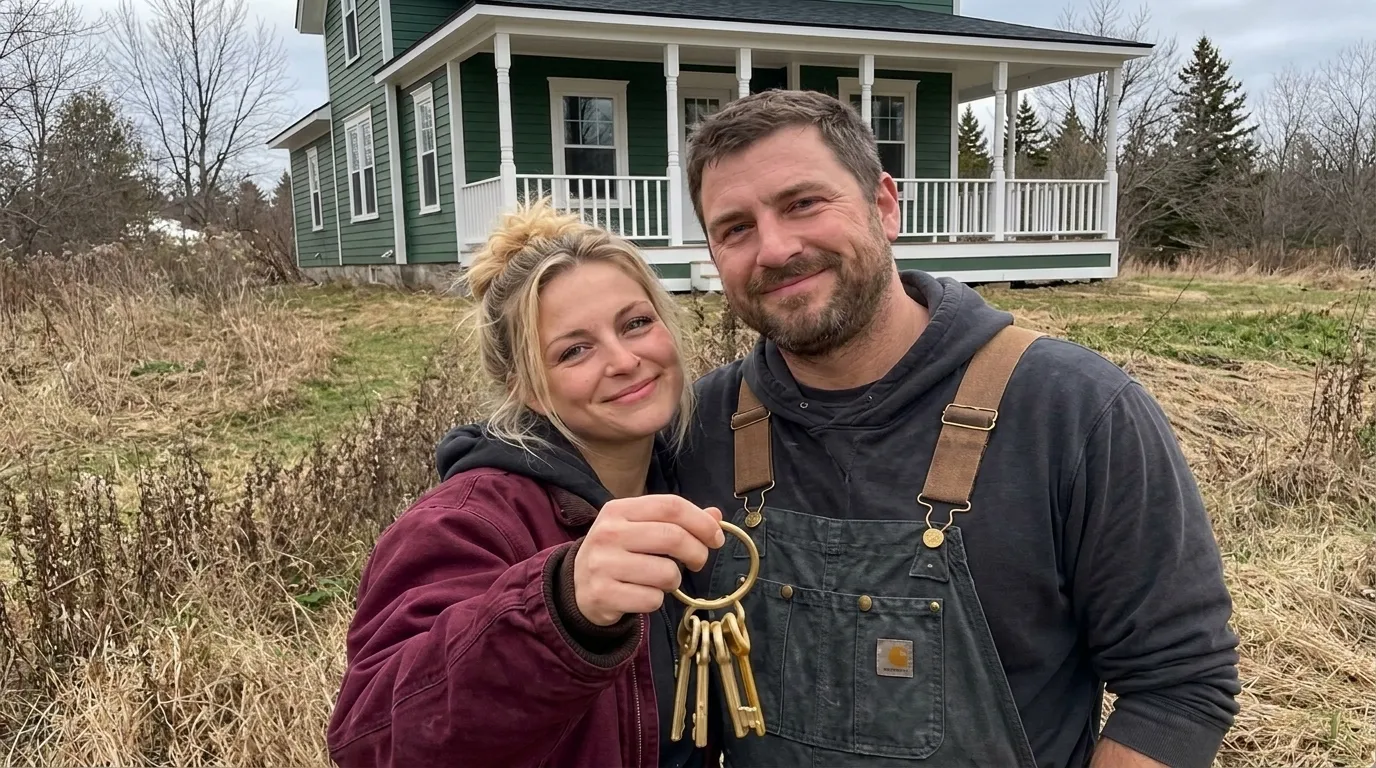
The fourth key opened the front door.
Inside, it smelled like mice and wet plaster and somebody’s old pipe tobacco. There was a calendar from a seed company still hanging on the kitchen wall. Turned to a July six years gone.
The wallpaper in the front room was coming down in long sheets all by itself.
The fuse box was in the cellar stairwell. Sixty amps for the whole house.
When Nate unscrewed the first fuse, there was a penny jammed in behind it.
“Well,” he said. “That’s one way.”
Behind the plaster walls, it was all knob-and-tube wiring. Cloth-covered wire run through little porcelain knobs. Eighty or ninety years old. Brittle as a cracker.
Nate did two years in the electrical program at the vocational school before he ever switched over to diesel.
He went down to the county office and pulled a homeowner’s permit. He bought a brand-new two-hundred-amp panel with the first paycheck after the sale.
And then he rewired that entire house at night.
He’d come off his shift at five o’clock. Eat whatever I’d packed in a cooler for him. And work until eleven with a headlamp on. Because of course there was no power in the house at all. Just one temporary pole out in the yard.
Room by room.
He drilled the old wall studs. They were true two-by-fours, oak, hard as iron. He pulled new cable through them and stapled it neat as a seam.
I never once saw him hurry a staple.
I pulled wallpaper.
There were five layers of it in the front room. And under the very last layer, somebody had written a column of numbers on the bare plaster in pencil. Somebody adding up sums a long time ago.
I pulled wallpaper until my thumbs cracked. Then I taped them up and went to my shift at the diner. And I came back.
I was still working both jobs. The house had taken nearly every dollar we had.
Wire costs money. So does a new well pump. And a septic man. And a dumpster.
There was one night in May when I sat down on an overturned five-gallon bucket in what was going to be the kitchen. Just to rest my feet for one minute.
I woke up an hour later with my cheek pressed against the plaster wall. And Nate’s work jacket over my shoulders.
He hadn’t woken me up.
He was up on the ladder six feet away, still working. With his headlamp turned down low.
The county inspector came out the first week of June.
He was a quiet man named Larry. He went through the whole house with a flashlight and didn’t say ten words. At the end he signed the inspection card and stuck it in the front window.
“Who’d you say did this?” he asked Nate.
“I did.”
“Hm,” Larry said. “You want a job?”
The power company set the meter that Friday.
Nate threw the main breaker.
And I stood in the kitchen and flipped the switch.
And one bare light bulb came on. Hanging over the spot where a kitchen table ought to go.
That same week, my phone rang at my desk at the hospital.
“Emily. This is Opal.”
Opal is Nate’s grandmother. Ron’s mother.
She was eighty-eight years old. She lived in the senior apartments behind the Methodist church. She did her own laundry. And she read the county paper front to back every single day with a magnifying glass. Legal notices included.
I’d always been a little afraid of Opal. She was a small, upright woman who didn’t chatter.
“Opal? Is everything all right?”
“The paper finally printed the trustee’s sales,” she said. “It says Schafer, Nathan and Emily, bought a house and two and three-tenths acres on the north road.”
There was a pause.
“Is that the Miller place?”
I looked around the billing office like somebody might be listening.
“Yes, ma’am. We haven’t told anyone yet. We wanted to get it fit to see first.”
She didn’t say anything for so long I thought the line had dropped.
“Come get me Sunday after church,” she said. “And don’t tell Ronald.”
“Opal, it’s not safe yet. The porch is bad. There’s plaster down everywhere.”
“I have walked on worse,” she said.
And she hung up.
So that Sunday, I pulled up in front of the Methodist church at a quarter past eleven.
Opal came down the walk in her navy blue dress and her good shoes. Her pocketbook hung on her wrist. She let me help her up into the truck.
She didn’t say one word the whole way out.
Six miles. She held that pocketbook in her lap with both hands and looked straight out the windshield.
When I turned in at the lane, she made a small sound.
I thought it was the ruts.
Nate was waiting in the yard. He’d cut the weeds back and laid two planks across the worst part of the porch.
He came over to help her out of the truck. She lifted her hand.
“I can manage steps, Nathan.”
She wouldn’t take my arm either.
She went up those planks slowly, with her hand on the porch post. She went in through the front door.
And here’s the thing I noticed. The thing I couldn’t account for.
She didn’t look around the way a visitor looks around.
She walked straight through the front room. Turned left. Then right. Through a doorway we hadn’t even hung a door on yet.
Like her feet already knew exactly where the kitchen was.
She stopped right in the middle of it. Under that one bare light bulb.
She looked at the window over the spot where the sink used to be.
She looked at the door to the little room off the kitchen. The one we’d been calling the back bedroom.
Then she went to the pantry. And she put her hand flat on the inside of the door frame, where the old varnish had gone nearly black.
And she began to cry.
There wasn’t any noise to it. Her face didn’t even change much. The tears just ran down her face, and she let them.
I’d known that woman eleven years. I’d never once seen her cry. Not even at her own husband’s graveside service, which the family still talks about.
“Opal,” I said. “What is it? Do you need to sit down?”
She was running her thumb down the wood. Feeling for something.
About four feet off the floor, her thumb stopped.
“Emily,” she said. “Did nobody ever tell you whose house this was?”
“The Millers’,” I said. “Dale Miller’s.”
“The Millers bought this house at a sale in the fall of 1961,” Opal said. “They got it for a good deal less than it was worth. They were decent people about it. And I never held it against them.”
She took a breath.
“Before that, it was Henry Brandt’s. My father’s. He built that porch himself. With his own hands.”
She looked at the little room off the kitchen.
“I was born in that room right there. In March of 1937. With a neighbor woman for a midwife. Because the roads were mud up to the axles, and the doctor couldn’t get out.”
Nate had come to the kitchen doorway.
He was standing there with his cap in his hand.
“Bring your light, Nathan,” Opal said. “Hold it here.”
He put his headlamp up to the door frame where her thumb was.
There were pencil marks in the varnish.
A whole ladder of them. Short level lines, one above another. Each one with a date next to it in a man’s square printing.
I’d scrubbed right past them a dozen times. I thought they were scratches.
Nate read them out loud. His voice wasn’t steady.
“Opal, six years, 1943.”
He moved the light up.
“Opal, nine years. Opal, twelve.”
He moved the light down. Near the bottom. There was one more line. Lower than all the others. In a different handwriting. A woman’s.
“Ronnie,” Nate read. “Four years. 1960.”
“I made that one,” Opal said. “The next year, we were gone.”
She told the whole story standing up. She wouldn’t sit down until it was told.
Her father died in 1957. He left the farm to her and her husband, Walt Schafer. Nate’s grandfather. A hundred and sixty acres and this house.
Walt was a hard worker. He wanted to do better than his father-in-law had done. He borrowed against the farm for a new tractor and a hog building.
Then came two bad years. One right behind the other. A sickness went through the hogs. And the bank called the note.
“They sold it right on the courthouse steps,” Opal said. “The same steps you two stood on.”
She looked out the kitchen window.
“Walt stood out there in the yard the week after, while they auctioned off all the machinery. I stood right here in this kitchen so I wouldn’t have to watch. And Ronald was five years old. He stood out there holding his father’s hand the entire time.”
She pointed at the window.
“I could see the two of them. Right through that glass.”
“Dad never said a thing,” Nate said. “Not one time. We drove past this house every single Sunday of my life on the way to Aunt Carol’s.”
“Your father has not turned his head toward this house since he was five years old,” Opal said. “Watch him sometime. He looks at the other side of the road. Walt did the same until the day he died.”
She shook her head slowly.
“They decided it was a shame. And they buried it. And I let them. Because back then, a man’s pride was about all he had left.”
She put her hand on the pencil marks again.
“I am eighty-eight years old,” she said. “I had made my peace that I would never stand in my mother’s kitchen again.”
She looked at Nate. Then at me.
“And you two children went and bought it with your own money. And told no one.”
She looked down at the tape on my thumbs.
“Whose money was it? Not Ronald’s.”
“No, ma’am,” I said. “Ours. Two years of it.”
“I heard about the envelopes,” Opal said. “At Easter. I told Ronald at the time exactly what I thought about it. He said you two didn’t need it.”
“We didn’t need it,” Nate said quietly. “That’s not the same as not wanting to be thought of.”
Opal nodded. Once. The way you’d nod at a child who just got a hard math problem right.
Then she let me bring her the bucket. And she sat down on it, in her good navy dress, in the middle of her mother’s kitchen.
And Nate knelt down on that filthy floor and put his arms around her.
I went out onto the porch planks and looked at that red clump by the cistern for a while.
It was rhubarb.
Opal told me later. Her mother planted it there in 1931.