The gravel beneath the tires of my Audi didn’t crunch so much as hiss, a low, grinding sound that matched the steady humming inside my temples.
In the rearview mirror, the vineyard estate of Saint-Père dwindled into a smear of manicured cypress trees and white party tents glowing under the amber wash of late-afternoon sun.
From two miles down the ridge, it looked like heaven.
From inside the car, smelling the faint chemical bite of new leather and feeling the cold metallic tang of my own adrenaline, I knew it was a place of ruin.
My phone vibrated against the passenger seat.
Not a polite buzz, but the violent, relentless shudder of an incoming deluge.
Mark (3)
Mark (7)
Mark (12)
Linda (1)
Arthur Bell (1)
I didn’t touch the device.
I watched it dance toward the edge of the stitched leather console until the screen went dark for two seconds, only to light up again with Linda’s contact photo.
It was a portrait taken three summers earlier in Martha’s Vineyard, where she wore a broad-brimmed linen hat and smiled with all thirty-two of her pristine, porcelain-capped teeth.
A woman who had spent forty-eight years refining the exact angle at which her head should tilt to make cruelty look like maternal patience.
Let it ring.
The first stage of a catastrophic loss is always panic; the second is denial.
I wanted them firmly rooted in the second before Arthur delivered the third.
I turned off the state highway onto the narrow, unlit blacktop that cut through the valley toward the eastern reservoir.
My father, Julian Vance, had built his life on land.
Not the kind of land you put brochures on. Not golf courses or boutique tasting rooms where tourists paid forty dollars to swish fermented sugar water around their gums.
Julian bought dirt that had things underneath it: water rights, limestone seams, telecommunication easements, and forgotten municipal utility deeds drafted during the New Deal that modern city planners had been too lazy to renegotiate.
“People who buy what’s pretty are always at the mercy of people who buy what’s necessary, Rachel,” he told me once, sitting on the screened porch of the old stone house in Rhinebeck, peeling an apple with an ivory-handled pocketknife.
He had sliced off a translucent ribbon of red skin without breaking it once.
“Your mother buys wallpaper. I buy the wall.”
For eleven years, I had forgotten that lesson.
I had let Mark Vance—born Mark Miller, who took my name at the altar under the guise of feminist solidarity, but in reality because the Vance name opened boardroom doors in Manhattan that his state-college degree couldn’t unlatch—convince me that I was fragile.
He had spent a decade softening me, murmuring about my “delicate nerves,” handling the financial transfers because spreadsheets “triggered my grief” after Dad died.
Eventually, I was so untethered from the family machinery that when he pushed me out, I fell without catching a single branch.
Now, my hands were steady on the wheel.
No tremor.
No tears.
Betrayal is an acid that either dissolves you or strips away the corrosion until only the iron remains.
At 7:15 p.m., I pulled into the gravel drive of the Bell & Hawthorne law offices, housed in a converted Federal-style brick building off the town green in Hudson.
The second-floor windows were squares of warm yellow light against the falling dusk.
Arthur was waiting.
He didn’t greet me with a kiss on the cheek or an expression of sympathy.
When I walked into the library—walled with leather-bound legal reporters smelling of dried glue, aged calfskin, and faint pipe tobacco—the old man was seated behind an oak partner’s desk.
A half-empty glass of rye sat atop a stack of blue-backed court motions.
“You left early,” Arthur said without looking up from a typed docket sheet.
His silver hair was cropped military-short, his shirt sleeves rolled twice to reveal forearms corded like dry cedar.
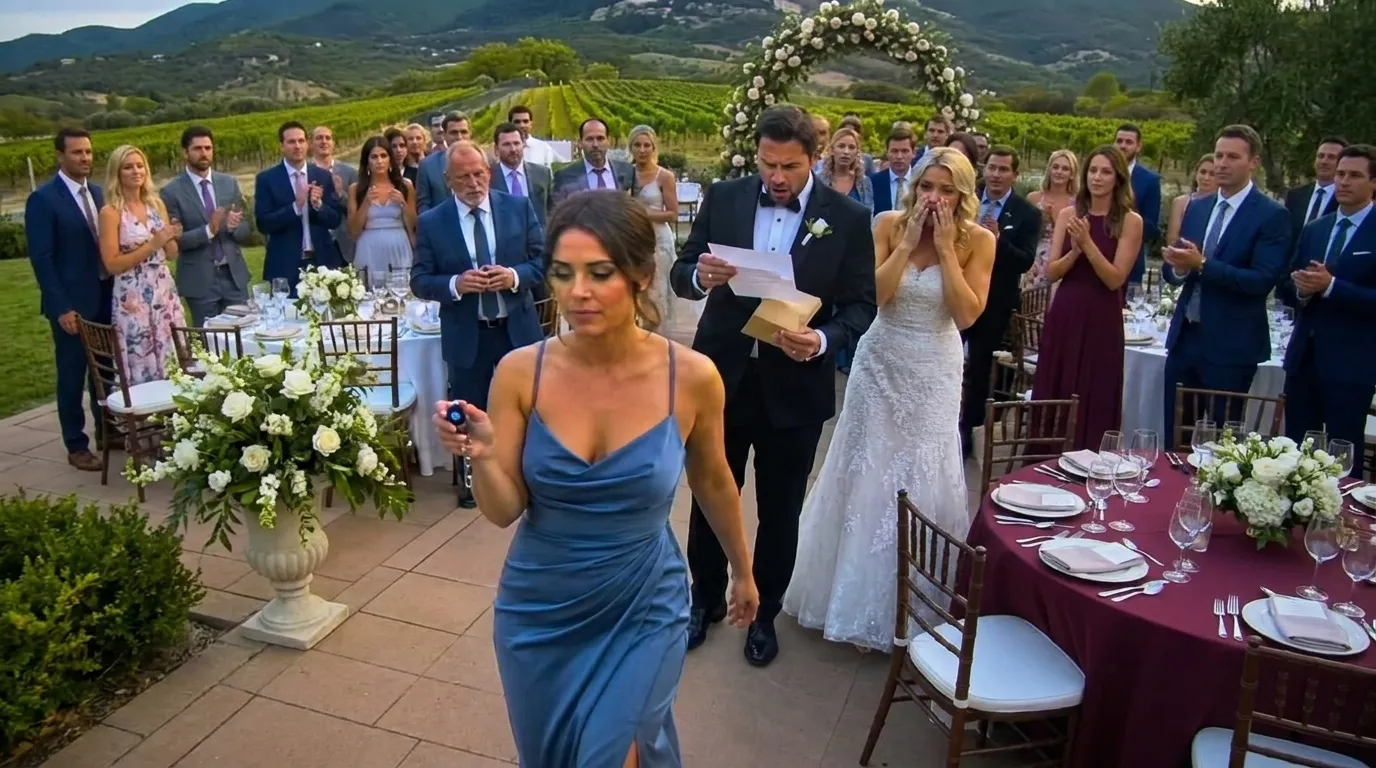
“I saw the drop,” I said, sliding into the oxblood leather wingback opposite him. “Mark dropped the pages in her duck.”
Arthur’s mouth twitched—the closest he ever came to an outright belly laugh.
“A waste of good duck. The caterer is furious, by the way. He called our liaison fifteen minutes ago.”
He glanced up.
“Apparently, when Mr. Miller tried to use the black card to pay for the overtime bar service, the machine spit out a decline code 05. Do you know what code 05 is, Rachel?”
“Do not honor.”
“Do not honor,” Arthur repeated softly, savoring the syllables. “A beautifully ambiguous phrase. It implies moral judgment from a computer server in Omaha.”
“What about the house?”
Arthur picked up a silver fountain pen, tapping the brass nib against his blotting pad.
“The locksmiths arrived at seven sharp, accompanied by two off-duty sheriff’s deputies executing the order of emergency possession.”
He continued in the same measured voice.
“Linda’s personal effects—and only her personal effects, defined strictly as garments, toiletries, and non-trust-purchased personal jewelry—are being boxed in standard U-Haul containers and stacked neatly in the carriage house.”
“The carriage house remains unlocked. The main residence, however, has had its deadbolts replaced with Medeco high-security cylinders, the digital keypad codes wiped, and the private security perimeter activated.”
I closed my eyes for a single heartbeat.
The stone house.
The wide-plank pumpkin pine floors my father had hand-planed in 1984.
The library with the smell of his pipe.
The garden where he had buried two golden retrievers under the lilac bushes.
Linda had threatened to sell it to an investment group that wanted to turn it into an upscale corporate retreat center.
During our final court mediation, she had told me, “A house that large is simply morbid for a single, childless woman, darling. Mark and I need space to breathe.”
“Did they try to enter?” I asked, opening my eyes.
“They haven’t arrived yet,” Arthur said, checking a gold pocket watch he pulled from his vest.
“According to our spotter at the vineyard, the wedding party collapsed into what can only be described as a public brawl around six-thirty.”
He paused.
“Mark’s brother tried to punch the wedding coordinator when she shut down the sound system. Linda broke a heel trying to pursue the photographer, who was packing his lenses because his second-half deposit had bounced.”
“They left the vineyard thirty minutes ago in Mark’s leased Mercedes. They are likely twenty minutes out from Rhinebeck.”
“And the firm?”
Arthur leaned back, the leather creaking beneath him.
He took a slow sip of the rye, his gray eyes fixing on mine with a gravity that made the room feel suddenly cooler.
“The firm is where this stops being an estate dispute, Rachel,” he said.
His voice had lost its dry humor.
“And where it becomes something… considerably more dangerous.”
I frowned.
“We went over the articles of incorporation, Arthur. Dad held seventy-two percent of the voting shares of Vance-Harrow Logistics through the primary trust.”
I leaned toward him.
“Mark was an executive vice president operating under a conditional employment contract tied to the board’s discretionary pleasure. With the trusteeship in my hands, I can vote him out by emergency resolution at eight o’clock tomorrow morning.”
Arthur didn’t answer immediately.
He set the glass down.
Then he reached into the deep center drawer of the desk and pulled out an object that didn’t belong in a lawyer’s office.
It was a small, black Moleskine notebook, its leather cover scarred by water rings and the corners bound with yellowing masking tape.
I knew that notebook.
“Dad’s,” I whispered.
“Julian gave this to me forty-eight hours before he suffered his stroke,” Arthur said quietly.
“He didn’t keep it in the safe-deposit box with the wills, the codicils, or the title deeds. He brought it to my house at midnight on a Tuesday in the rain.”
Arthur rested a hand on its cover.
“He told me that if Linda ever found out about the second will, I should burn this book without reading it.”
My heart gave an erratic, hollow thud.
“The second will? Arthur, what are you talking about? We spent four months executing the trust transfer based on the 2018 amendment!”
“The 2018 amendment was real,” Arthur said, his voice flat and rhythmic, like an iron pendulum swinging in a church tower.
“It was designed to do exactly what it did today: strip your mother of the estate if she remarried. Your father knew her nature.”
“He knew she was greedy. He knew she was vain. And he knew that sooner or later, some younger, hungry opportunist like Mark Miller would come along and smell Julian’s wealth.”
“The marriage clause was a trap. It worked. The trap has snapped shut.”
He paused, resting his dry, spotted palm on the black notebook.
“The problem, Rachel, is that your father wasn’t just setting a trap for Linda.”
A chill traced the line of my spine.
“What does that mean?”
“Your father didn’t die of a stroke,” Arthur said.
The silence that followed was absolute.
Outside, the distant hum of a truck engine on the highway rolled across the town green and faded.
In the corner of the office, an antique grandfather clock ticked with agonizing, mechanical precision.
Tick.
Tack.
Tick.
“He was in the hospital for three weeks,” I said, my voice barely carrying across the desk.
“I was there, Arthur. I held his hand. Dr. Morrison showed me the CT scans. The massive hemorrhage in the temporal lobe. The brain bleed.”
“Julian was being poisoned,” Arthur said without a tremor.
“Not with arsenic, or cyanide, or anything that turns up on a standard hospital toxicology screen when an old man’s heart falters.”
He watched me carefully.
“Anticoagulants. Warfarin, administered in small doses over a period of fourteen months, disguised inside the generic blood-pressure medication he took every morning with his grapefruit juice.”
My stomach lurched.
The room seemed to tilt thirty degrees to the left, the dark rows of legal books leaning inward like towering walls about to collapse.
“Linda,” I breathed.
The word tasted like copper.
“Linda did it.”
“No,” Arthur said.
I stared at him, my mind struggling to make sense of the words.
“No? You just said—”
“Linda doesn’t have the stomach for murder, Rachel. Linda is an interior decorator who married well.”
“She wanted your father’s money, yes, but she wanted it through complaints, alimony, and dramatic sighs over dinner. She’s a parasite, not an assassin.”
He folded his hands.
“When Julian started having nosebleeds and joint swelling in late 2019, Linda was the one who called the ambulance three separate times. She was terrified he would die before the new pool house was finished and leave her with the contractor’s lien.”
“Then who?” I demanded, rising from the chair, my hands slamming onto the edge of the desk. “Who was giving him the warfarin?”
Arthur didn’t flinch.
He didn’t blink.
He looked at me with an expression terrifyingly close to sorrow—a look I had never seen on his granite face in all the years I had known him.
“Turn to page forty-two,” Arthur said, nudging the notebook across the wood.
My fingers were cold.
The masking tape on the corners scratched my fingertips.
I flipped the yellowed, lined pages—filled with my father’s dense, sloping handwriting, his notes on timber sales, corporate dividend yields, and tax-shelter formulas—until I found the blue ink on page forty-two.
The date at the top was November 14, 2020.
Six months before my father died.
The entry was short.
Five lines.
The girl knows.
She brought the tea today. Same faint almond-metallic smell on the rim of the porcelain cup.
She watched me lift it to my lips without blinking.
She thinks I am blind because I love her.
May God have mercy on my house.
I read it once.
I read it twice.
The breath went out of my lungs in a sharp, ragged gasp.
“The girl? What girl? What is he talking about? Arthur, he didn’t have another daughter. He didn’t have an assistant who lived at the house—”
“Rachel,” Arthur said softly. “Look at the handwriting.”
I looked at the blue ink.
Then I looked at the slight slant of the letters. The way the crossbars on the t’s didn’t quite touch the stems. The way the capital M was drawn with a double loop at the peak.
It wasn’t my father’s handwriting.
It was Mark’s.
“Mark wrote this?” My voice cracked.
“Why would Mark write this in Dad’s notebook? Why would he write ‘The girl knows’? Who is he talking about?”
Arthur pulled a second document from beneath the docket sheet.
It was a folded, legal-sized carbon copy of a police report from the village of Rhinebeck, dated twenty-four years earlier.
June 1999.
“Your father had an older brother, Thomas,” Arthur said quietly. “You don’t remember him because he died when you were five years old.”
“A car accident on the Taconic State Parkway. A rainy night. A logging truck that lost its brakes.”
“I remember Uncle Thomas,” I whispered, my mind racing through the dark.
“He had a laugh like a foghorn. He bought me a pony for my fourth birthday that Mom made him take back.”
“Thomas was the majority partner in Vance-Harrow Logistics,” Arthur said. “Julian was the accountant. The quiet one. The one who stayed in the back office and handled the ledgers.”
“When Thomas died on the Taconic, there was an autopsy. But the coroner was a town boy whose brother-in-law owed Julian sixty thousand dollars on an unsecured mortgage.”
Arthur’s gaze did not move from mine.
“The investigation never properly examined the brake lines. It never established why Thomas’s steering box had sheared clean off its mountings before the truck ever hit him.”
Arthur leaned forward, placing both hands flat on the desk.
“Thomas had a son, Rachel. A four-year-old boy by a woman he never married—a girl from the dairy farms outside Millbrook.”
“When Thomas died, Julian didn’t acknowledge the child. He paid the girl forty thousand dollars in cash, bought her a bus ticket to Ohio, and had the records of the boy’s paternity sealed through an expungement proceeding in Dutchess County Surrogate Court.”
The blood in my ears was roaring now, a rushing sound like ocean water crashing through a cracked seawall.
“What was the boy’s name, Arthur?”
I asked, though deep in the dark cellar of my mind, the answer was already rising toward me.
“His mother’s maiden name was Miller,” Arthur said.
“She named him Mark.”
The world didn’t stop.
That was the terrible thing about reality: it didn’t collapse into a cinematic blackout or a dramatic freeze-frame.
The grandfather clock kept ticking.
A moth fluttered against the lampshade on the desk.
Outside, an ambulance drifted down the street, its siren distant.
Mark wasn’t just my husband.
Mark wasn’t just a predatory social climber who had discarded me for my mother’s money.
Mark was my cousin.
The true heir to Vance-Harrow Logistics.
“He knew,” I whispered, my nails pressing into the soft leather of the Moleskine cover. “He knew all along.”
“He knew since he was twenty-two,” Arthur said.
“When his mother died of ovarian cancer in a municipal ward in Cleveland, she left him the original carbon copy of the settlement agreement Julian forced her to sign.”
“She left him Thomas’s watch. And she left him the registration papers of the car Thomas died in.”
“So he targeted me.”
“He targeted you first,” Arthur corrected.
“He spent two years in New York positioning himself in the social circles you frequented after college. He studied your friends, your reading habits, your vulnerabilities.”
“He became the exact man you needed after your father’s first heart scare: attentive, steady, willing to handle the burdens you didn’t want to carry.”
“He married you to get inside the house.”
“And then he realized,” I said, the puzzle pieces slamming together, “that Dad hadn’t left the money to me. He had left it in the trust. Controlled by Linda.”
“Controlled by Linda until she died or remarried,” Arthur said with a nod.
“Mark tried to kill Julian slowly with the warfarin, hoping Julian’s death would trigger an immediate distribution.”
“But Julian was tough. The old man took fourteen months to die, and before he slipped into the coma, he reinforced the trust rules.”
Arthur lowered his voice.
“Julian knew someone was poisoning him, Rachel. But he didn’t know about Mark’s parentage. Julian thought… Julian thought Linda was doing it to run off with one of her country club tennis coaches.”
“So Dad put in the remarriage trap,” I said, my voice shaking so hard my teeth clicked together. “To protect the money from whoever Linda married next.”
“And Mark figured it out,” Arthur said.
“Mark realized that as long as you were his wife, he could only get half of your half in a divorce. But if he married Linda… he would step directly into control of the entire estate.”
“He would take Thomas’s revenge to its absolute conclusion: he would take Julian’s wife, Julian’s house, Julian’s company, and Julian’s daughter’s life.”
“Except the trust transfers to me if she remarries!”
I slammed my fist against the wood.
“He knew the trust terms! Why would he marry her if it triggered the transfer to me? That makes no sense, Arthur! He’s not stupid!”
Arthur looked at me for a long, terrible moment.
“Did you read page forty-three?”
I turned the page with trembling fingers.
The ink was black now.
A different pen.
Written in a tight, feminine script that was unmistakably my mother’s.
He told me tonight what Julian did to his brother.
I don’t care about Thomas. I don’t care about the farm girl.
Mark says the girl has to be handled before the paperwork clears the surrogate.
She has her father’s eyes. I never could stand the way she looked at me with those eyes.
We do it after the ceremony. When she comes to the house.
My breath caught.
When she comes to the house.
“Arthur,” I whispered, the room spinning again. “Why did Linda invite me to the wedding?”
“Because she wanted you to show up,” Arthur said, his face suddenly pale under the lamp.
“She wanted you to make a scene. She wanted you to follow them back to the house to confront them.”
“The locks,” I gasped. “You said the locksmiths changed the locks at seven.”
“Yes.”
“Who hired the locksmiths, Arthur?”
Arthur stared at me, his eyes widening in slow comprehension.
“The management company. Vance Properties LLC.”
“I didn’t sign that work order,” I said. “Did you?”
Arthur reached for the landline on his desk, his hand moving with a sudden urgency that shattered his decades of legal composure.
He pressed the speed-dial button.
He lifted the receiver to his ear.
He waited.
Five seconds.
Ten seconds.
He put the phone down hard.
“The deputies aren’t at the house,” Arthur said, his voice dropping into a hoarse whisper.
“The dispatch line says the order of possession was cancelled at six-forty-five p.m. by an emergency injunction filed electronically from a laptop in Rhinebeck.”
“Filed by whom?”
“By your attorney of record,” Arthur said, looking at me as though I were a ghost.
“Filed under your digital signature, Rachel.”